
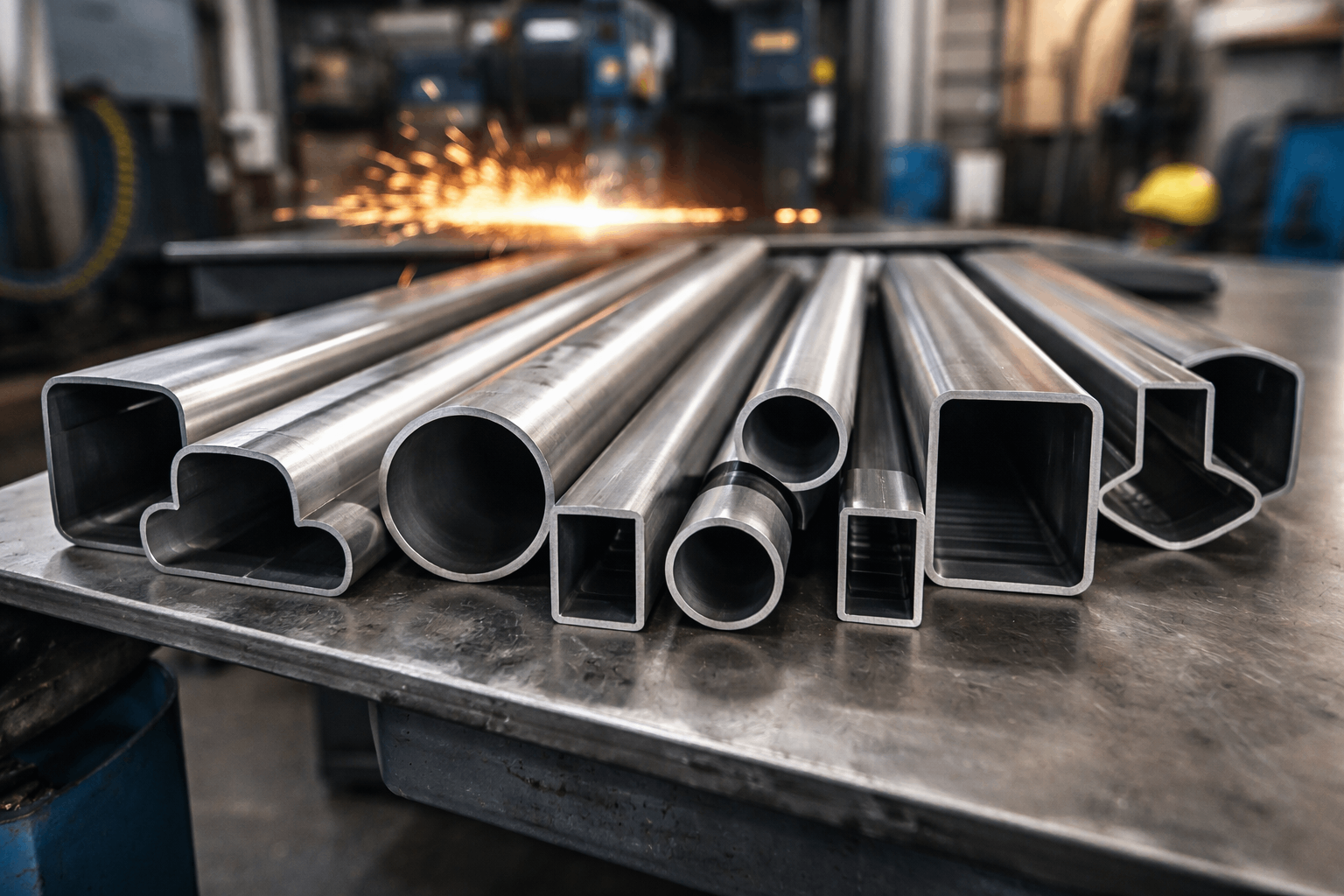
For overseas wholesale buyers, custom steel tubing is rarely “just a tube.” It is a control point that influences whether production stays stable at volume, whether assemblies fit without constant correction, and whether delivery schedules remain predictable as orders scale.
In frames, racks, enclosures, and welded systems, steel tube is often the longest continuous structural element. When its definition does not match real structural behavior and shop-floor realities, instability is introduced early—and paid for later in rework, fixture complexity, and slow assembly.
This article is written for procurement managers, sourcing engineers, and project buyers who compare suppliers based on repeatability and risk control. Instead of listing materials or industries, it follows a single logic line: assumptions → mechanics → production reality → sourcing decisions.
A Buyer’s Quick Reference: Standards, Tolerances, and “What Actually Moves”
If you are sourcing custom steel tubing for welded structures, the fastest way to avoid ambiguity is to anchor the conversation to two things: the governing tubing standard and the few tolerances that truly drive assembly repeatability.
Structural tubing and mechanical tubing are often treated as interchangeable in sourcing, but they are written for different realities. Mechanical tubing specifications typically define OD, wall, length, and straightness controls more specifically than structural tubing. That difference matters when tubing is bent, end-formed, or required to locate brackets repeatedly.
To keep RFQs comparable across suppliers, many buyers include a simple reference block early in the drawing package—then tighten only the features that control fit-up. This avoids “tight everywhere” while still protecting the interfaces that trigger rework.
| Buyer Question | What to Specify | Why It Matters for Wholesale Production |
|---|---|---|
| Is this structural tubing or mechanical tubing? | Example standards used in industry include ASTM A500 (structural HSS) and ASTM A513 (mechanical tubing) | It changes what tolerances are realistic and how repeatable bending/end forming will be |
| Which feature drives assembly? | OD/side dimension at clamp points, straightness where brackets reference the tube, and cut length when tube ends locate datums | These are the dimensions that turn small drift into real assembly time |
| Where is distortion created? | Identify weld sequence and where the tube is constrained in fixtures | If the dominant variation is created after welding, upstream “perfect tube” costs more than it saves |
| What is the acceptance plan? | Agree an early-lot validation approach (sampling logic, triggers, corrective action) | It prevents a good prototype from becoming a production surprise |
This reference is not intended to replace engineering. It is a procurement tool: it aligns language, shortens quoting cycles, and reduces late-stage rework.
The Hidden Assumption Behind Standard Steel Tubing
Most tubing-related sourcing problems start with a reasonable assumption: if a standard tube fits the drawing, it should work in production. Catalog sizes are convenient, familiar, and easy to quote across suppliers.
The catch is that standard steel tubing is optimized for inventory flow and broad compatibility. Common sizes exist because they serve many applications acceptably, not because they are tuned for your load paths, weld sequence, bracket interfaces, or coating buildup.
Wholesale buyers typically see the limitations indirectly. Assembly time per unit creeps up. Operators need to pull parts into alignment. Fixtures become heavier to compensate. Inspection reports show variation that is technically “within tolerance” but functionally disruptive.
Those are usually stability problems, not strength problems. In practice, a structure can meet a static load requirement and still be painful to build or inconsistent across lots.
What buyers usually notice first
In supplier meetings, the earliest signals are often operational rather than mechanical. Your team may report “fit-up is inconsistent” or “we’re chasing squareness.” The supplier may respond by tightening upstream tube tolerances.
That approach can help in the right place, but it can also add cost without fixing the system. When the dominant variation is created after the tube arrives—during welding, fixturing, or finishing—upstream precision is not the main lever.
This is where custom metal tube fabrication becomes relevant. Customization is not about being unusual. It is about defining the tube so production does not have to compensate for a generic choice.
When Steel Tubing Becomes a Structural Decision
Steel tubing becomes a structural decision when it starts to determine outcomes instead of reacting to them. This usually happens early in well-managed projects—before fixtures and inspection plans are locked.
From a buyer’s perspective, the difference is practical. When tubing is treated as a purchased item, specs focus on nominal size and grade. When it is treated as part of the structure, specs reflect stiffness, distortion sensitivity, and interface behavior.
That shift is the foundation of an effective custom steel tube strategy. It reduces the risk of expensive late-stage changes after weld procedures, jigs, and downstream processes have already been validated.
Why “early” matters in wholesale sourcing
If tube geometry is adjusted late, the cost rarely stays inside the tube line item. You may need new fixtures, updated WPS documentation, revised inspection routines, and requalification runs.
If tube geometry is aligned early, the opposite often happens. The assembly becomes less sensitive, fit-up becomes easier, and the supplier can run faster with fewer interventions.
A useful mental model for procurement is this: catalog tubing is an input to a design, while a custom steel tube is part of the design. That difference is what separates “it fits once” from “it fits every week.”
How Loads Actually Travel Through Tubular Structures
Tubular structures do not behave as rigid sticks connected at ideal joints. Loads move through them as combinations of bending, torsion, and local deformation.
In a welded frame, a force applied at one location redistributes through multiple members. A vertical load may generate bending in one tube, torsion in another, and combined stress near the joint region.
That is why tube selection is not only about preventing failure. It is also about controlling deflection, twist, and stress distribution under real service conditions.
Stiffness vs strength in buyer terms
Buyers often receive specs emphasizing yield strength and tensile strength. Those numbers matter, but they do not explain why assemblies drift or why bolt patterns stop lining up after welding.
Stiffness is often the limiting factor, and stiffness depends heavily on geometry. In bending-dominated cases, modest changes in diameter or section shape can stabilize a frame more effectively than simply increasing wall thickness.
Wall thickness still matters, especially for dent resistance and local stability, but it also affects weight, weld heat input, and shrinkage behavior.
Ovalization and interface repeatability
Thin-walled tubes can change shape slightly under bending or torsion. Ovalization is not automatically a defect, but it can reduce consistent contact in clamped interfaces.
This matters for procurement because “some units assemble smoothly, others need adjustment” is often an interface story. When a bracket relies on consistent tube geometry, small cross-section changes become real assembly time.
For wholesale buyers, the takeaway is simple: steel tube fabrication decisions should be based on structural response, not nominal size alone.
When Custom Steel Tubing Starts Controlling the System
Custom tubing starts controlling the system when it reduces sensitivity in fabrication. The goal is not to eliminate distortion entirely.
In production, “zero distortion” is rarely realistic. What you want is distortion that is repeatable and manageable.
During welding, heat input creates shrinkage. How shrinkage affects the assembly depends on tube stiffness, joint design, and constraint. A well-matched section distributes shrinkage so critical interfaces remain stable.
A mismatched section amplifies distortion and forces operators to compensate with heavy clamping, manual correction, or post-weld straightening.
What procurement can watch for
This difference often shows up in indirect indicators. Stable tube definitions allow lighter fixtures, faster fit-up, and less dependence on individual operator skill.
Unstable definitions require heavier fixtures, longer cycle times, and frequent adjustment. Those factors directly affect unit cost, throughput, and delivery reliability.
This is why evaluating custom metal tube fabrication in isolation can be misleading. It needs to be evaluated in the context of the full process chain: fit-up → tack → weld sequence → cooling → straightening → finishing → assembly.
Why Precision Can Increase Risk Instead of Reducing It
Precision is often associated with quality, but in fabricated structures it can increase risk when applied to the wrong features.
One of the most common sourcing issues is over-tolerancing—tightening dimensions that do not actually control functional outcomes.
Dimensional tolerances are easy to specify and inspect. Functional tolerances are harder to define, but far more relevant.
If welding distortion or coating buildup exceeds the tube’s dimensional tolerance, additional upstream precision adds cost without improving stability.
Aligning tolerance with what actually matters
Wholesale buyers often encounter this when specifications demand very tight cut length or straightness, while the assembly process introduces greater variation later.
A better approach is to align tolerance with function. Where tube ends locate machined datums, length control directly affects assembly alignment.
When tubes are welded into frames and trimmed after welding, length tolerance can often be relaxed without functional risk.
For brackets that clamp directly to the tube, OD consistency becomes critical, while adjustable brackets usually tolerate greater variation.
Why this is a conversion topic
This is where buyer intent is strongest. When someone searches for custom steel tubing and tolerances, they are often trying to prevent rework.
Cost of poor quality is widely discussed in manufacturing as a double-digit share of operations or sales, which is why stability-focused specs can be economically meaningful.
The goal is not “tighter everywhere.” The goal is “tighter where stability is earned.”
The Prototype Illusion in Wholesale Production
Prototype approval is often mistaken for production readiness. Prototypes are typically built under controlled conditions: experienced operators, slower pace, and manual correction.
These conditions hide variation that emerges later.
In wholesale production, variability comes from many sources. Coil properties change between lots. Tooling wears. Operators rotate.
Fixtures drift. Welding speed increases. Each factor interacts with tube geometry and tolerance strategy.
How buyers can validate stability without slowing the project
The most effective validation step is usually not “more inspection.” It is choosing a small set of stability signals and checking them across an early production lot.
For welded tube assemblies, those signals are rarely every dimension on the drawing. They are typically a few assembly-driving characteristics: squareness at key corners, hole-to-hole alignment after welding, bracket fit at clamp points, and repeatable datum-to-datum distances that affect downstream assembly.
Acceptance sampling standards such as ANSI/ASQ Z1.4 are commonly used to align buyer and supplier on inspection by attributes with AQL-based plans. This does not need to become bureaucracy.
In practice, it can be as simple as agreeing what will be checked, how often, what constitutes a meaningful trend, and what triggers corrective action.
Evidence that separates a stable supplier from a “sample-only” supplier
In early production, buyers often move faster when the supplier can provide a compact evidence pack. That pack does not have to be perfect documentation.
It needs to answer a procurement question: “If something shifts, will we see it early, and will the process be adjusted before the shipment becomes inconsistent?”
Depending on the project, that evidence may include material traceability, a simple control summary for key dimensions, and a clear plan for how fixtures and weld sequence are kept consistent.
A supplier that can speak to these controls usually produces more predictable outcomes than one that only promises tight tolerances.
Custom Steel Tubing Does Not Fail Alone
When assemblies drift out of square or become difficult to build, tubing is often blamed first.
In reality, instability usually results from interactions between tubing, joints, fixtures, and assembly sequence.
Weld heat introduces shrinkage. If parts are heavily constrained, shrinkage redistributes stress into the structure.
Aggressive clamping can hide this during inspection, only for distortion to appear later.
In volume production, this shows up as inconsistent downstream assembly or field mismatch.
Reducing misdiagnosis in supplier communication
Misdiagnosis is costly. If teams respond by tightening every tolerance and increasing inspection, cost rises while sensitivity remains.
Better outcomes come from identifying where small variations become large problems and reducing that amplification.
In practice, the corrective lever varies depending on where instability is created. Geometry changes may restore stability in some cases, while in others the root cause is better addressed through fixture strategy or joint redesign.
From a sourcing standpoint, the key is shared language. If weld quality requirements are part of the risk, references such as AWS D1.1 can help align expectations for welded steel structures.
This section keeps the discussion anchored to the theme: tube decisions as control variables inside a system.
How Tubing Decisions Lock in Cost Earlier Than Expected
From a sourcing perspective, tubing often appears as a simple line item.
In practice, tubing decisions lock in system cost very early.
A tube definition that supports stable welding and assembly reduces labor, scrap, and schedule risk.
A poorly matched tube can create hidden costs that exceed any savings in material price.
These include additional fixtures, longer assembly time, increased inspection, and corrective action in the field.
Total cost of stability
Wholesale buyers who evaluate custom steel tubing based on total cost of stability rather than unit price tend to achieve better long-term results.
Moderate customization aligned with function often lowers overall cost, even if the tube itself is not the cheapest option.
This is also a content advantage for SEO. Many competitor pages stop at pricing factors.
Buyers, however, search for predictable delivery and consistent assembly. Addressing total cost of stability matches that intent and supports higher-quality leads.
Specifying Custom Steel Tubing Without Over-Specifying It
Clear specifications are one of the most effective risk controls available to buyers.
The goal is not longer drawings, but clearer intent.
When RFQs include only dimensions, suppliers must guess which features are critical.
This leads to unnecessary cost or unstable assemblies.
A more effective approach is to identify interfaces: where the tube locates other parts, where it is clamped, and where weld distortion matters most.
Standards as shared language
Referencing widely used standards provides a shared language without excessive detail.
ISO 2768 is commonly used to define general tolerances for linear and angular dimensions when individual tolerances are not indicated. Used correctly, it simplifies drawings and reduces argument over “missing tolerances.”
For wholesale projects, the value is practical: fewer clarifying emails, fewer re-quotes, and fewer surprises between sample and production.
A buyer-first RFQ structure that improves quote accuracy
Many high-ranking supplier pages emphasize capabilities, but buyers convert when they feel the quote will be accurate and the delivery will be stable.
A buyer-friendly RFQ does not need to be long. It needs to be unambiguous about what drives function and what drives repeatability.
When possible, include CAD or STEP files plus a PDF drawing package. Then add a short note describing which interfaces are most sensitive: clamp points, locating faces, hole patterns after welding, and any “must-fit” assembly conditions.
If bending or end forming is involved, specify the features that affect manufacturability: bend radius intent, allowable ovalization at critical clamp regions, and how the part will be referenced during inspection.
Example language buyers can reuse
You do not need to write a new document for every project. A short paragraph can prevent most misunderstandings.
For welded frames: “Primary requirement is repeatable assembly fit without manual pulling. Control squareness at corners and bracket alignment after welding. Prioritize consistency over cosmetic perfection.”
For clamped interfaces: “Tube OD/side dimension at clamp region drives assembly. Maintain repeatability at these regions; other areas may follow general tolerance.”
For early lots: “Validate stability on first production lot using agreed sampling and trend triggers. If drift is observed, corrective action must occur before full shipment.”
This is not marketing language. It is procurement language, and it helps suppliers quote and plan correctly.
Custom Steel Tubing as a Long-Term Stability Strategy
Long-term performance is where sourcing decisions are fully tested.
Fatigue, environmental exposure, and repeated assembly cycles reveal whether a structure was designed for stability.
Tube geometry influences how stress concentrates at joints, how coatings behave at interfaces, and how assemblies respond over time.
Small improvements in stiffness distribution can reduce fatigue risk and extend service life.
Why this matters to wholesale procurement
For wholesale buyers, the benefit is tangible: fewer downstream issues, fewer delivery disruptions, and fewer costly field adjustments.
When defined with intent, custom steel tubing becomes a quiet contributor to reliability rather than a recurring topic of debate.
This also supports conversion quality. Buyers looking for a long-term supplier pay attention to lifecycle stability because it affects warranty risk and brand reputation.
A Quick Competitor Reality Check: What High-Ranking Pages Do Well
When you review pages that rank well for custom steel tube and custom metal tube fabrication, a pattern is consistent.
They provide immediate clarity on what they can make, how quickly they can respond, and what “custom” means in practical terms—size ranges, shapes, and secondary operations.
Many of those pages are service-led, and they convert because they remove uncertainty.
This article complements that approach by addressing the part many pages under-explain: why a tube that meets a drawing can still create instability, and how buyers can specify and validate stability early.
If you want this page to work as both an educational asset and a conversion asset, consider pairing it with a short internal link path on your site: a capabilities page for tube-related fabrication steps, and a simple RFQ upload page.
Closing Perspective
Across high-ranking pages for custom steel tubing and custom metal tube fabrication, one pattern is consistent: buyers are not looking for a catalog explanation. They are trying to reduce uncertainty before committing to a supplier. Pages that perform well tend to do three things at once: they explain behavior, they translate that behavior into production risk, and they show how that risk can be evaluated early.
This article is structured to support that decision process. Each section connects tube geometry to manufacturing reality and then to sourcing outcomes. That alignment is what allows custom steel tubing to function as a control variable rather than a reactive component.
For overseas wholesale procurement, predictable assembly, predictable cost, and predictable delivery matter more than any single specification. When tube decisions align with structural behavior and real fabrication constraints, production becomes easier to manage and results become repeatable.
If you are evaluating suppliers for custom steel tube fabrication, an early technical discussion around stability, tolerance intent, and validation approach can prevent downstream change and cost escalation.
For inquiries, you may contact YISHANG with drawings or performance requirements. Our feedback focuses on manufacturability and repeatability rather than marketing claims.