
In the current volatile landscape of global manufacturing, the role of a custom metal fabrication partner has fundamentally shifted. For wholesale buyers, procurement managers, and supply chain directors at Original Equipment Manufacturers (OEMs), the challenge is no longer simply finding a vendor with capacity. The true imperative is identifying a strategic partner capable of delivering consistent quality, securing intellectual property, and optimizing total landed costs.
At YISHANG, we recognize that for professional buyers, the “buy” decision involves a rigorous analysis of scalability and risk management. It is not merely about the transaction; it is about the reliability of the supply chain that supports your brand’s reputation.
From the structural integrity of heavy-duty automotive chassis to the hygienic precision of pharmaceutical vessels, transforming raw metal into precision-engineered parts is a complex orchestration. It requires a mastery of material science, advanced physics, and logistical foresight.
This guide serves as a definitive resource for B2B procurement professionals. We move beyond elementary definitions to explore the end-to-end lifecycle of high-quality metal fabrication. By mastering these core elements, businesses can optimize Designs for Manufacturability (DFM) and ensure seamless delivery from the factory floor to your distribution center.
1. Material Science in Fabrication: Selecting the Right Substrate for Performance and Cost
The foundation of any successful metal project lies in rigorous, data-driven material selection. For a wholesale buyer, this decision dictates not only the mechanical performance—tensile strength, ductility, and fatigue resistance—but also the economic viability of the entire program. In professional fabrication, generic terms like “steel” or “aluminum” are insufficient. We must address specific alloys, tempers, and the traceability of Mill Test Reports (MTRs) to ensure compliance and functionality.
Ferrous Metals: Balancing Strength, Surface Quality, and Cost Efficiency
Selecting the correct material grade is the first opportunity for cost optimization. We frequently observe that over-specifying materials is a common driver of inflated unit costs. Distinguishing between processing grades is vital for budget control.
Hot Rolled Pickled and Oiled (HRPO) steel is ideal for internal structural components where surface finish is secondary to tensile strength. Typically utilized in heavy equipment chassis and construction brackets, HRPO undergoes an acid bath to remove abrasive mill scale. This process provides a cleaner surface for welding than standard hot rolled steel but maintains a lower price point. It is an excellent choice for high-volume structural orders where aesthetics are not the primary concern, allowing buyers to allocate budget to more critical areas.
In contrast, Cold Rolled Steel (ASTM A1008) is the prerequisite for visible enclosures, appliance panels, and parts requiring high-quality powder coating. The cold rolling process induces work hardening, increasing yield strength and providing a superior surface finish (Ra < 30 µin). For procurement managers, specifying CRS ensures that automated assembly lines won’t be stalled by dimensional variations. Surface imperfections in lower-grade materials become glaringly obvious after painting, leading to high rejection rates that YISHANG helps you avoid through proper selection during the quoting phase.
Stainless Steel introduces complexity regarding the trade-off between corrosion resistance and formability. While Grade 304 serves as the industry standard for general application, Grade 316/316L is non-negotiable for marine or chemical environments to combat pitting corrosion. Furthermore, fabricators must meticulously select the mill finish. A 2B finish is standard for industrial use, but requires protection. We implement PVC film protection throughout laser cutting and bending to prevent cosmetic defects, protecting your investment from scrap and ensuring the final product meets aesthetic expectations.
Non-Ferrous Alloys and Material Traceability
In aerospace and electronics, material selection shifts toward weight reduction and thermal management. The distinction between Aluminum 5052 (workable, fatigue-resistant) and 6061 (structural, rigid) is a common pivot point in DFM discussions. Choosing the wrong aluminum grade can lead to cracking during forming operations, a costly mistake discovered only after production begins. Our engineering team reviews these choices early in the quoting phase to ensure the material matches the geometric requirements of your design.
For critical industries like nuclear and medical, the physical material is only half the equation. The accompanying paperwork—Material Test Reports (MTRs)—is mandatory. A qualified fabrication partner must maintain a robust lot traceability system. We link every finished part back to the specific heat number of the raw coil, providing the liability protection and regulatory compliance essential for Western markets. This level of detail is what separates a “job shop” from a strategic manufacturing partner.
2. Design for Manufacturability (DFM): How Engineering Saves You Money
Before a single sheet of metal is cut, the most significant cost savings are realized in the engineering phase. Design for Manufacturability (DFM) is the practice of designing parts in a way that makes them easy and cost-effective to manufacture. For wholesale buyers, engaging with YISHANG‘s engineering team early in the development cycle can lead to substantial reductions in unit price and lead time.
Simplifying Geometry for Tooling Standardization
One of the most effective DFM strategies is standardizing features to match available tooling. For example, if a design calls for a 5.2mm hole, but standard turret punch tooling is 5.0mm or 5.5mm, specifying the non-standard size may require custom tooling investment or slower laser cutting processes. By adjusting the hole size to a standard dimension, production speed increases, and costs decrease. Similarly, unifying bend radii across a part allows for fewer setup changes on the press brake, directly reducing labor costs.
Optimizing Nesting and Material Utilization
Material often accounts for 40-60% of the total part cost. Efficient nesting—the layout of parts on a raw sheet—is critical. Designs with irregular shapes that do not interlock well result in high scrap rates. Our engineers often suggest slight modifications to part geometry, such as clipping corners or adjusting flange lengths, to allow parts to nest tighter together. This optimization can increase material yield by 15-20%, a saving that is passed directly to the buyer.
Reducing Weld Count through Smart Bending
Welding is an expensive and time-consuming process. Through creative bending design, we can often replace welded seams with continuous bent flanges. For instance, a box chassis traditionally made of four welded plates can often be redesigned as a single unfolded part that is bent into shape and spot-welded only at the corners. This reduction in linear weld inches not only lowers labor costs but also minimizes thermal distortion, resulting in a more dimensionally accurate product.
3. Precision Cutting Technologies: Speed, Edge Quality, and Tolerance
Once the design is optimized and material validated, the transformation begins. The evolution of cutting technology has shifted from mechanical shearing to thermal and abrasive methodologies. Selecting the right method is a multi-variable calculus of edge quality, thickness, and production volume.
Fiber laser technology has revolutionized the industry, largely displacing CO2 lasers due to efficiency and speed. Modern 10kW to 30kW fiber lasers can process stainless steel and aluminum with tolerances within ±0.003 inches (0.07mm). However, high power alone is not enough; the process parameters must be tuned for specific outcomes.
The Hidden Cost Factor: Assist Gas Chemistry
For a procurement officer, the true differentiator in quality—and hidden cost—is the choice of assist gas. Many suppliers use Oxygen for speed when cutting carbon steel, but this leaves an oxide layer that compromises paint adhesion. High-purity Nitrogen Cutting shields the molten metal from oxygen. This results in an oxide-free edge, or “bright cut,” which is critical for parts that will be powder coated or welded.
If oxygen were used, the resulting oxide layer would need to be mechanically removed (pickled or ground) to prevent catastrophic paint delamination later in the field. By utilizing nitrogen, YISHANG eliminates this secondary operation, reducing the total cost per part despite the slightly higher gas consumption. This is a classic example of paying for process quality upfront to avoid failure costs later.
Heavy Plate and Heat-Sensitive Materials
While lasers dominate sheet metal, High-Definition (HD) Plasma remains the champion for heavy plate fabrication (1 inch+). It offers a significantly lower cost per linear foot for processing thick carbon steel beams used in construction machinery. The edge quality of modern ISO 9013 Range 3 plasma is sufficient for most structural applications, providing a cost-effective alternative to laser cutting for heavy gauge materials.
Waterjet cutting serves a distinct role for materials sensitive to thermal distortion. By utilizing a high-pressure stream mixed with abrasive garnet, waterjets act as a “cold cutting” process. This is essential for aerospace titanium, where the Heat Affected Zone (HAZ) from a laser would create alpha-case contamination. It is also the only viable method for thick aluminum plates without inducing edge hardening, facilitating easier downstream machining.
4. Metal Forming and Bending: The Physics of Plastic Deformation
Turning a 2D flat blank into a 3D component requires sophisticated forming processes. Press brake bending involves a deep understanding of K-Factors, Bend Deductions, and Springback—the metal’s tendency to return partially to its original shape. This is where the theoretical CAD model meets the reality of metallurgy.
Modern facilities utilize CNC press brakes equipped with active angle measurement systems. These systems measure the bend angle in real-time, automatically adjusting the ram depth to compensate for material variations. For a wholesale buyer, this technology is the guarantee of consistency. It ensures that the first part of the batch and the 10,000th part are identical. This repeatability is crucial for automated assembly lines at the buyer’s facility. Even minor deviations can cause jams and downtime, leading to expensive line stoppages that far exceed the cost of the part itself.
Tooling Strategy: Hard vs. Soft Tooling
A key decision in forming is the choice between soft tooling (press brakes/turret punches) and hard tooling (stamping dies).
- Soft Tooling: Ideal for low-to-medium volumes (100 to 5,000 units). It requires minimal upfront investment and allows for easy design changes. YISHANG utilizes a vast library of standard press brake tools to keep setup costs low.
- Hard Tooling: For high-volume production (10,000+ units), investing in progressive stamping dies becomes economical. While the upfront cost is high ($10k-$50k+), the per-part cost drops dramatically, and cycle times are measured in seconds rather than minutes. We help clients analyze the ROI to determine the exact break-even point for switching from laser/brake to stamping.
For high-mix, low-volume production of large enclosures, automated panel benders are superior. They fold flanges without operators flipping heavy sheets, improving safety and cycle time. This technology allows for complex geometries, such as positive and negative bends in a single sequence. By leveraging the right forming technology, we help partners achieve complex designs without incurring prohibitive tooling costs.
5. Strategic Joining: Welding Certification and Assembly Logic
The integrity of welds defines the safety and durability of the product. For a sourcing manager, the focus here should be on certification (AWS/ISO) and process repeatability. A weld failure is a liability risk that can damage a brand’s reputation permanently.
Tungsten Inert Gas (TIG/GTAW) is the preferred method for precision applications (AWS D1.2). It affords granular control over heat input, resulting in neat beads that often require no post-weld grinding. This is the standard for food-grade equipment and medical devices. It ensures that the joints are not only strong but also free of crevices that could harbor bacteria.
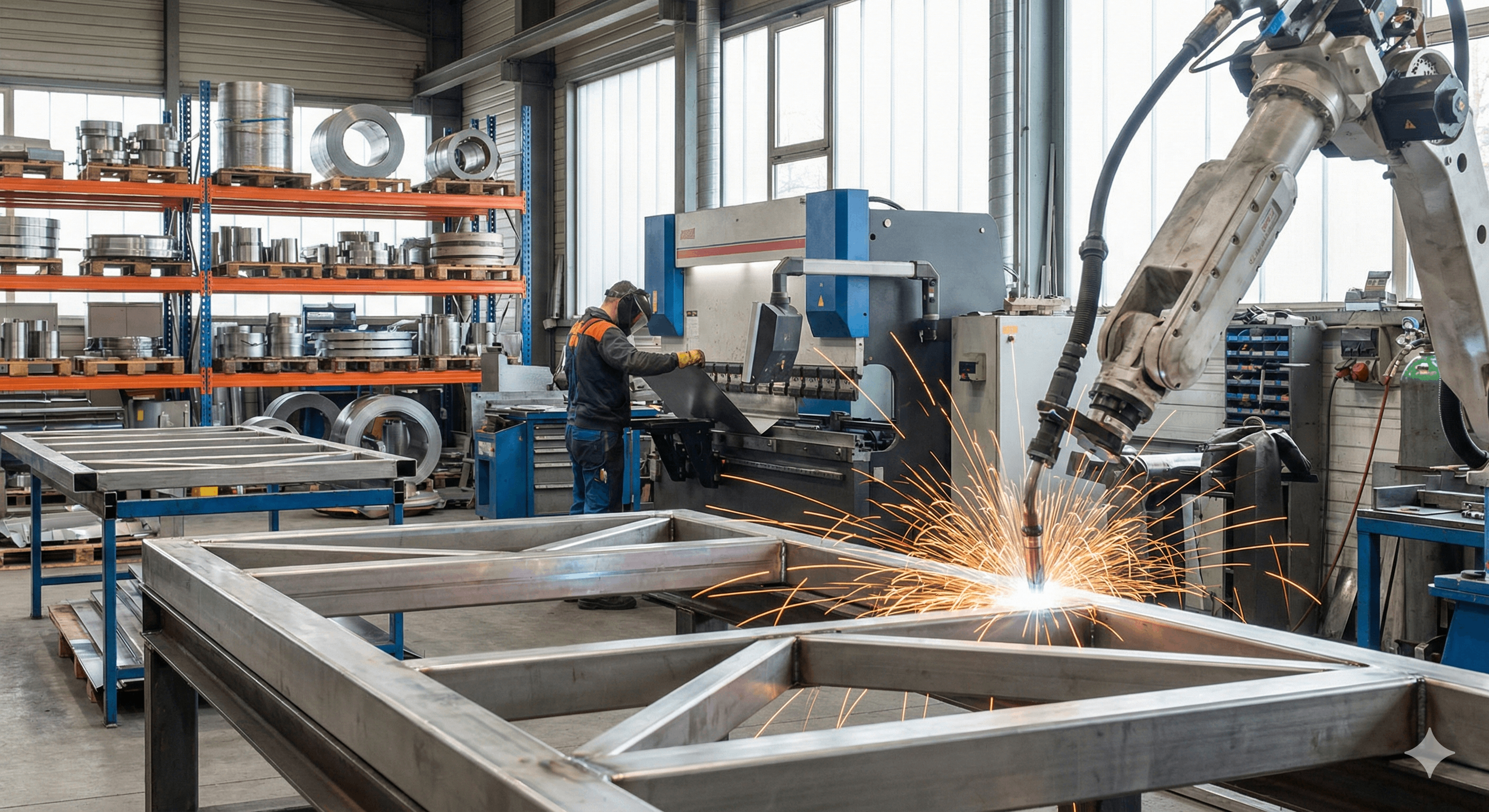
Metal Inert Gas (MIG/GMAW) is the workhorse for structural steel. In high-volume environments, robotic MIG welding cells are implemented to ensure perfect consistency. Robots do not fatigue, and their path programming ensures that every weld has the exact same penetration and throat thickness. At YISHANG, our robotic cells provide the scalability needed for large orders.
Modular Assembly Strategies
Not all assembly requires fusion welding. Resistance Spot Welding (RSW) joins overlapping sheets efficiently with minimal thermal distortion, ideal for enclosures. Alternatively, hardware insertion—using presses to install PEM® nuts and studs—provides reliable threaded points in thin sheet metal. This facilitates easier maintenance of electronics downstream. Adopting a “Tab-and-Slot” design strategy in laser cutting enables parts to self-fixture. This eliminates expensive custom welding jigs and drastically reduces non-recurring engineering (NRE) costs for the buyer.
6. Surface Finishing: Mechanical Polishing Services and Validation
The surface finish is the primary interface between the product and its environment. It provides corrosion protection, hygiene, and visual appeal. For discerning buyers, the selection of mechanical polishing services is a critical decision that influences both the aesthetic value and the functional performance of the final part.
The Science of Mechanical Polishing
Mechanical polishing is not merely about making a part shiny; it is a progressive process of surface refinement. It typically begins with coarse grinding (e.g., 80-120 grit) to level weld seams and remove deep scratches. This is followed by intermediate sanding (180-320 grit) to condition the metal, and concludes with fine buffing using specialized compounds to achieve a specific Roughness Average (Ra).
At YISHANG, our mechanical polishing services are engineered to meet exacting industry standards. For food processing and pharmaceutical applications, we target a Sanitary Finish (No. 4) with an Ra of 20-32 µin. This ensures the surface is smooth enough to prevent bacterial harborage while maintaining a consistent “grain” that hides future handling marks. We utilize automated wide-belt sanders for flat sheets and robotic polishing arms for complex geometries, ensuring that the “human factor” does not lead to inconsistent finishes across a large batch.
Mechanical Polishing vs. Electropolishing
A common procurement dilemma is choosing between mechanical polishing and electropolishing.
- Mechanical Polishing: The superior choice for restoration and leveling. It physically removes metal to flatten weld beads and erase deep gouges that electropolishing cannot hide. It is the necessary prerequisite for high-end aesthetics.
- Electropolishing: An electrochemical process that removes surface ions to create a featureless, microscopic smoothness. It is unrivaled for corrosion resistance and passivating stainless steel 316L, but it will not remove macro-defects.
Often, the optimal solution is a hybrid approach: using YISHANG‘s mechanical polishing services to achieve geometric perfection, followed by electropolishing for ultimate passivation. This combined capability allows us to deliver parts that are both visually flawless and chemically inert.
Powder Coating and Pre-Treatment
Powder coating is the industrial standard for durability. However, the quality relies entirely on the pre-treatment process. Without proper cleaning and etching, powder will not adhere. Wholesale buyers should request ASTM B117 salt spray test results. This validation ensures the coating system can withstand 500 to 1,000+ hours of corrosive exposure without blistering, protecting your brand reliability.
7. Intellectual Property (IP) Protection and Risk Management
For overseas buyers, entrusting proprietary designs to a manufacturing partner involves inherent risk. A professional fabrication partner mitigates this through rigorous IP protocols and legal frameworks. The relationship should begin with a comprehensive Non-Disclosure Agreement (NDA). This document must be enforceable in the jurisdiction of manufacture to provide real legal recourse.
Beyond legalities, data security is paramount. Manufacturing files (CAD, BOMs) should be stored in secure, access-controlled ERP systems rather than shared via unsecured email chains. This prevents unauthorized access and ensures strict version control. A trustworthy partner will also have clear policies regarding tooling ownership, confirming that custom dies remain your exclusive property.
At YISHANG, we treat your IP with the same vigilance as our own. We understand that your designs are your competitive advantage, and safeguarding them is a foundational element of our service. Risk management also extends to supply chain resilience. We maintain strategic relationships with multiple raw material suppliers to mitigate market fluctuations. By diversifying sourcing, we offer stable pricing and reliable lead times. We also encourage open communication regarding potential risks, identifying issues before they impact production timelines.
8. Logistics and Export Packaging: The Final Mile
A perfect part that arrives damaged is a failed order. For wholesale buyers, packaging logistics is a critical component of the Total Landed Cost. The journey of ocean freight exposes metal to humidity and salinity, making corrosion a real threat.
Professional exporters utilize VCI (Volatile Corrosion Inhibitor) packaging. VCI bags release molecules that form a barrier on the metal surface, preventing oxidation (“white rust”) during transit. This simple measure saves thousands of dollars in rejected shipments. Furthermore, engineering packaging for container optimization directly impacts the bottom line.
By designing pallets to maximize the Cubic Meter (CBM) utilization of a standard 40ft container, fabricators can significantly reduce shipping costs per unit. This is “invisible” profit for the buyer. At YISHANG, our logistics team designs custom solutions to minimize freight costs. We perform drop testing to ensure packaging withstands forklift handling and intermodal transport.
We also prioritize accurate documentation for customs clearance. Ensuring commercial invoices and certificates of origin are correct prevents costly delays at the port. Flexible shipping options (EXW, FOB, DDP) allow us to tailor solutions to your business model. Our goal is to make logistics seamless, letting you focus on distribution.
9. Quality Assurance: The E-E-A-T Framework for Trust
In B2B fabrication, “quality” is not subjective; it is measurable and documentable. A top-tier partner must operate under a Quality Management System (QMS) certified to ISO 9001:2015. Modern QA relies on advanced metrology. Coordinate Measuring Machines (CMM) verify complex geometries within microns. Vision systems scan laser-cut blanks in seconds to detect deviations before forming.
For automotive and aerospace clients, the Production Part Approval Process (PPAP) is standard. This includes PFMEA to identify failure points and Control Plans to document inspection frequency. Full lot traceability—linking finished parts to raw material heat numbers—is non-negotiable for critical applications. At YISHANG, we maintain records for rapid traceability in the event of any audit.
We utilize data-driven decision-making. Our QA team analyzes production KPIs to identify trends, proactively optimizing processes for better efficiency and lower defect rates. Ultimately, quality assurance is about building trust. When you partner with YISHANG, you can be confident that every part meets your exact specifications.
Conclusion: From Vendor to Strategic Partner
The landscape of custom metal fabrication has evolved. It is no longer a transactional exchange but a strategic integration. For wholesale buyers, the goal is to build a resilient supply chain that offers transparency and expertise.
By prioritizing partners who understand Design for Manufacturing (DFM), leverage Industry 4.0 technologies, and adhere to strict IP standards, procurement leaders secure a competitive advantage. The right partner doesn’t just cut metal; they engineer value. They ensure that your supply chain is as durable and reliable as the products you build.
At YISHANG, we are dedicated to being that strategic partner. With comprehensive capabilities—including specialized mechanical polishing services and global logistics support—we are ready to help you navigate global manufacturing.
Ready to optimize your metal supply chain? Contact YISHANG today to discuss your project requirements and discover how we can drive value for your business.