
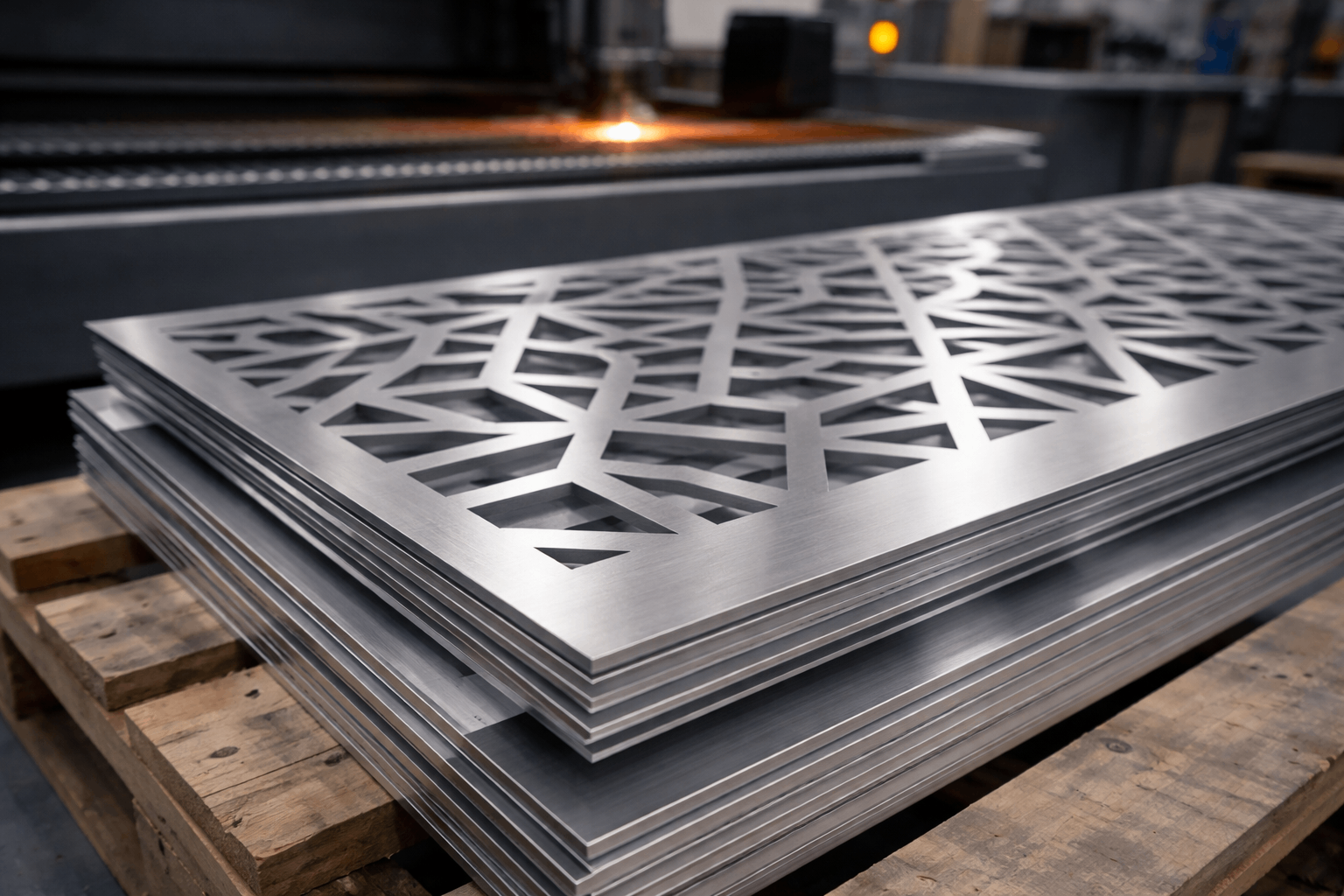
If you’re sourcing laser cut aluminum panels for repeat orders, you’re not looking for a definition of laser cutting.
You’re trying to predict outcomes: will panels stay flat after release, will batches remain consistent, and will downstream operations like bending, powder coating, and assembly run without rework.
That is why this article is structured around how issues typically appear in real production, not around generic “benefits” or a long list of uses.
We’ll focus on post‑cut behavior, repeatability, and the specification language that helps wholesale buyers align expectations early.
The Moment Cutting Ends: Why Panels Look Stable on the Laser Bed
The first surprise in many sourcing projects happens right after cutting.
On the laser bed, an aluminum sheet is supported by slats or a honeycomb surface and restrained by friction, gravity, and countless micro-contact points.
This creates a temporary constraint system that can make panels look flat even when they are storing distortion potential.
Buyers often validate the easiest things first.
Hole positions, slot widths, and outer dimensions can measure perfectly while the panel is still “held in shape” by the bed.
That is not a mistake.
It’s simply measuring geometry under constraint, not stability in a free state.
For wholesale programs, this distinction matters because panels are rarely “free floating” in the final product.
They bolt to frames, seal against gaskets, sit behind acrylic, or align with pre-drilled mating parts.
A small twist can become a visible gap.
A gentle bow can turn into fastener stress, squeaks, or sealing failure.
What early inspection proves—and what it cannot prove
Early inspection usually proves the cutting followed the drawing.
It rarely proves that the panel will stay flat after release, stacking, shipping vibration, or coating heat cycles.
In practice, procurement teams benefit from separating quality into two buckets.
One is “does it match the print.”
The other is “does it behave the same every time.”
That second bucket is where most hidden cost lives.
Here is a practical mapping that wholesale buyers can use during sourcing.
| What is easy to verify fast | What it tells you | What it does not guarantee | Where risk shows up later |
|---|---|---|---|
| Linear dimensions, hole sizes | Geometry is correct | Flatness and twist after release | Assembly fit, flushness, sealing |
| Visual edge check | No obvious heavy burrs | Micro-burrs at critical interfaces | Coating defects, bending cracks |
| 1–3 good samples | Basic capability | Batch stability at volume | Rework, sorting, disputes |
| Spot inspection of features | Some areas are OK | Risk features remain stable | Long slots, dense perforations |
If you are comparing suppliers of custom laser cut aluminum panels or broader custom metal panels, this framing helps you ask better questions without sounding confrontational.
It also helps suppliers respond with the kind of process thinking that signals a good long-term partner.
Removing the Constraint: How Aluminum Panels Change Shape After Cutting
Once the panel is lifted from the bed, the constraint disappears.
That is when aluminum often reveals what it was “holding in.”
Sheet aluminum carries residual stress from rolling, leveling, and heat treatment routes.
While the sheet is intact, those stresses can remain balanced.
When you introduce cutouts, slots, and dense patterns, you change stiffness and load paths.
The stress balance shifts, and the panel seeks a new equilibrium.
This is why post‑cut deformation is usually predictable.
It correlates strongly with geometry, panel size, and how much structure remains after cutting.
For buyers, the most useful mental model is simple.
During cutting, the bed helps the sheet behave.
After cutting, the panel behaves like a free structure.
Distortion patterns that affect real assemblies
In sourcing conversations, “warping” often refers to several different behaviors.
A global bow can create rocking in a frame or uneven contact against seals.
A diagonal twist can shift hole alignment and force fasteners to pull the panel into place.
That pull-down force may hide the issue until fatigue, vibration, or thermal cycles loosen joints.
Local oil-canning is another common pattern.
A panel may look acceptable, then pop or drum under small loads.
That is a problem for visible surfaces, doors, panels behind acrylic, or any part that needs a premium feel.
Edge lift or curl can appear after stacking.
Panels that were flat individually may develop edge deviation when packed tightly, strapped, or exposed to temperature swings during shipping.
Why geometry matters more than “material talk”
Many competitor articles spend pages on alloy descriptions.
For procurement outcomes, geometry is often more decisive.
Long narrow slots behave like hinges.
Large internal windows remove ribs that kept the sheet stable.
Dense perforations turn a stiff sheet into a flexible membrane.
Asymmetry releases stress unevenly and increases twist risk.
If your part depends on flush mounting, consistent gaps, or sealing, these design features should be treated as stability drivers.
That does not mean you must redesign everything.
It means you should identify which features are stability‑critical and communicate those expectations clearly before volume.
Why Prototypes Rarely Predict Batch Production Behavior
A good prototype is valuable.
It proves the design is manufacturable and the supplier can interpret your drawing.
But in wholesale programs, prototypes are often misread as proof of production stability.
A prototype run is typically produced under “friendly” conditions.
There are fewer sheets, lower cumulative heat input, and more manual attention.
Nesting density may be reduced.
Cut sequences may be adjusted carefully by an experienced operator.
The material itself may come from a particularly stable portion of a coil or plate.
All of that increases the chance that the sample looks perfect.
When production scales, conditions change.
Duty cycles increase.
Nesting is optimized for yield and throughput.
Material lots vary.
Consumables wear.
Shift-to-shift variation becomes real.
None of this means quality must drop.
It means the process window must be robust enough to survive normal production reality.
Capability versus control (the procurement version)
From a buyer’s perspective, prototypes confirm capability.
Control is demonstrated only when results remain consistent over time and at volume.
This is true whether you buy aluminum panels or mixed programs that include laser cut steel panels.
If a supplier can explain how they control drift and variation, it is a strong signal.
Drift can show up as small changes in edge condition across sheets.
Variation can show up as slightly different flatness behavior from one material batch to another.
For procurement teams, a practical way to reduce risk is to align on what “stable” means.
Not in abstract terms.
In terms of assembly outcomes.
For example, if the panel must sit flush without forcing fasteners, that is a functional requirement.
If the panel must seal evenly, that is a functional requirement.
Then sampling can be structured to stress those outcomes.
Instead of approving only geometry, you approve behavior.
A buyer-friendly sampling approach that avoids disputes
You do not need an expensive qualification program.
You need sampling that matches your production reality.
If your first order will be 500 panels per month, a supplier cutting 2 sample panels does not replicate heat accumulation, nesting density, or handling.
A more predictive sample plan is a short pilot batch that uses production nesting and normal cutting rhythm.
That is often where unstable designs reveal themselves.
This approach reduces late-stage surprises and helps both sides avoid the “sample was fine” argument.
When Heat Becomes a System Variable in Laser Cutting
Many pages describe laser cutting as if every cut is independent.
In production, a sheet is a connected thermal body.
Aluminum spreads heat efficiently.
That can reduce extreme hot spots in some cases.
It can also make thermal balance harder because energy moves across the sheet and affects stiffness evolution.
For wholesale buyers evaluating laser cut metal panels, the most useful insight is that heat behaves like a system variable.
It is influenced by nesting, sequence, and feature density.
Not just by power and speed.
Even if edges look acceptable, uneven thermal distribution can raise distortion risk after release.
Nesting strategy is not only a cost decision
Nesting is often optimized for yield.
That is normal.
But nesting also determines where heat accumulates.
If dense features are clustered, the sheet can develop localized thermal zones.
Those zones correlate with edge variability and stability drift.
Balanced layouts distribute heat more evenly.
They tend to produce more consistent behavior across the sheet.
For buyers, this matters because two suppliers can quote the same drawing and still deliver different stability.
The difference is often not “better machines.”
It is better control of how the sheet behaves during cutting.
Cutting sequence changes stiffness during the cut
Sequence matters because it changes the structure over time.
If a supplier cuts large windows early, stiffness drops sooner.
Heat input continues.
The sheet becomes more vulnerable to distortion.
If the perimeter is freed while the sheet is still thermally stressed, panels can move at the worst moment.
A supplier who treats sequence as a quality control tool will usually produce more stable panels.
Buyers do not need to dictate the sequence.
They simply need to source from partners who understand why it matters.
A practical “signal” buyers can request without overcomplicating
You do not need to ask for deep machine logs.
A simpler proxy is consistency of edge behavior across the sheet.
When edge striation patterns, dross presence, or burr tendency vary strongly by location, it can indicate thermal imbalance.
Thermal imbalance often correlates with flatness drift.
This is a buyer-friendly conversation starter.
It signals you care about repeatability, not only first-piece geometry.
Edge Quality: Why Problems Appear After Cutting, Not During It
Edge quality is often treated as cosmetic.
In wholesale programs, it is functional.
Edges become interfaces.
They meet bends, coatings, fasteners, and mating parts.
Small defects that seem minor at the cutting stage can cause high downstream cost.
Micro-burrs and light dross can pass a quick visual check.
Later, they can interfere with tight fits.
During powder coating, these small edge defects can telegraph through the finish as visible bumps.
During handling and packing, the same imperfections may slice protective film and lead to cosmetic rejects.
When panels are bent, those edge flaws can also act as crack initiators under forming stress.
This is why buyers often experience “late defects.”
The cut looked fine.
The problem appears after coating or assembly.
Turning edge expectations into usable procurement language
A common source of disputes is vague edge language.
“Clean edge” means different things to different teams.
A better approach is functional phrasing.
For example, no burrs on mating edges.
No dross on customer-visible edges.
Edge condition suitable for bending without micro-crack initiation.
This is not over-specification.
It is aligning quality with function.
It helps suppliers focus inspection on risk features rather than checking everything equally.
Where buyers should pay attention first
Not every edge is equally important.
Risk concentrates at tight radii, long narrow slots, dense perforation zones, and areas that will be bent or coated.
If your product uses laser cut designs metal features for branding or premium appearance, edges at those visible boundaries deserve extra clarity.
This keeps your specification practical while protecting what your customers will notice.
Default Process Selection and Its Impact on Risk
Laser cutting is often selected by default.
It is flexible and fast.
It supports complex geometries.
For many jobs, it is the right choice.
The risk appears when “default” replaces “fit-for-function.”
Thin or large-span aluminum panels can be sensitive to thermal history and stress release.
That does not mean laser cutting is unsuitable.
It means the decision should include stability expectations.
Wholesale buyers tend to trust suppliers who discuss trade-offs candidly.
That does not require long comparisons.
It requires honest framing.
Different processes shift different risks.
Waterjet may reduce thermal distortion risk but has its own edge texture and throughput trade-offs.
Punching can be highly repeatable for standardized patterns but has tooling and feature limits.
Machining can control critical features but is often cost-heavy for large panels.
This balanced view supports E‑E‑A‑T.
It signals practical judgment rather than sales pressure.
It also helps procurement teams select the method that best protects assembly outcomes.
Designing Aluminum Panels for Production Stability
Many post-cut issues can be reduced through design and specification choices.
This is where buyers have real leverage.
Small changes on the drawing can prevent large costs later.
Certain geometries consistently raise risk.
Long narrow slots reduce stiffness.
Dense perforation fields increase oil-canning likelihood.
Highly asymmetrical cutouts increase twist risk.
Sharp internal corners can concentrate stress.
The goal is not to remove functional features.
The goal is to design them in a way that survives production reality.
Stability without “overbuilding”
Many buyers assume the only solution is thicker material.
Sometimes thickness helps.
Often, smarter structure helps more.
Preserve load paths where possible.
Balance cutouts across the panel when function allows.
Use radii and spacing that reduce local concentration of thermal input.
Consider how panels will be supported, stacked, and transported.
These moves improve repeatability without automatically increasing cost.
Specifying what protects function (and avoids needless cost)
A common mistake is tightening linear tolerances everywhere.
That raises cost without guaranteeing stability.
If flush mounting or sealing is critical, flatness and twist should be treated as functional requirements.
This is where ISO-based geometric thinking is useful.
General tolerances such as ISO 2768 can cover non-critical dimensions.
Flatness and twist expectations can be defined for functional surfaces using GD&T principles aligned with ISO 1101.
The result is less ambiguity.
Suppliers can focus control where it matters.
Buyers get fewer surprises in assembly.
A short example of “wide but shallow” vs “narrow but decisive” requirements
A drawing that only tightens hole tolerances may still allow panels that bow.
A drawing that states a reasonable flatness requirement on the sealing surface can prevent a large share of downstream rework.
This is why experienced wholesale programs focus on functional constraints rather than blanket tightness.
It improves conversion too.
Buyers reading your blog recognize you understand the sourcing reality.
That builds trust faster than generic claims.
RFQ Language That Prevents “Sample Was Fine” Disputes
For many wholesale buyers, the largest sourcing disputes do not come from obvious defects.
They come from misaligned expectations.
The drawing was followed.
The sample was approved.
Yet assembly or coating still fails at scale.
This usually happens because functional behavior was never clearly stated.
Below are examples of specification language that buyers often use to align expectations early, without over-specifying every detail.
Instead of tightening every linear tolerance, these statements focus on how custom laser cut aluminum panels must behave in real use.
When included in RFQs or drawings, they significantly reduce interpretation gaps.
For panels that must sit flush or seal evenly, buyers often state that flatness and twist must remain within functional limits under free-state conditions.
This shifts the discussion from “did it match the print” to “did it perform as intended.”
For edge quality, buyers frequently distinguish between cosmetic edges and functional edges.
Mating edges, coated edges, and bent edges are identified as function-critical, while non-contact edges may follow general practice.
For production validation, many programs specify that samples must be produced using production nesting density and normal cutting rhythm.
This avoids approving behavior that only exists under ideal, low-load conditions.
This kind of language does not add cost by itself.
It adds clarity.
Clarity is often the most effective cost-control tool in wholesale sourcing.
Flatness and Twist: How Buyers Typically Define What “Stable” Means
One reason stability problems persist is that flatness and twist are often assumed rather than defined.
Linear dimensions are easy to specify.
Geometric behavior is not.
For laser cut metal panels, especially thin or large-span aluminum parts, defining functional geometry can prevent a large share of downstream rework.
Many wholesale programs rely on general tolerances such as ISO 2768 to cover non-critical dimensions.
This keeps drawings clean and avoids unnecessary cost.
When panel behavior matters, buyers then add targeted functional requirements.
Instead of tightening every feature, they focus on the surfaces that matter in assembly or sealing.
The table below illustrates how buyers commonly separate general accuracy from functional stability.
| Requirement type | Typical use in wholesale drawings | Why it matters |
|---|---|---|
| General linear tolerances (ISO 2768) | Non-critical holes, slots, outlines | Controls cost while maintaining consistency |
| Flatness on functional surfaces | Sealing faces, visible mounting planes | Prevents gaps, leaks, and forced assembly |
| Twist limitation across panel | Large panels, door skins, covers | Protects alignment and visual quality |
This approach helps suppliers focus control where it protects performance.
It also helps buyers avoid paying for unnecessary tightness where it adds no value.
Frequently Asked Questions From Wholesale Buyers
Will laser cut aluminum panels warp after cutting?
They can.
Warping usually does not happen randomly.
It is driven by stress release, geometry, and thermal distribution during cutting.
Panels with long slots, dense perforations, or large internal windows are more likely to change shape once released from the cutting bed.
Why do samples look fine but production panels behave differently?
Samples are often produced under favorable conditions.
Lower heat accumulation, reduced nesting density, and closer manual control all improve short-run results.
When production scales, these conditions change.
That is why behavior-based sampling is more predictive than approving a small number of parts.
How should flatness be specified for custom laser cut aluminum panels?
Instead of tightening all dimensions, buyers usually specify flatness only on functional surfaces.
This keeps cost under control while protecting assembly outcomes.
Using ISO-based geometric concepts helps suppliers understand intent without excessive detail.
What edge quality matters most for powder coating?
Edges that will be coated or are customer-visible matter most.
Micro-burrs and light dross can telegraph through coating and become visible defects.
Clarifying which edges are function-critical helps inspection focus where it matters.
Do laser cut designs increase distortion risk?
Decorative or branding-focused laser cut designs metal features can increase risk if they remove too much structure.
Balanced layouts and preserved load paths help maintain stability without sacrificing appearance.
Conclusion: Stability Is the Product in Wholesale Sourcing
For wholesale buyers, the value of laser cut aluminum panels is not only in clean geometry.
It is in predictable behavior after cutting, across batches, and through coating, assembly, and shipping.
When sourcing custom laser cut aluminum panels or broader custom metal panels, aligning on post-cut behavior, functional geometry, and production reality early can prevent most downstream issues.
If you want to discuss a project with an engineering-first approach, the team at YISHANG is happy to review requirements and recommend practical ways to protect stability.
References and Further Reading
Industry discussions on post-cut distortion, edge quality, and production stability are widely covered by manufacturing-focused platforms.
Readers interested in deeper technical background may refer to resources from fabrication and on-demand manufacturing communities, including SendCutSend, Xometry, and The Fabricator, which regularly publish guidance on laser cutting behavior, burr control, and design-for-manufacturing principles.