
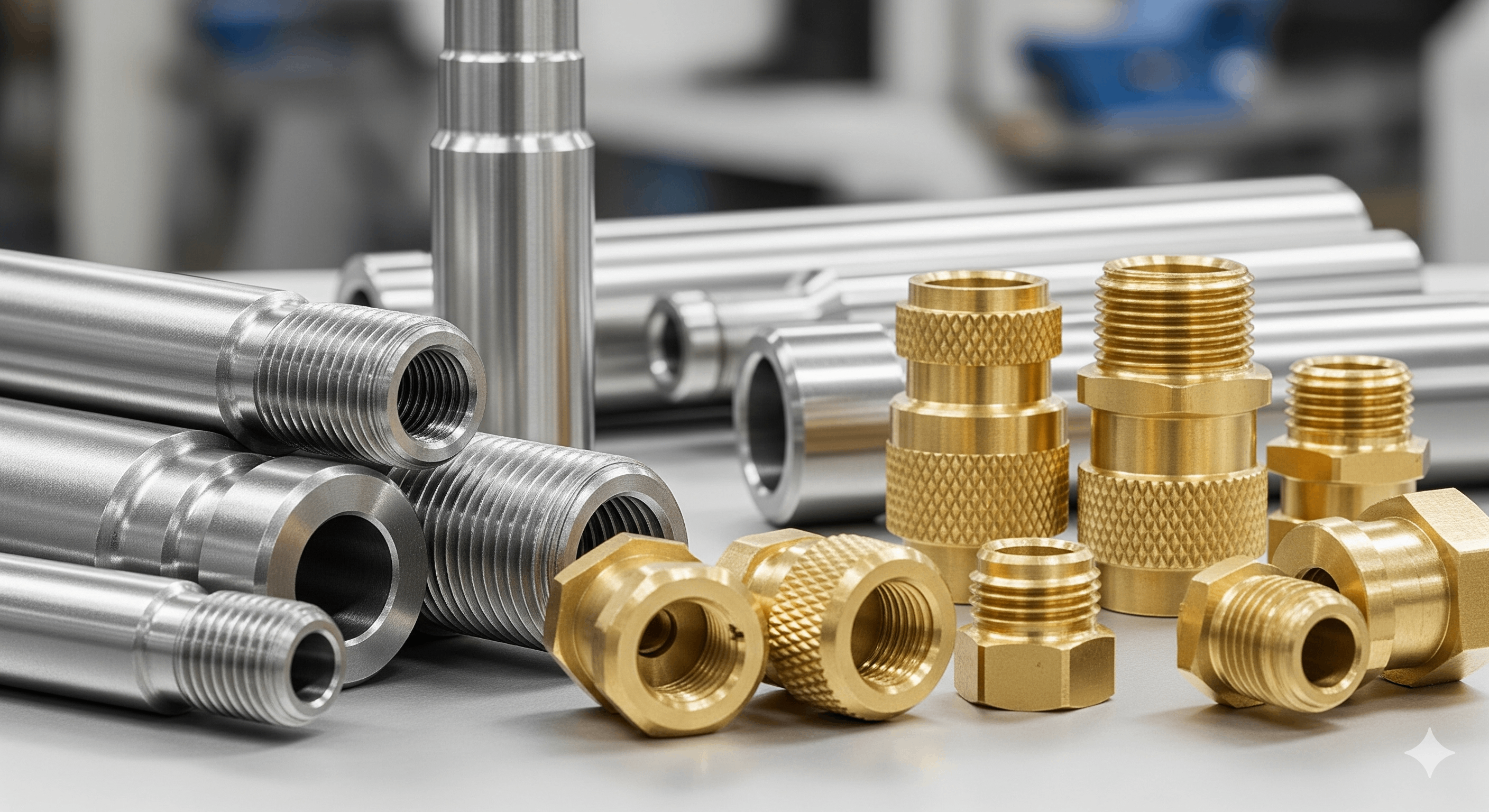
In the complex ecosystem of global manufacturing, sourcing custom CNC turned parts is frequently—and dangerously—viewed as a commodity transaction. Compared to the organic, multi-axis complexity of milled aerospace brackets, cylindrical components like precision shafts, dowel pins, and threaded bushings appear deceptively simple. Consequently, procurement teams often operate under the assumption that “any machine shop with a lathe” can fulfill these orders.
This assumption is the primary root cause of supply chain disruption in wholesale manufacturing. For procurement directors managing orders of 50,000+ units, the challenge is never about producing a single correct part. The true challenge is repeatability. It is the capability to maintain a concentricity tolerance of 0.01mm across a six-week production run without deviation. It is the logistical fortitude to ensure parts arrive in Europe or North America free of corrosion.
The friction in B2B procurement rarely stems from the visible price of raw materials. It originates from the “invisible costs” buried deep within the manufacturing process. These are the costs of high scrap rates due to improper machine selection, production delays caused by material work-hardening, or assembly line failures caused by uncontrolled plating thickness.
A CAD design that functions perfectly in a simulation environment can become a financial liability on the shop floor if the specific physics of turning parts manufacturing are ignored. Without early technical intervention, these oversights inflate the Total Cost of Ownership (TCO) and erode profit margins.
This guide is a strategic resource designed specifically for procurement professionals, supply chain managers, and product engineers. Drawing from YISHANG’s 26 years of empirical data exporting to over 50 countries, we dissect the structural cost drivers of CNC turning. We move beyond basic definitions to analyze how Design for Manufacturability (DfM), material strategy, and scalable logistics directly impact your bottom line.
1. Capabilities at a Glance: What YISHANG Offers
Before diving into the engineering details, it is crucial to align your project requirements with our manufacturing capabilities. This summary table provides a quick reference for procurement managers evaluating fit.
| Specification | YISHANG Capability Range | Standard Tolerance |
|---|---|---|
| Max Diameter (Turning) | 0.5mm – 300mm | +/- 0.01mm (Standard) |
| Max Length | Up to 750mm | +/- 0.02mm |
| Precision Turning | Swiss-Style Machining (Sliding Headstock) | +/- 0.005mm (Precision) |
| Materials | Stainless Steel (303, 304, 316), Aluminum (6061, 7075), Brass, Copper, Titanium, PEEK, POM, Nylon | N/A |
| Secondary Ops | Milling, Drilling, Knurling, Threading, Grinding | N/A |
| Surface Finishes | Anodizing, Zinc/Nickel Plating, Passivation, Black Oxide, Heat Treatment, Powder Coating | Ra 0.8 – Ra 3.2 |
| Production Volume | Prototype (1-50) to High Volume (100,000+) | AQL 1.0 / 2.5 |
2. Scalability Strategy: Aligning Equipment with Volume
The first step in mitigating sourcing risk is verifying that your supplier’s equipment aligns with your volume requirements. CNC turned parts production is not monolithic; the choice of machinery dictates both the unit cost and the stability of the supply chain. A mismatch here leads to bottlenecks that no amount of expediting can fix.
The Deflection Trap: Fixed Headstock Limitations
For short, robust components (where length is less than 3x the diameter), standard Fixed Headstock lathes are cost-effective workhorses. However, they present a significant scalability risk for long, slender custom turned parts. In these traditional machines, the workpiece is clamped in a chuck, and the cutting tool moves along the Z-axis.
As the tool moves further from the chuck, the unsupported material acts as a cantilever beam. Under cutting pressure, it deflects (bends) away from the tool. In a prototype scenario, a skilled operator can manually compensate for this with taper adjustments. In a production run of 10,000 units, however, this deflection causes inconsistent dimensions and “chatter” (vibration marks).
For a wholesale buyer, this manifests as high variability (low Cpk). This forces your receiving department to increase sampling rates or perform 100% inspection, adding hidden labor costs to your operations.
The Swiss Solution for Mass Consistency
For high-precision industries like medical devices, automotive sensors, or electronics, Sliding Headstock (Swiss-style) machining is often the only viable path to scalability. Originally designed for the watchmaking industry, these machines operate on a fundamentally different principle.
The bar stock feeds through a precision guide bushing, and the tool remains stationary in the Z-axis. The cutting action always occurs millimeters from the support point, regardless of the part’s length. This eliminates deflection entirely, allowing for Length-to-Diameter (L/D) ratios exceeding 20:1.
The value for a procurement manager lies in Process Capability. A Swiss machine ensures that the 50,000th part is statistically identical to the first. This consistency allows mature supply chains to move toward “Dock-to-Stock” programs, bypassing incoming inspection entirely.
Consolidating Operations with Live Tooling
Efficiency also comes from reducing “touches.” Traditional turning produces a round part that must be moved to a separate milling machine for secondary features like cross-holes, flats, or slots. Each physical move introduces labor cost, queue time, and cumulative tolerance errors.
YISHANG utilizes modern turning centers with “Live Tooling” to perform milling, drilling, and turning in a single setup. This “Done-in-One” approach typically reduces cycle time by 30-40% compared to multi-setup processes. More importantly, it protects your lead time by eliminating the bottleneck of waiting for a second machine to become available.
3. Design for Manufacturability (DfM): Engineering Out Cost
The most effective cost control occurs before the purchase order is cut—during the design phase. DfM is not about compromising quality; it is about aligning geometry with the physics of the cnc turned parts manufacturer to remove unnecessary processing time.
The Physics of Internal Corners
A frequent driver of unnecessary cost is the specification of sharp 90-degree internal corners. While easy to model in CAD, a rotating cutting tool always has a nose radius. It cannot physically create a perfectly sharp corner without specialized, slow intervention.
Demanding a sharp corner forces the manufacturer to use a tool with a microscopic nose radius (e.g., 0.1mm), which is fragile and prone to breakage. Alternatively, they must employ secondary EDM (Electrical Discharge Machining). Both options spike the unit price significantly.
Optimization Strategy: Design an “undercut” or “relief groove” at the shoulder. This feature allows a robust, standard cutting tool to clear the corner completely. It ensures mating parts sit flush while allowing YISHANG to run the machine at maximum feed rates. This simple geometric change can reduce machining cycle time by 15-20%.
Deep Hole Drilling: The “Drift” Factor
Drilling deep holes on a lathe presents a unique challenge: “Drill Walk.” As a drill bit goes deeper, it tends to wander off-center.
- Standard Ratio: Holes up to 5x diameter are standard.
- Deep Holes: Holes exceeding 10x diameter require specialized “Gun Drilling” or slow “Peck Drilling” cycles to clear chips.
Sourcing Logic: If your design requires a deep, blind hole, consider if the bottom of the hole truly needs to be flat. Allowing a standard drill point angle (118° or 135°) eliminates the need for a secondary bottoming end-mill operation. Furthermore, relaxing the concentricity tolerance at the bottom of a deep hole can save significant scrap costs.
Knurling: Cut vs. Form
Knurling (the diamond pattern for grip) is common, but often poorly specified.
- Form Knurling: Presses the pattern into the metal. It is fast but creates immense pressure, which can bend long, thin parts.
- Cut Knurling: Actually cuts the material away. It puts less stress on the part but is slower and requires expensive tooling.
Optimization Strategy: If you need knurling on a thin-walled or long part, consult with YISHANG engineers first. We may recommend “Cut Knurling” to maintain dimensional accuracy, or suggest changing the design to avoid crushing the part during production.
4. Material Strategy: The Hidden Multiplier of Cycle Time
In wholesale pricing models, the cost of the raw material is transparent. You can check the market price of steel or aluminum. The hidden variable is “Machinability”—the speed at which a material can be cut. A procurement manager who selects a cheaper but difficult-to-machine alloy often ends up paying a higher total price due to extended machine time and rapid tool wear.
The Stainless Steel Premium: 304 vs. 316
The choice between steel turned parts made of Grade 304 versus Grade 316 is a classic example of this trade-off. Stainless Steel 316 contains Molybdenum, offering superior resistance to chlorides (saltwater). However, it is significantly tougher and more prone to work-hardening.
From a manufacturing perspective, switching from 304 to 316 typically requires reducing cutting speeds (RPM) by 25-30% to prevent insert failure. This directly increases the “machine time” line item on your invoice.
Sourcing Logic: Challenge the specification. Is the component exposed to saltwater or aggressive chemicals? If the application is an indoor industrial housing, Grade 304—or the free-machining Grade 303—provides sufficient performance at a significantly lower manufacturing cost.
The Chip Control Factor in Automation
In high-volume manufacturing, the shape of the metal chip dictates efficiency. Ductile materials like pure Aluminum (1xxx series) or Copper form long, stringy chips that wrap around the tool (“bird-nesting”). This forces operators to frequently pause the machine to clear debris, killing the efficiency of automated bar feeders.
Sourcing Logic: To enable “lights-out” manufacturing (running machines overnight without operators), specify materials with chip-breaking properties. Alloys like Aluminum 6061-T6 or Lead-Free Brass break into small chips that flush away easily. This allows for uninterrupted 24/7 production, securing the lowest possible amortization of setup costs for your cnc turned parts.
Turning Engineering Plastics (POM, PEEK, Nylon)
Plastic turning is deceptive. While “soft,” plastics are dimensionally unstable.
- Nylon: Absorbs moisture from the air (hygroscopic). A tight-tolerance bushing machined in a dry factory may seize up in a humid environment.
- POM (Acetal/Delrin): The gold standard for precision turning. It is stable and machines like brass.
- PEEK: High performance but extremely expensive.
YISHANG Protocol: For high-precision plastic parts, we often employ an annealing process (heat treatment) before final machining to relieve internal stresses. This prevents the part from warping over time.
5. The Cost Breakdown: Understanding Your Quote
To negotiate effectively, a buyer must understand the cost structure of a CNC shop. A quote is typically composed of three elements:
- NRE (Non-Recurring Engineering): This is the one-time setup cost. It includes programming, fixture design, and tooling setup.
- Buyer Tip: Increasing batch size dilutes NRE. Ordering 5,000 parts instead of 500 makes the NRE per unit negligible.
- Material Cost: Fixed by the market, but influenced by bar stock utilization.
- Buyer Tip: Design parts to fit standard bar sizes (e.g., 10mm, 12mm). Designing a 12.5mm part forces the shop to buy 13mm or 14mm bars and turn away the excess, wasting money.
- Run Time (Cycle Time): The cost of the machine running per minute.
- Buyer Tip: Loosening non-critical tolerances allows for faster feed rates, directly reducing run time.
6. Surface Engineering: Managing Dimensional Growth
The manufacturing process does not end at the lathe. Surface treatments are critical for performance but introduce a layer of complexity regarding tolerances that is often overlooked in sourcing agreements.
The Plating Calculation Trap
Processes like Zinc Plating, Nickel Plating, or Anodizing are additive. They build up a layer of material on the surface. For precision parts with tolerances of +/- 0.01mm, a standard Zinc plating thickness of 0.012mm is statistically significant.
If a shaft is machined to the nominal dimension and then plated, it will arrive oversized. This is a leading cause of batch rejection. It is not a manufacturing error; it is a specification ambiguity.
YISHANG Protocol: We require drawings to explicitly state whether tolerances apply “Before Plating” or “After Plating.” Our engineering team calculates the “undersize” machining target, intentionally cutting the part smaller to accommodate the plating layer. This ensures the final component lands perfectly in the center of the tolerance zone.
Roughness vs. Function
Surface Roughness (Ra) specifications also impact cost. A mirror-like Ra 0.4 finish requires slow finishing passes or secondary grinding. For non-sealing surfaces, this is purely cosmetic and adds no functional value.
YISHANG Protocol: We advocate for “selective tolerancing.” By maintaining high precision (Ra 0.8) only on critical sealing surfaces and allowing a standard Ra 3.2 on the rest of the part, we can significantly reduce cycle time. This value engineering approach lowers the unit price without compromising the part’s performance in the assembly.
7. Quality Control & Logistics: Securing the Supply Chain
In international B2B trade, trust is a function of verification and logistics. A low unit price is meaningless if the parts are out of spec or arrive damaged due to poor packaging.
Metrology Beyond Calipers
For custom turned parts with tight tolerances, hand measurements are insufficient and prone to operator variation. A scalable supplier must rely on automated metrology.
YISHANG employs CMM (Coordinate Measuring Machines) to verify complex 3D geometries and GD&T features like True Position. Crucially, we use non-contact Air Gauges for internal bores. This prevents the measurement process itself from scratching delicate surface finishes, ensuring the integrity of the part.
Defining AQL (Acceptable Quality Limit)
In wholesale procurement, inspecting 50,000 parts individually is often impossible. The industry relies on statistical sampling (ISO 2859-1 / ANSI/ASQ Z1.4).
- Standard Level II: The default sampling plan.
- Critical Defects (0): Safety issues. Zero tolerance.
- Major Defects (e.g., 1.0): Functional failures.
- Minor Defects (e.g., 2.5): Cosmetic issues.
Sourcing Logic: Define your AQLs upfront. If you require Cpk > 1.33 (Automotive standard), state it in the RFQ. This filters out job shops that cannot maintain statistical process control.
The Documentation Trail
Supply chain security relies on traceability. Buyers should mandate a comprehensive documentation package:
- Material Test Reports (MTR): Verify chemical composition from the mill.
- First Article Inspection (FAI): Validate process capability before mass production.
- Plating Certifications: Proof of coating thickness and salt-spray test results.
- RoHS/REACH Compliance: Essential for entry into EU markets.
Logistics: The Last Mile of Quality
The physical transit of heavy metal parts poses a severe risk of damage. A box of loose steel turned parts will destroy itself through vibration during ocean freight. Additionally, the saline atmosphere creates a high risk of corrosion.
YISHANG treats packaging as an engineering discipline. We utilize VCI (Vapor Corrosion Inhibitor) bags that release a molecular protective layer to prevent rust without oily residues. We employ custom-molded blister trays or egg-crate separators to isolate each part. This ensures that the precision achieved in the CNC machine is preserved until the parts reach your assembly line.
8. Frequently Asked Questions (FAQ)
To assist in your sourcing research, we have compiled answers to the most common questions from procurement professionals.
Q: What is the difference between CNC turning and milling? A: CNC turning rotates the workpiece while a stationary tool cuts it, making it ideal for cylindrical parts like shafts and pins. Milling rotates the tool while the workpiece is stationary, used for square or complex shapes. For efficient production, we use Mill-Turn centers that combine both.
Q: How does YISHANG handle strict concentricity requirements? A: For high-concentricity parts (e.g., motor shafts), we use Swiss-style lathes to eliminate part deflection. We also employ “single-setup” machining to ensure all critical diameters are cut without re-clamping the part, guaranteeing perfect alignment.
Q: Can you provide material certifications for steel turned parts? A: Yes. We provide full traceability including Mill Test Reports (MTR) verifying the chemical and physical properties of the raw material, along with RoHS and REACH compliance documentation for export.
Q: What is the lead time for a wholesale order of 10,000 units? A: Typical lead time is 3-4 weeks, depending on material availability and surface finishing requirements. We also offer “Blanket Order” programs where we hold stock in our warehouse and ship to you on a JIT (Just-In-Time) schedule to reduce your inventory costs.
Conclusion: From Transaction to Partnership
Sourcing cnc turned parts is a multidisciplinary challenge that bridges engineering, material science, and logistics. It requires looking beyond the unit price to understand the total cost of quality and delivery.
The difference between a fragile supply chain and a resilient one lies in the details: the choice of a Swiss lathe for consistency, the DfM adjustment of a corner radius, and the strategic selection of free-machining alloys.
A technical drawing is a request; a finished part is the result of a process. To ensure that process is robust, scalable, and cost-effective, you need a manufacturing partner who acts as a technical consultant.
At YISHANG, we champion “Synchronized Engineering.” We review your designs to identify risks, optimize for volume, and safeguard your budget. With 26 years of experience supporting industries from medical to automotive across 50 countries, we are positioned to be that partner.
Ready to secure your supply chain? Contact YISHANG today for a comprehensive DfM review and a competitive quote for your next wholesale project.