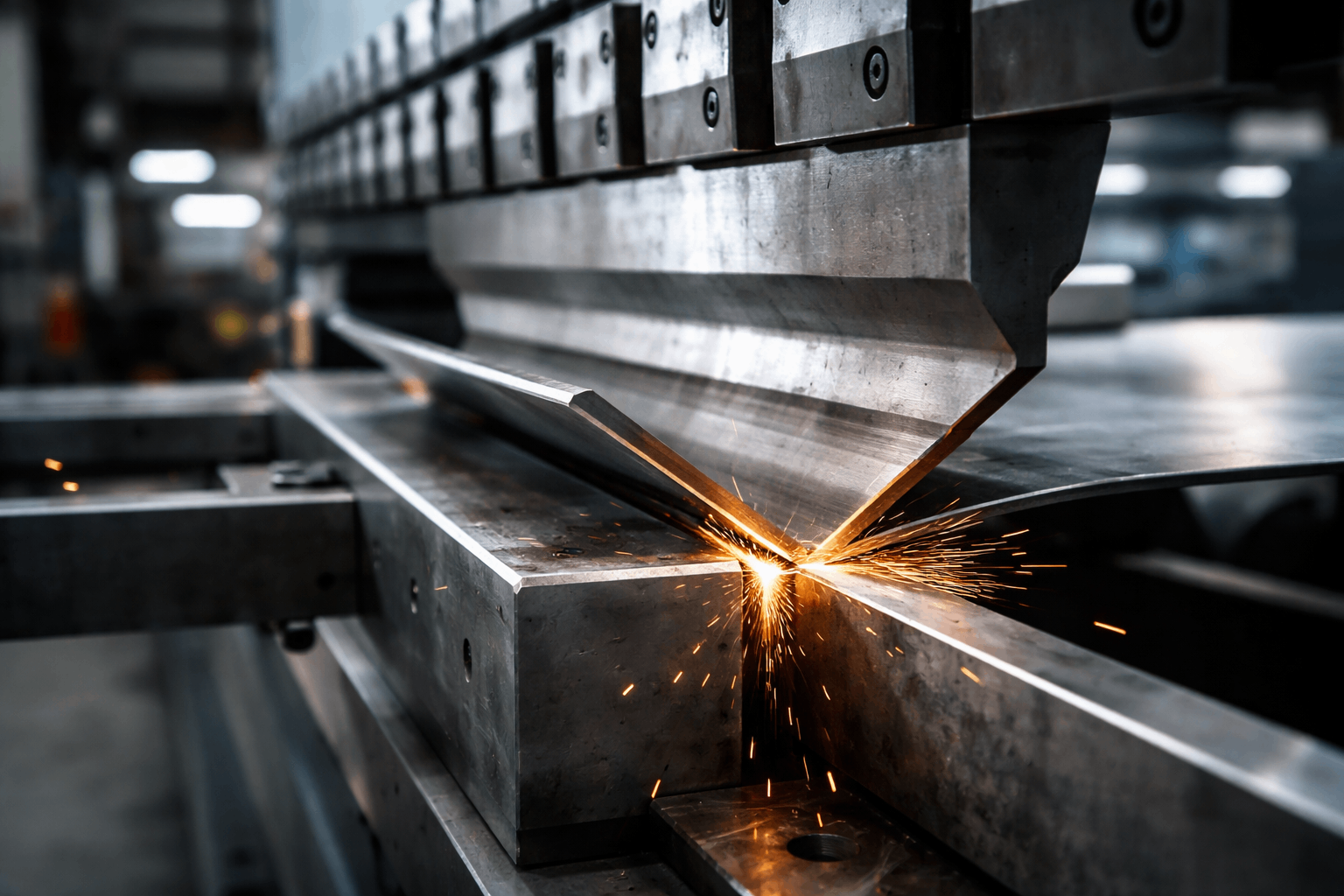
Understanding the Real Limits of Sheet Metal Bending in Production
Primary focus: press brake forming
Related concepts: brake forming, press brake metal forming, sheet metal bending, press brake process
Press brake forming is often explained as “bend the sheet to an angle.” That description is convenient, but it does not match what overseas wholesale buyers experience when parts enter real assemblies.
In procurement, the difference between an acceptable bend and a reliable bend shows up in delivery risk, rework cost, and whether a supplier can keep quality stable across batches.
This article is written for B2B sourcing teams and engineering-led buyers. It connects the mechanics of sheet metal bending to the decisions buyers make: what to specify, what to ask during RFQ, where tolerance risk hides, and how to avoid a “good sample / unstable production” situation.
You’ll see practical terms used in press brake metal forming—springback, backgauge, die opening, bend allowance, and bending sequence—but always tied back to procurement impact rather than textbook theory.
1. When Press Brake Forming “Works” — and Parts Still Don’t Fit
A frequent procurement surprise is receiving bent parts that pass incoming inspection, yet fail at assembly. The angle may look correct, flange lengths may be close, and the surface finish may be clean.
Then the parts reach the line: doors bind, seams open unevenly, holes don’t align, or fasteners require force to start. This is where a purchasing decision becomes an operational problem.
In many assemblies, a bend is not an isolated feature. It is a geometric “pivot” that shifts the position of downstream features such as holes, slots, weld seams, and mating flanges.
That means a small angle deviation can quietly become a larger positional error. The longer the flange, the more that deviation matters, especially when the part interfaces with rigid components.
Wholesale buyers care about this because the cost shows up outside the bending cell. A misfit part consumes time in sorting, rework, extra inspection, and production interruptions.
It also increases the risk of “hidden defects” where parts can be forced to assemble but create stress, preload, or misalignment that reduces field reliability.
From a sourcing perspective, the key question is not whether a part looks acceptable on a bench. The question is whether the bend outcome is stable enough to protect the assembly function.
This is why experienced buyers evaluate brake forming as a system-level contributor to assembly success, not simply a shop capability.
A helpful way to think about it is “fit intent.” If the part is structural, sealing, or alignment-critical, the bend is an assembly interface.
If it is cosmetic or non-critical, the bend is a shape feature. Those two use cases should not be quoted, tolerated, or inspected the same way.
To avoid surprises, buyers benefit from describing the functional requirement, not only the nominal angle. For example, “flush to mating panel” or “hole pattern alignment within the bracket.”
This gives suppliers a clearer target and reduces the chance that they optimize for a measurement that does not protect real fit.
2. The False Assumption Behind Most Press Brake Forming Errors
Many sourcing conversations start from a hidden assumption: if the press brake program says 90°, the part will reliably be 90°.
In reality, press brake forming is not a purely machine-determined process. It is material-responsive, tooling-dependent, and setup-sensitive.
The press brake applies force through a punch and die. The metal responds by deforming, first elastically and then plastically.
Elastic deformation stores energy that is released after unloading. Plastic deformation creates the permanent bend. The balance between them changes with material grade, thickness tolerance, and forming method.
This is why “same program” does not always mean “same result.” A coil from a different mill, a thickness at the high end of tolerance, or a different grain direction can shift springback.
Tooling wear and friction also matter. A slightly worn punch radius, a die with different surface condition, or a change in lubrication can alter contact and sliding.
From a buyer’s viewpoint, the practical takeaway is that bending accuracy is a conditional outcome, not a fixed promise.
This doesn’t mean the process is unreliable. It means reliability must be engineered through the right process window and the right specification approach.
If a quote assumes perfect determinism, it often hides cost that later appears as “adjustment time,” “extra inspection,” or “engineering change.”
A better procurement approach is to treat press brake metal forming like other variable-sensitive processes: define what must be controlled, allow reasonable compensation where appropriate, and validate stability at scale.
That is also how you avoid the common pattern where samples look excellent because the supplier manually tunes the first pieces.
Then production drifts because the process window was never designed to tolerate normal variation.
In this article, every section builds toward that procurement goal: reducing stability risk without over-specifying.
3. What Actually Happens to Sheet Metal During a Bend
Press brake forming is often described as a geometry operation. In practice, it is a stress redistribution event.
During sheet metal bending, the outer surface of the bend experiences tensile strain while the inner surface experiences compression.
Between them lies the neutral axis, where material length change is minimal. CAD models commonly assume a consistent neutral axis position.
In production, the neutral axis shifts depending on inside radius, die opening, material properties, and the forming method (air bending vs bottoming, for example).
As the punch moves down, the sheet first deforms elastically. If you unload in this range, the part returns to its original shape.
Once the stress exceeds yield strength, plastic deformation begins. This is what “sets” the bend.
However, the metal still holds elastic energy, so when the punch retracts, the part partially recovers.
That recovery is springback, and it changes the final angle and sometimes the flange position.
Different materials show different springback behavior. Mild steel tends to be forgiving. Stainless steel often springs back more.
Aluminum frequently amplifies small changes in thickness or temper into measurable angle differences.
High-strength alloys can narrow the process window because they require higher tonnage and can be more sensitive to radius control.
For procurement, the point is not to memorize material rankings. The point is to recognize that “material variability” is a real input.
If you source across multiple lots, multiple mills, or multiple suppliers, the bending outcome will reflect those upstream conditions.
That is why some buyers specify material grade tightly, request mill certs for critical applications, or qualify bending performance on a defined material family.
It is also why bend allowance and flat pattern calculations must be treated as calibrated models rather than universal rules.
3.1 Springback as a Procurement-Relevant Variable
Springback is sometimes blamed on machine precision. In reality, it is primarily elastic recovery inherent to metals.
A modern CNC press brake can improve repeatability by controlling depth, crowning, and backgauge positioning.
But it cannot eliminate springback because springback is a material response to unloading.
For buyers, the more useful question is how a supplier manages springback across production.
Do they use stable tooling, standardized die openings, and documented compensation values? Do they validate angles across the run?
A supplier who can explain their approach in simple terms usually has practical experience with batch stability.
That kind of experience matters more than marketing claims about “high precision equipment.”
4. Why Identical Bends Rarely Produce Identical Results
If you’ve ever seen two parts bent with the same program behave differently at assembly, you’ve seen real-world variation.
Brake forming variability rarely comes from one dramatic mistake. It comes from many small contributors that interact.
Material thickness tolerance is one contributor. Even small thickness changes affect bend force and springback.
Yield strength variation across coils or batches is another. Two sheets marked as the same grade can respond differently depending on processing history.
Grain direction matters too. Bending parallel or perpendicular to rolling direction changes how strain distributes.
Tooling condition adds another layer. Punch tip wear, die opening variation, and surface condition influence contact and sliding.
Setup variation is often underestimated. Backgauge calibration drift, operator positioning habits, and part support can shift the effective bend.
Upstream cutting can also matter. Laser cutting, punching, and shearing can introduce residual stress that releases during forming.
Each factor may look minor alone. Together they change how the sheet seats, how it contacts the die, and how it springs back.
For overseas wholesale buyers, this is why a supplier can deliver a beautiful first article and still struggle later.
The first article may be tuned with extra attention. Later, normal variation enters and the process window proves too narrow.
A practical buyer-friendly way to discuss this is “repeatability.” Repeatability is the ability to stay within tolerance without constant micro-adjustments.
That is what protects delivery schedules, reduces sorting, and keeps your assembly process stable.
4.1 Repeatability Matters More Than One-Time Accuracy
A press brake can almost always be adjusted to hit a target angle on a single part.
Production success is hitting that target consistently across a run while keeping flange lengths and feature positions stable.
For procurement, repeatability is the KPI that aligns with business outcomes: predictable cost, predictable lead time, and fewer quality disruptions.
When buyers ask questions during RFQ, “How do you maintain repeatability across batches?” often reveals more than “What tolerance can you hold?”
A supplier may quote tight tolerances, but if they cannot describe how they control variation, the risk is shifted to the buyer.
This is also where long-tail search intent lives. Many buyers search for “inconsistent press brake bending” or “bent parts not fitting.”
Those queries reflect repeatability problems, not definitions.
5. Setup Defines the Process Boundary
Many articles treat setup as one step in a press brake process list. In production, setup defines the boundary of what is achievable.
Tool selection, die opening, punch radius, backgauge strategy, and part support determine how sensitive the bend will be to variation.
A robust setup absorbs material fluctuation and minor handling differences. A fragile setup magnifies them.
This is why two suppliers with similar equipment can produce very different outcomes.
Setup is also where cost and lead time are shaped. Stable setups reduce trial bends, reduce adjustment loops, and reduce inspection burden.
For buyers, this matters because unstable setups often show up as delayed shipments, added “engineering time,” or inconsistent lots.
A useful concept here is the “process window.” A wide process window means small variations still produce acceptable parts.
A narrow process window means small variations push parts out of tolerance, increasing scrap and rework.
5.1 Backgauge and Positioning Effects
The backgauge is the referencing system for bend location and, indirectly, for repeatability.
Backgauge accuracy influences where the bend line is placed, but also how consistently the part seats before bending.
In multi-bend parts, each bend changes the reference geometry for the next bend.
A stable backgauge strategy reduces cumulative error, which improves assembly alignment and reduces downstream fitting.
Part support matters as well. Large panels can sag or twist during handling, changing how the next bend references the gauge.
For buyers, you don’t need to specify machine axes. You need to communicate functional risk.
If a part is long, thin, or multi-bend, asking how the supplier supports and references the part can prevent surprises.
It also helps to align inspection with the true risk, not with a convenient measurement point.
5.2 Die Opening, Inside Radius, and Tonnage — Why Setup Choices Drive Stability
In press brake metal forming, die opening (V-die), punch radius, and available tonnage are tightly linked. These parameters influence not only whether a bend can be made, but how stable that bend will be across production.
A wider die opening generally produces a larger inside bend radius and increases sensitivity to springback. A narrower die opening increases forming force and contact control, but also raises tonnage demand and tooling stress.
From a procurement standpoint, this matters because the same nominal angle can behave very differently depending on V-die selection. Two suppliers may quote the same angle tolerance, yet use very different tooling strategies with very different repeatability outcomes.
Tonnage margin is another hidden variable. When a bend operates close to machine or tooling limits, small material variations can push the process outside its stable window.
Buyers do not need to calculate tonnage themselves. A practical RFQ question is whether the supplier uses standardized die openings by material thickness range, and whether their bend tables are tied to fixed tooling sets.
This single question often reveals whether the process is engineered for repeatability or adjusted case by case.
6. Why Bend Calculations Lose Precision in Production
Bend allowance (BA), bend deduction (BD), and K-factor are essential for flat pattern development.
They are also common sources of misunderstanding between design intent and production reality.
In CAD, these values can be treated as constants. In production, they behave like calibrated parameters.
The reason is that the neutral axis position shifts with tooling geometry, forming method, and material condition.
K-factor is not a single number that universally applies to a material grade. It is an empirical ratio that depends on process context.
That is why two shops can produce different developed lengths from the same 3D model if they use different tool sets or methods.
For procurement, the practical impact is flange length and hole position drift.
A buyer may see “angle is fine,” but the part is slightly long, causing interference or a mismatch with mating features.
In many supply chains, this becomes a hidden cost. Suppliers may trim parts, adjust offsets, or add secondary operations.
Those workarounds protect shipment but increase cost and variability.
A stronger approach is calibration: controlled test bends, documented bend tables, and stable tooling assumptions.
When a supplier maintains internal bend tables by material family and thickness range, they can produce more consistent flat patterns.
For buyers, it helps to align expectations: are you ordering a one-off prototype where manual tuning is acceptable?
Or are you ordering repeat production where the supplier needs a stable, documented bending model?
This is also a good place for long-tail keywords to be naturally satisfied, such as “bend allowance accuracy” or “K-factor sheet metal.”
6.2 A Buyer-Friendly View of Bend Allowance, Bend Deduction, and K-Factor
For buyers, bend allowance and bend deduction are not academic formulas. They determine whether flange lengths and hole positions remain consistent when parts are produced at scale.
In practice, BA and BD depend on the neutral axis location, which shifts with tooling geometry, forming method, and material condition. The K-factor represents this relationship, but it is not a universal constant.
A simple way to think about this is calibration versus assumption. When suppliers rely on generic K-factor values, flat patterns may work for samples but drift in production.
Suppliers with stable press brake forming processes typically validate bend values through test bends and maintain internal bend tables by material family and thickness range.
For procurement, the actionable question is not “What K-factor do you use?” but “How do you validate flat patterns across batches?”
That question aligns engineering reality with purchasing risk and avoids late-stage length corrections that add cost and variability.
7. Bending Sequence and Cumulative Error
Multi-bend parts are where press brake forming becomes a system problem rather than a single bend problem.
Each bend changes stiffness, reference edges, and how the part contacts the tooling during the next operation.
CAD unfolding and refolding is mathematically perfect. Production bending is physically variable.
That difference is why bending sequence matters.
When the first bend introduces even slight twist, the second bend no longer starts from a true reference plane.
Forming a long flange early in the sequence can also make the part harder to gauge consistently during later bends.
In cases where a return flange requires complex handling, operator technique itself can become a measurable source of variation.
For procurement, sequence is a quality lever. It affects repeatability, delivery speed, and scrap risk.
Suppliers with deep press brake metal forming experience plan sequences to minimize error amplification.
They choose reference surfaces intentionally and avoid setups where the part “floats” or self-supports unpredictably.
They also plan around collision risk and the reality of part handling, not only the geometry.
A buyer does not need to dictate sequence. But it is reasonable to ask how the supplier approaches sequence for complex parts.
If the answer is vague or purely procedural, it may indicate limited experience with batch stability.
If the answer describes reference control and error accumulation, it often signals a more production-ready capability.
This section stays tightly tied to the theme because sequence is one of the most common hidden sources of “good sample, unstable batch.”
8. Press Brake Forming Tolerances as Practical Trade-Offs
Tolerances in press brake forming are often misunderstood as a simple numeric capability.
In reality, tolerance is a trade-off between geometry sensitivity, forming method, inspection strategy, and cost.
Angle tolerance may be achievable, but the functional requirement is often positional: where the flange edge ends up in space.
A small angle deviation can create a meaningful positional shift, especially on long flanges.
That is why buyers sometimes feel confused: inspection says “angle OK,” yet assembly still struggles.
The relationship is simple to visualize.
| Flange Length | Angle Deviation | Approx. Edge Shift |
|---|---|---|
| 50 mm | 1° | ~0.87 mm |
| 100 mm | 1° | ~1.75 mm |
| 200 mm | 1° | ~3.49 mm |
| 300 mm | 1° | ~5.24 mm |
This does not mean every part needs tight angles. It means the buyer should match tolerances to functional needs.
For example, a cosmetic cover may tolerate more variation than a sealing surface or alignment bracket.
Standards such as ISO 2768 can help communicate general expectations. They do not remove the physics of bending.
If the assembly function is sensitive, the specification should call out functional datums or interface requirements.
This is also where buyer behavior matters. Over-specifying everything increases cost and does not always protect function.
Under-specifying critical interfaces creates hidden assembly cost.
The best outcomes occur when the drawing communicates what truly matters and the supplier quotes accordingly.
That approach supports both high conversion and lower dispute risk because expectations are aligned upfront.
8.2 Typical Achievable Ranges — Context, Not Promises
Buyers often ask what tolerances are “normal” for press brake forming. The most accurate answer is that achievable ranges depend on geometry, material, and process control.
In general production environments, angle tolerances of ±0.5° to ±1° are common for many parts, but the functional impact depends on flange length and assembly sensitivity.
Positional variation at the flange edge increases with length, which is why long flanges and alignment-critical interfaces require more careful process design.
Rather than treating tolerance as a single number, buyers benefit from discussing which features are function-critical and which are cosmetic.
This allows suppliers to focus control effort where it protects function, rather than tightening every dimension and increasing cost unnecessarily.
9. Why Prototypes Rarely Reveal Production-Level Risk
Prototype success is valuable, but it can create a false sense of security in brake forming.
Prototypes are often made under ideal conditions: slower pace, more measurement, and more manual adjustment.
An experienced operator can “dial in” a part so the first pieces look excellent.
That does not guarantee the process is stable enough for volume.
In production, the supplier must run within a window that tolerates normal variability.
Material lots change. Tooling wears. Setups are repeated across shifts. Handling differs between operators.
These realities introduce drift that does not show up in a small prototype run.
For buyers, the key distinction is one-time success versus sustained process stability.
This is why procurement teams often add a production validation step.
Instead of approving only a few samples, they may request a pilot run, capability check, or a defined “first batch” review.
The goal is not to burden the supplier. The goal is to validate that the process window is wide enough.
This also improves supply reliability: stable processes ship on time with fewer surprises.
When buyers search for “prototype vs production sheet metal,” they are really searching for this risk.
Addressing it in a supplier blog builds trust because it shows you understand the buyer’s lived experience.
10. When Press Brake Forming Problems Originate in Design
Many bending issues originate upstream in design decisions, not only in shop execution.
A design can be manufacturable in a one-off sense while still being unstable in a volume sense.
Short flanges can be difficult to gauge consistently.
Holes close to bend lines can distort due to deformation and tooling clearance.
Tight positional dependencies can magnify small bending variation into assembly failure.
From a buyer’s perspective, redesign is expensive, especially after tooling, fixtures, or downstream parts are already locked.
That is why design-for-manufacturing discussions are most valuable early.
The goal is not to change the design for the supplier’s convenience. The goal is to reduce risk for the buyer.
Design robustness often beats tighter tolerances.
Small adjustments—such as increasing inside radius where function allows, adding bend relief where needed, or adjusting hole-to-bend distance—can widen the process window.
A robust design is one that tolerates the normal reality of press brake metal forming.
That tolerance reduces cost, reduces delivery variability, and reduces the need for sorting.
This section stays tightly tied to the theme because design is part of the press brake forming system.
Ignoring design contribution is one reason buyers experience recurring quality disputes across suppliers.
10.1 Hole-to-Bend Distance — Why Proximity Amplifies Variation
Holes placed close to bend lines often shift during forming due to material flow and tooling clearance.
In one-off parts this may be manageable, but in production it becomes a repeatability risk.
For buyers, increasing hole-to-bend distance where function allows can significantly improve consistency without changing material or equipment.
10.2 Bend Relief and Distortion Control
Without adequate bend relief, material near the bend can tear, distort, or pull adjacent features out of position.
This distortion often appears minor in samples but grows across batches as tooling and material vary.
Designing appropriate relief features helps stabilize forming behavior and reduce downstream correction.
10.3 Minimum Flange Length and Gaging Stability
Very short flanges can be difficult to gauge consistently, especially in multi-bend parts.
Increasing flange length slightly can widen the process window and improve referencing stability.
For procurement, these adjustments are often less costly than chasing tighter tolerances after production begins.
11. Practical Limits of Press Brake Metal Forming
Press brake metal forming is versatile, but it is not universal.
Problems arise when the process is pushed beyond its economical stability zone.
Extremely long flanges increase sensitivity to angle variation and handling distortion.
High-strength materials can increase tonnage demand and reduce available forming radius options.
Complex multi-bend profiles can create reference drift and handling variability.
Assemblies that require machining-level positional precision can be risky if they rely on forming alone.
For buyers, the important question is not “Can it be bent?”
The question is “Can it be bent repeatably, at volume, within a stable cost and lead-time structure?”
If the answer is no, the right solution may be design adjustments, different forming strategy, or different assembly interface design.
This is also where suppliers can help buyers by describing trade-offs in simple terms.
For example, a request for extremely tight positional control on a long flange may be feasible but costly.
If the interface can be redesigned to be more forgiving, cost and risk both drop.
A supplier blog that explains limits clearly is not being negative.
It is helping buyers make decisions that avoid downstream disputes, late changes, and hidden assembly costs.
That tone supports conversion because it signals partnership rather than sales pressure.
12. Press Brake Forming as a Supply Capability
Many supplier pages emphasize equipment lists. Equipment matters, but it does not define capability.
Press brake forming capability is a system: tooling discipline, setup repeatability, bend table calibration, and process learning.
A production-ready supplier treats bending as a controlled process, not a one-time achievement.
They standardize tooling where possible, maintain dies and punches, and keep consistent setups.
They monitor variation and use inspection feedback to stabilize the process window.
For buyers, these behaviors translate to supply reliability.
Reliable supply means fewer late shipments, fewer quality escapes, fewer disputes over tolerance interpretation.
It also means better predictability when you reorder months later.
If you are qualifying a supplier, a practical conversation is about control logic, not marketing claims.
How do they manage springback across material lots?
How do they handle multi-bend sequence risk?
And how are bend allowance assumptions kept stable across production runs?
A supplier who answers these questions clearly usually has stronger manufacturing maturity.
That maturity is what wholesale buyers value, because it lowers total procurement risk.
Closing Perspective
Press brake forming challenges are predictable when viewed through material behavior, geometry interaction, and process control.
When buyers understand the process window, they can specify more effectively, evaluate suppliers more accurately, and scale orders with fewer surprises.
If you are sourcing bent sheet metal parts for volume production and want stable, repeatable outcomes, it helps to align assumptions early.
If you’d like to discuss a project briefly—material, thickness range, bend count, and functional interfaces—YISHANG can help you identify the most practical press brake metal forming approach and reduce downstream rework risk.