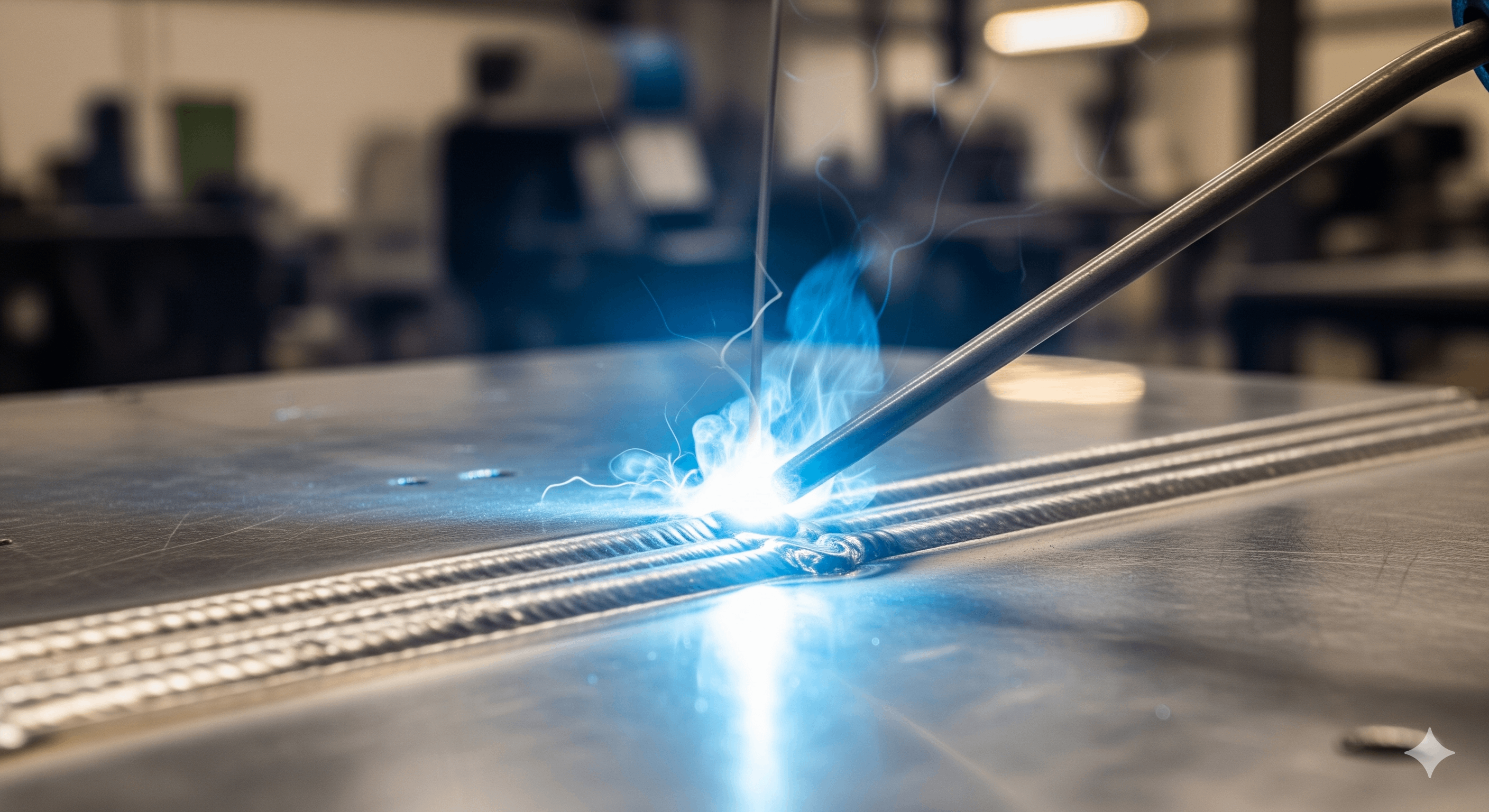
Executive Summary: When procurement officers or product engineers ask, “Can you weld aluminum to aluminum?“, the answer determines the viability of your entire supply chain. While technically possible, joining aluminum alloys requires navigating specific metallurgical challenges—from the aluminum oxide melting point to thermal conductivity issues. This guide explores the manufacturing realities, cost implications, and quality assurance protocols necessary for high-volume, export-grade fabrication.
Introduction: The Supply Chain Reality
In the global custom metal fabrication market, a simple “yes” to an RFQ (Request for Quotation) is often insufficient. Sourcing managers aren’t just looking for a shop that can melt metal; they are looking for reliability at scale.
They need to verify if a factory can join two highly reactive base metals consistently, across 5,000 or 50,000 units, without encountering the catastrophic failure modes that plague this material.
Strictly speaking, welding aluminum is a battle against physics. It involves breaking through a refractory ceramic oxide skin that melts at 2060°C (3740°F), while the base metal melts at just 660°C (1220°F).
This must be done while managing a heat sink that dissipates energy five times faster than steel.
For a partner like YISHANG, with over 26 years of experience exporting to strict markets in Europe and North America, we view aluminum fabrication not as a manual task, but as a rigorous exercise in chemical control and process discipline.
This guide serves as a roadmap for B2B buyers. We will move beyond basic tutorials to dissect the hidden cost drivers of different welding methods, the risks of alloy mismatch, and the AWS D1.2 standards required to ensure your shipment arrives free of defects.
The Material Strategy: Selecting Alloys for Manufacturability
The first point of failure in many projects happens before the metal even reaches the shop floor: alloy specification. In the B2B context, “aluminum” is a family of distinct series with vastly different behaviors.
Selecting the wrong alloy can drive up unit costs due to high scrap rates or necessitate expensive post-process corrections. When you ask, “can you weld aluminum,” the answer depends heavily on the series number.
The Reliable Workhorses: 5xxx and 6xxx Series
In the custom metal fabrication industry, particularly for sheet metal and structural components, specific series dominate due to their balance of strength and weldability.
- 5xxx Series (Al-Mg): Alloys like 5052 and 5083 are the gold standard for marine and industrial enclosures. They are non-heat-treatable, meaning they rely on work hardening.
- Procurement Benefit: They retain high strength after welding without needing expensive heat treatment ovens. This makes them the most cost-effective choice for fuel tanks, chassis, and outdoor cabinets.
- 6xxx Series (Al-Mg-Si): Containing magnesium and silicon, 6061 aluminum is the industry ubiquity for extrusions and frames.
- The Engineering Risk: Welding 6061 aluminum introduces a thermal penalty. Because it is heat-treatable, the arc’s heat “erases” the T6 temper in the Heat Affected Zone (HAZ).
- Impact: This reduces localized tensile strength by up to 40-50%. Successful procurement teams ensure their design engineers have accounted for this drop, or they budget for post-weld artificial aging to restore the temper.
The “High-Risk” Alloys: A Warning for Buyers
Conversely, we frequently see inquiries for aerospace alloys like the 2xxx (Al-Cu) and 7xxx (Al-Zn) series. While 7075 aluminum is legendary for its strength, it is widely considered “unweldable” for standard industrial applications.
The chemistry of these alloys leads to liquation cracking—where the grain boundaries melt before the grain interior, causing the metal to tear apart upon cooling.
While specialized techniques like Friction Stir Welding exist, they are rare in general fabrication. For projects requiring 7075 strength, experienced manufacturers will recommend riveting or bonding instead of welding to ensure supply chain security.
The Physics of Cost: Why Aluminum Fabrication Quotes Differ
To understand why aluminum welding quotes often differ from steel fabrication quotes, one must look at the underlying physics that drive labor hours and equipment wear.
The process is governed by three “invisible saboteurs” that directly impact the line items on your invoice.
The Oxide Paradox (Cleaning Labor)
The most significant factor driving labor costs is the Oxide Paradox. Aluminum instantly forms a hard oxide skin. If a welder simply applies heat, the inside melts while the skin remains solid, leading to a “lack of fusion” defect.
Unlike steel, where minor contaminants can sometimes be burned off, aluminum requires a dedicated cleaning step.
- The Process: Mechanical removal using dedicated stainless steel brushes + solvent degreasing.
- The Cost: This prep work adds approximately 15-20% more labor time per joint compared to mild steel.
Thermal Conductivity (Energy & Skill)
Aluminum pulls heat away from the weld zone rapidly. This acts as a massive heat sink.
- Equipment Impact: It requires higher amperage machines (300A+) to maintain the weld pool, increasing energy consumption.
- Skill Premium: On thin gauges, this conductivity increases the risk of “burn-through” (melting a hole). Preventing this requires highly skilled (and higher-paid) certified welders, not entry-level operators.
Hydrogen Solubility (Porosity Risk)
Molten aluminum absorbs hydrogen; solid aluminum expels it. If the weld freezes too fast, gas gets trapped, creating porosity (pinholes).
- QA Cost: Controlling this requires strict storage environments for filler wire (to prevent moisture absorption) and often requires higher gas flow rates for shielding (Argon/Helium mixes), which are more expensive consumables.
Production Method Selection: Balancing Volume vs. Quality
For a professional buyer, the choice of welding method is a strategic trade-off. A capable OEM factory must master TIG, MIG, and Laser welding, deploying each where it offers the best ROI (Return on Investment).
TIG Welding (GTAW): Precision & Aesthetics
Gas Tungsten Arc Welding is the premium choice for low-volume, high-value components.
- Best Application: Medical carts, Yishang Display racks, food-processing equipment.
- Pros: precise control via AC Balance; produces the classic “stack of dimes” aesthetic; no spatter.
- Cons: Extremely slow travel speed. It is rarely cost-effective for high-volume structural runs (e.g., 5,000+ units).
Pulse MIG Welding (GMAW): The Volume Workhorse
For structural fabrication like automotive brackets or server racks, MIG Welding is the standard.
- The Upgrade: Modern Pulse MIG technology pulses the current to minimize spatter and control heat input, bridging the gap between MIG speed and TIG quality.
- Procurement Insight: Switching from TIG to Pulse MIG on non-cosmetic joints is often the single most effective lever to reduce BOM (Bill of Materials) costs on large orders.
Handheld Laser Welding: The Modern Disruptor
This technology is a game-changer for thin sheet metal (0.8mm – 2mm), such as electronic enclosures.
- Pros: 4x-10x faster than TIG; minimal heat input means near-zero distortion (no warping).
- The Catch: It requires perfect fit-up. Laser cannot bridge gaps. Your supplier must have high-precision CNC laser cutting and bending capabilities. If the upstream fabrication is sloppy, laser welding will fail.
Robotic Welding: The Consistency King
For orders exceeding 1,000 units per month, manual welding becomes a bottleneck and a quality variable.
- The Solution: Robotic aluminum welding cells ensure 100% repeatability.
- YISHANG’s Approach: We utilize robotic arms for repetitive chassis welds to guarantee that the heat input and travel speed are identical on every single unit, stabilizing the microstructure consistency.
Design for Manufacturability (DFM): Lowering Costs
The most effective way to reduce procurement costs is not squeezing the supplier’s margin, but optimizing the design. Joint design for aluminum must differ from steel.
Geometry Adjustments
Because aluminum weld pools are fluid and heat dissipates fast, standard steel joints often fail.
- Wider Grooves: V-grooves on plates thicker than 3mm often need a 60°+ included angle to ensure the arc reaches the root.
- Backing Bars: Designing with temporary or permanent backing bars helps prevent burn-through and ensures full penetration.
Distortion Control
Aluminum expands roughly twice as much as steel when heated.
- Stitch Welding: We advise designing intermittent welds (stitch welding) rather than continuous seams where possible. This reduces total heat input and minimizes warping.
- Symmetry: Placing welds near the neutral axis helps balance shrinkage forces. Engaging engineering teams early in the design phase can eliminate the need for expensive straightening fixtures later.
Surface Finishes: The Hidden “Color Match” Problem
A frequent issue B2B buyers face is receiving parts where the weld seam is a different color than the base metal after anodizing. This is purely a filler wire selection issue.
- The Problem: The default filler wire for 6061 is often ER4043 (Al-Si) because it is crack-resistant and easy to flow. However, Silicon turns a dark, charcoal gray during the anodizing process.
- The Solution: If your RFQ specifies “Clear Anodize” or “Color Anodize,” the factory must switch to ER5356 (Al-Mg). This wire is color-compatible with the base metal.
- Action Item: Always specify your final surface finish requirement clearly on the welding print to avoid this cosmetic disaster.
Quality Assurance: Verifying Supplier Competence
In the B2B world, the quality of a prototype is easy; the consistency of the 1,000th unit is the challenge. A robust QA protocol goes beyond visual checks.
Pre-Weld Hygiene Audit
If you visit a potential supplier, check their cleaning station.
- Red Flag: Using the same wire brush on steel and aluminum. This introduces iron particles that cause rust later.
- Green Flag: Dedicated “Aluminum Only” stations with stainless steel brushes and acetone solvents.
Defect Management (NDT)
Porosity and Crater Cracks are the enemies.
- Process Control: Look for machines with “crater fill” settings that taper off the current to prevent end-cracks.
- Testing: For critical loads, request Macroscopic Cross-Section Testing (cutting a sample weld and etching it) to verify root penetration depth according to AWS D1.2 standards.
Conclusion: Partnering for Supply Chain Security
Ultimately, the question “Can you weld aluminum?” should be rephrased: “Can you engineer a reliable aluminum joint at scale?“
Achieving a bond that withstands vibration, pressure, and time requires a manufacturing partner who respects the metallurgy and operates with rigorous process discipline. The “hidden costs” of aluminum fabrication rarely come from the raw material; they come from rework, delayed shipments due to rejection, and the reputational damage of field failures.
At YISHANG, we position ourselves as technical partners. Whether utilizing the speed of Pulse MIG for automotive runs or the precision of Laser for electronics, our commitment to the science of fabrication ensures your supply chain remains robust.
Ready to secure your aluminum supply chain? Contact our engineering team today for a DFM review of your next project.