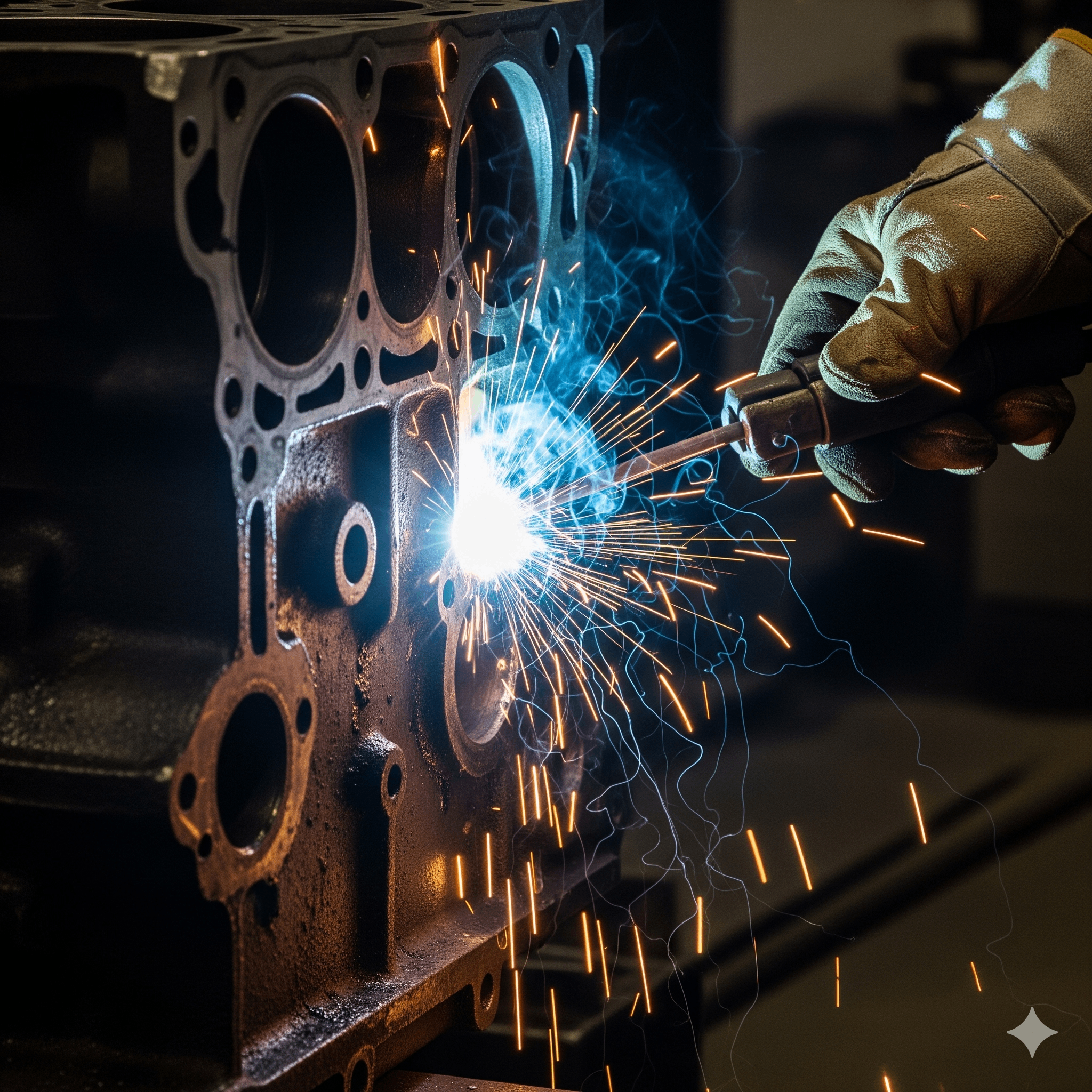
For wholesale distributors and procurement managers, a failed cast iron repair is a supply chain liability. When an end-user’s repaired engine block cracks again, the blame often falls on the supplier who recommended the consumable.
Providing the best welding rod for cast iron requires more than just catalog knowledge; it requires technical risk mitigation. Cast iron is rigid, brittle (often 0% ductility), and metallurgically complex. It cannot be treated like mild steel.
This guide leverages YISHANG‘s fabrication data to dissect repair failures. We analyze cast iron welding electrode specifications (AWS A5.15), provide technical parameter tables, and explore the economic logic of “Repair vs. Replace,” equipping your sales team to offer high-reliability solutions to your B2B network.
The Diagnostics Phase: Reducing Returns via Material ID
A primary cause of “defective product” returns is actually material mismatch. Before fulfilling a bulk order or advising a client, identifying the substrate is critical for reducing warranty claims.
The Inventory Challenge: Grey vs. Ductile Iron
Grey Cast Iron (ASTM A48): Common in legacy machinery bases. It contains graphite flakes that act as stress risers.
- Tensile Strength: Low (20k – 60k PSI).
- Procurement Insight: Repairs on Grey Iron demand high-nickel consumables (ENi-CI) to prevent brittle martensite formation. Supplying cheaper steel-based rods for this application will result in immediate cracking and customer dissatisfaction.
Ductile (Nodular) Cast Iron (ASTM A536): Common in modern automotive parts. Graphite exists as spheres (nodules).
- Tensile Strength: High (60k – 100k PSI).
- Procurement Insight: While more weldable, Ductile Iron requires strict heat input control. Positioning cast iron welding rod types designed for nodular iron (ENiFe-CI) establishes your brand as a technical authority.
Field Verification (Sales Tip): Advise your clients to perform a “Spark Test” if material certs are missing:
- Grey Iron: Short, dull red sparks with complex bursts.
- Ductile Iron: Longer, orange-red streams.
- Mild Steel: Long, bright yellow-white streamers.
The “Sponge” Effect: Why Pre-Weld Cleaning Matters
Cast iron acts like a rigid metallic sponge, absorbing oils and coolants over decades of service.
- The Problem: When welded, trapped contaminants vaporize, causing gross porosity (pinholes).
- The Solution: Advise the “Sweat Out” protocol—heating the casting to $400^{\circ}\text{F}$ – $600^{\circ}\text{F}$ to drive out impurities.
- Distributor Note: Even premium welding rod iron with scavengers cannot fix a saturated substrate. Educating clients on cleaning reduces complaints about “bad rods.”
Cast Iron Welding Rod Types: Navigating the “Triangle of Trade-offs”
There is no “universal” rod. Inventory selection is a strategic trade-off between Machinability, Tensile Strength, and Cost. Understanding these cast iron welding rod types ensures you recommend the right tool for the job.
The “Machinability” Priority: AWS ENi-CI (99% Nickel)
- Composition: ~99% Nickel core.
- Hardness: ~150 HB (Soft).
- Best For: Cylinder heads, valve seats, precision surfaces.
The Engineering Logic: Pure nickel prevents hard iron carbides (cementite) from forming. Carbon precipitates as free graphite, keeping the weld soft.
- Selling Point: This is the only option for parts requiring post-weld drilling or milling. While the unit cost is higher, it saves the client expensive cutting tools.
The “Strength” Priority: AWS ENiFe-CI (55% Ni / 45% Fe)
- Composition: ~55% Nickel, ~45% Iron.
- Hardness: ~200 HB (Harder, but workable).
- Best For: Heavy equipment, structural castings, dirty iron.
The Engineering Logic: Pure nickel expands differently than iron (CTE mismatch). Adding iron to the rod creates a thermal expansion match, significantly reducing shrinkage cracks in thick welds.
- Inventory Strategy: This is the “workhorse” rod. It balances high strength (up to 85,000 PSI) with moderate cost. It should be your core SKU for structural maintenance customers.
The “Economy” Trap: Steel Rods (ESt)
- Composition: Steel core.
- Hardness: >350 HB (Glass-hard).
The Warning: Mixing steel with cast iron creates Martensite (brittle tool steel) in the fusion zone.
- Strategic Positioning: Market steel rods only for non-structural cosmetic filling (e.g., counterweight blowholes). Never recommend them for load-bearing repairs.
Technical Reference: Quick Selection & Parameter Guide
For procurement professionals creating datasheets or technical support guides, the following table summarizes the best welding rod for cast iron based on specific application needs.
| AWS Class | Common Name | Polarity | Amperage (1/8″ Rod) | Best For… |
|---|---|---|---|---|
| ENi-CI | Nickel 99 | DCEP / AC | 80 – 110 Amps | Machinability. Thin sections, cosmetic repairs, cylinder heads. |
| ENiFe-CI | Nickel 55 | DCEP / AC | 70 – 100 Amps | Strength. Thick sections, heavy machinery, dirty/oily castings. |
| ESt | Steel Rod | DCEP | 90 – 120 Amps | Non-Critical Fills. Cosmetic repairs only. Non-machinable. |
Note: Always recommend the lowest possible amperage to maintain a stable arc. Low heat input is critical for success.
Advanced Execution: Empowering Your Sales Network
Supplying the right cast welding rods is only 50% of the solution. Process control dictates the rest. Sharing this knowledge builds trust with your downstream buyers.
Joint Design: The U-Groove Mandate
- Stop-Drilling: Drilling 1/8″ holes at crack tips is mandatory to physically arrest propagation.
- Geometry: Unlike steel (V-groove), cast iron requires a U-groove (bathtub shape).
- Why: A sharp V-bottom concentrates solidification stress, leading to centerline cracking.
The “Cold Welding” Protocol
Full furnace pre-heating ($1000^{\circ}\text{F}$) is rarely feasible for on-site maintenance. The industry standard is “Cold Welding” (Low Heat Input):
- Short Beads: Weld segments must not exceed 1 inch (25mm).
- Cooling Discipline: The part must be cool enough to touch with a bare hand ($<140^{\circ}\text{F}$) before the next pass.
- Peening (Stress Relief): Striking the hot weld bead with a ball-peen hammer is mandatory.
- The Mechanism: Peening stretches the cooling metal, converting dangerous Tension into harmless Compression.
Failure Analysis: Reducing Warranty Claims
Diagnosing failure modes helps you guide clients toward the correct product choice.
Toe Cracks (HAZ Failure)
- Symptom: Cracks in the base metal, parallel to the weld.
- Root Cause: Rapid cooling created a brittle zone.
- Correction: Recommend a rod with higher nickel content (ENi-CI) for ductility, or advise a mild pre-heat ($300^{\circ}\text{F}$).
Centerline Cracking
- Symptom: A crack running down the center of the bead.
- Root Cause: Concave bead profile or high phosphorus.
- Correction: Switch to ENiFe-CI (better impurity tolerance) and use a convex bead profile.
Porosity (Pinholes)
- Symptom: Surface bubbles.
- Root Cause: Vaporized oil or moisture in the flux.
- Correction: Re-verify surface cleaning. Ensure cast welding rods are stored in moisture-proof packaging (flux is hygroscopic).
The Engineering Pivot: Moving from Repair to Upgrade
For wholesale buyers, the highest value lies in knowing when not to repair.
The Economic Calculus
If a casting is “burnt” (red oxidation) or repair costs >50% of replacement, welding is a liability. A welded cast iron part rarely returns to 100% integrity.
The ODM/OEM Fabrication Alternative
This is where the conversation shifts from “Consumables” to “Solutions.” Many legacy cast iron components were cast simply because it was the cheapest mass-production method decades ago.
Custom Steel Fabrication offers a superior alternative. Steel (S355/A36) is ductile, weldable, and immune to brittle fracture.
At YISHANG, we support distributors by offering comprehensive fabrication capabilities:
- Reverse Engineering: Converting broken castings into optimized CAD models.
- Material Conversion: Redesigning components to be manufactured from high-strength steel plate using laser cutting and CNC bending.
- Scalable Manufacturing: Providing batch production of upgraded components under your brand or ours.
Offering a “Fabrication-Grade Replacement” service alongside standard welding consumables creates a full-service value proposition.
Optimize your inventory with high-reliability consumables or explore custom fabrication solutions—Contact the YISHANG engineering team today.
Frequently Asked Questions (FAQ) for Procurement
Q: Why is packaging critical for wholesale cast iron electrodes? A: Flux coatings are hygroscopic. Damp rods cause immediate porosity. We ensure all wholesale shipments are vacuum-sealed to guarantee shelf stability for your distribution network.
Q: Can ENiFe-CI (Nickel 55) join cast iron to steel? A: Yes. This is the industry standard for dissimilar metal joining (e.g., steel brackets to cast blocks) due to its balanced CTE properties.
Q: Does YISHANG offer private labeling? A: Yes. We provide OEM services for both metal fabrication and consumable packaging, allowing you to build brand equity with our manufacturing quality.