
🚀 Key Takeaways: The Short Answer
For engineers and buyers asking, “Can you weld titanium to stainless steel directly?”:
- The Verdict: No. Direct fusion welding (TIG/MIG) creates brittle intermetallic compounds that shatter upon cooling.
- The Solution: You must use Solid-State Processes (Explosion Welding, Friction Welding) or Intermediate Buffer Layers (Vacuum Brazing).
- The Supply Chain Risk: Direct welds pose a 100% failure risk for structural applications. Sourcing requires validating the specific joining process used by your supplier.
The Procurement Paradox: Why Hybrid Designs Threaten Supply Chains
For global procurement directors and product engineers in sectors like marine shipbuilding, chemical processing, and desalination, the material specification of Titanium connected to Stainless Steel presents a high-stakes paradox. Your engineering team demands Titanium (Grade 2 or Grade 5) for wet-side corrosion resistance, yet budget constraints dictate 316L Stainless Steel for the structural body.
The sourcing challenge landing on your desk is precise: How do you procure a reliable, scalable solution for joining these two metallurgically incompatible materials without creating a latent defect in your supply chain?
If you are sourcing customized metal components from overseas, simply asking “can you weld titanium to stainless” is a dangerous simplification. The market is saturated with suppliers who may attempt a direct TIG weld to secure a purchase order. While these parts may pass a visual check at the factory, they represent a ticking time bomb.
For a B2B wholesaler, the risk isn’t just a broken part; it is systemic batch failure. A direct weld creates a joint with the structural integrity of glass. When subjected to shipping vibrations or the first thermal cycle in the field, these joints often suffer from catastrophic solidification cracking. The result is not just a warranty claim, but potential reputational damage and immense liability.
This guide moves beyond basic definitions. Drawing from YISHANG’s 26 years of custom fabrication experience, we analyze the industrial viability, logistics, and validation protocols required to join these metals safely.
The Physics of Failure: A Metallurgical Deep Dive
To defend your company’s interests, you need to understand the mechanism of failure. It is not a lack of welder skill; it is a fundamental chemical rejection. When a buyer asks, “can you weld titanium to stainless directly?”, the answer for structural applications is a definitive no.
The Formation of Intermetallic Compounds (IMCs)
When Titanium and Iron (the base of stainless steel) melt together, they do not mix into a ductile alloy. Instead, they react at specific stoichiometric ratios to form Intermetallic Compounds, primarily TiFe and TiFe2.
Unlike parent metals that stretch under load, these compounds are ceramics. They possess zero ductility. In a fusion weld, this brittle phase forms a continuous network across the joint.
The “Hardness Spike” Data Point
For your Quality Assurance (QA) data sheets, consider the Vickers Hardness (HV) disparity:
- 316L Stainless Steel Base: ~200 HV
- Titanium Grade 2 Base: ~180 HV
- Direct Weld Interface (Ti-Fe IMC): 800 – 1100 HV
By allowing a direct weld, you introduce a seam harder than hardened tool steel but as brittle as glass into a ductile component. Any thermal expansion or mechanical load will cause this seam to shatter. Understanding this barrier is the first step in filtering unqualified vendors and pivoting to dissimilar metal joining techniques.
Industrial Process A: Explosion Cladding (For Heavy Structural Transitions)
For heavy industrial applications—such as attaching a titanium tubesheet to a steel pressure vessel—Explosion Welding (EXW) is the industry standard, validated by ASTM B898.
The Engineering Mechanism
This is a cold-working process. The impact pressure acts like a fluid jet, stripping oxides from both surfaces and forcing the atomic lattices into intimate contact without melting. Because there is no liquid phase, the dangerous brittle IMCs never form.
Procurement Impact: Lead Time and Cost Analysis
- Lead Time: Explosion bonding requires specialized blast sites. Sourcing explosion-bonded plates often adds 4-8 weeks to the raw material lead time compared to standard CNC machining.
- Minimum Order Quantity (MOQ): Setup costs are high. It is economically unviable for single prototypes but highly cost-effective when purchasing full master sheets (e.g., 2000mm x 6000mm) that YISHANG can cut into hundreds of transition strips.
Industrial Process B: Friction Welding (For High-Volume Scalability)
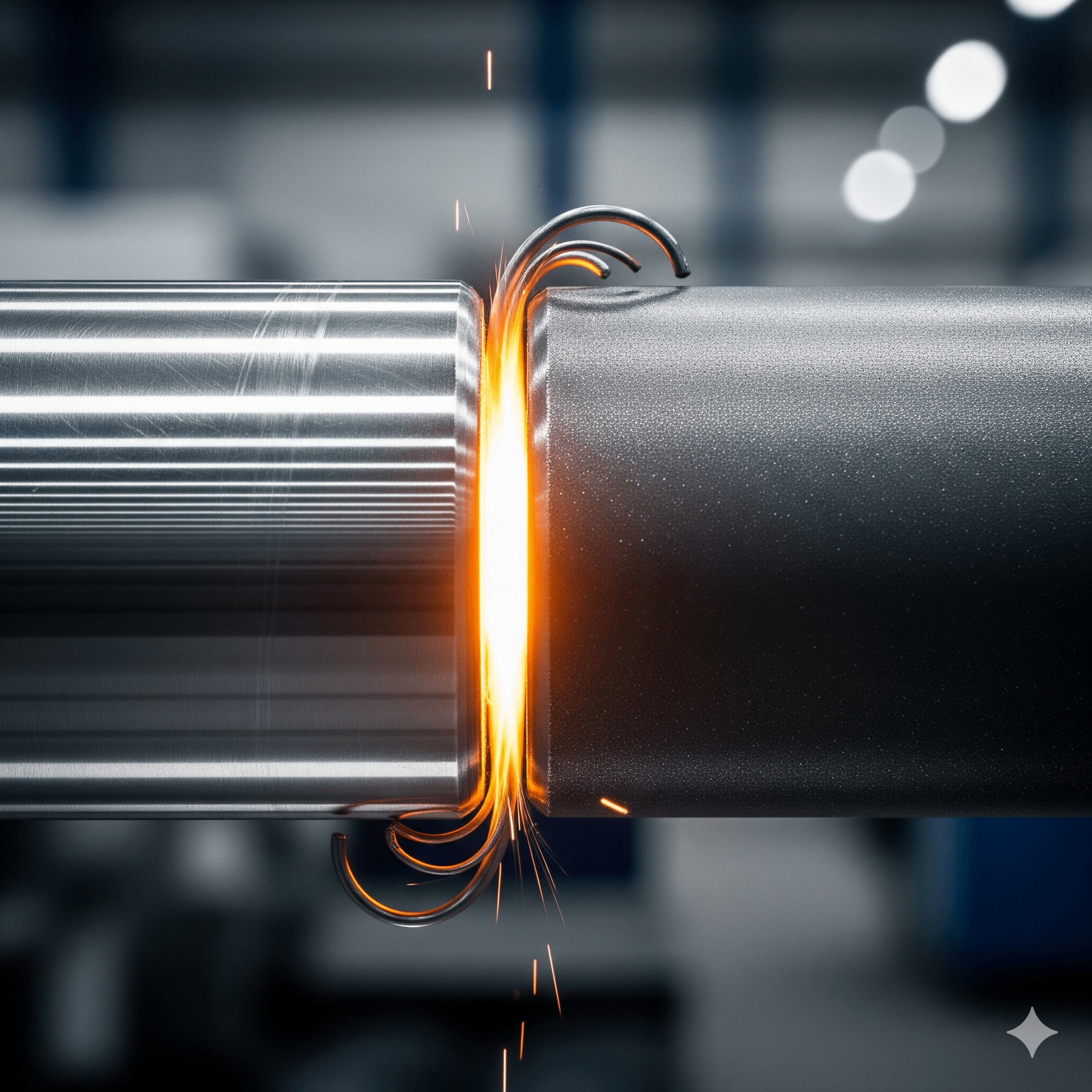
If your inquiry involves rotationally symmetric parts—such as titanium pipe fittings joined to stainless flanges—Rotary Friction Welding is the most commercially viable solution for mass production.
The Engineering Mechanism
This is a solid-state forging process. One component spins at high RPM while the other is pressed against it. Heat is generated solely by friction, plasticizing the metal faces without melting them. Crucially, oxidized material is mechanically expelled as “flash,” leaving a virgin metal bond.
Procurement Impact: Batch Consistency
- Repeatability: Unlike manual welding, this is machine-controlled. The 10,000th part is identical to the 1st, eliminating “Monday Morning” variability.
- Testing Protocol: For large batches, we recommend a Destructive Testing Strategy. If a sample survives a 90-degree bend test without snapping, the batch is validated.
- Geometry Constraint: Strictly for round parts. You cannot friction weld a square block to a plate.
Industrial Process C: Vacuum Brazing (For Precision & Complexity)
For delicate components like aerospace sensors or medical devices, Vacuum Brazing provides a refined solution.
The Engineering Mechanism
This relies on chemical compatibility. Since we cannot weld Ti to SS directly, we introduce an interlayer material—typically Vanadium or a Silver-based alloy. Vanadium acts as a “peacemaker,” possessing good solubility with both Iron and Titanium, blocking brittle phase formation.
Procurement Impact: Cleanliness
- The Hidden Cost of Cleanliness: Success in brazing is 90% preparation. Any oil results in voiding. Your supplier must have ultrasonic cleaning lines and clean-room assembly protocols.
- Batch Efficiency: Furnaces can hold hundreds of parts, making the “per unit” cost surprisingly low for high-volume small parts.
Sourcing Decision Matrix: Which Process Fits Your Project?
For B2B buyers, choosing the right process is about balancing cost, geometry, and volume.
| Feature | Explosion Welding | Friction Welding | Vacuum Brazing | Direct TIG Weld |
|---|---|---|---|---|
| Best For | Heavy Plates / Sheets | Round Bars / Pipes | Complex / Small Parts | Nothing (Avoid) |
| Scalability | Project-Based | High Volume | High Volume | N/A |
| Geometry | Flat Surfaces | Round/Tubular Only | Any Shape | N/A |
| Relative Cost | High (Setup) | Low (Per Unit) | Medium | Low (But Fails) |
| Lead Time | Long (Materials) | Short (Processing) | Medium (Batching) | Short |
Quality Assurance: Validating the “Unseen” Bond
Trusting a supplier’s Certificate of Conformance (CoC) is not enough. Your Quality Agreement should mandate specific validation points.
1. The Color Standard (For Titanium HAZ)
Titanium oxidizes rapidly. The color of the Heat Affected Zone (HAZ) indicates shielding quality:
- Silver/Bright: Perfect shielding. (Accept)
- Blue/Purple: Oxygen contamination. Brittle. (Reject)
- White/Flaky: “Sugaring.” Total failure. (Scrap)
2. Non-Destructive Testing (NDT)
- Ultrasonic Testing (UT): Essential for explosion-bonded plates (per ASME SA-578) to detect delamination.
- Helium Leak Testing: Mandatory for brazed vacuum/pressure components.
Lifecycle Risks: What Happens After Delivery?
Risk A: The Thermal Expansion Trap (CTE)
Stainless Steel expands nearly twice as much as Titanium when heated ($17.3$ vs $8.6 \mu m/m·K$).
- The Failure: The steel side expands, shearing away from the titanium during thermal cycling.
- DFM Advice: Use mechanical expansion loops or bellows to absorb this movement.
Risk B: Galvanic Corrosion (The Battery Effect)
In saltwater, Titanium (Noble) coupled with Stainless Steel (Active) creates a battery, corroding the steel.
- DFM Advice: Apply heavy-duty dielectric epoxy coatings, design with sacrificial anodes, or use mechanical isolation kits (Teflon gaskets) instead of welding.
FAQ: Common Questions on Dissimilar Metal Joining
Q: Can you weld titanium to stainless using a standard MIG welder? A: No. Standard MIG welding will result in immediate cracking due to brittle intermetallic compounds. Do not attempt this for any load-bearing part.
Q: What filler rod is used to weld titanium to stainless steel? A: There is no single filler rod that allows for direct arc welding. Successful joining requires an intermediate insert (like Vanadium) used in a controlled vacuum brazing environment, not a standard filler rod.
Q: Can you weld titanium to stainless for non-structural exhaust tips? A: While some hobbyists attempt this with mechanical crimping or very weak tack welds, it is not recommended for B2B manufacturing. The thermal expansion difference will eventually cause the joint to rattle loose or crack. Mechanical riveting is safer.
Conclusion: A Strategic Sourcing Decision
For the global wholesaler, the question “can you weld titanium to stainless steel” evolves into a broader strategic decision: “Which joining technology offers the stability my supply chain requires?”
- Choose Explosion Welding for heavy structural transitions.
- Choose Friction Welding for mass-produced round parts.
- Choose Vacuum Brazing for complex precision geometries.
At YISHANG, we do not just execute prints; we audit designs for manufacturability. We ensure that the transition from a CAD model to a shipping container is managed with rigorous adherence to metallurgical science.
Do not let a “hybrid” material requirement become a supply chain bottleneck.
Contact YISHANG’s engineering team today. Let us review your drawings, recommend the optimal joining process, and provide a manufacturing plan that prioritizes reliability and cost-effectiveness.