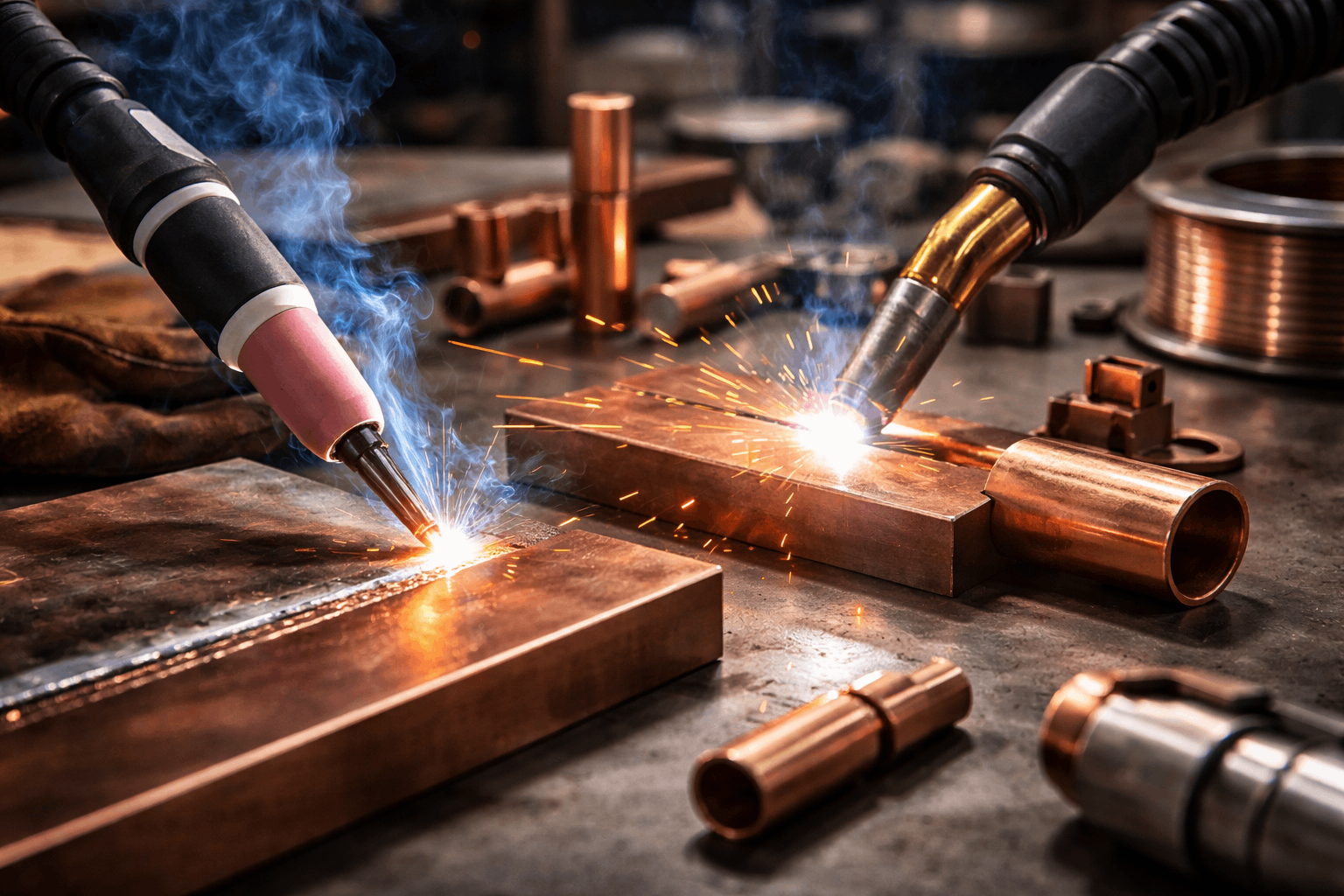
Copper welding is not a casual topic. For overseas OEM and wholesale buyers, it connects directly to real questions:
- Can my supplier weld copper busbars and terminals reliably?
- Can they support TIG and MIG welding copper at scale?
- Will copper to copper welding joints stay electrically stable and leak‑tight over time?
When buyers search
welding copper,
can you weld copper,
can you MIG weld copper, or
can you TIG weld copper, they are usually evaluating process feasibility and supplier capability, not learning a personal hobby. This article is written from that perspective.
It explains how MIG and TIG welding copper work in industrial practice, how these processes compare with brazing and soldering, and which controls matter most for quality, consistency, and total cost. The goal is to give purchasing and engineering teams a practical framework for sourcing welded copper components, not a step‑by‑step school for welders.
Quick Answers: Can You MIG and TIG Weld Copper?
Before looking at engineering detail, it helps to address the most common search questions directly.
1. Can you weld copper?
Yes. You can weld copper using TIG, MIG, stick, or laser processes, and you can also join it with brazing or soldering. In production environments, TIG and MIG welding copper are the most common fusion processes, supplemented by brazing for tubes and mixed‑metal joints. The challenge is not whether it is possible, but whether it can be done repeatably with controlled heat, surface preparation, and filler selection.
2. Can you MIG weld copper? Can you weld copper with a MIG welder?
Yes, you can MIG weld copper and copper alloys. MIG welding copper is best suited to thicker sections, busbars, and structural copper where deposition rate and productivity are important. In many factories, MIG is also used for silicon bronze MIG brazing of copper, where the base metal is not fully melted but bonded with a lower‑temperature filler. This reduces distortion and can be ideal for high‑volume OEM copper fabrication.
3. Can you TIG weld copper? What about TIG welding copper to copper?
Yes. TIG welding copper is widely used for thin to medium‑thickness plate, copper pipe, terminals, and precision joints. TIG copper welds offer excellent control and low spatter, which is valuable in power electronics and energy storage assemblies. When buyers search
tig welding copper,
tig copper, or
tig welding copper to copper, they are usually interested in high‑quality fusion rather than maximum speed.
4. Can you weld copper to copper?
Yes, copper to copper welding is routine in busbars, coils, and copper pipe fabrication. TIG and MIG can both handle copper to copper welding when heat paths, surface cleaning, and shielding gas are properly controlled. For thin copper tubes, brazing is sometimes preferred over full fusion to manage distortion and leakage risk.
These short answers align with what buyers see in high‑ranking technical resources and create a starting point for deeper engineering and sourcing decisions.
Why Welding Copper Matters for Modern Electrical and Thermal Systems
Copper appears throughout modern electrical and thermal hardware: busbars, inverter terminals, battery tabs, heat spreaders, cooling plates, HVAC coils, grounding straps, and heat exchangers. In these applications, joining copper reliably is central to performance.
For high‑current components, copper joints must maintain
low resistance and avoid localized heating. For fluid‑carrying assemblies such as HVAC coils or cooling plates, seams must be
leak‑tight. In both cases, copper welding or brazing directly influences durability, efficiency, and safety.
Copper’s material properties explain both its value and the welding challenge:
- Thermal conductivity is roughly 400 W/m·K, much higher than carbon steel.
- Electrical conductivity is often above 100% IACS for high‑purity grades.
These values are excellent for service performance, but they create a key difficulty: heat leaves the weld zone quickly. As a result, fusion is harder to maintain, preheat becomes more important on thick parts, and the weld pool responds rapidly to small changes in heat input.
For OEM and wholesale buyers, this means that welding copper is not just another process on the factory list. It is a capability that affects yield, rework rate, and warranty exposure in every project where copper plays a critical role.
Core Engineering Principles Behind Welding Copper
In many online discussions, welding copper is described simply as “needing more heat.” That is technically true but incomplete. In industrial practice, three engineering principles define whether welding copper is predictable and scalable.
1. Heat Path Management
Copper behaves as a heat sink. When an arc is applied, heat rapidly flows away from the weld pool into the surrounding mass. If this heat path is not managed, the weld pool will:
- struggle to reach fusion temperature,
- solidify too quickly, or
- require excessive current that causes oxidation and distortion.
Factories manage heat paths by:
- preheating copper sections (often 150–300°C for thicker parts),
- using helium‑enriched shielding gases for deeper penetration where justified,
- designing joints that avoid unnecessary heat sinks,
- using backing bars and fixtures to stabilize part geometry.
For buyers, consistent language around heat input, preheat, and gas selection is a clue that a supplier is managing copper welding as an engineered process, not by feel.
2. Fusion Window Control
Copper’s fusion window—the narrow temperature band where the metal is molten enough to wet and fuse, but not overheated—requires tighter control than steel. Surface oxides and contamination reduce wetting and promote lack of fusion.
When OEM buyers compare TIG and MIG welding copper, they often care about two things:
- whether the weld will fuse completely without internal defects,
- whether the joint will maintain low resistance and stable behavior under load.
Suppliers who specify cleaning methods, interpass temperature controls, and inspection steps are applying fusion window control rather than relying on visual appearance alone.
3. Material and State Effects
Different copper grades behave differently in the weld zone:
- OFHC copper (oxygen‑free) has excellent conductivity but is more sensitive to hydrogen porosity.
- ETP copper (electrolytic tough pitch) contains controlled oxygen, affecting filler and gas choices.
- Brass and bronze introduce zinc or tin, changing melting and fume characteristics.
- Copper‑nickel alloys bring additional corrosion resistance but have their own welding windows.
The delivered state—annealed or work‑hardened—also affects distortion and stress response. Buyers who specify “copper” without grade or temper leave this variable ambiguous. A supplier who asks for clarification on copper grade and state is protecting both process stability and your end‑use performance.
Welding vs Brazing vs Soldering Copper in Production
Many high‑ranking articles compare welding, brazing, and soldering copper because this reflects real decision points. For OEM buyers, the choice is usually driven by:
- joint temperature in service,
- mechanical load,
- electrical requirements,
- leak‑tightness needs.
Fusion welding copper (TIG, MIG, laser) melts the base metal to form a metallurgical bond. It is favored for structural joints, high‑current busbars, and parts with demanding thermal cycling.
Brazing copper, including silver brazing and silicon bronze MIG brazing, joins copper with a filler that melts below the base metal’s melting point. It is common in HVAC coils, copper pipe systems, and some copper‑to‑steel joints. Brazing offers good leak resistance and can control distortion effectively.
Soldering copper is usually limited to low‑temperature, low‑load electrical connections such as PCB work and small wiring—less relevant for heavy copper fabrication.
For industrial copper assemblies, the main comparison is between welding copper for strength and brazing copper for leak integrity and dimensional control. A competent supplier will recommend welding, brazing, or a combination based on your component’s operating conditions.
Process Selection for Industrial Copper Welding
With the principles and joining modes in place, the next question is: which process fits your specific application? Here is how TIG, MIG, stick, brazing, and laser typically apply in copper welding for OEMs.
TIG Welding Copper
TIG welding copper is commonly used for:
- thin plates and small busbars,
- copper terminals and lugs,
- TIG weld copper pipe in HVAC and refrigeration,
- precision copper to copper welding in power electronics.
Beyond positional accuracy, TIG provides operators with fine control over heat input and filler addition, resulting in visually clean beads that suit exposed or electrically sensitive joints. For thin copper, pure argon can be sufficient; for thicker copper, helium‑argon mixes help maintain a stable weld pool. Buyers who emphasize aesthetic appearance and electrical performance often favor TIG copper in their specifications.
MIG Welding Copper
MIG welding copper is a better fit when:
- section thickness is from about 3–10 mm,
- production volume is high,
- automation or fixtures are planned,
- appearance is important but not the primary constraint.
For buyers searching
can you MIG weld copper or
can you weld copper with a MIG welder, the answer is yes—but with the condition that copper’s high conductivity is considered in power, gas, and preheat decisions. Suppliers may also use MIG for copper brazing with silicon bronze filler, particularly in mixed‑metal structures.
Stick Welding and Brazing
Stick welding is occasionally used for repair and site work on copper, but rarely for high‑volume fabricated components. Brazing and silver brazing are more common in HVAC coils, copper manifold assemblies, and some copper‑to‑steel joints where leak integrity is critical.
Laser Welding
Laser is gaining ground for:
- battery tabs and busbar connections in EV packs,
- sensor and instrumentation connectors,
- compact copper assemblies in power electronics.
These advantages make laser welding a strong choice for automated production lines and for assemblies where minimal distortion and tight dimensional tolerances are critical.
Process Summary for Buyers
| Process |
Thickness (approx.) |
Precision |
Automation Fit |
Typical Use |
| TIG |
<3 mm |
High |
Medium |
Tabs, terminals, visible joints, copper pipe |
| MIG |
3–10 mm |
Medium |
High |
Busbars, frames, cabinets, OEM copper assemblies |
| Stick |
>4 mm (repair) |
Low–Medium |
Low |
On‑site repair and maintenance |
| Brazing |
Tubes/dissimilar |
Medium |
Medium |
HVAC coils, copper tubes, mixed joints |
| Laser |
<1.5 mm |
Very High |
High |
Battery tabs, compact electronics |
This table reflects the pattern seen across many top “how to weld copper” guides, but interpreted from a sourcing point of view instead of a hobbyist point of view.
High‑Level TIG and MIG Workflows for Copper (Buyer‑Friendly View)
Top search results often provide step lists for TIG and MIG welding copper. For OEM and wholesale buyers, the exact hand motions matter less than knowing that the supplier follows a consistent workflow.
TIG Welding Copper: High‑Level Workflow
A typical industrial TIG copper procedure includes:
- Surface preparation — remove oxides and contamination using abrasion and solvent.
- Joint fit‑up — maintain consistent gaps to stabilize arc and fusion.
- Preheat (if required) — apply controlled preheat on thicker or high‑mass parts.
- Shielding gas setup — select argon or argon‑helium mix and set flow based on torch and joint type.
- Welding execution — control travel speed, arc length, and filler addition to maintain a stable weld pool.
This is not a DIY checklist but a signal that the supplier has a defined process rather than improvisation.
MIG Welding Copper: High‑Level Workflow
For MIG welding copper and MIG brazing copper, a structured procedure usually includes:
- Surface cleaning — wire brushing or grinding to remove oxides.
- Parameter selection — setting current, voltage, and wire feed for thickness and joint design.
- Shielding gas selection — choosing argon/helium mixes when deeper fusion is required.
- Wire choice — selecting pure copper or silicon bronze wire based on fusion vs brazing needs.
- Welding and inspection — maintaining consistent gun angle and travel, followed by visual and, where appropriate, leak or electrical testing.
If a supplier can describe their TIG and MIG welding copper workflow at this level, it is a strong indicator that they are aligned with best practices seen in leading technical content online and are capable of scaling production.
Safety and Setup Considerations When Welding Copper
Top technical resources also emphasize basic safety and setup choices. While OEM buyers are not the ones holding the torch, awareness of these factors helps in evaluating supplier competence.
Key considerations include:
- Ventilation and fume control — especially when copper alloys contain zinc or other elements that can generate harmful fumes.
- Polarity and current type — DCEN (direct current electrode‑negative) is typical for most TIG and MIG welding on copper; specialized procedures may differ for certain alloys.
- Tooling and contact tips — appropriate contact tips, nozzles, and cable ratings are needed for sustained high current on copper.
- Heat input limits — avoiding overheating of adjacent components such as seals, insulation, or electronic parts.
Suppliers who mention safety and setup in their procedures are generally working closer to the standards seen in high‑quality welding guides and manufacturer recommendations.
Operational Controls That Affect Quality, Yield, and Warranty Risk
Beyond the overall workflow, certain control points have outsized impact on quality and yield. High‑ranking technical articles frequently emphasize these factors, and they are equally important in a sourcing context.
Surface Preparation and Oxide Control
Copper oxide and surface contamination inhibit wetting and fusion. For high‑current joints or critical fluid paths, this can translate into hotspots or leaks.
Effective suppliers will:
- define specific cleaning tools and chemicals,
- avoid cross‑contamination with steel brushes,
- inspect surfaces before welding or brazing,
- control time between cleaning and welding to limit re‑oxidation.
Shielding Gas Selection
Shielding gas composition influences:
- depth of penetration,
- weld pool stability,
- porosity formation,
- operating cost.
For TIG and MIG welding copper, helium‑argon mixes are often used when additional heat is needed, while pure argon can be sufficient on thin sections. A supplier using a one‑gas‑fits‑all approach for thick and thin copper may be prioritizing simplicity over optimal quality.
Preheat and Interpass Control
Preheat reduces thermal gradients and stabilizes the weld pool on thick or heavy sections. Interpass temperature control prevents excessive heat buildup that could distort parts or damage coatings.
Well‑run operations define preheat thresholds (for example, copper thicker than a certain value) and use appropriate measurement tools instead of guessing by touch.
Filler Metal Selection
Filler choices—pure copper, silicon bronze, or silver‑based alloys—affect electrical behavior, mechanical properties, and crack resistance.
For buyers, it is reasonable to ask suppliers which filler they intend to use on:
- high‑current busbars,
- pressure‑bearing copper tubes,
- copper to steel joints,
- thin copper tabs in energy storage systems.
A clear answer anchored in joint function, not simply stock availability, is another maturity signal.
Failure Modes That Matter to Procurement
Copper weld failures are not random events; they follow identifiable patterns. Understanding the basic failure modes helps buyers ask focused questions during supplier evaluation and first article inspection.
Lack of Fusion
Lack of fusion happens when the weld pool does not properly bond with the base metal. In copper, this often results from inadequate heat input at the joint interface or poor fit‑up. The consequence is higher resistance, local heating, and potential mechanical failure.
Porosity
Porosity consists of trapped gas pockets in the solidified weld. It is commonly linked to surface moisture, contamination, or poor shielding. In brazed or welded copper pipes and coils, porosity can become a leak path. In electrical joints, it can reduce effective cross‑section and serve as a crack initiator.
Cracking
Cracking stems from thermal stress, restraint, or incompatible filler/base combinations. In high‑vibration machinery or assemblies subjected to repeated thermal cycles, cracks can propagate and cause unexpected failures.
When discussing copper to copper welding with potential suppliers, buyers can ask how these failure modes are detected and mitigated. Specific controls and test methods (such as leak testing, electrical resistance checks, or non‑destructive testing for critical joints) show process maturity.
Industries Where Copper Welding Influences Sourcing Decisions
Copper welding has direct impact in several sectors where OEM and wholesale buyers are active:
- Energy storage and EV — copper busbars, battery tabs, cooling plates, junction boxes.
- Power distribution and switchgear — terminals, bus links, grounding systems.
- HVAC and refrigeration — copper tubes, manifolds, coil assemblies.
- Industrial machinery — high‑current connectors, heat spreaders, thermal plates.
- Electronics and instrumentation — sensor housings, shielding enclosures, precision copper parts.
In all these applications, welding copper is linked to system reliability and energy efficiency. The better controlled the copper welding process, the lower the risk of heat‑related failures, leaks, and unplanned downtime.
How OEM and Wholesale Buyers Can Evaluate a Supplier’s Copper Welding Capability
Professional buyers do not need to know amperage charts or torch angles. Instead, you can focus on a few targeted questions that reflect the best practices seen across high‑ranking technical resources.
Questions such as:
- Which processes do you use for different copper thickness ranges, and why?
- How do you handle preheat and shielding gas selection when MIG welding copper busbars?
- What is your standard approach to surface preparation and oxide removal?
- When do you choose welding copper versus brazing copper in your designs?
- Which fillers do you use for copper to copper welding and copper to steel joints?
- What inspection steps do you apply for porosity, leakage, and electrical resistance?
Clear, specific answers to these questions indicate that copper welding is supported by defined procedures and quality controls. Vague or generic answers suggest higher risk when projects move from sample to series production.
A concise sourcing takeaway is:
Copper welding capability is not just another line on a capability list; it is a leverage point for lower lifecycle cost, fewer field issues, and more stable supply.
FAQ: Detailed Answers to Common Copper Welding Questions
Adding a concise FAQ section helps address common search queries directly and supports buyers who are scanning for specific answers.
Can you MIG weld copper?
Yes. MIG welding copper works well on thicker sections, typically 3–10 mm, especially for busbars and structural components. It requires appropriate power settings, correct wire selection, and often helium‑argon shielding gas mixes for stable fusion.
Can you TIG weld copper?
Yes. TIG welding copper is often the preferred method for thinner sections, precision joints, and TIG weld copper pipe in HVAC systems. It provides excellent control and is suitable for high‑reliability copper to copper welding in power electronics and energy storage.
Can you weld copper to copper?
Yes. Copper to copper welding is common in power distribution, coils, and copper assemblies. The key is to manage heat flow, surface cleaning, and shielding gas so that fusion is complete and joints remain electrically and mechanically stable.
Can you weld copper with a MIG welder?
Yes, you can weld copper with a MIG welder if parameters are adjusted for copper’s high thermal conductivity. Many industrial operations use MIG welding copper or MIG brazing copper for busbars and heavy copper parts.
Is TIG or MIG better for welding copper?
For thin, precision, or highly visible copper joints, TIG is usually preferred. For thicker sections and higher production volumes, MIG often offers better productivity. In many projects, both processes are used in different areas of the same assembly.
Conclusion and Inquiry
You can MIG weld copper, you can TIG weld copper, and you can weld copper to copper using several processes. The critical difference lies not in the word “can,” but in how controlled, repeatable, and application‑appropriate those processes are.
For OEM and wholesale buyers, understanding the basics of heat path management, fusion control, and process selection makes it easier to choose suppliers, specify requirements, and interpret technical proposals.
If your next project involves welded copper components—busbars, terminals, cooling plates, copper pipes, or custom copper welded assemblies—
YISHANG can support engineering review, sampling, and volume production. You are welcome to send drawings or RFQs for evaluation, and our team will respond with technical suggestions and quotations aligned to your requirements.