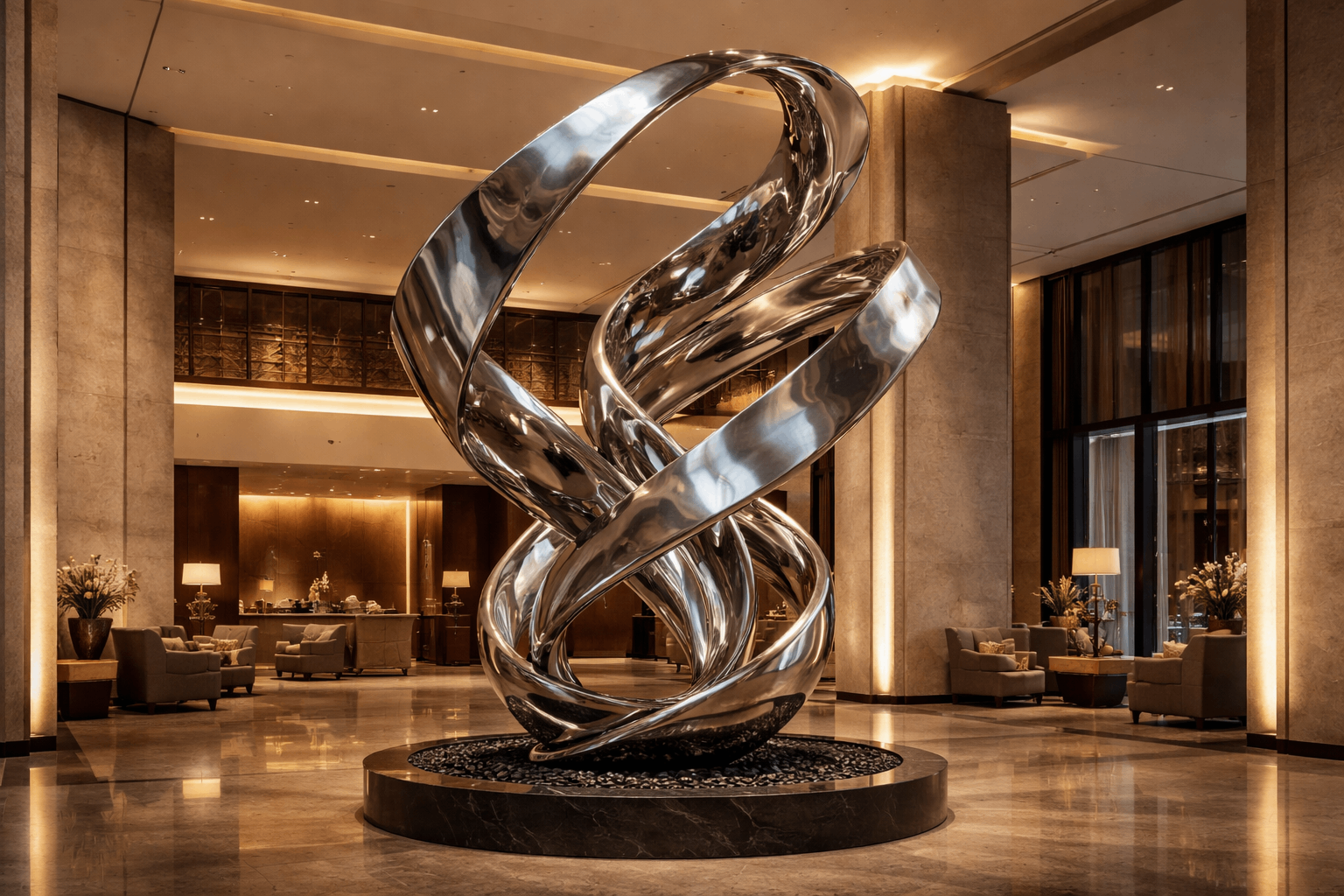
Metal artwork has moved beyond lifestyle décor and into commercial and architectural environments. For overseas wholesale buyers, metal art is now a viable product category that sits next to architectural metalwork, fixtures, and outdoor structures. When these buyers explore supplier content, they are not looking for hobby projects or DIY metal art tutorials. They want to assess whether a creative idea can become a repeatable SKU that meets industry expectations for durability, documentation, compliance, and logistics.
This guide is written for procurement teams, importers, brand owners, and distributors involved in commercial projects. It focuses on metal artwork ideas that can be manufactured at scale, shipped internationally, and integrated into real-world applications. Along the way, relevant search phrases such as metal art ideas, metal artwork ideas, simple metal art ideas, and even consumer-origin terms like diy metal art or how to make metal art are addressed in a B2B context—showing how inspiration can evolve into wholesale-ready products.
In this guide, you will learn:
- how overseas wholesale buyers evaluate metal art content and validate suppliers
- how to turn diy metal art inspiration into scalable OEM/ODM products
- how to match materials and finishes with different installation environments
- how to control technical, logistical, and warranty risk in metal art procurement
- how to brief factories clearly so concepts become repeatable SKUs
YISHANG appears only where it clarifies the role of a manufacturing partner. The focus remains on providing actionable insight that shortens the buyer learning curve and improves RFQ quality.
How Overseas Wholesale Buyers Read Metal Art Content
Experienced B2B buyers consume supplier blogs differently from end consumers. They work with deadlines, budgets, stakeholders, and performance obligations. When they land on a page about metal artwork ideas, they quickly scan to determine if it discusses manufacturability, materials, standards, logistics, and risk—not just design inspiration.
Topics like “how to make metal artwork” from a hobby perspective are less relevant than guidance on structuring OEM projects, aligning drawings, or choosing metals for different climates. If the page reads like a lifestyle magazine, most buyers close it quickly.
Next, they look for concrete signals of experience—mentioning alloys (304/316/5052), coating systems, ASTM or EN standards, minimum bend radii, environmental categories, or container loading strategies. This type of language feels familiar to buyers who already handle metal cabinets, racks, facades, or fixtures.
Finally, they assess whether the page helps them answer real organizational questions: “Can this become a product line?”, “Can it be repeated across multiple projects?”, “What would warranty and logistics look like?”, and “Where does this fit in our portfolio?”. If a blog about metal art crafts cannot support those decisions, it feels like marketing rather than guidance.
What Overseas Wholesale Buyers Need to Validate
Behind most B2B search queries—whether metal art ideas for hotels, metal wall art wholesale, or custom metal artwork manufacturer—there is a validation process. Buyers must confirm that a design is manufacturable, environmentally appropriate, compliant, and logistically feasible.
Manufacturability and Repeatability
A design is only useful to a wholesaler if it can be manufactured reliably, batch after batch. Buyers look for evidence that the supplier can execute laser cutting, CNC bending, welding, grinding, and coating with consistent results. Terms like tolerance, Ra value, coating thickness, and QC checkpoints are not decorative jargon—they are evidence that the supplier understands repeatability.
For example, an architectural metal art screen must maintain consistent dimensions so that multiple panels align on site. If the supplier cannot hold tolerances within a few millimetres, installation time and claim risk increase. Article content that addresses these realities is more valuable than broad statements about creativity.
Environmental Suitability
Wholesale buyers sell into diverse environments: dry inland cities, humid tropical climates, seaside resorts, and industrial districts. An outdoor sculpture in Dubai, with high UV and temperature swings, differs significantly from a boardwalk installation in Northern Europe. The same simple metal art ideas cannot be applied blindly to both.
Buyers therefore look for guidance on pairing metals and finishes with environments. Stainless 316L may suit coastal sculptures, while coated aluminum may balance weight and corrosion resistance for hotel facades. Clear links between environment and specification help avoid warranty issues.
Compliance, Testing, and Documentation
Commercial projects often involve hospitality groups, municipalities, or developers who require documented performance. Buyers are wary of vague claims like “rust-proof” without test references. When suppliers reference ASTM B117 salt spray or AAMA 2604/2605 coating guidelines, the conversation becomes evidence-based.
Documentation—including coating datasheets, material certificates, and basic test summaries—protects both buyer and end client. Articles that explain compliance simply provide better support for sourcing and tender work.
Freight, Packaging, and Claims Management
Metal art products may be structurally strong but surface-sensitive. Scratches, dents, and coating abrasion occur during handling and freight. Buyers have learned that packing engineering matters as much as welding.
Content discussing KD (knock-down) construction, nesting strategies, palletization, or crate design resonates strongly with wholesale buyers. When they see that a supplier considers CBM, weight distribution, and ISTA-style testing, they trust that large metal artwork ideas can survive ocean freight.
Why Metal Artwork Works in Commercial Projects
Once buyers are confident in manufacturing and logistics, they still need to evaluate whether metal artwork will sell in their markets. This decision blends design trends with lifecycle economics.
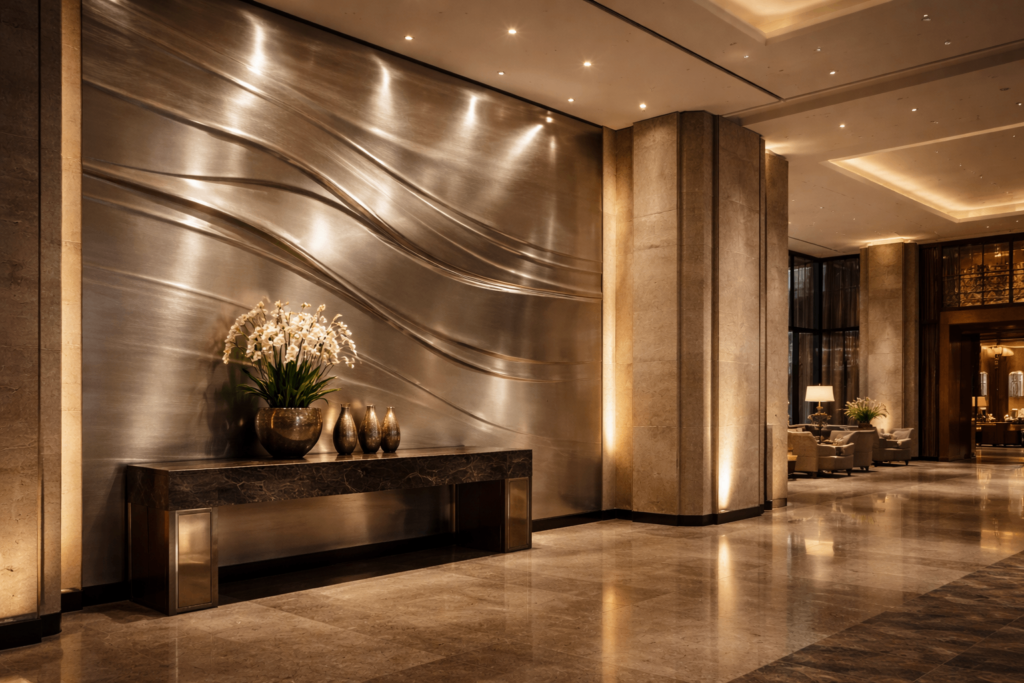
Lifecycle Economics and Total Cost of Ownership
Metals such as stainless steel, aluminum, and weathering steel often outlast painted wood or composites. In hospitality and commercial real estate, spaces are typically refurbished every eight to fifteen years. Asset owners may not want to repaint or replace external art pieces mid-cycle.
A simplified comparison helps frame lifecycle discussions:
| Material | Typical Service Life | Outdoor Suitability | Notes |
|---|---|---|---|
| Stainless 316L | 20–30 years | Excellent | Chloride-resistant; coastal projects |
| Stainless 304 | 15–25 years | Good | Semi-outdoor and indoor applications |
| Aluminum 6061/5052 | 10–20 years | Good | Lightweight; anodizing or powder coat advised |
| Weathering Steel | 15–25 years | Excellent | Stable patina in dry climates |
| Mild Steel + Powder Coat | 7–12 years | Moderate | Performance tied to coating quality |
This information allows buyers to discuss total cost of ownership with end clients. A higher upfront cost for stainless may avoid multiple repaint cycles, reduce maintenance labour, and minimize guest disruption. For distributors, this means fewer disputes and longer product relevance.
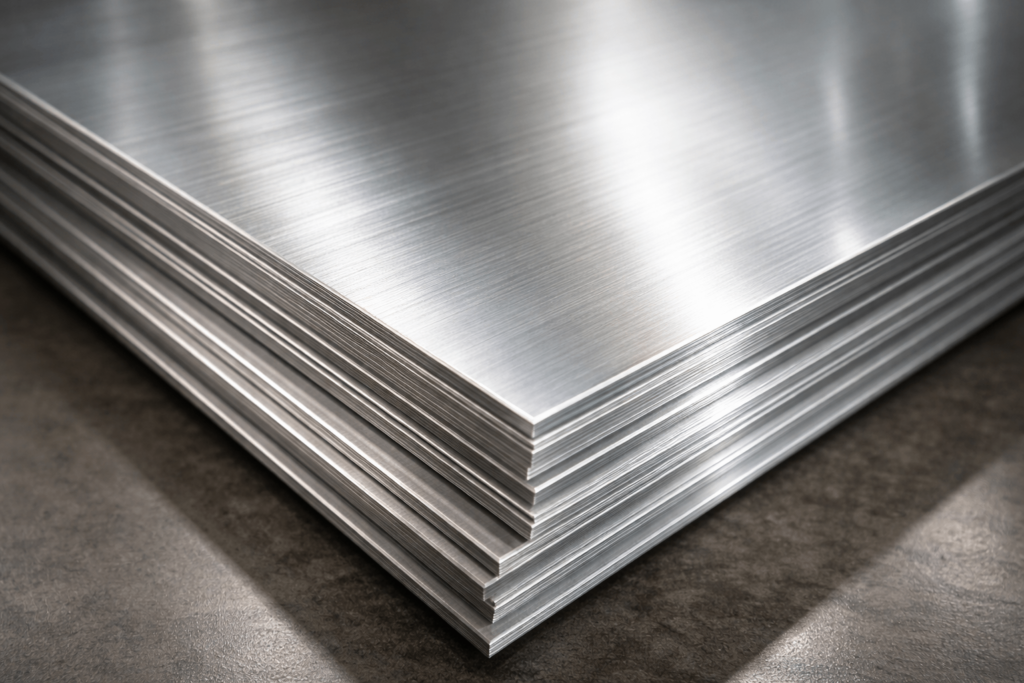
Material Authenticity and Brand Identity
Commercial design trends favour real materials—stone, concrete, stainless, brass—over printed imitations. Brushed stainless, blackened steel, oxidized copper, and patinated brass communicate authenticity and age gracefully.
For wholesale buyers, authenticity matters because genuine materials hold relevance longer. A series of metal wall panels or lobby sculptures can be sold across multiple regions for years with only finish adjustments. That makes metal artwork ideas suitable for medium-term product strategies rather than seasonal décor.
How to Turn DIY Metal Art Ideas into Wholesale-Ready Products
Many buyers encounter diy metal art, metal art crafts, or how to make metal art tutorials while researching aesthetics. These resources are useful for visual inspiration, but wholesale success requires additional steps. The core challenge is not welding skill but transforming creative concepts into controlled specifications.
A practical way to think about this transformation:
- Define use case and environment — e.g., indoor wall decor, hotel lobby feature, garden screen, or outdoor sculpture.
- Select appropriate metals and finishes — adjust alloys, thicknesses, and coatings to move from one-off pieces to durable products.
- Standardize modules and sizes — convert unique pieces into families of SKUs that can be stocked and reordered.
- Document tolerances and QC points — specify flatness, edge quality, Ra, gloss, and coating performance.
- Engineer packaging and freight — reconfigure large artwork into KD or modular formats to control CBM and damage risk.
In short, the real answer to how to make metal artwork for commercial use is specification management and collaboration with capable OEM/ODM manufacturers.
Turning Design Concepts into Manufacturable SKUs
Many buyers receive mood boards or reference images from designers. Their task is to convert visuals into products that a factory such as YISHANG can manufacture consistently. Understanding how that conversion works reduces project risk and makes RFQs clearer.
Material Selection by Environment
Material choice should be driven first by installation environment, then by aesthetics. A helpful mapping is:
| Environment | Recommended Metals | Rationale |
|---|---|---|
| Indoor | Stainless 304 / Aluminum / Brass | Controlled humidity; wide finish options |
| Semi-Outdoor | Stainless 304 / Coated Aluminum | Balanced performance vs. cost |
| Outdoor | Stainless 316 / Weathering Steel / Coated Aluminum | Corrosion and patina management |
| Coastal | Stainless 316L / Marine Aluminum | Chloride resistance is essential |
This framework aligns with queries such as how to make metal art for outdoor use but expands them into industrial strategy. It also gives buyers a justification model for client discussions and tender notes.
Fabrication Methods and Tolerance Control
Metal artwork uses production methods similar to cabinets, enclosures, and fixtures: laser cutting, CNC bending, TIG/MIG welding, grinding, and powder coating. From a purchasing perspective, the key issue is not machine brand, but control.
Useful questions include:
- What are the minimum bend radii and maximum panel sizes?
- How flat can large laser-cut sheets remain after cutting and coating?
- What Ra and gloss values can be achieved and verified?
- What weld appearance standards apply to visible seams?
- How are critical dimensions measured during QC?
Factories that can answer these questions demonstrate not only how to make metal artwork but how to maintain consistency batch after batch.
Structural and Installation Considerations
Large architectural pieces require internal frames, gussets, and anchoring details. Installers often request shop drawings showing lifting points, fixing methods, tolerances, and interfaces with other trades. Buyers working with hotels or mixed-use developments benefit when manufacturers provide these drawings, because it reduces site coordination issues.
Five Product Directions Suitable for OEM/ODM Metal Art
Not every artistic idea is suitable for OEM or ODM. The following directions combine visual impact with manufacturing practicality:
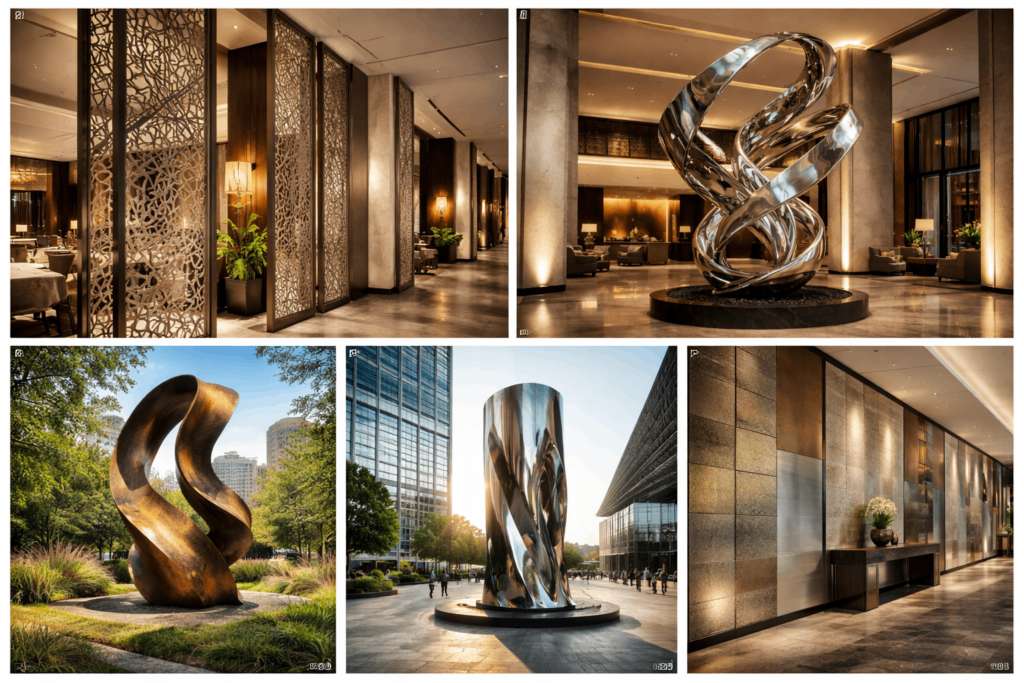
1. Light and Shadow Screens
Laser-cut or perforated screens create dynamic light effects. These products serve corridors, lobby backdrops, garden partitions, and restaurant dividers. Aluminum is often preferred due to its weight and coating efficiency. This category aligns with search intent around architectural metal art panels.
2. Reflective and Brushed Monoliths
Polished stainless and brushed aluminum monoliths act as visual anchors in lobbies and gallery spaces. For OEM buyers, the value lies in defining finish parameters—not just “mirror finish”, but Ra and gloss ranges. Families of heights and footprints can yield coherent SKU lines.
3. Patinated and Weathered Metals
Corten steel, brass, and copper develop patina and are favored in civic and landscape applications. Climate matters: weathering steel performs best in dry cycles, while coastal zones often require 316L or coated systems. Explaining these nuances prevents misapplication.
4. Large-Format Sculptural Volumes
Airports, campuses, and city districts commission large abstract forms as placemaking tools. These pieces require structural engineering and coordinated drawings. Once a structural approach is validated, similar forms can be adapted for multiple clients.
5. Modular Metal Panel Systems
Modular systems turn artwork into components. Instead of single monoliths, buyers develop sets of panels with standardized fixing details. This suits hotel corridors, retail backdrops, and multi-family residences. Distributors gain inventory efficiency and layout flexibility.
Positioning Metal Art by Spatial Function
Wholesalers commonly sell across hospitality, office, residential, and public sectors. Positioning metal artwork by spatial function makes communication simpler.
Visual Anchors
These pieces capture first attention—entrance portals, lobby sculptures, façade features. They support wayfinding and brand expression. When presenting to clients, terms such as commercial metal sculpture supplier help link search behavior with sourcing.
Material Complements
Smaller elements reinforce a material palette: wall inlays, trims, signage surrounds, or wall-mounted panels. They are ideal for SKU development because a single finish family can apply across multiple touchpoints.
Identity Markers
Identity markers express location or culture—university emblems, city maps, or stylized motifs. Content may change, but fabrication systems remain constant. Buyers can standardize plate layering or silhouette systems and localize only the artwork.
Risk and Cost Control in Metal Art Procurement
Even strong metal art ideas can fail commercially if risks are unmanaged. Professional buyers evaluate total landed cost and lifecycle outcomes.
Technical and Specification Risk
Specification gaps create inconsistent interpretations. Buyers can reduce ambiguity by defining:
- Alloy and thickness
- Structural reinforcement method
- Coating system and thickness
- Environmental category (indoor / semi-outdoor / outdoor / coastal)
Clear specifications make pricing comparable and reduce under-engineering.
Logistics and Packaging Risk
Surface-sensitive products require engineered packaging. KD structures, nested components, and modularity reduce CBM. ISTA-style tests, VCI bags, corner protectors, and desiccant packs reduce claims. For high-value projects, custom crates with internal blocking may be warranted.
Warranty and Claim Risk
Coating failure, corrosion, and deformation are expensive. Datasheets, material certificates, and test reports make performance visible. Buyers can integrate documentation into warranty terms and maintenance guides.
Practical Briefing Tips for RFQs and Projects
Good RFQs save time for both buyers and factories. A practical briefing approach:
- Separate design intent from technical execution—mood boards convey effect; drawings convey constraints.
- State fixed vs. flexible parameters—height may be fixed; material may be negotiable.
- Align on approvals—finish samples, scaled mock-ups, or partial prototypes may reduce risk.
This workflow is more valuable to procurement teams than general lifestyle advice on metal art crafts.
Conclusion and Next Steps
Metal artwork sits between design and engineering. For overseas wholesale buyers, the most valuable metal artwork ideas are those that can become repeatable SKUs, supported by documentation and adapted across regions.
By focusing on manufacturability, environment, compliance, logistics, and risk control, buyers can turn creative concepts into sustainable product lines. Product directions such as screens, monoliths, weathered metals, sculptural volumes, and modular panels make discussions concrete.
If you are exploring OEM or ODM metal art for commercial, architectural, or hospitality projects, a technical conversation with a manufacturing partner like YISHANG can clarify materials, structures, and finishes. Well-structured inquiries supported by drawings and context are the first step toward metal artwork that performs in both design reviews and long-term use.