
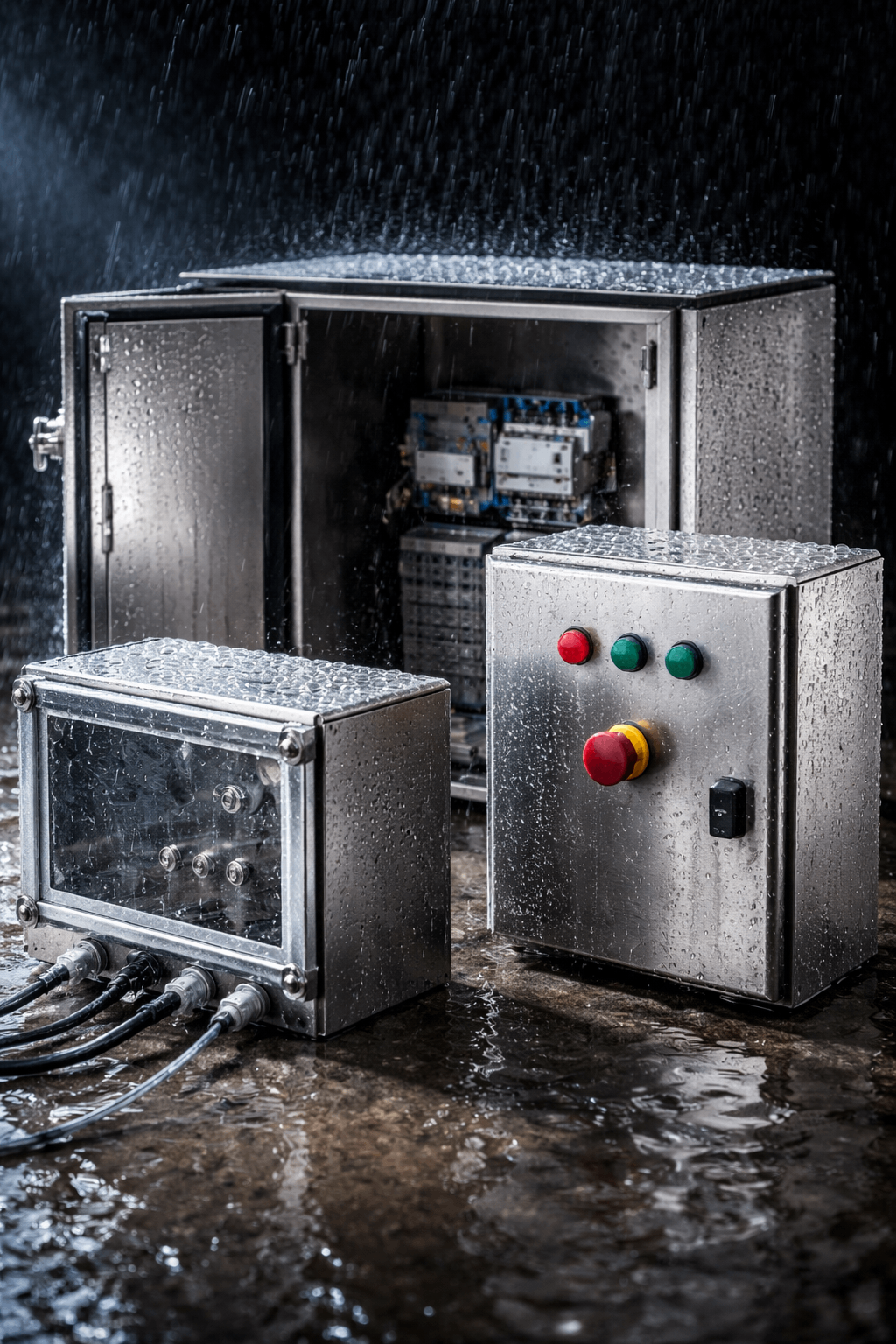
If you buy electrical enclosures in volume, you already know the uncomfortable truth: an “IP-rated” label reduces risk, but it does not eliminate it. When water gets into a control cabinet, junction box, meter box, or telecom enclosure, the cost rarely stays at the component level. It becomes a chain reaction—field troubleshooting, replacement freight, warranty pressure, and customer confidence that is difficult to win back.
This guide compares IP65 vs IP67 enclosure ratings from a wholesale procurement perspective. Instead of repeating textbook definitions, it connects rating differences to water exposure behavior, seal mechanics, manufacturing repeatability, RFQ language, and supplier verification evidence. It also bridges common North American enclosure NEMA language (NEMA 3R, NEMA 4, NEMA 4X, NEMA 6/6P) so cross‑market projects can be specified more accurately.
The goal is simple: help you choose an enclosure rating you can defend in a technical review, a customer audit, and a long service lifecycle — not just on a datasheet.
Quick Procurement Summary — IP65 vs IP67 in One Decision Frame
From a procurement standpoint, the difference between IP65 and IP67 is not about “higher versus lower.” It is about spray exposure versus immersion exposure. IP65 is designed for protection against water jets and rain from all directions. IP67 is designed for protection against temporary water immersion under defined static conditions.
If your enclosure will face rain, splash, and hose spray but will not sit in standing water, IP65 is usually the correct and more thermally forgiving choice. If your enclosure can realistically be surrounded by water — pooling, flooding, or temporary submersion — IP67 is the safer specification.
The most common specification mistake is choosing IP67 “just in case” without immersion risk, and then creating avoidable heat and condensation side effects. The most reliable rule is to match the rating to actual water contact behavior, then verify sealing design and production consistency.
How Wholesale Buyers Search and Read “Enclosure Ratings” Content
Most end users type “is IP67 fully waterproof” and stop there. Wholesale procurement teams search differently because their job is to control downside risk. You’ll see queries like “ip65 vs ip67 enclosure for outdoor cabinet,” “electrical enclosure nema 3r vs nema 4,” “ip67 enclosure 1 meter 30 minutes,” “enclosure rating for water jets,” or “verify IP rating supplier test report.” The intent is not to learn vocabulary—it is to choose the right enclosure rating and avoid avoidable failures.
That search intent creates a predictable reading habit. Buyers skim first, looking for a clear comparison and a usable conclusion. Then they slow down where the content signals expertise: correct standard language, realistic failure modes, and practical supplier questions. If the page reads like a generic marketing article, buyers bounce. If it reads like a buyer-grade guide with manufacturing reality—door enclosure compression, cable gland sealing, tolerance stack-up, and lifecycle degradation—they continue because it supports specification work.
There is also an audit layer to how procurement teams evaluate information. Many buyers must justify enclosure rating choices to OEM customers, utilities, or integrators. They need language that explains what the rating covers, what it does not, and how verification should be documented. Content that supports RFQ writing and audit defense has higher practical value than feature lists.
For that reason, this article follows a single decision path. Each section adds a new layer: exposure model, rating difference, test boundary, seal mechanics, over‑specification risk, NEMA mapping, RFQ logic, and verification evidence — without repeating the same claim in multiple forms.
Why “Correct” IP Ratings Still Fail After Installation
A surprising number of water ingress cases happen in enclosures that were specified responsibly. A buyer selected an IP65 enclosure for outdoor use, or upgraded to IP67 rated enclosures for safety margin. The product passed inspection and looked solid. Months later, moisture appears inside a control cabinet or meter box, and the rating is blamed. In many cases, the rating was not wrong — the exposure model was.
Laboratory IP tests remove variability on purpose. Field installations add it back. Wind‑driven rain hits seams at angles not emphasized in tests. Vibration from nearby machines and equipment gradually changes fastener preload and gasket compression. Large wall mount enclosure panels can distort slightly during mounting, affecting latch engagement. Cable routing can defeat sealing when conduit or cable gland orientation allows water to track inward.
Another frequent issue is configuration mismatch. The enclosure may have been tested with sealed cable entries, but the field build adds extra penetrations or substitute glands. Junction box and surface mount enclosure installations often vary under schedule pressure. Protection from water is therefore a system outcome, not just an enclosure outcome.
Internal condensation is another overlooked failure mode. Even when rain stays out, trapped humidity plus temperature cycling can create condensation inside telecom enclosures, traffic control enclosures, and battery enclosure systems. This explains why some failures occur with no visible external leak path.
For procurement teams, the key lesson is that enclosure rating is a baseline filter. A reliable specification also considers mounting, cable entry, vibration, service frequency, and supplier process control.
The Core Difference Between IP65 and IP67: Water Exposure Behavior
Many comparison pages present IP65 and IP67 as a simple ranking. That framing causes over‑ and under‑specification. The true difference is the type of water exposure each rating is designed to resist.
An IP65 enclosure is built to resist water jets. Under IEC test methods, this corresponds to projected water from a defined nozzle and flow rate applied from multiple directions. In practical terms, this maps to rain, splash, and hose spray conditions typical for many outdoor electrical enclosures, operator stations, and push button enclosure assemblies.
An IP67 enclosure is built to resist temporary immersion. The commonly referenced test shorthand is immersion up to about 1 meter for about 30 minutes in static water. This maps to standing water and short‑term submersion scenarios such as low elevation cabinets or flood‑prone mounting zones.
These exposure patterns stress seals differently. Water jets apply directional impact and try to force entry quickly. Immersion applies steady hydrostatic pressure and allows time for seepage through micro paths. Because the physics differ, optimization differs. Choosing correctly depends on whether your risk is jets from all directions or water surrounding the enclosure.
A useful RFQ phrase is: specify the expected water behavior explicitly — spray, washdown, or immersion — rather than only naming the IP number.
What IEC 60529 IP Tests Cover—and Where Their Boundaries Matter
IP ratings are defined under IEC 60529, which gives procurement teams a shared baseline. But the test methods are controlled and limited by design. Understanding those limits improves specification accuracy.
For IP65, the enclosure is tested for dust tightness and resistance to water jets. Typical IPX5 jet testing references a defined nozzle size and flow (commonly described in industry guides as roughly 6.3 mm nozzle with around 12.5 L/min flow) applied for a defined duration from multiple directions. The goal is repeatable comparison — not simulation of every storm or cleaning process.
For IP67, the enclosure is tested for dust tightness and temporary immersion. The widely cited condition — about 1 meter depth for about 30 minutes — reflects a static, clean water scenario. It does not represent flowing water, pressure washing, or repeated immersion cycles.
Neither rating automatically includes corrosion resistance, UV aging, chemical exposure, or vibration. Material decisions — stainless steel enclosure, galvanized steel enclosure, aluminum enclosure, or coated carbon steel — address different risks. Likewise, IP test outcomes depend on how cable entries were configured during testing, which is why test configuration notes matter in reports.
From a procurement standpoint, IP ratings should be paired with environment notes in the RFQ: washdown yes or no, chemicals yes or no, vibration level, temperature range, and cable entry count. That turns enclosure rating from a marketing label into a controlled requirement.
Where IP66 and IP68 Fit (and Why They’re Often Misused in Specs)
Buyers comparing IP65 vs IP67 often also encounter IP66 and IP68. These ratings are useful, but they are frequently misapplied when the exposure model is not clearly defined.
IP66 is generally associated with more powerful water jets than IP65. It is often relevant for heavy washdown environments. If your specification driver is aggressive hose cleaning rather than immersion, IP66 may be more appropriate than IP67.
IP68 relates to deeper or longer immersion, but unlike IP67, the exact depth and duration are defined by the manufacturer. That means IP68 without test detail is incomplete as a procurement requirement.
Including a short clarification line in your RFQ — for example, “washdown with strong water jets” or “immersion depth and duration to be defined” — prevents misuse of these higher ratings.
Seal Failure Physics: Why Rated Enclosures Can Still Leak Over Time
A metal enclosure resists water because the sealing system maintains compression, not because the wall is thick. Understanding a few seal mechanics helps buyers evaluate design quality.
Gaskets can experience compression set — reduced rebound after long compression and heat exposure. When rebound drops, sealing pressure falls and micro gaps form. Under water jets, those gaps become fast leak paths. Under immersion, they become slow seepage paths.
Capillary action is another mechanism. Very small channels can draw water inward without obvious pressure. In sheet metal designs, slight flatness variation or coating buildup at sealing surfaces can create these channels. A door enclosure can appear fully closed yet have uneven compression.
Manufacturing repeatability controls risk here. Door squareness, flange flatness, hinge alignment, and latch distribution determine compression uniformity. Welding and bending variation can change that geometry. Two suppliers offering the same enclosure rating may not deliver the same field performance.
Cable gland interfaces are often the weakest point. If the gland range does not match cable diameter, or orientation allows water pooling, leakage occurs. For junction box and meter box builds, cable entry design deserves as much attention as the enclosure shell.
When Higher Rating Creates New Risk: The Over‑Specification Trap
Choosing IP67 instead of IP65 can reduce risk where immersion is plausible. But where immersion never happens, higher sealing can create new problems.
Highly sealed enclosures reduce air exchange. Trapped humid air combined with temperature swings creates condensation risk. This is common in outdoor telecom cabinets, EV charger enclosure systems, and control stations. Repeated condensation can damage terminals and electronics even without external leaks.
Thermal buildup is another effect. Electronics in control cabinets and distribution board enclosures generate heat. If immersion‑grade sealing is used where only rain protection is needed, internal temperature may rise unnecessarily and reduce component life.
A more reliable procurement question is not “is IP67 better,” but “does our environment require immersion protection, and how will heat and moisture be managed.” That framing improves both reliability and lifecycle cost.
IP vs NEMA: How Buyers Prevent Cross‑Market Specification Confusion
In North American projects, buyers often specify enclosure NEMA types instead of IP. NEMA 3R, NEMA 4, NEMA 4X, and NEMA 6/6P are common in RFQs. These systems are not identical and should not be treated as direct equivalents.
In procurement practice, NEMA 3R is commonly linked with outdoor rain protection. For washdown or hose‑directed spray conditions, buyers often reference NEMA 4. When corrosion resistance is also required, NEMA 4X is typically specified. Immersion‑type scenarios are generally associated with NEMA 6 and 6P, which imply more robust construction expectations.
IP ratings focus on dust and water ingress test methods. Because scope differs, safe specification requires clarification rather than conversion. When a customer requests a NEMA type, confirm exposure details: rain only, washdown, chemicals, corrosion, or immersion. Then match IP rating plus material and construction features accordingly.
In RFQs, neutral clarification language works best: confirm whether exposure includes water jets, standing water, corrosion risk, or chemical cleaning. This avoids false equivalence and reduces dispute risk.
A Procurement‑Ready Selection Logic You Can Put Into an RFQ
Procurement teams need a decision logic that converts directly into specification language.
If exposure is mainly rain, splash, and hose spray, IP65 is often appropriate. This fits many wall mount enclosure and pole mount enclosure applications. Focus evaluation on seam geometry, gasket compression stability, and cable gland selection.
If exposure includes standing water or temporary flooding, IP67 is appropriate. This fits some pad mount enclosure and low‑elevation installations. Focus on gasket groove design, latch distribution, and sealing stability after repeated access.
Add one exposure sentence to the RFQ: describe spray versus immersion expectation. Also define cable entry count and orientation. This small addition reduces ambiguity and aligns supplier design decisions with real risk.
How Buyers Verify an Enclosure Rating Claim Without Running a Lab
Most buyers cannot perform their own IP tests, but they can verify credibility through documentation and design review.
A credible IP test report should reference IEC 60529 and describe test configuration — door closure, cable entry condition, and accessories installed. Representative configuration matters more than a bare enclosure test.
Design review should check sealing surface continuity, gasket type, and latch distribution. Multi‑point latching often improves compression consistency. Gasket material and temperature suitability should be documented.
Production consistency should also be discussed. Ask how door alignment is checked, how sealing areas are protected during coating, and how packaging prevents distortion during shipping. Batch consistency matters more than one perfect sample.
Evidence pack that works for RFQs and audits
| Evidence item | What it should include | Why it helps procurement |
|---|---|---|
| IP test report | Standard reference, rating, configuration notes, date | Clarifies test scope |
| Critical dimension control | Door and flange geometry checks | Predicts compression consistency |
| Gasket specification | Material and temperature range | Signals seal durability |
| Assembly control | Closure and latch setup method | Reduces variation |
| Packaging method | Door and edge protection | Prevents transport distortion |
IP Ratings Degrade Over Time: Planning for Lifecycle Reality
IP performance reflects test condition at one point in time. Over service life, seals age and hardware changes.
Gaskets harden under heat, UV, and chemicals. Compression changes with thermal cycling. Hinges and latches wear. Repeated service openings introduce dirt and misalignment. These effects reduce sealing margin.
Procurement specifications should consider service frequency and maintenance practice. Designs that maintain repeatable closure perform better where access is frequent.
Corrosion strategy should be specified separately from enclosure rating. Material choice supports lifecycle durability but is not defined by IP digits.
Procurement FAQ — Questions Buyers Commonly Raise
Buyers often ask whether IP65 is enough for outdoor use. The correct answer depends on whether exposure is limited to rain and water jets, or includes standing water and immersion.
Another frequent question is whether IP and NEMA ratings are interchangeable. They are not. They describe different test scopes and construction expectations, so clarification is required.
A third common question is what makes an IP rating claim credible. The answer is test configuration detail plus production consistency — not just a rating label.
Final Decision Guidance for IP65 vs IP67
The most reliable way to decide between IP65 vs IP67 is to match the enclosure rating to water exposure behavior and then verify the supplier’s ability to deliver consistent sealing across production.
Use IP65 when the main risk is rain and water jets. Use IP67 when temporary immersion is plausible. In both cases, treat cable entry, door compression, and manufacturing repeatability as primary risk drivers.
If you are sourcing industrial enclosures and want specification support aligned with procurement needs, YISHANG can provide technical documentation and verification detail for evaluation. A short inquiry with mounting method and exposure scenario is enough to start a focused discussion.