I. The Profit Paradox: Engineering the “Total Landed Cost”
In the strategic arena of B2B automotive procurement, calculating the true value of a custom aluminum toolbox is a complex equation that goes far beyond the FOB price listed on a spreadsheet. For wholesale distributors, fleet managers, and brand owners supplying the demanding mining, construction, and overland sectors, the primary financial metric must be the Total Landed Cost combined with the long-term warranty liability risk.
A common and painful industry scenario involves a distributor switching suppliers to save 10% on the initial unit cost. This decision often seems financially sound in the boardroom. However, the reality shifts drastically six months later. As end-customers navigate the corrugated roads of the Australian outback or the freezing highways of North America, reports of cracked welds, seized locks, and water ingress begin to flood in. The administrative cost of processing a single warranty claim—including reverse logistics, replacement shipping, and intangible brand damage—can easily consume the profit margin of twenty successful sales.
Therefore, sourcing from China must be approached not as a commodity transaction, but as an engineering partnership focused on lifecycle durability and supply chain optimization. This guide provides procurement professionals with the technical foresight to audit China custom aluminum toolbox factory partners effectively. By shifting the focus from “price per kilo” to “engineering integrity,” distributors can secure a product line that builds brand equity rather than eroding it.
If you are ready to stabilize your supply chain with a partner who understands these high stakes, send your inquiry now to YISHANG. We don’t just manufacture boxes; we engineer profit protection.
II. Material Science: The Mathematics of Reliability
Metallurgy is the invisible foundation of quality. For B2B buyers, understanding aluminum alloy selection is essentially a strict risk control measure. In the sample room, a box made of 1060 aluminum looks identical to one made of 5052 aluminum. However, in the field, they perform like completely different materials.
The Hidden Dangers of 3003 H14
While generic 3003 H14 alloy is adequate for static architectural use (like window frames or siding), it poses critical risks in mobile storage solutions due to its lower fatigue limits. Mobile applications induce constant cyclic stress and high-frequency vibration. Under these conditions, the crystalline structure of softer alloys can micro-fracture.
To ensure that the product withstands thousands of kilometers of vibration, specifying 5052 H32 Marine Grade aluminum is the non-negotiable standard at YISHANG. The engineering rationale is precise:
- Magnesium Content: 5052 contains 2.2% – 2.8% magnesium. This alloying element significantly boosts tensile strength and fatigue resistance compared to the 1000 or 3000 series.
- Corrosion Resistance: The magnesium also provides superior resistance to intergranular corrosion, making it essential for coastal environments where salt spray is omnipresent.
This choice effectively purchases insurance against stress fractures at mounting points. It creates a box that is not easy to fail under dynamic loads, protecting your reputation with commercial fleet clients.
The “Thickness Illusion” Trap
Furthermore, the “Thickness Illusion” is a prevalent negotiation trap in the Chinese market. A quote for a “2.5mm checker plate toolbox” is ambiguous. Buyers must ask: “Is that 2.5mm base thickness, or 2.5mm total thickness including the raised tread?”
If the supplier includes the raised tread pattern (typically 0.5mm to 0.8mm high) in that measurement, the base metal thickness may only be roughly 1.8mm to 2.0mm. Such thin panels lack the necessary moment of inertia (stiffness). This leads to the “oil canning” effect, where large flat surfaces buckle and pop under thermal expansion or heavy loads.
A robust specification must explicitly state the base thickness (e.g., “2.5mm base + pattern = 3.0mm total”). This attention to detail ensures the unit does not deform or damage no matter how harsh the environment or how heavy the tools inside are.
Comparative Analysis: YISHANG vs. Generic Market Standard
To help you benchmark your current suppliers, use this reference table.
| Feature | Generic Market Standard | The YISHANG Engineering Standard | Buyer Benefit |
|---|---|---|---|
| Alloy Grade | 1060 or 3003 H14 | 5052 H32 Marine Grade | Prevents vibration cracking and saltwater corrosion. |
| Material Thickness | Nominal (Includes tread height) | Base Thickness Guaranteed | Ensures true structural rigidity and prevents warping. |
| Welding Process | Manual Stitch Welding | Robotic Full Seam Welding | Consistent penetration, no pinholes, superior aesthetics. |
| Pre-treatment | Solvent Wipe Only | Chromate Conversion Coating | Paint will not peel off after stone chips; high UV stability. |
| Lock Material | Zinc Alloy (Rust Prone) | Stainless Steel 304 | Locks remain functional even in coastal humidity. |
| Waterproofing | Flat Lip + Foam Tape | Deep Gutter + EPDM Pinch Weld | Physical water diversion ensures dryness even if seals age. |
III. Strategic Classification: Targeted Engineering Solutions
A “one-size-fits-all” manufacturing approach fails in specialized markets. Different vehicle zones require different engineering defenses. YISHANG categorizes engineering challenges by mounting position to provide targeted solutions that solve specific user pain points.
1. Ute Canopies & Jack-Off Systems
The Challenge: Modern Ute Canopies are no longer just storage; they are structural bases for rooftop tents, spare tires, and ladders. A standard sheet metal box cannot support dynamic roof loads of 300kg+ without crushing or warping the door frames.
The Engineering Solution: YISHANG engineers a dedicated internal skeleton using 6061-T6 aluminum extrusions (typically 40x40mm or 50x50mm RHS profiles). This internal frame acts as a roll cage. It transfers the weight of the roof load directly to the chassis mounts, bypassing the sheet metal skin entirely.
This ensures the canopy bears more weight than standard folded designs. For “Jack-Off” systems, we integrate reinforced floor channels and heavy-duty jacking points. This allows the end-user to transport and carry their work module during the week and lift it off for weekend recreation, offering true versatility.
2. Underbody Toolboxes
The Challenge: Mounted behind or in front of the wheel arches, these boxes face the harshest conditions: constant bombardment by road debris, mud, and salt spray thrown up by the vehicle’s own tires.
The Engineering Solution: The geometry must be defensive. We utilize a slanted (tapered) profile matching the truck’s departure angle to prevent ground impact off-road. Crucially, the door seal is positioned higher than the bottom lip. This “anti-capillary” design prevents water from wicking up into the box when the vehicle is stationary in a puddle. We also recommend a coarse-texture powder coat here to hide stone chips.
3. Cross-Deck / Gullwing Boxes
The Challenge: These boxes often span the full width of the tray, leading to massive lid weight. Accessibility is key, but heavy lids can be dangerous if they fall.
The Engineering Solution: Gullwing doors require precise gas strut calculation based on Newton-meters of force. A strut that is too weak is a safety hazard; a strut that is too strong will bow the lid over time. We also integrate filtered ventilation louvers (dog box vents) to mitigate condensation, protecting expensive electronics or batteries housed inside from moisture buildup.
4. Trailer Tongue / A-Frame Boxes
The Challenge: Fitting maximum storage into a tight triangular footprint on a caravan drawbar without interfering with the handbrake or jockey wheel operation.
The Engineering Solution: We employ trapezoidal designs with recessed backs to clear brake handles. Since these boxes often house heavy lead-acid batteries or LPG bottles, the floor is double-reinforced with a localized sub-frame to handle high point-loads preventing the floor from cracking.
IV. Structural Integrity: Precision Fabrication Protocols
Material quality is irrelevant without precise fabrication. In the world of sheet metal fabrication, the difference between a premium product and a budget one often lies in the invisible details of the bending and welding process.
The Geometry of Bending
High-tensile 5052 aluminum cannot be folded like mild steel. It has a specific grain structure. Forcing a sharp 90-degree bend causes the outer grain structure to stretch beyond its yield point, creating microscopic cracks (stress risers).
YISHANG uses specialized CNC tooling to achieve a calculated bend radius (typically $R \ge 1.5 \times Thickness$). This preserves structural continuity, ensuring the box lasts for a long time without developing cracks along the fold lines after months of vibration.
Internal Stiffeners vs. Skeleton
Beyond the primary skeleton, rigidity for large flat panels (like the lid and floor) is achieved through Omega channel stiffeners. These are hat-shaped profiles welded to the inside of the skin. They serve two purposes:
- Anti-Drumming: They prevent the panels from vibrating and making noise.
- Mounting Ecosystem: They provide a Unistrut-compatible frame allowing end-users to bolt in shelves, electrical panels, or cargo hooks without drilling through the waterproof skin. This transforms the box from a container into a workspace.
Robotic vs. Manual Welding
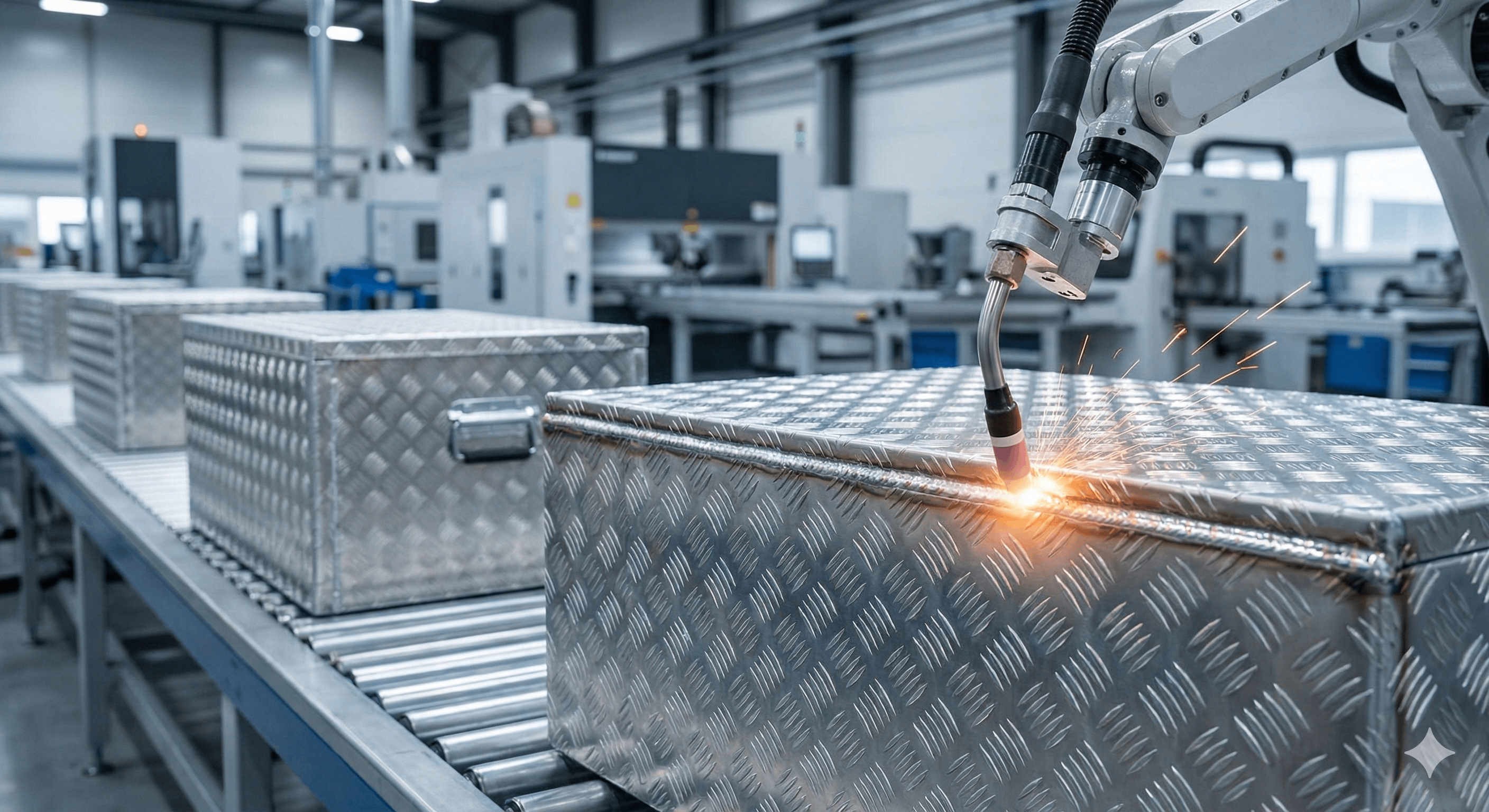
Regarding joining, YISHANG utilizes robotic welding arms for volume consistency. While manual TIG welding is an art form, it introduces human variability. Robots control heat input precisely, minimizing the Heat Affected Zone (HAZ).
Excessive heat in aluminum welding softens the material adjacent to the weld (annealing). By strictly controlling the heat input, we prevent panel warping and ensure every custom aluminum toolbox in a container has identical structural properties. This consistency is vital for wholesalers who need to guarantee product uniformity to their dealers.
V. The Physics of Weatherproofing and Security
For the end-user, a toolbox has two non-negotiable jobs: security and dryness. If tools get wet or stolen, the product has failed. Waterproofing is not achieved by simply “adding more glue” or thicker rubber. It is achieved through fluid dynamics.
The Deep Channel Gutter
We employ a Deep Channel Gutter design. This U-shaped channel acts as a gravity-fed moat around the door opening. When high-pressure water (from highway driving or pressure washers) hits the box, it is captured by the gutter and drained away before it touches the inner seal.
The weather-resistant rubber seal (automotive-grade EPDM pinch weld) sits on the crest of this channel, creating a “labyrinth” barrier. Even if the rubber degrades over years, the physical geometry prevents water ingress. This ensures the box is heavy duty enough for monsoon conditions.
Compression Security Logic
Security follows a similar engineering logic. Traditional butt hinges are vulnerability points that can be pried open. We standardize on continuous stainless steel piano hinges which run the full length of the door, eliminating pry points.
These are combined with Whale Tail compression locks. The compression mechanism is vital: unlike a standard cam lock, a compression lock actively pulls the door in by 3-5mm as it closes. This creates the necessary pressure to engage the seal fully and prevents lid rattle. It ensures the aluminum toolbox with expensive tools remains secure and dry, giving fleet managers peace of mind.
VI. Internal Architecture: Value-Added Systems
To compete with premium local brands in Australia or the US, a toolbox must be a “mobile workspace,” not just an empty shell. Wholesalers can command higher margins by offering “fit-out ready” solutions. YISHANG focuses on internal value-add features that solve end-user problems.
Heavy Duty Drawer Systems
We integrate high-grade drawer systems using heavy-duty ball bearing slides rated for 125kg, 150kg, or even 227kg. Crucially, these must feature a “Lock-in / Lock-out” trigger mechanism. This safety feature is essential for preventing drawers from becoming dangerous projectiles during cornering or slamming shut when the vehicle is parked on an incline.
Electrical Integration Readiness
Modern tradespeople rely on cordless tools, which means they need charging stations. YISHANG designs canopies with “false floor” cavities or integrated wiring channels. These allow for concealed wiring harnesses, separating 12V battery systems from tools and can drastically reduce installation time for the end-user.
By offering a box that is “12V Ready,” you differentiate your product from the generic bare-metal boxes flooding the market.
VII. Surface Engineering: The Chemistry of Adhesion
A durable finish is the first line of defense against corrosion. Powder coated aluminum toolboxes (often in Flat Black or Ripple Black) are increasingly popular. However, aluminum is notoriously difficult to paint due to its smooth surface and rapid oxidation.
A common failure point in cheaper productions is paint delamination—where the powder coat peels off in sheets like a sticker after a stone chip occurs. This is a chemical failure, not a paint failure.
To solve this, YISHANG mandates a rigorous chemical pre-treatment process. Before painting, units undergo:
- Acid Etching: To remove the natural oxide layer.
- Rinse: To remove contaminants.
- Chromate Conversion Coating: This creates a chemical bond between the metal and the powder.
Without this “invisible” step, the coating will fail within a year. Verifying this process via video audit is the only way to guarantee UV stability and ensure the plate the surface is protected for the product’s lifespan. We encourage buyers to ask for a “Cross-Hatch Adhesion Test” report before shipping.
VIII. Logistics Engineering: The “Nesting” Economy
Shipping fully assembled boxes means paying ocean freight to ship “packaged air.” For wholesalers operating on tight margins, shipping container utilization is a critical lever for profitability.
YISHANG employs a rigorous “Nesting Strategy.” We engineer the dimensions of “Small,” “Medium,” and “Large” boxes to fit precisely inside one another. For example, a 900mm box fits inside a 1200mm box, which fits inside a 1500mm box. This “Russian Doll” method increases container density by 30% to 50%.
This allows you to transport and carry significantly more stock per dollar of freight, directly improving your bottom line.
However, nesting requires engineered packaging to prevent internal damage. We use honeycomb cardboard spacers and high-density foam blocks to suspend the inner boxes, ensuring no metal-on-metal contact.
Whether shipping FCL (Full Container Load) or reinforced LCL, our packaging ensures goods arrive in retail-ready condition. We also offer palletization services to ensure that the forklift handling at your warehouse is safe and efficient.
IX. Quality Control: The Buyer’s Audit Checklist
To ensure that every shipment meets the “Gold Standard,” YISHANG implements a multi-stage Quality Control (QC) protocol. As a buyer, you should demand transparency on these steps.
- Material Certification: Before production, we verify the mill certificates to confirm the magnesium content of the 5052 alloy.
- First Article Inspection (FAI): We assemble the first unit and check all dimensions, lock alignment, and gas strut pressure before mass production begins.
- Waterproof Testing: Random samples are subjected to a high-pressure rain booth test to verify the IP rating of the seal and gutter design.
- Salt Spray Testing: Lock assemblies and hinges undergo salt spray testing to ensure corrosion resistance.
- Pre-Shipment Photos: We provide detailed photos of the packaging and loading process so you can see exactly how your goods are secured.
This comprehensive approach ensures that the box is easy to sell and difficult to break.
X. Step-by-Step Customization: From Concept to Container
Understanding the process reduces the perceived risk of custom manufacturing. YISHANG streamlines this for B2B partners.
- Inquiry & Concept: You send your inquiry with a rough sketch, photo, or simply dimensions (L x W x H).
- Engineering & Quote: Our team provides a DFM analysis and an instant quote. We highlight cost-saving adjustments (e.g., changing dimensions slightly to fit container widths).
- CAD & 3D Rendering: We generate professional drawings for your approval, ensuring every fold and hole is accounted for.
- Prototyping: A sample is built to verify fitment and quality. This is shipped to you or inspected via video call.
- Mass Production: Once approved, we launch the robotic welding lines.
- Logistics: We handle the nesting, packaging, and container loading.
XI. Frequently Asked Questions (FAQ) for Wholesalers
Q: What is the MOQ (Minimum Order Quantity) for a custom design? A: We understand the need to test the market. While mass production offers the best pricing, we are flexible with smaller trial runs for new custom designs to help you validate your product line.
Q: Can you match my brand’s specific color? A: Yes, we offer custom powder coating. Simply provide the RAL color code. We can also laser cut your logo into the box structure or add branded stainless steel nameplates.
Q: How do you handle shipping for such bulky items? A: We are experts in logistics density. We recommend the “Nesting Strategy” (placing smaller boxes inside larger ones) to maximize container space. We also provide reinforced crates for LCL shipments to prevent transit damage.
Q: What is the typical lead time? A: For standard designs, production is typically 25-30 days. For new custom tooling, allow an extra 7-10 days for the first prototype.
XII. Conclusion: The Engineering Audit
Moving from a transactional buyer to a strategic partner requires auditing the “invisible specs.” A lower price is irrelevant if the product fails in the field and damages your brand.
By focusing on magnesium content, bend radii, pre-treatment chemistry, and logistics density, distributors insulate their business from risk.
When engaging with a China custom aluminum toolbox factory, challenge the engineering. Ask for gas strut force calculations. Request salt spray test reports. Discuss nesting efficiency.
At YISHANG, we welcome this level of scrutiny. We believe that transparency builds trust. If you have a concept or a drawing, send your inquiry now for a technical DFM (Design for Manufacturing) review.
Or, to benchmark your current supply chain and see how much you could save on landed costs, get instant quote from our engineering team today. Let’s build a product line that defines quality in your market.