Executive Summary: Key Takeaways for Procurement Officers
- Cost Control: Understanding the labor and consumable differences between MIG and TIG processes can impact per-unit production costs by up to 40%.
- Quality Assurance: The stability of the plasma arc and shielding gas directly correlates to the structural integrity and ISO-compliant rejection rates of metal batches.
- Scalability: Advanced inverter-based equipment and robotic compatibility are key indicators of a manufacturer’s ability to handle high-volume orders (10,000+ units).
- Risk Mitigation: Proper management of the Heat Affected Zone (HAZ) prevents field failures (cracking/corrosion) in high-stress environments.
In the complex ecosystem of global supply chains, the structural integrity of a metal product—whether a precision medical chassis, a heavy-duty automotive bracket, or a custom electronic enclosure—relies fundamentally on the molecular bonds holding it together.
For procurement officers and supply chain engineers, the question “how does arc welding work” is not merely an academic inquiry into manufacturing techniques. It is a critical framework for evaluating the reliability, scalability, and cost-efficiency of your production partner. Unlike CNC machining, where tolerances are cut mechanically, welding involves a complex interplay of electrical thermodynamics, plasma physics, and metallurgy.
A minor variance in voltage or a lapse in shielding gas can compromise an entire batch, leading to costly recalls. This guide explores the industrial physics of welding processes, providing the technical insight needed to make informed sourcing decisions that balance unit cost with structural performance.
The Core Definition: What is Arc Welding?
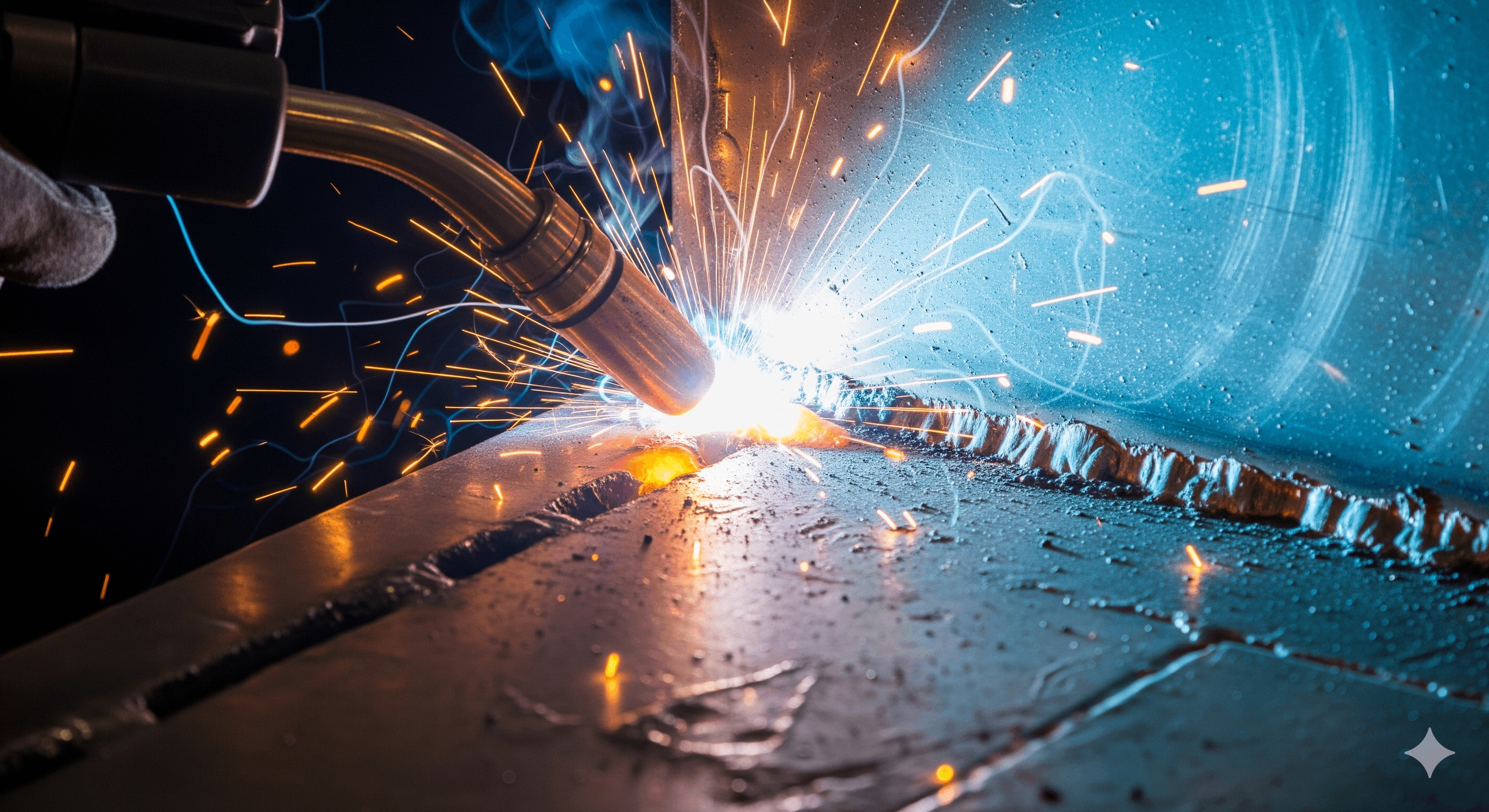
Arc welding is a fusion joining process that uses an electric arc to create intense heat to melt and join metals. A power supply creates an electric arc between a consumable or non-consumable electrode and the base material using either direct (DC) or alternating (AC) currents. This arc generates temperatures exceeding 6,000°F, melting the metal at the joint line to form a cohesive pool that solidifies into a bond often stronger than the parent material.
The Science of Consistency: Understanding the Physics Behind the Arc
At an industrial level, consistency is currency. To achieve repeatable quality across thousands of units, a manufacturer must precisely control the violent forces of the electric arc. The process is fundamentally a challenge of circuit management.
When a power source creates a potential difference between the electrode and the workpiece, it forces electrons to jump across an air gap. This ionization transforms the gas into plasma, a highly conductive state of matter.
For the buyer, the stability of this plasma column is the leading indicator of weld quality. An unstable arc leads to inconsistent heat input, resulting in defects like lack of fusion or burn-through.
The Hidden Variable: Polarity and Heat Distribution
One technical aspect that directly affects production speed and quality is Polarity. Advanced sourcing teams often review Welding Procedure Specifications (WPS), and understanding this variable is key to interpreting supplier capabilities.
The direction of electron flow—Direct Current Electrode Positive (DCEP) or Negative (DCEN)—dictates where the thermal energy is concentrated within the weld zone.
- DCEP (Reverse Polarity): The industry standard for most arc welding processes like MIG. It concentrates approximately 70% of the heat at the electrode tip. This ensures the filler wire melts consistently and penetrates deeply into the base metal, crucial for structural steel applications.
- DCEN (Straight Polarity): Focuses heat on the workpiece. This is critical for specific TIG welding applications or surfacing, where the goal is to melt the base metal without over-melting the electrode.
The Aluminum Challenge: Alternating Current (AC)
A special case arises with Aluminum fabrication, a core capability for industries like automotive and aerospace. Aluminum possesses a refractory oxide layer that melts at 3,700°F, while the pure aluminum beneath melts at only 1,200°F.
To solve this, advanced manufacturers use Alternating Current (AC), which rapidly cycles between positive and negative polarities. The positive cycle provides a “cleaning action” to blast away oxides, while the negative cycle fuses the metal. If your product involves complex aluminum components, ensure your fabrication partner utilizes advanced AC waveform controls to prevent oxide inclusions.
Equipment Evolution: The Role of Inverter Technology
To understand how does a welding machine work in a modern factory, one must look at the evolution from transformers to inverters. Traditional heavy transformers were reliable but crude, often leading to fluctuations in arc stability when facility input power varied.
Leading manufacturers, including YISHANG, have transitioned to Inverter-based power sources. These units rectify and switch current at high frequencies (up to 100 kHz), allowing for micro-second adjustments to the arc characteristics.
Why this matters for procurement:
- Energy Efficiency: Inverters consume less power, indirectly stabilizing overhead costs.
- Pulsed Waveforms: This technology allows for “Pulsed MIG” or “Pulsed TIG,” which minimizes heat input. This is vital for thin-gauge sheet metal (common in server racks) to prevent warping and dimensional distortion.
Process Selection Strategy: Balancing Speed, Cost, and Aesthetics
One of the most common pitfalls in B2B procurement is specifying the wrong welding process for the application. Each method offers a distinct trade-off between cycle time (speed), deposition rate (volume), and aesthetic finish. Understanding these trade-offs is essential for optimizing the Total Cost of Ownership (TCO).
1. Gas Metal Arc Welding (MIG/GMAW): The Volume Leader
Gas Metal Arc Welding, commonly known as MIG, serves as the workhorse for high-volume manufacturing. By utilizing a continuously fed consumable wire, MIG eliminates the inefficiencies of manual rod replacement.
- Best Application: Structural brackets, server cabinets, automotive frames, and volume sheet metal parts.
- Procurement Benefit: High speed equals lower labor costs. It is also the primary candidate for Robotic Automation, which ensures that the 10,000th part is identical to the first.
- Modes of Transfer:
- Short Circuit: For thin sheet metal (prevents burn-through).
- Spray Transfer: For heavy structural components (deep penetration).
2. Gas Tungsten Arc Welding (TIG/GTAW): The Precision Standard
Gas Tungsten Arc Welding (TIG) separates the heat source (tungsten) from the filler material, affording the operator absolute control.
- Best Application: Food-grade Stainless Steel 304/316, medical devices, and visible aesthetic joints (e.g., architectural brass).
- Procurement Benefit: While the cycle time is longer (higher initial unit cost), TIG produces a clean, spatter-free bead. This often eliminates the need for expensive post-weld grinding and polishing, potentially reducing the total part cost.
3. Flux-Based Processes: Niche Utility
Flux-based processes like Stick and FCAW are rarely used for precision OEM manufacturing due to the slag they leave behind. However, they are useful for heavy outdoor construction where wind might blow away shielding gas. For precision shop fabrication, clean gas-shielded processes (MIG/TIG) are preferred.
Comparative Decision Matrix for Buyers
| Feature | MIG (GMAW) | TIG (GTAW) | Stick/FCAW |
|---|---|---|---|
| Primary Advantage | Speed & Scalability | Precision & Aesthetics | Outdoor Tolerance |
| Material Suitability | Carbon Steel, Aluminum | Stainless, Exotic Alloys | Heavy Plate Steel |
| Aesthetic Finish | Good (some spatter) | Excellent (clean bead) | Rough (requires cleanup) |
| Cost Efficiency | High (Low Labor Cost) | Low (High Labor Cost) | Medium |
| Automation Potential | Excellent (Robotics) | Moderate | Low |
The Economics of Shielding Gas: An Often Overlooked Cost Driver
A critical component often ignored in arc welding work discussions is the shielding gas. This gas prevents atmospheric nitrogen and oxygen from contaminating the molten pool. The choice of gas impacts both quality and cost.
- Pure Argon: The standard for TIG welding and Aluminum MIG. It provides a stable arc but is more expensive.
- CO2 (Carbon Dioxide): The cheapest shielding gas, used for deep penetration on carbon steel. However, it creates more spatter, requiring post-weld cleanup.
- Argon/CO2 Blends (e.g., C25): The industry “sweet spot” for steel. It costs more than pure CO2 but produces cleaner welds with less spatter, reducing finishing labor.
Procurement Tip: When auditing a supplier, ask about their gas selection. A supplier using the cheapest gas (100% CO2) on a precision part might save pennies on consumables but cost dollars in post-weld grinding labor.
Risk Mitigation: Metallurgy and the Heat Affected Zone (HAZ)
The most significant risk in welded assemblies is rarely the weld bead itself, but the metal immediately adjacent to it: the Heat Affected Zone (HAZ). This is the region where the base metal did not melt but experienced temperatures high enough to alter its crystalline structure.
High Carbon Steels and Brittleness
In High Carbon Steels, the rapid heating and cooling cycle can unintentionally heat-treat the HAZ, forming untempered Martensite—a brittle microstructure prone to cracking under vibration. Experienced fabricators mitigate this through strict pre-heating protocols to control the cooling rate.
Stainless Steel and Corrosion Resistance
For Stainless Steel components, the risk is Carbide Precipitation. If the weld area lingers too long in the critical temperature range (800°F – 1500°F), chromium reacts with carbon, depleting the stainless steel’s corrosion-resistant layer. This leads to “intergranular corrosion,” where the part rusts from the inside out.
At YISHANG, engineering teams emphasize strict adherence to thermal limits and pulsed welding techniques. This ensures the material transitions through the danger zone rapidly, preserving its corrosion-resistant properties for harsh environments.
Quality Assurance: Identifying Common Defects
Understanding potential defects allows buyers to set clearer quality standards.
- Porosity: Tiny pinholes caused by trapped gas (usually nitrogen). Cause: Drafty shop floor or low gas flow. Result: Weakened joints.
- Undercut: A groove melted into the base metal near the weld toe. Cause: Excessive amperage or travel speed. Result: Stress risers that lead to fatigue failure.
- Lack of Fusion (Cold Lap): The weld sits on top of the base metal without bonding. Cause: Low heat input. Result: Catastrophic structural failure.
Design for Manufacturing (DFM): Engineering for Cost and Quality
Ultimately, the most effective way to optimize welding costs occurs before the arc is ever struck: during the design phase. A collaborative relationship with your fabrication partner can unlock significant savings through Design for Manufacturing (DFM).
Optimizing for Robotic Access
As manufacturing scales, the integration of robotics becomes a game-changer. Robotic welding cells offer repeatability that human operators cannot match. However, robots require access. If a design places a weld joint in a deep corner inaccessible to a standard torch, it forces a shift to expensive manual labor.
YISHANG encourages early design reviews. By refining geometries—such as moving a seam 5mm to the left—we can often enable automated processing, reducing unit costs by 20-30% for large volume orders.
Tolerances and Standards (ISO 2768)
Professional buyers should also consider tolerances. Unlike machining, welding involves heat distortion. We recommend adhering to ISO 2768-c (coarse) or ISO 13920 standards for welded assemblies. Expecting machining-level tolerances (±0.05mm) on a welded frame without post-machining is unrealistic and costly.
Common Engineering Questions (FAQ)
Q: Which arc welding process is the strongest? A: All arc welding processes (MIG, TIG, Stick) produce welds stronger than the base metal if executed correctly. Strength is determined by the filler metal selection and penetration, not the process itself. For structural integrity, TIG is often preferred for its lack of defects, but MIG is equally strong for heavy gauges.
Q: How do welders work to prevent distortion in thin sheet metal? A: Welders use techniques like “stitch welding” (welding in short segments), “back-stepping,” and rigid fixturing (jigs) to dissipate heat. Using Pulsed MIG/TIG technology also significantly reduces thermal input.
Q: Is arc welding safe for food-grade applications? A: Yes, specifically TIG welding on Stainless Steel (304/316). TIG does not produce spatter and creates a smooth, crevice-free bead that prevents bacterial growth, making it the standard for FDA-compliant equipment.
Conclusion: Sourcing Structural Integrity
In the world of wholesale manufacturing, arc welding is more than just a process; it is a promise of performance. It is the guarantee that a server rack will support its load and that a medical cart will remain sanitary.
For the B2B buyer, assessing a supplier’s welding capability goes beyond checking for certifications like ISO 9001. It involves verifying their understanding of the physics that drive consistency. It requires strategic selection of arc welding processes to balance cost and quality, and metallurgical expertise to mitigate invisible risks like HAZ cracking.
By partnering with a manufacturer who views welding through this engineering lens, you secure not just a shipment of metal parts, but the long-term reliability of your brand.