
📋 Key Takeaways for Procurement Managers
- Hidden Costs: The unit price is irrelevant if tolerance stacking causes assembly line failures.
- Logistics ROI: Switching from welded frames to Knock-Down (KD) designs can reduce freight costs by up to 75%.
- Material Risk: Validating raw materials with Mill Test Certificates (MTC) is non-negotiable for outdoor telecom enclosures.
- Scalability Test: A supplier who doesn’t design custom welding fixtures cannot guarantee consistency for volume orders.
I. Introduction: The Hidden Economics of the Structural Chassis
In the complex calculus of global manufacturing, the structural chassis—the custom sheet metal frame—often occupies a paradoxical position. While it may represent a fraction of the total Bill of Materials (BOM) compared to high-value electronics or hydraulic systems, it acts as the single point of failure for the entire assembly.
For wholesale procurement managers and supply chain directors, the “cost” of a frame is never just the number on the invoice.
The true cost includes:
- The halted assembly lines caused by warped rails that refuse to align.
- The expedited air freight to replace rusted batches of outdoor telecom enclosures.
- The reputational damage of structural failure in the field.
When sourcing a manufacturer in China, the objective for B2B buyers is not merely to find a factory that can perform sheet metal fabrication. The market is saturated with capacity; however, it is starved of capability.
The distinction lies in finding a partner who understands the “Total Landed Cost”—a partner who approaches fabrication not as a commodity transaction, but as an engineering discipline. This guide moves beyond the surface-level metrics of machine lists and factory size.
Drawing from over 26 years of precision custom sheet metal experience, YISHANG dissects the technical and logistical realities that determine the profitability of your supply chain. We will explore how Design for Manufacturing (DFM) can reduce shipping volume for large server rack cabinets, how specific metallurgical choices impact warranty claims for nema 4x enclosures, and why the invisible details of welding procedures are the true indicators of a supplier’s scalability.
II. Phase 1: Design for Manufacturing (DFM) – Engineering for Profitability
The trajectory of a project’s profitability is set long before the laser cutter strikes an arc. It is determined on the digital drawing board. For wholesale buyers distributing to diverse markets, the primary challenge is often reconciling the designer’s ideal vision with the harsh realities of mass production and logistics.
A rigorous Design for Manufacturing (DFM) review is the first line of defense against margin erosion. Many inquiries we receive, such as those for a complex electrical enclosure, arrive with designs that are functionally sound but economically inefficient. The role of a strategic partner is to identify these inefficiencies before they become fixed costs.
1. The Mathematics of Tolerance Stacking and Assembly Flow
One of the most critical yet frequently overlooked aspects of frame design is tolerance stacking analysis. In a complex welded assembly composed of dozens of brackets, channels, and gussets, relying on a standard general tolerance (ISO 2768-m) for every individual part is a recipe for assembly failure.
Consider this scenario: If five parts, each with a variance of +/- 0.2mm, are welded in a linear chain, the final cumulative error can exceed 1.0mm.
For a high-density server rack enclosure or a precise medical instrument enclosure, this deviation is catastrophic. It means mounting holes for sensitive electronics will fail to align. This forces your assembly team to engage in costly manual rework like re-drilling or grinding, destroying your production cadence.
The Solution: Self-Fixturing Design A sophisticated metal frame manufacturer counters this through a geometric dimensioning strategy. Rather than simply tightening tolerances on every edge—which exponentially increases inspection costs—we engineer “Self-Fixturing” features into the parts themselves.
By designing interlocking tab-and-slot mechanisms into the laser-cut profiles, the components naturally align to the correct geometry before welding begins. This approach absorbs the tolerance variances of individual parts. It ensures that the final assembly maintains critical fitment dimensions across production runs of thousands of units.
2. Strategic Structural Decisions: Tube vs. Bent Sheet
A fundamental strategic decision in frame design is choosing the construction method. Should the frame be built from Standard Square Tubing or CNC-Bent Sheet Metal Profiles? This decision directly impacts weight, labor costs, and aesthetics.
Comparison: Structural Approaches for Wholesale Orders
| Feature | Standard Square Tubing | CNC-Bent Sheet Metal |
|---|---|---|
| Primary Cost Driver | High Labor (Cutting, Deburring, Welding) | Machine Time (Laser, Bending) |
| Weight | Typically Heavier | Optimized / Lighter |
| Design Flexibility | Low (Limited by standard tube sizes) | High (Custom shapes & integrated features) |
| Scalability | Linear (Hard to automate) | Exponential (Easy to automate) |
| Best Application | Heavy Construction, Low Volume | Telecom Enclosures, Server Racks, High Volume |
The Scalable Choice: Bent Sheet Metal Transitioning to a bent sheet metal chassis design can unlock significant value for high-volume wholesale orders. By utilizing the automation of fiber laser cutting and CNC bending, we can integrate multiple features—such as cable management paths, ventilation louvers, and mounting points—into a single continuous part.
This reduction in part count and welding labor can lower the unit cost by 20-30% while offering superior aesthetic consistency. This technique is particularly effective for telecommunications enclosures where weight reduction and precise airflow management are critical design factors.
III. Phase 2: Material Science – The Foundation of Consistency
For a wholesaler, consistency is currency. Receiving a batch of frames that behaves differently from the previous shipment is a supply chain nightmare. This consistency begins with rigorous material science. It is not enough to specify “Stainless Steel” or “Aluminum”; one must understand the provenance and specific grade suitability.
1. Carbon Steel Grades and Surface Implications
In the realm of industrial frames, carbon steel is the workhorse, but selecting the correct grade is nuanced.
- Cold Rolled Steel (SPCC/DC01): This material provides the superior surface finish and tight thickness tolerances required for precision indoor electrical enclosures and high-gloss powder coating applications. It is the gold standard for visible parts.
- Hot Rolled Steel (SHCC): For internal structural components where aesthetics are secondary, Hot Rolled Steel offers a cost advantage. However, the mill scale must be properly removed before welding to prevent contamination.
The Galvanized Advantage for Outdoor Use For applications exposed to humidity or requiring long-term outdoor storage, a galvanized steel enclosure becomes the strategic choice. The pre-plated zinc layer offers cathodic protection that raw steel cannot match.
However, welding galvanized material requires specialized fume extraction and parameter adjustments to prevent zinc inclusion porosity, which compromises weld strength. A capable manufacturer must demonstrate specific Welding Procedure Specifications (WPS) for galvanized materials to ensure structural integrity is not sacrificed for corrosion resistance.
2. Stainless Steel and The Corrosion Equation
When serving industries like healthcare, food processing, or marine technology, the material choice is non-negotiable.
- Grade 304: The industry standard for most nema 4 enclosures. It offers good corrosion resistance for standard indoor or mild outdoor environments.
- Grade 316: For coastal or heavy-industrial applications, Grade 316, with its molybdenum addition, is essential.
Crucial Insight: Low Carbon Variants (316L) For welded frames, we emphasize the use of “Low Carbon” variants (such as 316L). Standard grades can suffer from carbide precipitation at the weld zone, leading to intergranular corrosion. This is often seen in poorly manufactured washdown electrical enclosures.
Ensuring your supplier validates incoming material with Mill Test Certificates (MTC) that confirm chemical composition is the only way to guarantee the material matches the specification.
3. Aluminum Alloys for Lightweight Performance
In the era of electric vehicles and mobile workstations, weight is a cost driver.
- 5052 Aluminum: Excellent for bending and forming. It is commonly used for complex control cabinet enclosure skins.
- 6061 Aluminum: A structural alloy often used for machined frames or heavy-duty rack mount electrical chassis.
However, aluminum requires specific AC TIG welding or advanced CMT (Cold Metal Transfer) MIG welding processes to prevent cracking. An experienced oem sheet metal partner will know exactly which filler rod matches your base alloy to ensure structural continuity.
IV. Phase 3: The Physics of Fabrication – Controlling Process Variables
The transformation from raw sheet to precision frame involves battling the physical properties of metal: elasticity, heat distortion, and internal stress.
1. Advanced Laser Cutting Standards
The quality of a laser cut is determined not just by the machine’s power, but by the assist gas employed. Standard oxygen-assist cutting leaves a hard oxide layer on the cut edge of carbon steel. While visually acceptable, this oxide layer is a contaminant that prevents proper paint adhesion.
Over time, this leads to paint flaking and edge corrosion, a common failure point in budget distribution board enclosures.
The YISHANG Standard: Nitrogen-Assist Cutting For high-quality frames, specifically those intended for welding or powder coating, utilizing Nitrogen-Assist Fiber Laser Cutting is critical. This process shields the cut edge from oxidation, ensuring a clean, porous-free surface.
- Result: Maximum weld strength and coating longevity.
- Application: Non-negotiable for high-IP rated products like a nema 6p enclosure.
Although nitrogen cutting consumes more gas, the elimination of mechanical grinding and coating failure risks offers a lower Total Landed Cost for the buyer.
2. CNC Turret Punching vs. Laser Cutting
For wholesalers dealing with perforated products, such as ventilated server rack cabinets, choosing the right cutting method is a major cost lever.
While laser cutting is flexible, it is slow for making thousands of small holes. In these cases, we recommend CNC Turret Punching. A turret punch can create hundreds of holes per minute and can also form 3D features like louvers, card guides, and dimples in a single pass. By moving appropriate parts from laser to turret punch, we have helped clients reduce fabrication costs by up to 40% on specific sheet metal parts.
3. Mastering Metal Spring-Back
Bending metal is not a static process; it is a dynamic interaction with material elasticity. When bending forces are released, high-tensile steel naturally tries to return to its original shape (spring-back). Inconsistent bending angles lead to variable gaps during welding, causing weak joints and dimensional drift.
We utilize advanced CNC Press Brakes equipped with real-time angle measurement systems. These systems automatically compensate for variations in material thickness and tensile strength. This ensures that a 90-degree bend is mathematically precise every time, facilitating seamless robotic welding and assembly.
V. Phase 4: The Art of Welding – Strength, Standards, and Scalability
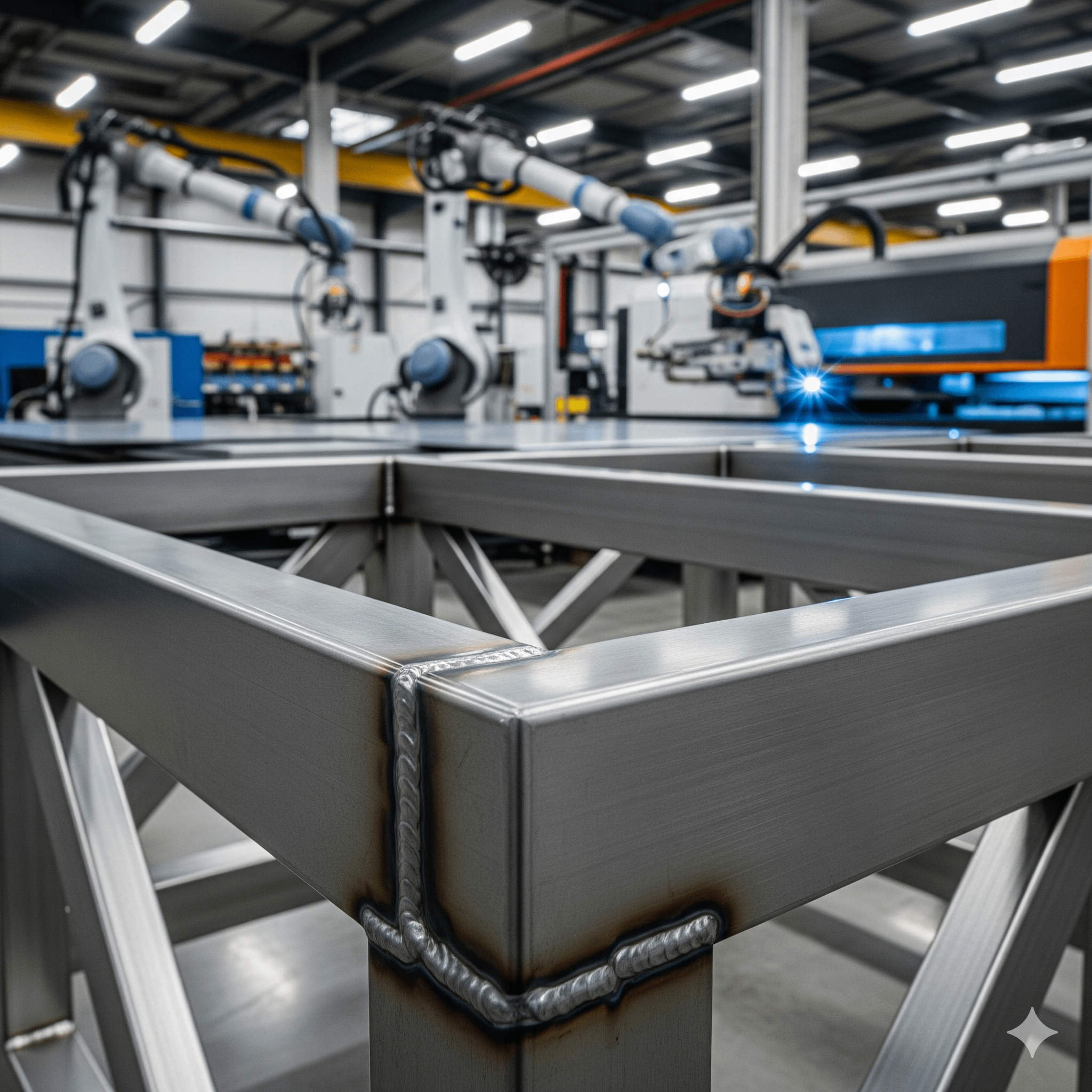
Welding is the core of frame manufacturing and the process most vulnerable to human error and physical distortion. For a B2B buyer, the welding department is where the factory’s true scalability is tested.
1. Distortion Control through Fixture Engineering
The introduction of welding heat (exceeding 6,000°C) creates immense internal forces that pull frames out of square. Without a robust strategy, a perfectly cut set of parts will warp into a propeller shape upon cooling.
The Solution: Proprietary Fixture Design A fixture is not merely a clamp; it is a heat sink and a restraint system designed to counter thermal contraction. A supplier who cannot demonstrate a dedicated fixture design process for your product cannot guarantee dimensional repeatability across large batches.
At YISHANG, fixture design is an integral part of the New Product Introduction (NPI) process. This ensures the 1,000th frame matches the geometry of the first. This consistency is vital for mass-produced items like a junction box nema rated product, where the lid seal depends on a perfectly flat flange.
2. Validation Beyond Visual Inspection
For load-bearing structures, visual inspection of weld beads is insufficient. “Cold lap”—where the weld metal sits on top of the base metal without fusing—can look perfect to the naked eye but will fail under load.
We operate under strict quality protocols:
- Macro-Etch Testing: verifying penetration depth and fusion profiles.
- Dye Penetrant Inspection (DPI): detecting microscopic surface cracks.
Compliance with standards such as ISO 3834 (Quality Requirements for Fusion Welding) provides our clients with the documentary evidence needed to satisfy their own audit requirements. This level of scrutiny is standard for critical infrastructure components, such as a street light junction box or a heavy-duty transformer enclosure.
3. Achieving Watertight Integrity for IP Ratings
For outdoor applications, the welding process must guarantee an impermeable seal. Whether it is an outdoor electrical enclosure or a nema 4 junction box, the continuity of the weld bead is paramount.
We employ continuous robotic welding for long seams to eliminate the start-stop craters associated with manual welding. Following fabrication, enclosures designed for outdoor use undergo rigorous leak testing. This ensures they meet the IP66 certificate or NEMA 4X standards required to protect sensitive internal components from rain, dust, and washdown procedures.
VI. Phase 5: Surface Engineering – The Guarantee of Longevity
For your end-customers, the finish is often the only visible indicator of quality. A failure in coating is a failure of the product. The longevity of a powder-coated frame is determined 90% by the pre-treatment and only 10% by the painting itself.
1. The Pre-Treatment Imperative
Applying powder to a frame that hasn’t been chemically perfected is a waste of resources. Our process involves a rigorous multi-stage chemical wash, including degreasing and Phosphate Conversion Coating.
This phosphating process creates a microscopic crystalline structure on the metal surface. This structure acts like Velcro for the powder, ensuring maximum adhesion. This mechanical and chemical bond is what allows the frame to pass the grueling 500-hour Salt Spray Test (ASTM B117).
Wholesalers distributing weatherproof enclosures should always request salt spray reports as part of their batch documentation. A nema 3r enclosure placed in a coastal city will fail rapidly without this specific pre-treatment.
2. Edge Rounding for Corrosion Resistance
Surface tension causes liquid paint and powder to pull away from sharp, 90-degree laser-cut edges during the curing process, leaving the very edge exposed and vulnerable to rust.
The Fix: Automated Deburring We implement a mandatory Edge Rounding (Deburring) protocol to create a specific radius on all exposed edges. This ensures the coating wraps uniformly around the corner, maintaining consistent thickness. This simple step doubles the corrosion resistance lifespan of the frame, a critical detail for pad mount enclosures and traffic control enclosures.
VII. Phase 6: Strategic Logistics – Optimizing Landed Cost
A frame that is cheap to make but expensive to ship destroys wholesale margins. Logistics optimization is a design feature, not an afterthought. At YISHANG, we view packaging as the final stage of manufacturing.
1. The “Flat-Pack” (KD) Design Revolution
Shipping “air” is the enemy of efficiency. A fully welded server rack cabinet or large kiosk enclosure occupies significant volume, severely limiting the number of units per container.
By collaborating with our engineering team, we can convert monolithic welded designs into Knock-Down (KD) / Flat-Pack architectures. Using high-strength structural rivets or flow-drill screws, we can achieve rigidity comparable to welded frames while increasing container loading quantity by 200% to 400%.
The ROI of Design Change:
| Metric | Original Welded Design | Optimized KD Design | Impact |
|---|---|---|---|
| Units per 40HQ | 20 Units | 80 Units | +300% Capacity |
| Freight Cost per Unit | $200 | $50 | 75% Savings |
| Assembly | Done at Factory | Done at Destination | Local Labor Utilization |
This dramatic reduction in freight cost per unit significantly lowers the Total Landed Cost, providing a competitive edge in your local market. This approach is standard for our free standing enclosure and modular electrical enclosures product lines.
2. Packaging for Heavy Metal
Finally, the frame must arrive in pristine condition. Transit damage is a major leakage point for wholesale profits. Standard cardboard is rarely sufficient for heavy metal frames.
We utilize reinforced wooden pallets, custom foam inserts, and corner protection. This ensures that frames, whether they are delicate instrument enclosures or rugged ev charger enclosures, withstand the rigors of ocean freight and local trucking. We also provide detailed packaging inspection reports before shipment, giving you visibility into how your product is secured.
VIII. Frequently Asked Questions (FAQ)
Q: What is the difference between NEMA 4 and NEMA 4X enclosures? A: Both provide protection against dirt, rain, and hose-directed water. However, NEMA 4X adds extra protection against corrosion, making it mandatory for marine or chemical environments. We typically use 316 Stainless Steel for NEMA 4X ratings.
Q: Can you match my specific corporate color for the powder coating? A: Yes, we offer customized color design services. Provide us with the RAL code or a physical sample, and we will calibrate our coating line to ensure brand consistency across all batches.
Q: What is the lead time for a custom sheet metal frame order? A: For a new oem sheet metal project, standard lead time is 3-4 weeks for tooling and first article sample, and 4-5 weeks for mass production, depending on complexity and volume.
IX. Conclusion: The Partner Vetting Checklist
Sourcing custom sheet metal frames is a complex discipline that demands a partner, not just a vendor. A low unit price is meaningless if it comes with the hidden costs of rework, inconsistent quality, or logistical inefficiency.
True value is found in a manufacturer who acts as an extension of your engineering team—one who challenges designs to save costs, engineers fixtures to ensure consistency, and validates quality with international standards.
The Wholesale Vetting Checklist:
Before committing to a supplier for your next sheet metal products order, validate their capability with these three questions:
- Engineering Capability: “Can you perform a tolerance stacking analysis on my wall mount electrical enclosure and propose a flat-pack design to reduce my shipping costs?”
- Process Control: “Do you have specific Welding Procedure Specifications (WPS) for my stainless steel enclosure, and do you design custom welding fixtures in-house?”
- Quality Verification: “Can you provide Mill Test Certificates (MTC) for the raw materials and Salt Spray Test reports for the galvanized steel enclosure finish?”
At YISHANG, these protocols are the standard operating procedure. With over 26 years of experience optimizing supply chains for global wholesalers, we are ready to build the foundation of your success.
Ready to secure your supply chain? Don’t settle for estimates. Send us your technical drawings today for a comprehensive, no-obligation Cost-Down Analysis and DFM Review.