
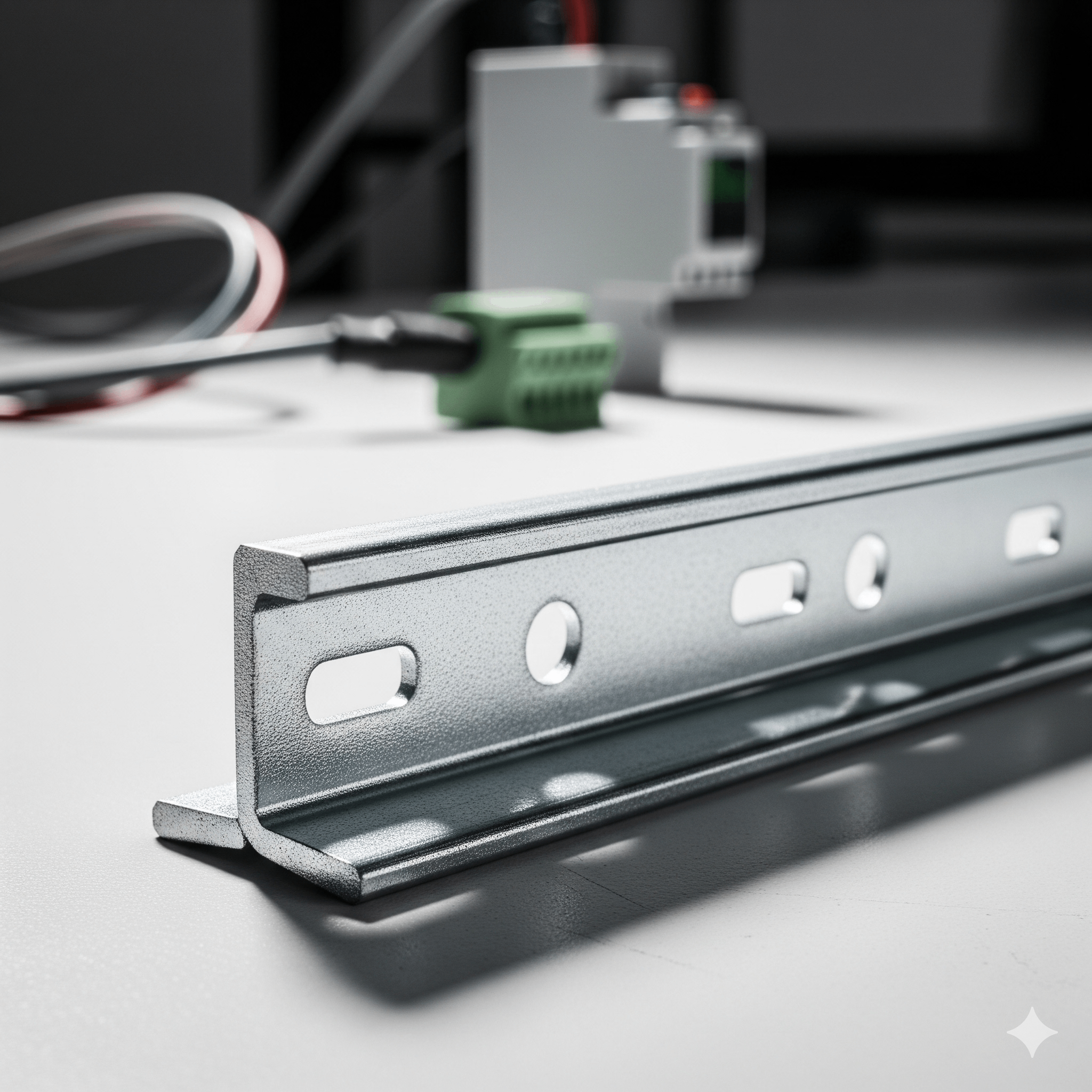
I. Introduction: The Hidden Liability in Your Supply Chain
In the fast-paced world of global industrial distribution, the DIN rail is frequently misclassified. It is often seen as a low-risk, “C-class” hardware commodity. For procurement managers and wholesale distributors, the temptation to source strictly based on the lowest price per meter is understandable. Margins are tight, and steel prices fluctuate.
However, this “price-first” strategy creates a strategic vulnerability. While the rail represents a fraction of the total bill of materials, it acts as the structural foundation. It holds thousands of dollars of sensitive equipment, from heavy Variable Frequency Drives (VFDs) to delicate PLC communication modules.
When a mounting rail fails, it rarely results in a simple warranty claim for a piece of metal. It manifests as a systemic failure. This could be intermittent grounding faults causing unexplained machine downtime. It could be dimensional variances slowing down your customer’s assembly lines. Or, it could be galvanic corrosion compromising the integrity of a premium NEMA 4X enclosure.
For a distributor, these issues translate into costly batch returns. They damage your reputation as a supplier of quality goods. They can lead to lost contracts with key installers who cannot afford field failures.
This guide moves beyond elementary definitions. We approach the DIN rail from the perspective of risk mitigation and value-added engineering. Drawing on over 26 years of precision manufacturing experience at YISHANG, we analyze technical nuances. We look at everything from plating metallurgy to structural physics.
Our goal is simple. We aim to equip procurement professionals with the technical insight needed to vet suppliers. We want to help you guarantee inventory integrity and position your company not just as a vendor, but as a technical partner to your clients.
II. The Evolution of Standards: IEC 60715 as a Global Passport
In the precision world of industrial engineering, adherence to standards is the dividing line. It separates a usable product from scrap metal. While “DIN” refers to the German institute (Deutsches Institut für Normung), the modern authoritative standard has migrated. It is now on the global stage under IEC 60715.
For importers, strict adherence to IEC 60715 is a guarantee of global interoperability. Your customers may be building panels in Asia for deployment in Europe or North America. They need assurance that components will fit.
A rail that strictly adheres to these tolerances ensures that components from global brands fit perfectly. Whether it is a Siemens breaker, an Allen-Bradley PLC, or a Schneider Electric relay, the fit must be exact.
The risk lies in rails that mimic the shape but fail the tolerance test. A deviation of just 0.5mm in the lip width is critical. It causes rigorous stress on the mounting feet of components.
Over time, this stress compounds. This is especially true in a climate controlled enclosure where thermal expansion cycles occur. Eventually, the component’s plastic mounting mechanism snaps, leading to a loose device and potential electrical hazards.
By enforcing strict IEC compliance, you are selling “compatibility insurance.” At manufacturing facilities like YISHANG, coil steel is measured against these benchmarks. We check it before it even enters the rolling die.
This ensures that batch one and batch ten thousand are identical. This consistency is vital for your customers’ quality control process. It eliminates the need for them to inspect every incoming shipment.
III. The Physics of Stability: Load Dynamics for Heavy Industry
Selecting a rail profile is a mechanical engineering decision. It dictates how the assembly handles static loads and dynamic vibrations. Understanding these physics allows distributors to recommend the right product. It moves the conversation from price to technical solutions.
1. The Mechanics of the Top Hat Section (TS35)
The top hat section (TS35) is the industry standard. However, the distinction between 7.5mm and 15mm depth is critical. It is often misunderstood. The engineering reality involves the Area Moment of Inertia.
The standard TS35x7.5mm rail provides adequate support for lightweight components. It works well for terminal blocks found in a typical junction box NEMA setup. It is cost-effective and low profile.
However, it lacks the torsional rigidity for heavy automation equipment. When a heavy VFD or transformer is mounted, gravity creates a lever arm. This torque twists a shallow rail, causing the component to sag.
For heavy-duty applications, the TS35x15mm rail is non-negotiable. Its additional sidewall height exponentially increases resistance to twisting. It acts as a stiff beam.
Distributors who stock the deep rail help customers prevent this “component sag.” This is particularly important in a large electrical enclosure. In these cabinets, vibration from heavy machinery can be amplified, shaking loose components on weak rails.
2. Safety via Asymmetry: The G Section (TS32)
While less common in new designs, the G section (TS32) remains critical. It is vital for specific legacy and power applications. Its asymmetrical profile acts as a hardware-level mistake-proofing mechanism.
In high-power legacy systems, polarity reversal could be catastrophic. The physical inability to mount a component upside down on a G section rail is a built-in safety feature.
Furthermore, the curved lip design offers superior retention strength. It grips high-torque terminal blocks securely. This prevents them from popping off the rail during wiring tightening in power distribution panels.
3. Compact Solutions: Miniature Top Hat (TS15)
For IoT devices or a small surface mount enclosure, the miniature top hat (TS15) is standard. It saves space and weight.
However, engineers must recognize its thermal limitations. The reduced surface area acts as a poor heat sink. It cannot dissipate heat as effectively as larger rails.
Quick Selection Matrix: DIN Rail Profiles
| Profile Name | Standard Ref | Dimensions (WxD) | Key Application | Load Capacity |
|---|---|---|---|---|
| Top Hat (Standard) | TS35x7.5 | 35mm x 7.5mm | Junction box NEMA 1, Relays, Terminal Blocks | Medium |
| Top Hat (Deep) | TS35x15 | 35mm x 15mm | Large electrical enclosure, VFDs, Heavy PLCs | High (Heavy Duty) |
| Miniature | TS15 | 15mm x 5.5mm | Surface mount enclosure, IoT, Compact Sensors | Low |
| G-Section | TS32 | 32mm x 15mm | Legacy power distribution panels, High Torque Terminals | High |
IV. Material Science: Corrosion Resistance and Trade Compliance
For international wholesalers, material science is not just about rust. It links directly to trade compliance and inventory longevity. A rail that rusts in a warehouse is a loss. A rail rejected by customs due to hazardous substances is a disaster.
1. Plating Thickness and Salt Spray Integrity
Cold rolled carbon steel is the industry workhorse. But its longevity depends entirely on surface treatment. Low-cost manufacturers often use a “flash plating” method.
This results in a layer of only 3-4 microns. It looks shiny and clean upon delivery. However, it degrades rapidly once exposed to humidity or salt air.
High-quality rails engineered for global export use a different standard. They utilize a zinc plating thickness of 8 to 12 microns. This provides a robust sacrificial barrier.
This difference is quantifiable via the Salt Spray Test (ASTM B117). A premium rail must withstand 72+ hours before showing red rust. Inferior products often fail in less than 24 hours.
This durability is essential for long shelf life. It is also critical when the rail is installed in weatherproof enclosures large enough to be exposed to harsh outdoor elements.
2. RoHS Compliance Strategy
Passivation is the chemical process that seals the zinc plating. Historically, “Yellow Chromate” was the standard. It provided excellent corrosion resistance.
However, it contained Hexavalent Chromium. This substance is carcinogenic and strictly banned under EU RoHS directives. Importing rails with this finish risks shipment seizure at customs.
Reliable manufacturers have shifted to Trivalent Clear Chromate. It offers comparable robust protection but is fully compliant. It is the safe choice for global supply chains.
Ensuring your supplier provides inspection certification electrical documents is key. It protects your business from legal nightmares and customs delays.
3. Stainless Steel Metallurgy
In food processing or pharmaceuticals, carbon steel is insufficient. Even with good plating, it cannot withstand washdowns. Here, the choice between SS304 and SS316 is pivotal.
Stainless steel enclosure projects often mandate these materials. SS304 is the standard for general hygiene. It resists typical cleaning agents.
However, for coastal environments, SS316 is required. It contains Molybdenum, which resists chloride pitting. This is a common requirement for solar battery enclosure projects located near the ocean.
Note on Magnetism: A common supply chain friction point is the magnetism of stainless steel. Distributors often face claims that magnetic stainless rail is fake.
In reality, the cold rolling process induces a partial phase change. It alters the grain structure of the steel. This creates slight magnetism.
This is not a defect. It is evidence of the work-hardening process. This process gives the rail its necessary mechanical stiffness. Educating your customers on this can reduce false returns.
V. Electrical Integrity: The Rail as a Grounding Busbar
Often overlooked is the rail’s function as an electrical busbar. In many control panel designs, the rail serves as the primary Protective Earth (PE) path. Grounding blocks bite into the rail to discharge current.
1. Short Circuit Current Ratings (SCCR)
If a major short circuit occurs, the rail must handle the surge. It must conduct the fault current without melting before the breaker trips.
A rail manufactured with inconsistent steel grades acts as a fuse. It heats up and breaks the ground path exactly when safety depends on it.
High-quality manufacturing ensures consistent electrical impedance. This allows for reliable breaker tripping. This is critical in high-voltage environments like traffic control enclosures where safety is paramount.
2. The Galvanic Corrosion Risk
For distributors supplying the outdoor market, understanding galvanic corrosion is a key value-add. This occurs when dissimilar metals meet in the presence of moisture.
When an aluminum rail is mounted directly onto a zinc-plated steel backplate, a battery effect occurs. The aluminum acts as the anode.
It corrodes sacrificially, turning into white powder. This destroys the electrical bond over time.
By advising customers to use isolation washers, distributors prevent field failures. This advice is critical for outdoor telecom enclosure specifications where humidity is constant.
VI. Manufacturing Precision: The Economics of Tolerances
The difference between a “usable” rail and a “reliable” rail lies in manufacturing precision. At YISHANG, we understand the distributor’s perspective. Consistent quality reduces the overhead of handling returns.
1. Tolerance Control
If a rail is manufactured 0.5mm too wide, standard components will be under extreme stress. Installers will struggle to snap them on.
If it is 0.5mm too narrow, components slide under vibration. This can lead to disconnected wires and system faults.
Maintaining IEC tolerances requires precision rolling dies. It also requires continuous Go/No-Go gauge testing on the production line.
This consistency allows you to sell the same rail to diverse clients. You can supply a precision electronics factory and a heavy machinery builder with equal confidence.
2. The Hidden Liability of Burrs
Burrs—sharp metal edges left by stamping—are a hallmark of poor manufacturing. While they seem minor, they represent a significant liability.
Sharp edges cause lacerations to assembly workers, leading to safety claims. More critically, they can slice through wire insulation.
Inside a crowded control cabinet enclosure, this can cause dead shorts. A manufacturing process that includes rotary deburring eliminates this risk.
It creates a product that is safe to handle. This is a key selling point for electrical enclosure assembling teams who value safety and speed.
VII. Application Ecosystem: Matching the Rail to the Environment
The DIN rail does not exist in a vacuum. It is the anchor of the enclosure ecosystem. Distributors must match the rail specification to the intended environment to prevent systemic failure.
To assist procurement teams, we have compiled a material matching guide based on common enclosure rating ip and NEMA standards.
DIN Rail Selection Guide by Enclosure Type
| Enclosure Environment | Recommended Rating | Rail Material Strategy |
|---|---|---|
| General Indoor | NEMA 1 Enclosure / IP20 | Zinc Plated Steel (Standard 8-12 micron) |
| Outdoor Rain/Sleet | NEMA 3R Enclosure / IP54 | High-Passivation Zinc or SS304 |
| Washdown / Corrosive | NEMA 4X Enclosure / IP66 | Stainless steel enclosure requires SS304 or SS316 |
| Submersible | NEMA 6P Enclosure / IP68 | SS316 (Mandatory for salt water) |
| High Vibration | NEMA 12 Enclosure / IP55 | Steel TS35x15 (Deep Rail) for rigidity |
Specific Industry Scenarios:
- Telecom & Thermal: For telecom enclosure telecommunications, airflow is key. In a rack mount electrical setup, precision cutting is vital to fit standard rack widths.
- EV Infrastructure: As ev charger enclosure networks expand, durable mounting for outdoor kiosks (often NEMA 3R) is driving demand for high-corrosion-resistant steel rails.
- Solar Power: Coastal solar battery enclosure projects demand SS316 rails to prevent salt spray failure over a 20-year project lifespan.
VIII. Strategic Customization: Value-Added Services for Wholesalers
The traditional model of selling standard 2-meter sticks is shifting. Wholesalers are finding more margin in customized solutions that save labor for the end-user.
Panel builders face high labor costs. Cutting a rail by hand is slow. Measuring, sawing, and filing edges takes skilled time—often five to ten minutes per rail.
1. Factory Cut-to-Length
By sourcing factory cut-to-length rails, distributors offer a “ready-to-install” solution. This eliminates scrap waste for the customer. It significantly reduces assembly time.
While the unit cost is slightly higher, the total installed cost drops. This makes it a compelling sales proposition for projects involving hundreds of modular electrical enclosures.
2. Custom Slotting and Kitting
Specific OEM applications benefit from custom hole patterns. These can be aligned with enclosure ribs or proprietary brackets.
Offering bespoke solutions transforms a distributor from a vendor into a partner. At YISHANG, we utilize laster cutting electrical technologies. This allows us to create custom profiles with zero tooling cost.
Additionally, kitting is an emerging trend. Packaging rails with screws and end clamps is ideal for enclosure assembling about projects. It simplifies inventory for the installer.
IX. Logistics and Traceability: The Backbone of Distribution
For a wholesale buyer, the physical product is only half the equation. The other half is logistics, packaging, and traceability. A high-quality rail that arrives bent is useless.
YISHANG places immense emphasis on enclosure packaging inspection. Rails are heavy. They are prone to bending if not stacked correctly in the container.
We utilize reinforced wooden crates and interlayer protection. This ensures straightness upon arrival at your warehouse.
Traceability is also paramount. In the event of a field failure, you need answers. Tracing a specific batch to its raw material source is a requirement for ISO-certified industries.
We provide comprehensive inspection report resource documents with every shipment. This includes chemical analysis and plating thickness verification.
This level of transparency allows distributors to audit their supply chain confidently. It also helps in obtaining ul certification iso9001 approvals for the final assembly.
X. Procurement FAQ: Logistics & Compliance
To assist with your sourcing decision, here are the most common queries from our wholesale partners.
Q: What is the HS Code for DIN Rail for import duties? A: Generally, DIN rails fall under HS Code 7326.90 (Other articles of iron or steel). However, stainless steel versions may have distinct codes. We provide full documentation for customs clearance.
Q: Can you provide Mill Test Certificates (MTC)? A: Yes. As part of our quality control process, we provide MTCs verifying the chemical composition and mechanical properties of the steel coil used in production.
Q: What is the standard packaging for LCL vs. FCL shipments? A: For LCL (Less than Container Load), we use fully enclosed heavy-duty wooden crates to prevent forklift damage. For FCL, we optimize pallet height to maximize weight utilization without compromising rail straightness.
XI. Conclusion: Sourcing Certainty, Not Just Steel
The DIN rail is the skeletal system of industrial automation. While it may not command the high price tag of a PLC, its failure is just as costly. For wholesale distributors, the goal is to source a product that balances competitive pricing with uncompromising engineering standards.
Prioritizing IEC 60715 compliance is key. Verifying plating thickness via salt spray data is essential. Understanding metallurgical nuances helps build a resilient supply chain.
Quality in this sector is not an abstract concept. It is defined by the absence of returns, the speed of assembly for your customers, and the absolute safety of the final installation.
Whether for a single door enclosure or complex server rack cabinets, the rail plays a pivotal role. At YISHANG, we view our role as the technical backbone of your inventory.
By adhering to global standards and manufacturing precision, we ensure one thing. When you supply a rail to your customer, you are supplying certainty.
For detailed specifications, Salt Spray Test reports, or to discuss OEM customization for your market, connect with YISHANG’s engineering support team. Let us optimize your procurement strategy today.