I. Introduction: The Strategic Economics of Precision CNC Grinding
Precision Challenges in Mass Production
Navigating the complexities of global wholesale metal fabrication requires procurement teams to execute a difficult balancing act. Buyers must constantly secure aggressive cost-reductions. Simultaneously, they must enforce zero-defect quality standards across massive production batches. When sourcing precision custom sheet metal parts, supply chains frequently encounter a severe economic bottleneck. This often occurs during the final finishing stages of the manufacturing cycle.
Traditional manufacturing methods, such as standard multi-axis milling and turning, fundamentally remove bulk material rapidly. However, these conventional cutting operations physically rely on shearing forces. These forces inevitably leave microscopic tool marks and induce slight thermal deflections. When an engineering blueprint strictly demands absolute micron-level tolerances, standard machining often falls short. This is particularly true for flawless surface finishes seen in high-end industrial enclosures.
Why CNC Grinding Solves the Consistency Gap
Attempting to force standard milling equipment to achieve extreme precision introduces unacceptable dimensional variance. This variance directly leads to high-friction assembly failures and compromised environmental seals. Consequently, buyers face escalated scrap rates that silently erode their profit margins. To permanently solve this consistency issue, leading global manufacturers utilize precision CNC metal grinding.
This abrasive process represents the ultimate manufacturing solution for high-volume OEMs. It effectively secures absolute dimensional accuracy at scale. Unlike standard machining that utilizes a single cutting edge, the typical CNC grinding process uses a highly advanced, multipoint method. It employs a rapidly rotating abrasive wheel composed of millions of microscopic cutting edges. These edges shave off minuscule chips of metal. This unique micro-mechanics approach allows the machine to reliably achieve geometric accuracies that are physically impossible to attain otherwise.
II. Machine Anatomy: Engineering Hardware for High-Yield Reliability
Foundation and Vibration Dampening
To truly comprehend how premium equipment achieves repeatable precision, procurement teams must look past the software. They should examine the physical CNC grinding machine and components. The raw physical architecture of the machine directly dictates the final yield rate. Furthermore, it ensures long-term consistency for the delivered order. Achieving tolerances tighter than a few microns requires a stable environment. This environment must remain completely devoid of mechanical vibration, harmonic resonance, and thermal fluctuation.
Building upon this strict requirement, the machine bed emerges as the absolute foundation of the process. Unlike lightweight sheet metal bending equipment, premier CNC grinding machines utilize massive structural bases. Manufacturers typically cast these beds from high-grade Meehanite iron. Some utilize advanced polymer-concrete composites, such as epoxy granite. These dense materials provide exceptional vibration-dampening coefficients. Specifically, they maintain a stable cutting zone during high-speed operations.
Thermal Stability and Consistency
In wholesale metal manufacturing, machines run continuously across multiple shifts to meet international lead times. Any micro-vibration generated by the spindle motor will translate directly into “chatter marks.” Chatter represents unacceptable wavy flaws that cause immediate part rejection and waste. The immense thermal mass of a premium machine bed ensures the structural geometry remains perfectly stable.
Consequently, the base actively resists expansion or contraction caused by ambient temperature shifts on the factory floor. This thermal inertia guarantees that the first part of a production run remains identical to the ten-thousandth. Moreover, the control center driving this heavy hardware utilizes an advanced CNC closed-loop system. Modern precision grinding requires multi-axis interpolation with sub-micron positioning accuracy to guarantee batch-to-batch consistency.
High-Resolution Feedback Loops
Industrial machines utilize sophisticated feedback systems equipped with high-resolution linear glass scales. These highly sensitive sensors continuously monitor the exact physical position of the cutting tool. They feed data back to the central processor thousands of times per second. If a dimensional deviation occurs due to mechanical cutting load or ambient heat, the CNC controller instantly compensates.
It autonomously adjusts the servo motors to maintain the target path. To prevent costly metallurgical failures, these machines also utilize advanced coolant delivery and filtration systems. The micro-mechanics of abrasive cutting generate intense, localized friction. This friction produces extreme heat at the exact point of contact. Modern machines use precisely aimed, high-pressure nozzles to blast specialized synthetic cutting fluids directly into the grinding zone. This fluid mitigates the thermal load and protects the integrity of the metal.
III. Kinematics and Applications: The 4 Main Types of CNC Grinding
Strategic Selection for Procurement
With a firm understanding of the robust machine hardware, procurement managers can accurately evaluate various CNC grinding techniques. Choosing the correct abrasive process is entirely about matching the part’s geometric profile with the most cost-effective method. Each type of grinding offers unique advantages for specific component geometries. Understanding these differences is key to optimizing production lead times and unit costs.
1. CNC Surface Grinding for Flat Mating Faces
CNC surface grinding is the definitive process for achieving absolute flatness and exceptional surface finishes. It specifically targets planar geometries and strict parallelism. In this classic setup, a heavy-duty electromagnetic chuck typically secures the metal workpiece firmly. The grinding wheel rotates at high speeds and lowers incrementally onto the workpiece. As the worktable moves longitudinally in a smooth motion, the wheel makes sequential passes.
Each pass shaves away microscopic layers of material. In the context of heavy hardware procurement, surface grinding machines are indispensable for custom sheet metal fabrication. Manufacturers routinely utilize them for final finishing operations on stamped metal plates and mounting brackets. For example, achieving perfect parallelism across opposing flat faces is critical for a heavy-duty pad mount enclosure. This precision ensures that components bolt together seamlessly during final assembly. Consequently, it entirely eliminates the need for costly manual shimming.
2. CNC Cylindrical Grinding for Shaft Precision
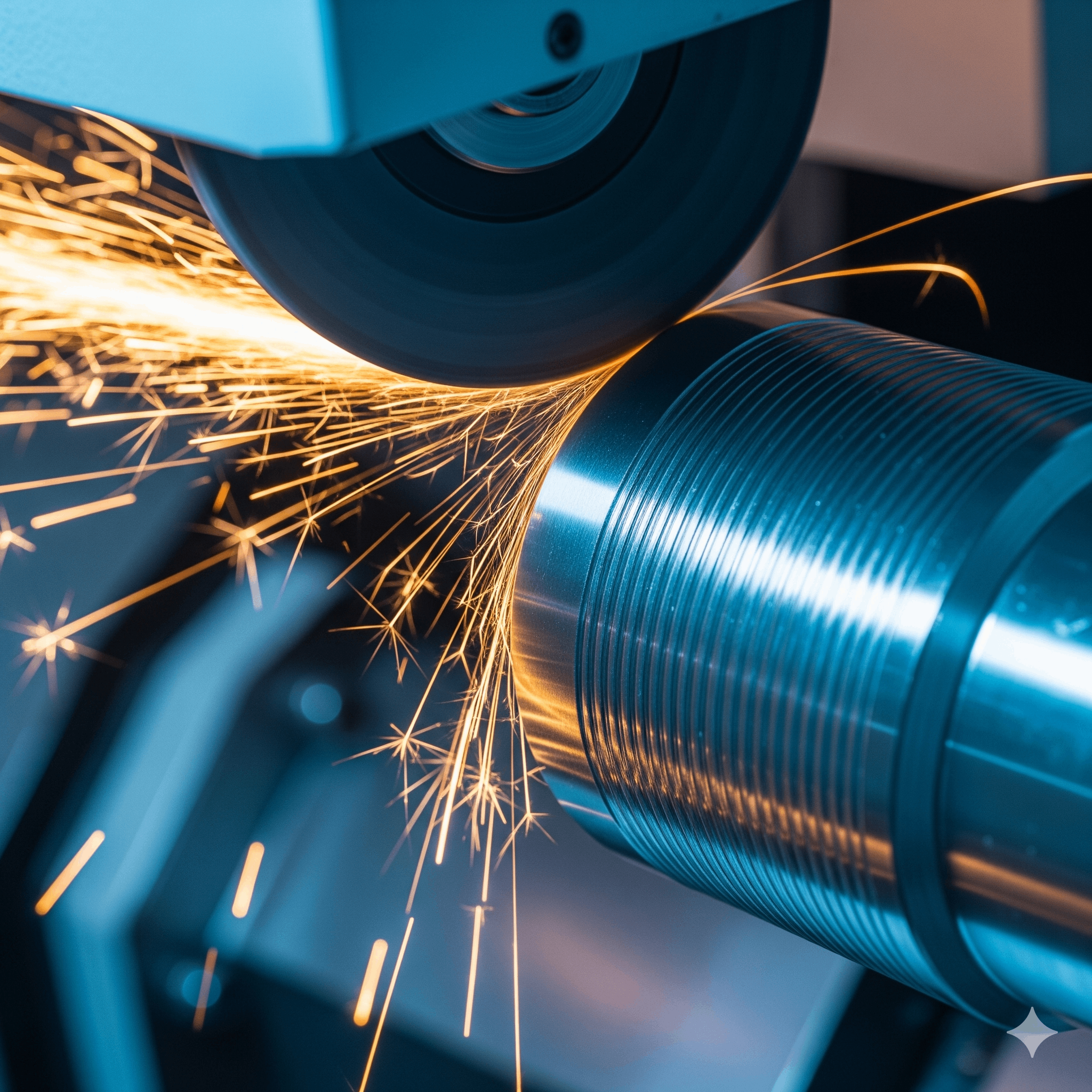
When an engineering blueprint calls for precision on rotationally symmetric parts, CNC cylindrical grinding is the standard. In this operation, the factory securely mounts the metal workpiece between two highly accurate dead centers. Alternatively, a rotating collet holds the part. The workpiece spins on its own longitudinal axis at a controlled speed. Simultaneously, the rotating wheel traverses along its exterior surface.
This methodology ensures perfect cylindricity and flawless roundness. Even advanced multi-axis CNC lathes cannot achieve this level of radial precision. It is strictly necessary for metal shafts that fit into high-tolerance industrial bearings. Such precision prevents premature mechanical wear and vibration. For wholesale buyers, this translates to longer product lifespans and significantly reduced warranty claims.
3. CNC Internal Grinding for Bores and Seats
Conversely, CNC internal grinding finishes internal bores, cylinders, and deep cavities. A smaller grinding wheel, mounted on an elongated quill, enters the pre-drilled hole of the component. Internal grinding presents a profound mechanical engineering challenge for factories. Because the grinding wheel must be smaller than the hole, the quill is prone to deflection.
To counteract this physical limitation, premier ID grinders utilize ultra-high-speed spindles, often exceeding 80,000 RPM. These machines also employ highly sensitive CNC deflection compensation controls. Maintaining strict concentricity here is critical for manufacturing hydraulic cylinders and pneumatic valves. Specifically, it prevents high-pressure fluid leakage and ensures long-term operational safety.
4. CNC Centerless Grinding for High-Volume Efficiency
For procurement managers seeking maximum cost-efficiency and massive scalability, CNC centerless grinding is the undisputed champion. It is the core process that exponentially drives down the per-unit labor cost of cylindrical components. Unlike traditional methods, this process completely eliminates the need for a spindle, chuck, or mounting centers.
Instead, an angled work rest blade supports the metal part from below. The part is sandwiched between a large grinding wheel and a smaller regulating wheel. The regulating wheel automatically spins the workpiece and feeds it horizontally past the abrasive wheel. Because there is no machine downtime wasted manually clamping individual parts, cycle times are incredibly rapid. This continuous “thru-feed” mechanism makes centerless grinding ideal for massive wholesale batches of hardware.
IV. Material Metallurgy: Machining Behaviors in Mass Production
Understanding Metallurgical Responses
The technical success and surface integrity of any precision finishing operation depend on distinct metallurgical properties. Understanding how different metals behave under extreme abrasive friction separates reliable factories from high-risk shops. Each material requires a specific abrasive strategy and coolant chemistry. This ensures the desired results without compromising the metal’s internal integrity.
Ferrous Metals and Work Hardening Challenges
Grinding ferrous metals, particularly austenitic stainless steels like 304 and 316, presents unique challenges. Stainless steel is notorious for its high ductility and its severe tendency to “work harden” during abrasive machining. When subjected to intense friction, the surface layer undergoes a micro-structural change. It becomes significantly harder and more resistant to cutting than the material underneath.
If the factory’s feed rate is too aggressive, this leads to rapid wheel glazing and severe metallurgical burn. This burn can completely ruin the metal’s passive anti-corrosion layer. To successfully grind a material stainless steel enclosure, operators must utilize highly porous wheels. Specifically, self-sharpening wheels achieve medical-grade, mirror-like finishes. Similarly, grinding carbon steel components often involves parts that have already undergone induction hardening. The factory must carefully calibrate the wheel speed to remove scale without softening the hardened substrate.
Non-Ferrous Metals and Wheel Loading Prevention
Non-ferrous metals such as aluminum alloys and brass are heavily utilized for their electrical conductivity. However, these soft metals are the natural enemies of the standard grinding wheel. Because they possess low melting points, grinding these metals frequently results in a condition known as “wheel loading.”
Wheel loading occurs when microscopic chips of soft metal melt and become embedded into the wheel’s pores. This prevents the abrasive grains from cutting properly. To overcome this and maintain high yield rates, skilled facilities employ specifically formulated Silicon Carbide wheels. These wheels have highly open pore structures. Furthermore, projects involving a galvanized steel enclosure require specific environmental exhaust controls. Removing zinc produces hazardous airborne particulate that must be managed to ensure worker safety and compliance.
V. Strategic Applications: High-End Enclosures and Critical Assemblies
Precision Surfaces as Environmental Defense
The practical applications of CNC grinding span across critical sectors, including telecommunications and renewable energy. Precision ground surfaces act as the primary defense against environmental and mechanical failure. This is especially true in the manufacturing of high-spec enclosures where sealing and fit are non-negotiable.
Achieving IP68 and NEMA Ratings
One of the most critical applications of CNC grinding is the manufacturing of heavy-duty electrical enclosures. When an OEM designs an outdoor telecom enclosure, weatherproofing is paramount. To legitimately achieve an IP68 enclosure NEMA rating, the mating surfaces must be flawlessly flat.
Standard sheet metal bending and welding inevitably induce slight thermal warping along the seams. CNC surface grinding guarantees that these critical mating surfaces have absolutely zero warp or waviness. This perfect flatness ensures that rubber gaskets compress evenly. Consequently, they form a perfect, continuous, watertight seal. This prevents catastrophic water and dust ingress during decades of harsh field use in extreme climates.
EMI Shielding and Heat Dissipation
In the telecommunications sector, a high-end telecom enclosure requires excellent Electromagnetic Interference (EMI) shielding. Ground, perfectly mated bare metal surfaces provide superior electrical continuity across the cabinet joints. This continuous metal-to-metal contact ensures robust EMI protection. Standard painted or bent sheet metal simply cannot guarantee this level of shielding.
For renewable energy infrastructure, such as an enclosures solar battery setup, precision machining is equally vital. High-power inverters require heat sinks to be mounted directly to the chassis. CNC grinding provides the ultra-flat mating surface necessary for maximum thermal transfer. Specifically, it allows internal components to transfer heat efficiently to the exterior cooling fins. This ensures that expensive battery systems remain within their optimal operating temperature range.
VI. The Economics of Grinding: Understanding High-Volume Cost Drivers
Tolerance Selection and Cost Curves
For procurement managers, auditing a CNC grinding quote requires an understanding of cost drivers. Unlike rough machining, grinding costs depend heavily on setup complexities and consumable wear. The relationship between dimensional tolerance and unit cost is an exponential curve. Tightening a tolerance from ±0.01mm to ±0.002mm can increase machining cycle time by 300%.
This increase results from necessary “spark-out” passes and frequent automated gauging. Procurement teams should audit if such tight tolerances are truly necessary for the part’s function. Over-specification leads to unnecessary expenses without adding functional value. Therefore, balancing precision with cost is a fundamental skill for sourcing professionals.
Tooling and Maintenance Factors
Grinding wheels are expensive, precision-engineered consumables. When grinding complex profiles or extremely hard alloys, the wheel loses its sharp geometric edge rapidly. Consequently, the machine must pause to “dress” or re-sharpen the wheel using a diamond tool. Frequent dressing adds significant non-value-added time and cost to the production cycle.
Furthermore, holding a highly irregular or thin-walled part securely requires custom-engineered fixtures. These specialized magnetic chucks or mechanical jigs prevent warping under grinding pressure. For wholesale buyers, ordering in higher volumes drastically reduces the amortized cost of this specialized tooling. Consequently, larger batches often result in a much more favorable per-unit price.
VII. Design for Manufacturability (DFM): Controlling Wholesale Costs
Designing for Production Efficiency
Translating theoretical manufacturing knowledge into cost-effective procurement requires early adherence to Design for Manufacturability (DFM) principles. How a CAD drawing is dimensioned drastically dictates the final wholesale price. By following a few key strategies, engineers can significantly lower production costs without sacrificing performance.
Strategic Tolerance Allocation
We recommend reserving tight tolerances strictly for critical bearing journals or sealing faces. Specifying standard machining tolerances, such as ISO 2768-m, allows the factory to use faster feed rates. Consequently, this secures more competitive manufacturing rates for high-volume orders. In addition, providing a clear reference surface in the CAD model reduces setup time.
Pre-Grinding Machining Allowances
Grinding is fundamentally a finishing operation. Leaving too much material results in excessive cycle times and rapid wheel degradation. Conversely, leaving too little may not “clean up” tool marks or oxidation left by prior roughing. An optimal allowance typically ranges from 0.127mm to 0.15mm. This specific range ensures both factory throughput and part quality.
Designing for Tooling Access
Grinding wheels are physical cylinders and cannot create a perfectly sharp 90-degree internal corner. Designing a small relief groove or “undercut” into the CAD drawing allows the wheel to over-travel slightly. This ensures flush mating surfaces and perfect fits. Furthermore, it eliminates the need for frequent, expensive wheel dressing. Such small design modifications lead to significant cumulative savings in large-scale production.
VIII. Quality Assurance: Metrology and Traceability
Verifying Micron-Level Precision
In global wholesale manufacturing, the ability to manufacture a precision part is only as good as the ability to prove its accuracy. Premier facilities invest heavily in environmentally controlled Quality Assurance (QA) laboratories. These labs satisfy stringent OEM audits and provide peace of mind to international buyers.
CMM Verification and Traceability
To verify complex geometries, QA inspectors utilize Coordinate Measuring Machines (CMMs) equipped with sensitive ruby-tipped probes. Before full volume production officially begins, advanced factories generate comprehensive First Article Inspection (FAI) reports. This critical engineering document proves to the buyer that the tooling and material are perfectly calibrated.
Furthermore, material traceability is non-negotiable for high-liability industries. Whether sourcing for a waterproof NEMA 6P enclosure or medical hardware, premier facilities provide full Material Test Reports (MTRs). These reports prove the exact chemical composition of the metal directly from the steel mills. Consequently, this prevents international procurement risks and ensures compliance with global standards.
IX. FAQs: Expert Insights on CNC Grinding Operations
1. How can procurement teams optimize designs for high-volume CNC grinding? Teams should favor designs explicitly optimized for centerless grinding for cylindrical parts. This eliminates the need for chucking, facilitating rapid “thru-feed” continuous production. Additionally, practicing strategic tolerance allocation drastically reduces unnecessary machine cycle times and lowers the per-unit cost.
2. How long and fast is the typical CNC grinding process compared to standard milling? While rough multi-axis milling removes bulk material faster, grinding is optimized for rapid, micro-precision final finishing. For high-volume cylindrical parts using centerless grinding, continuous feed rates can exceed several meters per minute. However, surface grinding large heavy-duty enclosures is intentionally methodical to ensure perfect geometric flatness.
3. What are the current CNC grinding machines cost implications for OEM buyers? The initial capital investment for a premium multi-axis grinder can exceed hundreds of thousands of dollars. Partnering with an established OEM/ODM factory allows buyers to access world-class precision without shouldering the massive capital expenditure and maintenance costs of in-house equipment.
4. Which CNC grinding machine specifications matter most when auditing a supplier? Procurement managers should focus on machine bed material, which is essential for vibration dampening. They should also evaluate spindle RPM capabilities and the resolution of linear glass scales. These factors combined determine the factory’s true Process Capability Index (CPK) and long-term reliability.
X. Conclusion: Your Partner in Precision Manufacturing Excellence
In the highly demanding world of international manufacturing, precision is a strict functional requirement. It dictates product success and assembly line efficiency. Achieving true micron-level accuracy requires a sophisticated intersection of advanced machine mechanics and rigorous metrology. Furthermore, a profound understanding of high-volume DFM principles is essential. Executing these complex processes seamlessly across global supply chains requires strict quality controls and a commitment to engineering excellence.
Operating as an ISO 9001 and RoHS certified manufacturing partner, YISHANG offers comprehensive OEM and ODM solutions. By fully integrating precision sheet metal fabrication, heavy welding, and specialized CNC grinding under one highly controlled roof, we eliminate supply chain fragmentation. Our team speaks the language of procurement professionals. We deeply understand the critical importance of yield rates, lead times, and continuous cost optimization. Send your inquiry today to connect with our engineering team, review your technical drawings securely, and obtain a highly competitive manufacturing quote.