
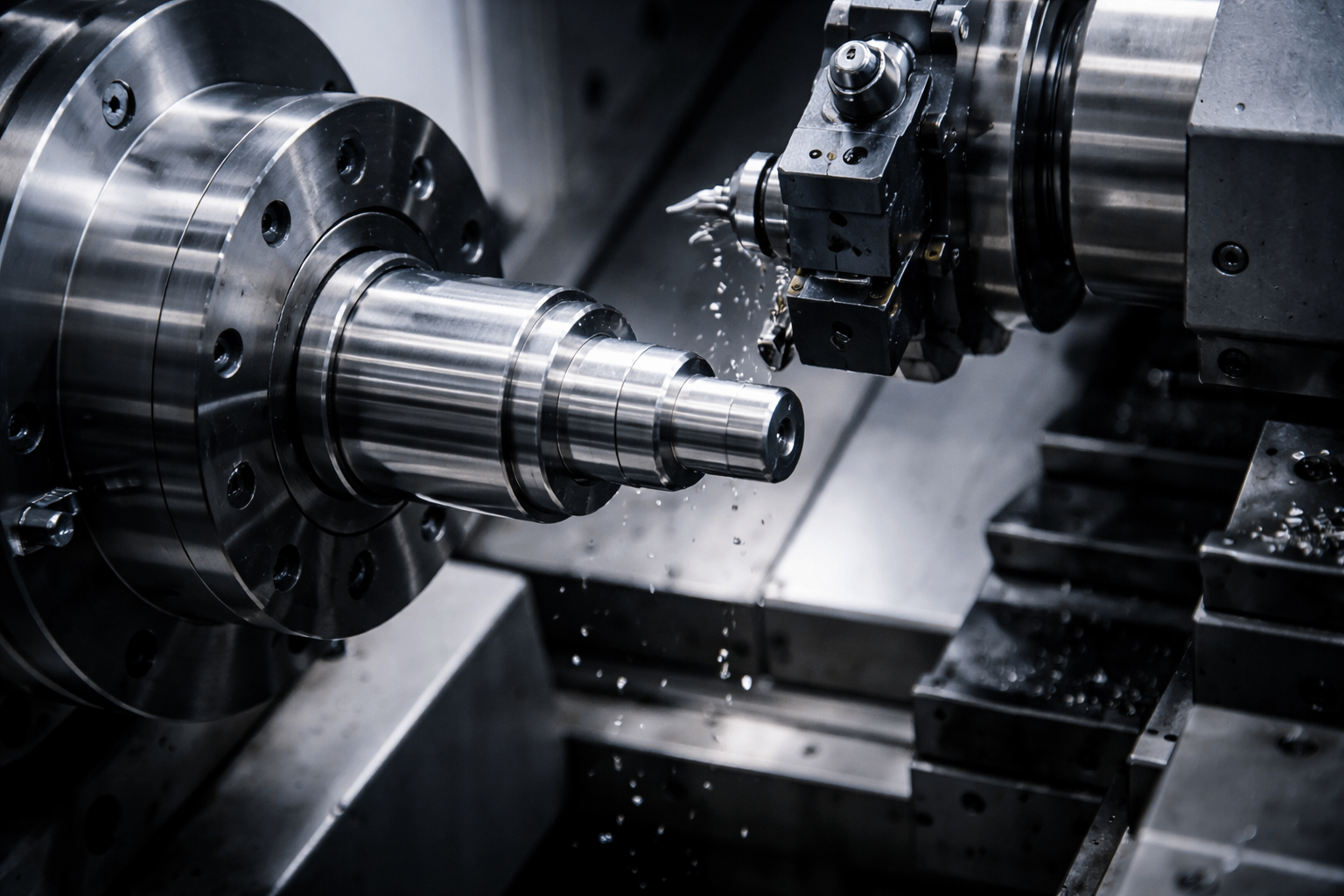
Overseas wholesale buyers rarely search for a CNC lathe service because they want to learn how a lathe works. They search because they need a dependable supply of custom turned parts that will assemble smoothly, ship on schedule, and remain consistent across repeat orders.
In global distribution and OEM supply, small machining deviations can create outsized consequences. If a tolerance drift is discovered after an overseas shipment arrives, the cost is not only rework. It can include line stoppage, additional incoming inspection, re-labeling, expedited freight, and damaged customer trust.
This guide is written for buyers who think in contracts, batches, and risk. It moves in the same sequence a procurement team typically follows: supplier evaluation criteria, precision mechanisms, process capability and batch consistency, cost structure, international supply-chain risk, and integration with wider metal fabrication. The tone is practical and collaborative, because the goal is to support confident sourcing decisions.
I. How Wholesale Buyers Evaluate CNC Lathe Service Providers
When procurement managers evaluate cnc axis turning services, they are not primarily comparing spindle speed or marketing claims. They are assessing whether a supplier can deliver stable machining tolerance across volume, time, and distance.
The first lens is dimensional reliability. For industrial components such as shafts, sleeves, bushings, connectors, and threaded inserts, tolerance stability directly affects assembly yield and warranty exposure. A diameter that runs only 0.02 mm high might still “measure close,” yet it can change bearing preload, increase vibration, or create press-fit failures in automated assembly.
The second lens is interchangeability across repeat orders. Overseas wholesale contracts often run on rolling forecasts. Buyers need parts produced in May to match parts produced in November without hidden drift. This is where disciplined setup documentation, tool offset control, and revision traceability matter more than a one-time prototype success.
The third lens is scalability. Many suppliers can deliver 200–500 pieces with careful attention. Fewer can maintain the same stability at 20,000 pieces when tool wear, operator shifts, and thermal cycles begin to influence results. Buyers look for process controls that scale: tool life management, statistical monitoring, inspection capacity, and engineering oversight.
The fourth lens is cost predictability. Experienced buyers do not optimize only for the lowest unit price. They optimize for total landed cost over time. A quote that looks low can become expensive if quality escapes lead to sorting costs, returns, or schedule disruption. Suppliers who can explain how geometry, tolerance tightening, and surface finish standards affect cycle time tend to be easier to work with during long-term agreements.
The fifth lens is communication clarity. Wholesale sourcing typically involves short timelines and multiple stakeholders. Buyers favor partners who can communicate clearly about feasibility, tolerance risk, and manufacturability tradeoffs. Good communication reduces change orders, speeds up approval, and prevents misunderstanding.
YISHANG sees this procurement behavior daily. Initial discussions tend to focus on drawings, target tolerance bands, annual volume, and inspection requirements, because those factors determine whether a CNC turning supplier can deliver stable results at scale.
II. Engineering Foundations of Precision CNC Turning Services
Once the procurement criteria are clear, the next question is how precision is actually achieved. Precision CNC turning services are the outcome of controlled geometry removal under stable mechanical and thermal conditions.
Rotational Geometry and Axis Accuracy
CNC turning relies on controlled rotation around a spindle axis while cutting tools move along programmed coordinates. In precision cnc lathe turning services, spindle runout, servo positioning accuracy, and tool offset calibration influence not only diameter but also circularity and concentricity.
For many industrial assemblies, geometric tolerances matter as much as linear size. A part can pass a diameter check and still fail if total indicated runout is too high. Runout can create imbalance in rotating systems and reduce bearing life, especially in high-speed equipment.
In cnc axis turning services with multi-axis capability, maintaining consistent datums becomes more important as features increase. Parts with multiple diameters, grooves, or threaded sections often require careful datum planning to keep geometric relationships stable. Reliable partners treat datums as a production control concept, not a drawing detail.
Thermal Stability and Dimensional Control
Heat generation during cutting is inevitable. Friction between tool and workpiece increases temperature and may cause expansion. Stainless steel and certain alloy steels retain heat more than aluminum, which can influence micrometer-level tolerance during long production runs.
Effective cnc lathe service incorporates balanced feed rates, stable coolant delivery, and consistent shop conditions. Thermal stability becomes especially important when orders are large and production runs span multiple shifts. If temperature varies significantly from day to night, the same program can produce slightly different results.
For wholesale procurement, thermal control is a practical concern because it affects batch consistency. Stable thermal behavior helps ensure that the first part and the ten-thousandth part share the same dimensional signature.
Tool Wear Modeling and Surface Finish Integrity
Tool wear gradually alters cutting geometry. As edges dull, effective diameter shifts and surface roughness increases. In precision cnc turning services, predictable tool replacement schedules and offset compensation prevent gradual drift.
Surface finish is commonly defined in Ra values. Lower Ra values usually require slower feeds, sharper tooling, stable chip control, and finishing passes. Buyers often specify Ra not for aesthetics, but for friction behavior, sealing performance, fatigue life, or wear resistance.
| Ra Value | Typical Application | Machining Strategy |
|---|---|---|
| 3.2 µm | Structural brackets, housings | Standard cycle |
| 1.6 µm | Bearing journals, sliding fits | Reduced feed |
| 0.8 µm | Sealing interfaces, precision shafts | Finishing passes |
Stable surface integrity across volume is a quality signal. It indicates that tool wear and thermal conditions are being controlled rather than tolerated.
What “Precision” Means in Bulk Production
In procurement, “precision” is often misunderstood as the best-case part a supplier can show. For wholesale orders, precision is better defined as the worst-case variation that still remains within specification.
A supplier who can hold ±0.01 mm for one sample may still struggle in a long run if tool wear, thermal cycles, or setup inconsistency are not actively managed. This is why buyers should connect precision claims to process capability evidence, not only sample measurements.
III. Process Capability and Long-Term Batch Consistency
Precision without stability becomes a risk. For overseas buyers, the more valuable quality is repeatability across batches and across time.
Process capability indices such as Cp and Cpk quantify how consistently a process operates within tolerance limits. As a practical reference, Cpk above 1.33 is often considered capable for standard industrial components, while higher values may be preferred when tolerance windows are tight or the cost of failure is high.
Capability matters because it converts quality from a promise into a measurable signal. A supplier who tracks capability demonstrates that variation is being monitored, managed, and improved rather than treated as an occasional issue.
Setup repeatability is another core driver. Recurring orders require consistent tool offsets, fixture configuration, chuck pressure, program revision control, and material traceability. Without disciplined version management, small changes can introduce dimensional variation that shows up months later.
For wholesale buyers, documentation is not bureaucracy. It is insurance. Revision history and stable setups support interchangeability between shipments, which reduces incoming inspection time and prevents assembly disruption.
Statistical Process Control adds another layer. SPC is valuable not because it produces charts, but because it detects drift early. By tracking key dimensions at defined intervals, engineers can identify trends before parts exceed tolerance limits. For high-volume CNC turning, this proactive approach reduces scrap, supports stable delivery, and improves predictability.
A practical procurement-friendly deliverable is a consistent inspection package. Many buyers request a first article inspection report for initial approval, then receive ongoing measurement data for critical dimensions on production batches. While requirements vary by industry, the underlying goal is consistent: evidence that the process remains centered and stable.
YISHANG supports this procurement logic by aligning documentation, traceability, and repeatability so that custom turned parts approved today can be reproduced reliably in future cycles.
IV. Cost Structure in High-Volume CNC Lathe Service Contracts
After confirming precision and stability, buyers naturally evaluate economics. In CNC turning, cost is not random. It follows a structured relationship between cycle time, tolerance, surface finish, material machinability, and inspection scope.
Cycle time is the primary driver because it determines machine occupancy. Geometry complexity influences cycle time directly. Stepped diameters, internal bores, grooves, knurling, and threading operations add tool passes and tool changes. In high-volume CNC turning, even a 10–20 second difference per part can materially change the annual contract cost.
Tolerance tightening increases cost in a non-linear way. Moving from ±0.05 mm to ±0.01 mm often requires slower feeds, more frequent tool changes, additional in-process checks, and greater environmental control. The cost increase reflects risk control and process reinforcement, not only “better machining.”
Surface finish targets also affect economics. Achieving lower Ra may require finishing passes, stable chip control, and tighter tool wear limits. If surface integrity is functional, it should be treated as a performance requirement with a cost implication, not a decorative preference.
Material machinability influences tooling consumption and cutting speed. Aluminum generally supports higher cutting speeds and lower tool wear. Stainless steel can increase tool wear and heat retention. Hardened alloys may require specialized inserts and conservative parameters. These factors are part of machining economics and should be discussed early in quoting.
For buyers comparing quotes, a helpful way to reduce misalignment is to ask suppliers how they model cycle time and how they manage tolerance risk. A quote that includes clear assumptions about tolerance bands, surface finish, inspection frequency, and batch size is usually more reliable than one that offers a low number without explanation.
YISHANG typically supports procurement discussions by clarifying what drives machining time and where design choices can lower cost without compromising performance.
V. Managing Risk in International CNC Turning Supply Chains
International procurement amplifies the impact of quality escapes. A defect discovered after shipment is harder and costlier to correct. That is why overseas buyers prioritize prevention systems over “after-the-fact” fixes.
Dimensional drift in long production runs is one of the most common risks. Drift can be caused by tool wear, thermal accumulation, or setup changes across shifts. Continuous measurement and predictive tool maintenance reduce this exposure.
Surface integrity risk is often underestimated. A part may meet size tolerance yet fail prematurely if surface finish degrades, especially in sliding or rotating applications. Stable Ra performance helps protect durability and reduces warranty risk for distributors.
Thread variability is another procurement pain point. Under tool wear, thread profile can change subtly even if pitch appears correct. For load-bearing fasteners or connectors, this can affect torque retention and mechanical reliability.
Integration risk is also real. Turned parts frequently proceed to welding, coating, or assembly. Coating thickness can change fits. Welding can introduce distortion. If these downstream stages are not accounted for, tolerance stack-up can cause assembly issues even when individual parts measure within spec.
A reliable CNC turning supplier treats machining as part of a system rather than a standalone service. That approach helps buyers reduce operational risk across distance and time.
VI. Integration with Broader Metal Fabrication and Material Variants
Wholesale buyers often source not only turned shafts but complete metal assemblies. For a metal products company, integration capability becomes a practical advantage because it reduces supplier fragmentation and simplifies quality ownership.
Tolerance stack-up analysis matters when custom turned parts interface with laser-cut or bent sheet metal components. If a turned insert fits into a sheet metal housing, both processes contribute to final fit. Coordinated dimensional planning reduces assembly adjustment time, prevents rework, and improves interchangeability.
Welding introduces localized heat that can distort machined features. When turned components are welded into frames or brackets, post-weld verification helps ensure that functional interfaces remain within tolerance.
Surface treatments such as plating, anodizing, or powder coating add measurable thickness. It is common for procurement teams to overlook coating buildup during drawing review. When coating thickness is accounted for in turning dimensions, final fit becomes more predictable.
Some buyers also require cnc plastic turning services for insulating spacers, bushings, or lightweight components. Plastic turning has its own stability challenges, including thermal expansion and surface finish behavior. Coordinating plastic and metal turned components under one sourcing plan can reduce variability in assembled products.
YISHANG works with procurement teams who prefer consolidated sourcing for metal fabrication and turned components, because it simplifies communication, accelerates approval cycles, and reduces responsibility gaps.
VII. Choosing a CNC Turning Partner for Long-Term Wholesale Contracts
By the time buyers reach a short list, the differentiators are rarely slogans. They are evidence, discipline, and responsiveness.
Measurable discipline includes calibrated inspection tools, traceable material documentation, repeatable setups, and consistent measurement reporting. These elements support trust because they make quality visible.
Scalability includes not only capacity but control at capacity. Automation readiness, multi-axis capability, and stable shift-to-shift standards are practical indicators for high-volume CNC turning.
Responsiveness matters because procurement timelines are often tight. A supplier who can respond clearly to tolerance questions, propose manufacturability adjustments, and provide realistic lead-time commitments is easier to work with in a wholesale environment.
Many suppliers can machine parts. Fewer align their operational systems with the way overseas wholesale buyers evaluate risk, cost, and repeatability over multiple purchase cycles.
VIII. RFQ Clarity: How to Improve Quote Accuracy and Reduce Revisions
One area that directly affects both pricing accuracy and project speed is the quality of the RFQ package. In wholesale procurement, repeated quotation adjustments often result not from supplier error, but from incomplete technical inputs.
For CNC lathe service projects, clear 2D drawings with defined tolerance callouts are more effective than general notes such as “machine to standard tolerance.” Critical-to-quality dimensions should be identified explicitly, especially for bearing seats, press fits, threaded sections, and sealing surfaces. When buyers distinguish between functional tolerances and general tolerances, suppliers can allocate machining control more efficiently and avoid unnecessary cost inflation.
Including information about annual volume, batch size, and forecast stability also improves quote realism. High-volume precision CNC turning services can justify optimized tooling strategy and cycle time balancing. Prototype-level quantities, by contrast, may carry higher unit cost due to setup concentration. When volume expectations are transparent from the beginning, pricing becomes more predictable.
Material specification should be detailed beyond generic labels. For example, specifying stainless steel 304 versus 316, or identifying required hardness range for alloy steel, reduces later clarification. If cnc plastic turning services are required for engineering plastics such as POM, Nylon, or PEEK, noting operating temperature range and dimensional stability requirements helps avoid rework due to thermal behavior differences.
Buyers who provide CAD models along with controlled 2D drawings typically reduce quotation cycles. The 3D file supports geometry interpretation, while the 2D drawing defines tolerances and inspection reference points. This combination supports more accurate machining strategy planning and lowers the probability of re-quote discussions.
IX. What Evidence Wholesale Buyers Can Request to Validate Capability
While marketing descriptions are common in the industry, experienced procurement teams rely on documentation to evaluate precision CNC turning services. Requesting structured evidence does not signal distrust; it clarifies expectations before production begins.
For new projects, a First Article Inspection Report (FAI or FAIR) provides dimensional verification of key characteristics. When accompanied by material certification such as MTR or CMTR, it confirms both geometry and material compliance. These documents are particularly valuable for overseas shipments where revalidation on arrival adds time.
For recurring contracts, buyers may request periodic measurement summaries for critical dimensions. Even simple trend data can demonstrate whether a process remains centered within tolerance. When suppliers track Cp or Cpk internally and are able to discuss process capability openly, it signals maturity in quality management.
Calibration records for gauges and CMM equipment also contribute to confidence. In high-volume custom turned parts programs, traceability between batch number, material lot, and inspection data reduces ambiguity if field issues ever arise.
The purpose of these documents is not administrative complexity. It is supply chain stability. When quality evidence accompanies each shipment, incoming inspection can become more efficient, and long-term cooperation becomes smoother.
X. Lead Time Predictability from Prototype to Volume
Lead time consistency is often as important as dimensional accuracy for wholesale buyers. Transitioning from prototype runs to bulk production introduces operational variables that affect scheduling.
Prototype precision CNC lathe turning services usually concentrate setup cost into a small batch. Once fixtures, tooling strategy, and process parameters are validated, volume production benefits from smoother workflow. However, capacity planning must account for tool life cycles, inspection intervals, and machine loading.
Clear communication about sample lead time, first article approval cycle, and expected mass production rhythm helps buyers align inventory planning. For international procurement, understanding whether shipments can be split into staged deliveries also supports distribution scheduling.
Suppliers who manage cnc axis turning services with documented production planning reduce surprises. When tooling replacement schedules and preventive maintenance are integrated into production forecasts, delivery reliability improves.
At YISHANG, discussions around lead time typically occur alongside tolerance and volume review, because schedule stability and dimensional stability are closely connected in high-volume manufacturing.
Conclusion: Precision CNC Turning as a Strategic Supply Asset
For overseas wholesale buyers, cnc lathe service is best viewed as a structured manufacturing capability that supports dimensional reliability, cost stability, and scalable production in global supply chains.
When supported by measurable process capability, stable thermal management, disciplined tool wear control, documented inspection evidence, and coordinated fabrication integration, precision cnc turning services become a predictable asset rather than a sourcing risk.
If your team is evaluating high-volume custom turned parts, cnc plastic turning services, or scalable cnc axis turning services for recurring programs, YISHANG welcomes a technical discussion around drawings, tolerance strategy, and production planning to support confident procurement decisions.