
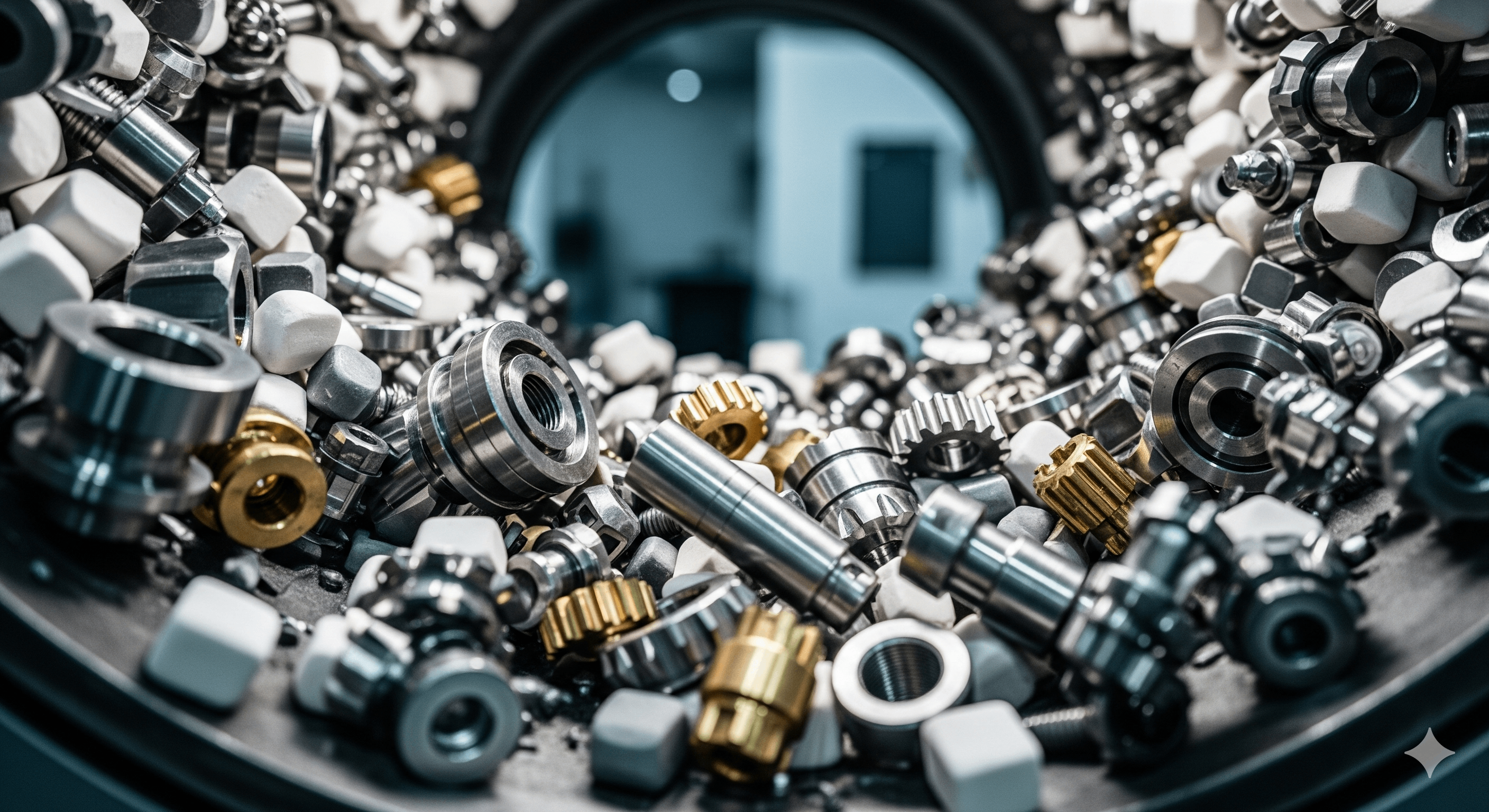
For professional procurement managers and global hardware wholesalers, the surface finish of a metal component is the ultimate indicator of supply chain stability. In high-volume manufacturing, a single micro-fissure or inconsistent edge radius can lead to catastrophic assembly failures and brand erosion.
At YISHANG, with over 26 years of field data in custom metal fabrication, we understand that barrel tumbling is not merely a cleaning step; it is a critical variable in the Total Cost of Ownership (TCO). This guide provides the technical and economic insights required to optimize your mass finishing strategy and ensure superior batch repeatability.
1. The Strategic Impact of Surface Integrity: Beyond Aesthetics
In the realm of high-precision engineering, “surface integrity” refers to the mechanical and metallurgical state of a part’s exterior. When metal undergoes fiber laser cutting or heavy-duty stamping, it experiences localized thermal and mechanical stress. These processes often leave “stress risers”—microscopic burrs and jagged edges that concentrate mechanical tension.
For a wholesaler distributing parts for energy storage systems or automotive powertrains, these stress risers are liabilities. Under repetitive loading, they become initiation sites for fatigue cracks. Systematic barrel tumbling services neutralize these zones by smoothing transitions at the molecular level, effectively acting as an insurance policy for your brand’s reputation.
Why Precision Radiusing Matters for Wholesale ROI:
- Reduced Friction: Components integrate more smoothly into automated assembly lines, reducing downtime.
- Enhanced Coating Adhesion: A homogenized surface energy ensures that powder coating or electroplating bonds at a 30% higher efficiency.
- Safety Compliance: Eliminating sharp edges reduces workplace injuries during the assembly and maintenance phases.
The impact of micro-geometry on performance is quantified through “Fatigue Life.” Longitudinal tests show that parts treated with professional edge radiusing exhibit a 300% extension in service life. At YISHANG, we use these metrics to help procurement officers justify the investment in higher-grade finishing by demonstrating long-term savings in warranty claims and field replacements.
2. The Physics of the Sliding Layer: Achieving High-Volume Consistency
Wholesale buyers prioritize “batch consistency”—the guarantee that the 10,000th part is identical to the first. To achieve this, a manufacturer must master the physics of the “sliding layer.” Unlike vibratory deburring services, which agitate the workload, rotary barrel tumbling relies on a controlled “waterfall effect” within the mass.
As the barrel rotates, centrifugal friction carries the parts and media upward. Once the mass exceeds the “angle of repose” (typically 45° to 60°), the top layer cascades down. This sliding zone is where 90% of the abrasive work occurs. At YISHANG, we precisely calibrate the RPM to ensure the kinetic energy is converted into uniform friction rather than damaging impact.
The Variables of Kinetic Management:
- Optimal RPM: If the rotation is too slow, the load “slumps,” leading to uneven wear. If too fast, “centrifuging” occurs, pinning parts to the wall and halting all work.
- Fill Level Dynamics: A 50-60% fill level provides the maximum sliding distance. For complex enclosures, we increase this to 80% to create a protective “hydraulic cushion.”
- Part-to-Media Ratio: We typically maintain a 3:1 or 4:1 ratio by volume to ensure that no two parts collide directly, preventing “impingement” or surface denting.
Technical Insight: “Load Velocity” is the key metric here. By utilizing 26 years of process logs, we identify the exact velocity needed for different alloys—from lightweight aluminum 6061 to high-strength 316L stainless steel—ensuring that your delivery schedule remains unaffected by high scrap rates.
| Rotational Variable | Slumping (Low RPM) | Cascading (Optimal) | Centrifuging (High RPM) |
|---|---|---|---|
| Mechanical Energy | Inefficient / Low | Maximum / Uniform | Zero (Static Load) |
| Batch Consistency | Poor / Directional | Excellent / Isotropic | N/A |
| Scrap Risk | Minimal | Managed | High (Impact Damage) |
| TCO Impact | Increased Lead Time | Optimized Cost | Wasted Energy |
3. Strategic Process Selection: Navigating Scalable Finishing Solutions
Selecting the right mass finishing method is a commercial decision as much as a technical one. For high-volume wholesalers, the rotary barrel is the workhorse of the industry due to its robust nature and immense capacity. However, urgent global orders may require the speed of centrifugal finishing (CBF).
CBF operates on a planetary gear system, creating a high-G environment (up to 30x gravity). This compresses a 12-hour traditional cycle into a 20-minute rapid-finish, allowing YISHANG to provide rapid-response OEM manufacturing during market surges. While more expensive per hour, the reduced lead time can significantly lower the opportunity cost for buyers.
Comparing Deburring Methods for B2B Procurement:
- Barrel Tumbling: Best for heavy-duty scale removal, cost-effective for large batches, and superior for radiusing heavy structural frames.
- Vibratory Deburring: Ideal for fragile, large parts that might tangle in a rotating barrel; better for “flat-on-flat” surface smoothing.
- Centrifugal High-Energy: Reserved for high-precision components (medical, aerospace) where cycle time and Ra values are non-negotiable.
The choice between “Wet” and “Dry” processes also impacts the final landed cost. Wet tumbling is the industrial standard, using water-based compounds to flush away metal swarf. Dry tumbling, using organic media like walnut shells, is preferred for high-luster polishing on soft metals. At YISHANG, we recommend the process that aligns with your final application, ensuring you don’t overpay for unnecessary cosmetic brilliance when structural integrity is the primary goal.
4. Abrasive Science: Engineering Media for Custom Geometries
In professional fabrication, media is not “rocks”—it is a precision tool. The geometry of the media determines whether it can reach into the internal recesses of a custom part. For a wholesaler, using the wrong media shape leads to “lodging”—where media becomes stuck in holes, requiring expensive manual labor to remove.
YISHANG’s Media Selection Framework:
- Ceramic Media: High density and hard-cutting. Essential for removing laser oxide from stainless steel. Its “self-sharpening” nature ensures that the cut-rate remains consistent from the start of the batch to the end.
- Plastic/Resin Media: Ideal for “soft-landing” on aluminum or zinc. It provides a smooth Ra finish without the risk of chipping the base metal.
- Steel Media: Used for “burnishing.” Instead of removing metal, it smears the surface peaks, creating a reflective, work-hardened exterior that resists wear.
Calculating the “Lodging Potential”: Before starting a wholesale run, our engineers compare the diagonal measurements of the media against the smallest aperture of the part. If a part has 5mm ventilation slots, we utilize 8mm triangular media. This 3mm margin of safety ensures that your production line never stops due to a “stuck stone,” maintaining your delivery timeline.
| Media Category | Base Material | Key Benefit for Wholesalers | Typical Application |
|---|---|---|---|
| High-Density Ceramic | Al2O3 / Clay | Consistent Cut-Rate | Steel Structural Frames |
| Resin-Bonded | Polyester / Silica | No Impingement Marks | Aluminum EV Enclosures |
| Chrome Steel | Hardened Steel | Surface Hardening | Automotive Fasteners |
| Precision Porcelain | Fine Ceramic | Mirror Isotropic Finish | Medical Implants |
Beyond material removal, we monitor “Media Wear Rates.” As media shrinks, its geometry changes. At YISHANG, we maintain a strict replacement protocol (usually at 15% volume loss) to ensure that the finishing quality does not drift over long-term contract manufacturing.
5. The Chemistry of Success: pH Balance and Global Compliance
The chemical compound in a tumbling barrel is the “silent regulator” of quality. Its primary job is to manage “media loading”—the buildup of metal swarf that can turn an abrasive stone into a smooth, useless pebble. Surfactants in the solution keep these micro-particles in suspension, allowing them to be flushed away.
Chemical Management for Global Export:
- pH Equilibrium: For aluminum, we maintain a neutral pH to prevent “tarnishing” or darkening. For stainless steel, alkaline compounds assist in the “passivation” process, reinforcing the chromium oxide layer.
- Corrosion Inhibition: We utilize Vapor-Phase Corrosion Inhibitors (VPCI). These molecules form a mono-molecular layer that prevents “flash rust” during the critical 48-hour window between finishing and packaging.
- Regulatory Compliance: All YISHANG compounds are RoHS and REACH compliant. For wholesalers in the EU or North America, this documentation is vital for customs clearance and environmental auditing.
By ensuring the chemistry is optimized, we deliver parts that are not just clean, but “chemically ready” for the next stage, whether it be powder coating or precision assembly. This reduces the risk of paint delamination—a common failure mode that can destroy a wholesaler’s reputation in the field.
6. Industry-Specific Case Scenarios: B2B Success Stories
To illustrate the impact of engineered finishing, we analyze three distinct sectors where YISHANG‘s expertise has solved complex procurement challenges:
A. Electric Vehicle (EV) Battery Racking:
- Challenge: Aluminum battery rails (typically 6061-T6) required burr-free edges for safety but had to remain scratch-free to maintain the integrity of an insulating dielectric coating.
- Solution: A “High-Fill” tumbling strategy with resin-bonded cones provided the necessary radiusing while the hydraulic cushion prevented any part-on-part impingement.
- Result: 0% rejection rate over a 50,000-unit wholesale order.
B. Surgical Instruments & Medical Implants:
- Challenge: 316L stainless steel components required a hyper-smooth finish (Ra < 0.2μm) to prevent bacterial growth.
- Solution: A two-stage process. Initial ceramic tumbling for scale removal, followed by a centrifugal cycle with porcelain media.
- Result: Achieved a mirror-like isotropic finish that exceeded ISO 13485 standards.
C. Energy Storage Systems (ESS) Enclosures:
- Challenge: Large galvanized steel cabinets needed a “micro-tooth” surface to ensure heavy-duty powder coating would not chip in outdoor environments.
- Solution: A short-cycle tumble with aggressive ceramic media created a controlled Ra 1.2 surface profile, maximizing mechanical interlocking.
- Result: 10-year salt-spray test pass, ensuring long-term field durability for the distributor.
7. The Troubleshooting Vault: Proactive Risk Management
In 26 years, we have documented every potential failure mode in mass finishing. For a wholesaler, a “bad batch” is more than a delay—it is a significant reputational risk. Our Root Cause Analysis (RCA) protocols ensure that if a deviation occurs, it is corrected before the shipment leaves our facility.
Common Defects and Engineering Corrections:
- Orange Peel Effect: Caused by excessive kinetic energy. Solution: Reduce RPM and increase compound lubricity.
- Surface Pitting: Caused by “Dirty Water” (saturated swarf). Solution: Increase the flow rate of the aqueous solution and improve filtration.
- Over-Radiusing: Caused by lack of cycle control. Solution: Implement PLC-controlled timers and mandatory “Incremental Inspection” every 30 minutes.
At YISHANG, we share our quality logs with our clients. For a procurement manager, this transparency is the foundation of a long-term partnership. We don’t just provide a service; we provide a documented guarantee of precision.
| Finishing Defect | Potential Root Cause | Engineering Solution |
|---|---|---|
| Orange Peel | Excessive G-force | Reduce RPM; switch to plastic media |
| Tarnishing | pH drift in solution | Adjust compound; add pH buffers |
| Media Lodging | Geometry mismatch | Re-calculate media diagonal vs aperture |
| Impingement | Low media-to-part ratio | Increase media volume to 4:1 ratio |
8. The Economics of Outsource Tumbling: Optimizing Your Supply Chain
The decision to outsource barrel tumbling services is a strategic move to lower the Total Cost of Ownership. While in-house finishing seems attractive, the “hidden” costs—such as wastewater treatment for metallic effluent and the storage of 20 different types of media—often outweigh the benefits for all but the largest OEMs.
By partnering with YISHANG, you leverage our economies of scale. We operate dozens of high-capacity barrels simultaneously, allowing for “Parallel Processing.” This means we can handle a 100,000-unit hardware order with the same level of consistency as a small prototype run.
The Wholesale Advantage of Parallel Processing:
- Batch Uniformity: Parts are treated in the same environment, ensuring identical mechanical properties.
- Reduced Lead Time: Multiple barrels running the same part reduce the “Finishing Bottleneck.”
- Regulatory Peace of Mind: We handle the RoHS documentation and industrial effluent disposal, reducing your compliance burden.
Our “Process Library”—built over 26 years—allows us to bypass the “Trial and Error” phase. When you send us a 304 stainless steel bracket, we already know the optimal RPM, the exact media shape, and the precise chemical concentration needed. This data-driven approach translates into a lower price-per-unit and a faster time-to-market for your wholesale inventory.
9. Material-Specific Mastery: From Stainless to Copper Alloys
Different metals react uniquely to the friction of tumbling. For instance, 316 Stainless Steel is notoriously work-hardened. If the tumbling cycle is too aggressive, the surface can become brittle, leading to micro-cracks during secondary bending operations. YISHANG manages this by modulating the RPM and using lubricant-heavy compounds that dissipate heat faster.
Copper and brass alloys, frequently used in the electrical and vending sectors, require an entirely different chemical approach. These “soft” metals are prone to tarnishing within minutes of leaving the tumbling barrel. We incorporate a two-stage “Anti-Tarnish” dip within our automated tumbling lines to ensure that components arrive at your facility with a brilliant, conductive surface.
Aluminum alloys like 6061-T6 present the risk of “Media Impregnation,” where microscopic abrasive particles become embedded in the soft metal surface. This can ruin the aesthetics of an anodized finish. We mitigate this by using resin-bonded media which is softer than the aluminum matrix, ensuring a smooth Ra 0.8 finish without surface contamination.
10. Conclusion: Finishing as a Strategic Advantage
Industrial barrel tumbling is far from a commodity. It is a technical discipline that requires a deep understanding of friction, chemistry, and industrial scale. For the global wholesaler, the finish of a part is the final seal of professional integrity.
Investing in high-grade barrel tumbling services is an insurance policy for your supply chain. It separates high-performance industrial components from the low-cost, unreliable alternatives in the global marketplace.
FAQ: Technical Insights for Procurement Managers
Q: Is barrel tumbling safe for precision threads? A: Yes, if managed via “Hydraulic Dampening.” We use a high media-to-part ratio (5:1) and larger media shapes that cannot enter the thread roots, protecting the pitch while deburring the surrounding edges.
Q: Can it remove heavy oxide from laser-cut carbon steel? A: Absolutely. This requires a high-density ceramic media and an acidic surfactant. For thick plates (>10mm), we may recommend a centrifugal pre-treatment to quickly knock off the dross.
Q: How do you prevent parts from rusting after a wet tumble? A: We use aqueous solutions infused with VPCI (Vapor-Phase Corrosion Inhibitors). This provides a protective “skin” that prevents oxidation for up to 72 hours, giving us ample time for drying and packaging in our ISO-certified facility.