
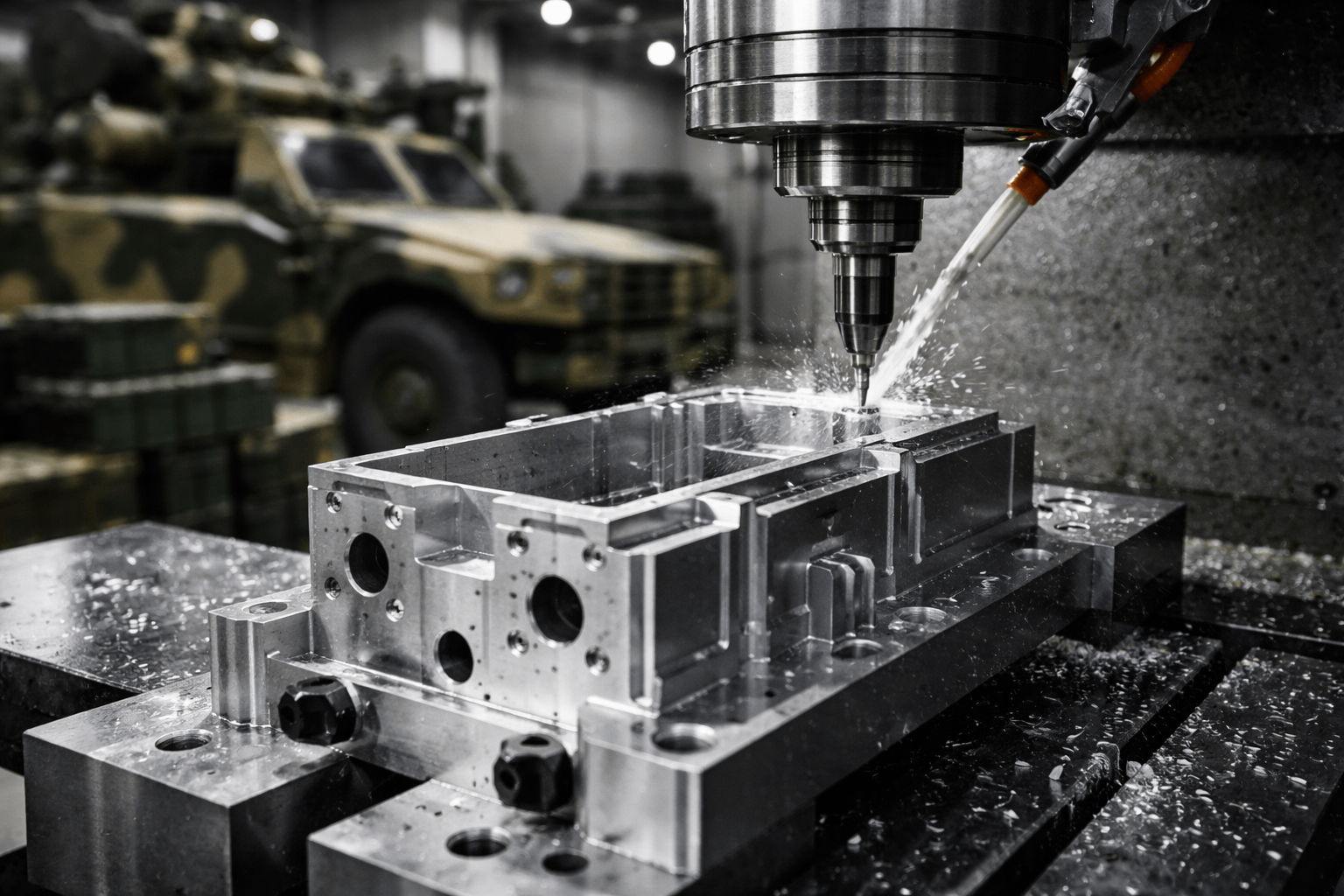
Introduction: Why Serious Buyers Look Beyond the Drawing
In the defense industry, a part is rarely judged only by what is printed on a technical drawing. For overseas wholesalers, OEM sourcing teams, and system integrators, the real evaluation starts with a different question: can this supplier deliver stable, repeatable machining outcomes across batches, timeframes, and design revisions?
When procurement professionals search phrases like “defense CNC machining supplier,” “tight tolerance CNC machining,” or “precision machining for defense applications,” they are usually screening risk. They want confidence that dimensional accuracy will hold up after finishing, after coating, after assembly, and after the first thousand parts—not just on a single sample.
This article takes that procurement-led perspective. Instead of repeating generic benefits, it explains how machining precision, variability control, inspection evidence, and documentation discipline connect to what buyers actually measure: approval speed, rework rate, on-time delivery, and lifecycle reliability.
Precision as Functional Performance, Not a Marketing Claim
In defense-related programs, precision is not a decorative metric. A tolerance such as ±0.01 mm is only meaningful if it is repeatable, measurable, and tied to function. Buyers who have lived through integration problems know the difference between “parts that measure” and “parts that assemble and survive.”
Dimensional accuracy becomes assembly behavior
Dimensional accuracy affects how components align, transfer load, and respond to stress. A slight positional deviation in a bore can shift bearing clearance. A minor flatness variation can introduce unintended preload on a gasketed joint. These shifts may not trigger immediate rejection, but they can change vibration patterns, heat generation, or wear behavior over time.
This is where tolerance stack-up matters. In real assemblies, many parts contribute to a single functional condition. Ten parts can each be “in tolerance,” yet the assembled system can drift outside functional range if the stack-up is not controlled or if the process is not centered.
Procurement teams care about this because stack-up issues often appear late—during integration testing—when schedule pressure is highest. A stable process, centered around the nominal, reduces that late-stage risk.
Surface finish is a reliability variable
Surface integrity reinforces this point. Surface roughness influences sealing performance, coating adhesion, friction coefficients, and fatigue initiation. In sliding interfaces, a surface that is too rough can accelerate wear. In coated components, a surface that is inconsistent can reduce adhesion and corrosion resistance.
Even edge condition (burrs, sharp corners) affects assembly time and field maintenance safety. For wholesale buyers, the practical takeaway is simple: a supplier who controls both geometry and surface condition is easier to qualify and more predictable to scale.
That is the importance of CNC machining in the defense industry in commercial terms: fewer surprises between prototype approval and volume shipments.
Understanding Variability: The Core of Risk Management
Every machining process contains variables. What differentiates mature defense machining operations is not the absence of variability, but disciplined control of it—so results remain predictable from shift to shift and batch to batch.
Thermal distortion: the hidden driver of drift
Thermal distortion is one of the most common sources of dimensional drift. During cutting of hardened steel, titanium, or high-strength alloys, localized heat can cause temporary expansion. After cooling, geometry may shift, especially in thin-wall parts or asymmetric shapes.
Experienced process planning reduces this risk through staged roughing and finishing, controlled stock allowance, thermal stabilization, and toolpath strategies that balance heat input. For buyers, this is not academic.
Thermal control shows up in real metrics: stable CMM results, lower scrap rate, and fewer “dimension moved after finishing” surprises.
Tool wear: slow changes that become quality escapes
Tool wear introduces gradual deviation. As cutting edges degrade, surface finish and tolerance control change incrementally, and burr formation can increase. Without tool life management or statistical process monitoring, drift may only become visible after inspection nonconformities rise.
Procurement teams often see this as a supplier who starts strong and then “loses control” mid-run. The best defense machining suppliers treat wear as a predictable variable.
They define tool life limits, monitor key characteristics, and adjust before drift becomes a shipment hold.
Residual stress: accuracy today, deformation tomorrow
Residual stress is subtler. Clamping pressure, aggressive material removal, or uneven machining sequences can introduce internal stress. That stress may release later during heat treatment, coating, welding, or operational vibration, leading to deformation.
A supplier’s ability to explain mitigation—fixture design, balanced removal, intermediate stress relief, and verification after critical processes—signals deeper process understanding.
For defense-adjacent procurement, this reduces risk of late-stage rework and schedule disruption.
Material Behavior: Why Alloy Knowledge Matters in Procurement
Defense-related components frequently involve stainless steel, carbon steel, aluminum alloys, and other high-strength materials. Each material responds differently to machining forces, heat generation, and clamping conditions, so “material capability” is never just a list on a website.
Stainless steel: work hardening and heat management
Stainless steel is prone to work hardening. If cutting parameters are not optimized, the surface layer can harden during machining, reducing tool life and affecting surface integrity.
This matters for parts like ruggedized housings, brackets, and stainless steel enclosure components used in harsh environments. From a buyer perspective, inconsistent stainless machining often shows up as burr variation, surface inconsistency, or unexpected tool marks.
Those issues slow assembly and create inspection debate.
Carbon and galvanized steel: process sequencing and coating readiness
Carbon steel and galvanized steel components introduce surface preparation and finishing considerations. Machining strategy should align with downstream processes such as powder coating, plating, or passivation.
If not, the buyer may see adhesion issues, corrosion concerns, or dimensional shifts after finishing. For procurement, the key is predictability.
The supplier must control dimensional change across machining plus finishing, not just after machining.
Aluminum alloys: deformation control in thin walls
Aluminum alloys, especially in thin-wall aerospace-style parts, present deformation challenges. Improper fixture strategy, aggressive material removal, or poor sequencing can result in warping.
Maintaining dimensional stability requires careful clamping design, balanced removal, and sometimes machining in multiple passes.
Many defense-adjacent products also include aluminum enclosure designs for electronics where sealing surfaces and door alignment must remain stable. When a supplier understands deformation control, gasket compression and IP-rated sealing performance become easier to maintain.
A practical way buyers can compare “material experience”
Buyers do not need a metallurgy lecture. A more practical indicator is whether the supplier can describe, in plain language, how they manage heat, chips, tool wear, and distortion for your specified alloy and geometry.
That capability is often what separates a shop that can quote from a shop that can deliver.
Process Control and Verification: The Backbone of Buyer Confidence
In B2B defense supply chains, documentation is not administrative overhead; it is risk control. The fastest supplier approvals tend to go to shops that can produce clear evidence, not just confident claims.
Inspection capability: proving what matters
Buyers commonly request material certificates (MTR/CMTR) to confirm alloy grade and traceability. Dimensional inspection reports—often from CMM measurement—verify that key characteristics meet specified tolerances.
First article inspection (FAI) validates that the initial production run aligns with drawing intent. Many aerospace-adjacent customers prefer an AS9102-style format where applicable.
When procurement teams evaluate a defense machining supplier, they often focus on how critical features are controlled. Are key characteristics identified? Is the measurement method defined?
These details reduce disputes and shorten the path from prototype to repeat production.
Change control: preventing “silent shifts”
Beyond dimensional compliance, mature suppliers maintain revision control systems and change tracking logs. Silent drawing revisions or undocumented process adjustments can create downstream nonconformities.
Transparent change control protects both parties: the buyer avoids uncontrolled variation, and the supplier avoids being blamed for changes they did not authorize.
Documentation packages buyers often request
Below is a simplified overview of documents typically associated with defense-adjacent machining projects. Requirements vary by program and customer, but these items are common in procurement workflows.
| Documentation | Primary purpose | Why it helps wholesale buyers |
|---|---|---|
| Material certificate (MTR/CMTR) | Confirms alloy and lot | Reduces raw material risk and supports traceability |
| Dimensional inspection report | Verifies key features | Speeds approval and supports audits |
| First Article Inspection (FAI) | Validates initial run | Reduces launch uncertainty and rework loops |
| Process record (as required) | Captures critical steps | Improves root-cause analysis and accountability |
| Change control log | Tracks revisions | Prevents uncontrolled deviation across repeat orders |
| Packaging / labeling spec | Prevents transit damage | Supports consistent receiving and inventory handling |
Procurement teams prefer these packages because they simplify internal review, support compliance needs, and reduce back-and-forth during acceptance.
CNC Machining Compared with Alternative Manufacturing Methods
Casting, forging, stamping, and additive manufacturing each play a role in defense manufacturing. However, final dimensional control frequently relies on subtractive machining, especially for tight positional tolerances and functional surfaces.
CNC finishing as the final quality gate
Near-net shape processes reduce material waste and initial shaping time, but they rarely achieve refined surface finishes or precise true-position control without secondary machining.
CNC finishing corrects geometry, aligns critical features, and ensures surface consistency. For buyers, this clarifies responsibility.
The supplier performing final machining usually owns final dimensional accountability.
Prototyping and flexibility: why machining stays relevant
For projects requiring prototyping and flexibility, machining offers adaptability without extensive tooling investment. When specifications evolve—as often occurs in defense development cycles—machining processes can adjust more efficiently than tooling-dependent methods.
This matters for overseas wholesalers because revision changes are common. Enclosure cutouts change with connectors.
Mounting features are updated for new brackets. CNC machining supports controlled iteration while preserving traceability between revisions.
The Role of CNC Machining in Supply Chain Stability
The defense industry is particularly sensitive to supply chain reliability. For overseas buyers, accuracy is important, but schedule predictability and communication clarity often decide whether a supplier becomes a long-term partner.
Process stability supports delivery stability
Stable machining processes reduce scrap rates and limit corrective action cycles. When processes are predictable, delivery timelines become more reliable.
Reduced variability supports better production planning and fewer last-minute adjustments.
Buyers experience this as fewer shipment holds, fewer urgent engineering reviews, and fewer “can you sort parts locally” emergencies.
Process stability is a commercial advantage because it reduces management overhead on the buyer side.
A buyer-oriented view of what drives lead time
Lead time is rarely just machine time. It is influenced by material availability, fixture readiness, programming capacity, inspection throughput, and finishing coordination.
When a supplier can explain these drivers clearly, buyers can plan inventory and buffers more intelligently.
| Lead-time driver | What it affects | Typical buyer question |
|---|---|---|
| Material availability | Start date | Is there an approved equivalent material if the preferred grade is delayed? |
| Programming & setup | First-run timing | Can you support fast DFM feedback before cutting metal? |
| Inspection throughput | Release timing | Will CMM capacity become a bottleneck at volume? |
| Finishing coordination | Final shipment | Who owns dimensional verification after coating or plating? |
| Packaging & logistics | Transit risk | What packaging spec prevents damage for overseas shipping? |
This is where a machining supplier becomes part of supply chain management rather than a simple job shop.
Minimal brand note, aligned with buyer expectations
YISHANG works with overseas wholesale buyers who need repeatable metal parts, clear inspection evidence, and stable delivery planning. The value is not in a slogan.
It is in process transparency that buyers can verify through documentation and results.
How Procurement Teams Evaluate Defense Machining Suppliers
Online searches may begin with broad phrases like “what is CNC machining” or “importance of CNC machining,” but serious procurement quickly shifts from definitions to evaluation.
What buyers look for in the first five minutes
Most B2B buyers skim. They scan for signals that the supplier understands risk and can support qualification.
That includes: clear discussion of repeatability, understanding of key characteristics, realistic documentation support, and practical language about process control.
They also look for responsiveness. In procurement, slow clarification equals project delay.
Suppliers who answer technical questions clearly—without overpromising—tend to earn trust faster.
Questions that reveal supplier maturity
Instead of asking for a long equipment list, buyers often ask a few targeted questions. How do you control thermal drift on thin walls?
How do you manage tool wear and burr consistency? How do you verify true position and flatness?
What changes require re-FAI? What inspection data can you provide with each shipment?
A supplier that can answer these questions in plain terms—supported by process evidence—usually has a more mature system than a supplier who only repeats “high quality.”
Linking Precision to Lifecycle Reliability
Precision machining influences structural reliability across the lifecycle of a component. Accurate load distribution, consistent assembly alignment, and stable surface finish contribute to fatigue resistance and predictable performance.
Minor dimensional drift can amplify under vibration or thermal cycling. Over time, that amplification can lead to premature wear, leakage, or system imbalance.
This is why defense programs pay for stability. They are buying predictable behavior under unpredictable conditions.
For wholesalers supplying ruggedized housings, brackets, frames, or enclosure assemblies—including IP-rated or NEMA-style configurations in defense-adjacent equipment—reliability is not abstract.
Field issues often trace back to upstream process variation: a sealing surface that is not flat enough, a hinge alignment that drifts, or a mounting pattern that creeps over batches.
When a machining supplier controls variability, buyers see fewer returns, fewer containment actions, and more stable downstream assembly.
That stability is the practical payoff of precision machining for defense applications.
FAQ: Quick Answers Buyers Often Search Before Sending an RFQ
What is “defense CNC machining” in practical terms?
In procurement language, “defense CNC machining” usually means a workflow that can hold tight tolerances repeatedly, provide traceable material documentation, and support structured inspection reporting.
The parts may be for defense programs or for defense-adjacent equipment, but the expectations are similar: stable batch output, controlled process changes, and evidence that critical features were verified.
How tight are “tight tolerances” for defense components?
There is no universal value because requirements depend on function, material, and assembly stack-up. Many buyers will see general tolerances on drawings, and then tighter tolerances on key characteristics such as true position, flatness, or coaxiality.
A practical sourcing approach is to identify the features that drive assembly fit and performance, then confirm that the supplier can measure them reliably (often via CMM) and maintain capability through production.
What should I include in an RFQ to get an accurate quote and fewer surprises?
For tight tolerance CNC machining, include the latest drawing revision, material and finish requirements, annual volume or batch size, key characteristics (if known), preferred inspection format (for example, FAI/AS9102-style), and packaging expectations for overseas shipment.
This helps the supplier propose an appropriate process plan and prevents misalignment that can delay first delivery.
Conclusion: Precision as a Structured Approach to Risk Reduction
The importance of CNC machining in the defense industry lies in its contribution to predictability. Controlled dimensional accuracy, disciplined process management, and transparent verification reduce uncertainty for procurement teams.
For overseas wholesale buyers, precision machining is more than a fabrication method. It is a structured approach to risk reduction within complex supply chains—one that supports faster approvals, steadier deliveries, and stronger long-term reliability.
If you are evaluating machining partners for defense-related components, focus on process stability, inspection transparency, and material understanding. If it helps, share your drawing package, target tolerances, and documentation expectations.
Then the right supplier can respond with a clear, evidence-based plan—and you can move from inquiry to qualified supply with fewer surprises.