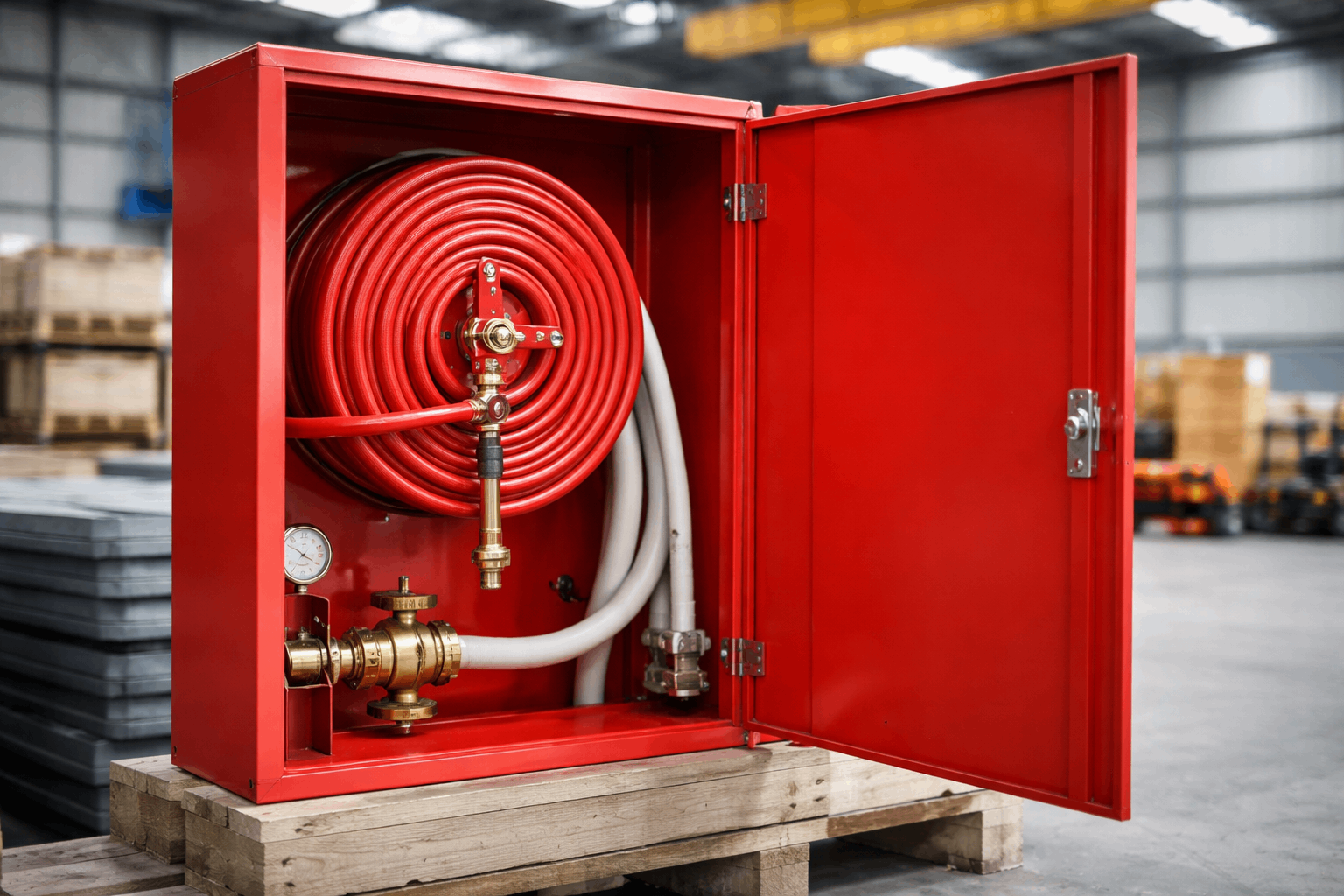
Overseas distributors and project wholesalers look at a fire hose cabinet through a very different lens than an end user. Your margin depends on repeatability: stable dimensions, consistent finish, predictable lead time, and documentation that clears project approvals without back-and-forth.
When buyers search for a fire hose cabinet supplier in China, or compare a custom fire hose cabinet manufacturer, the hidden question is usually: will this become a claim after shipment. A cabinet that needs on-site adjustment, shows early corrosion, or arrives with transport damage turns a good price into rework labor, credit notes, and replacement freight.
This guide stays practical. It connects structural design choices and sheet metal fabrication controls to the wholesale outcomes you care about: fewer complaints, faster installation, lower warranty exposure, and smoother reorders. It is written in procurement language—MOQ, tolerance, AQL, coating thickness in microns, salt spray hours, inspection reports, and export packaging—because that is how professional buyers actually evaluate suppliers.
What Wholesale Buyers Actually Evaluate When Comparing Suppliers
The Three Risk Layers Behind Every RFQ
A practical mindset starts with one question: can you predict outcomes. When a supplier clearly explains how they control thickness, bending accuracy, welding distortion, coating, inspection, and packing, fewer surprises occur. Without that clarity, risk increases and you must price that uncertainty into your decision.
If you serve contractors or facility developers, you are selling consistency as much as you are selling cabinets. That is why experienced wholesalers do not start with features. They start with three risk layers: structural reliability, batch consistency, and delivery execution.
Structural reliability is about long-term alignment: the door opens smoothly year after year, hinges do not loosen prematurely, and the frame stays square after installation. Batch consistency is about whether an approved sample truly represents the full container load. Delivery execution is about whether products arrive undamaged, correctly labeled, and supported by the paperwork your customer expects.
In many metal cabinet categories—including hose cabinets, extinguisher cabinets, and even electrical enclosures—the most expensive disputes are not caused by a wrong design. They come from variation: a run where the door gap drifts, a batch where coating is thinner than usual, or packaging that lets corners get dented. These are control problems, not concept problems.
A useful way to read supplier websites is to look for signals of control. Do they discuss tolerance, inspection criteria, and packaging method, or only show photos and claim high quality. The first group tends to be easier to scale with because they think like manufacturers. The second group may still deliver good products, but your risk is higher because important details are undefined.
Commercial Fit and Operational Alignment
Wholesalers also evaluate whether a supplier can support the way they sell. That includes practical constraints such as MOQ, carton quantity per pallet, container loading plan, and whether the factory can hold a stable configuration for repeat orders. If you sell into multiple countries, you may need the same cabinet in two packaging standards or with different labeling, and that is a coordination task, not just production.
Search behavior reflects this commercial intent. Phrases like fire hose cabinet price in China, bulk order fire hose cabinet, or get instant quote usually indicate that the buyer is building a comparison set. Your content performs better when it explains what makes quotes truly comparable, such as whether steel thickness includes tolerance, whether coating thickness is defined, and whether packaging is included in the quotation scope.
To keep this evaluation grounded, wholesalers often summarize requirements in procurement-ready terms: target steel thickness with tolerance, critical dimensions with allowable deviation, coating system with measurable thickness, functional checks for door operation, and a pre-shipment inspection plan. You do not need to over-engineer the RFQ. You just need enough definition that quality is verifiable.
Product Configurations Most Frequently Requested by Wholesalers
Before going deep into structure and materials, most wholesalers first want to confirm one practical point: what configurations are realistically available and commonly supplied in bulk. In global RFQs, more than 80 percent of inquiries fall into a limited number of configuration patterns. Mapping these early reduces back-and-forth and improves quotation comparability.
The most common configuration split is by installation type: surface-mounted fire hose cabinet and recessed fire hose cabinet. Surface-mounted units simplify installation and are widely used in retrofit projects. Recessed units are preferred in new construction where corridor clearance and visual integration matter. Recessed models demand tighter dimensional control because wall openings are pre-defined.
Door configuration is the second variable. Single door cabinets dominate smaller hose reel applications. Double door fire hose cabinets are frequently specified when internal space must accommodate both a fire hose reel and additional equipment. Glass window doors remain popular for quick visual inspection, while solid doors are selected in environments where impact resistance or privacy is preferred.
Below is a simplified configuration map often seen in wholesale RFQs:
| Configuration Type | Typical Use Case | Key Procurement Focus |
|---|---|---|
| Surface-mounted single door | Retrofit and light commercial | Mounting hole alignment, packaging stability |
| Recessed single door | New commercial buildings | Tight dimensional tolerance |
| Double door cabinet | Large hose or combined equipment | Reinforcement and hinge load capacity |
| Hose reel cabinet with glass | Visual inspection priority | Glass thickness and door rigidity |
Confirming configuration first allows buyers to align thickness, reinforcement, coating, and packaging requirements more accurately. Once this framework is clear, structural evaluation becomes meaningful rather than abstract.
Structural Design: Thickness, Reinforcement, and Long-Term Stability
A fire hose cabinet is a fabricated metal assembly that must stay dimensionally stable under repeated door cycles, anchor loads, and environmental variation. Whether it is a wall-mounted fire hose cabinet or a recessed fire hose cabinet, the door must remain aligned and easy to open, because access speed matters in emergencies and user frustration drives complaints.
Door sagging is one of the most common field issues in lower-spec units. It typically traces back to one of three root causes: steel thickness too light for the door span, insufficient reinforcement, or hinge support concentrated on thin sheet metal edges. In wholesale projects involving hundreds of units, even a small percentage of sagging doors can create cumulative site delays and escalation calls.
Steel thickness is the first control parameter most buyers lock down. In mainstream commercial projects, 1.0 mm cold-rolled steel is a frequent baseline because it balances rigidity and cost. Industrial facilities, schools, transportation hubs, and high-traffic sites often move to 1.2 mm for extra stiffness. Some economy lines use 0.8 mm, but that only works reliably if reinforcement is well designed and manufacturing tolerance is well controlled.
Thickness alone does not guarantee performance. Reinforcement geometry often matters more than the headline gauge. Folded edges around the door perimeter, internal stiffening ribs, and reinforced hinge plates distribute stress and reduce panel flex. A flat, unsupported door panel—whether mild steel or stainless—behaves like a large thin plate. Over time it will deflect. A properly reinforced panel behaves like a boxed structure and stays stable.
Why reinforcement is a procurement item, not an engineering detail
Many suppliers quote steel thickness and stop there. For wholesale buyers, it is worth treating reinforcement as part of the written spec. A simple way is to request photos of the door interior and the hinge mounting area on the sample. If you see a continuous hem, stiffening ribs, or a hinge backing plate, you are looking at a more stable design. If the inside is mostly flat sheet, you should expect a higher probability of door alignment drift.
Common thickness choices and what they imply
| Nominal steel thickness | Typical wholesale positioning | Practical implication |
|---|---|---|
| 0.8 mm | Economy indoor distribution | Requires strong reinforcement to avoid sag |
| 1.0 mm | Mainstream commercial | Balanced stiffness and cost for repeat orders |
| 1.2 mm | Industrial or high-traffic | Lower deformation risk and better long-term feel |
This table is intentionally pragmatic. It does not replace your project spec. It helps you align the cabinet’s structural margin with your customer’s expectations and claim tolerance.
Material Strategy and Environmental Matching
Material selection is often oversimplified into mild steel, galvanized steel, or stainless steel. For wholesalers, the better question is: what environment will this cabinet live in, and what does my customer consider acceptable aging.
Powder-coated cold-rolled steel is cost-effective for controlled indoor environments such as offices, residential corridors, and many commercial interiors. A galvanized steel cabinet provides extra corrosion protection through a zinc layer and is often a safer choice in moderate humidity or semi-exposed areas. Stainless steel fire hose cabinets—commonly 304, and 316 for more aggressive exposure—perform best in coastal regions, chemical environments, food-related facilities, or places where frequent cleaning is expected.
Corrosion performance should be measured, not assumed. The two procurement-friendly metrics are coating thickness, usually expressed in microns, and salt spray test duration. Coating thickness gives a direct sense of film robustness. Salt spray hours provide a standardized comparison point when the market expects it. For indoor commercial projects, 60 to 80 microns is a common target range for powder coating; for harsher environments, buyers often request higher film thickness and stronger pretreatment.
Why anti-rust claims are not enough for wholesale business
Generic claims are hard to defend when a customer calls with rust photos. A small shift toward verifiable language reduces disputes. Ask suppliers how they measure coating thickness, where they measure it, flat panel, edge, welded area, and whether records are kept per batch. It is not about distrust. It is about making quality measurable so both sides can manage it.
In addition, edge protection deserves attention. Corrosion often starts at cut edges and weld seams. A cabinet can pass a quick visual check yet still be vulnerable if edges are thinly coated. This is why suppliers with stable surface preparation and controlled curing tend to perform better long term, even when the material is the same.
For wholesalers building a product line, consider segmenting by environment rather than by material label. For example: indoor economy powder-coated steel, indoor premium powder-coated steel with tighter control, semi-exposed galvanized, and coastal stainless. This aligns with how buyers search long-tail terms like stainless steel 304 fire hose cabinet, galvanized steel fire hose cabinet for outdoor use, surface-mounted fire hose cabinet, or recessed fire hose cabinet supplier. It also reflects how contractors evaluate risk at the project level.
In addition to material, wholesalers frequently ask about standard finish expectations. RAL 3000 (fire red) remains common in many markets, but some regions request neutral colors for architectural integration. Defining finish early avoids production delay caused by powder batch change or color approval cycles.
Manufacturing Process Control and Batch Consistency
From Cutting to Welding: Where Variation Starts
Many buyers use search phrases like laser cutting, CNC bending, or welding quality—even in adjacent categories such as electrical enclosures, junction box NEMA, NEMA 4X enclosure, or push button enclosure products—because the underlying concern is the same: process control.
Laser cutting accuracy influences hole positioning, hinge alignment, and repeatable door gaps. CNC bending precision drives frame squareness and consistent mounting depth. Welding sequence and heat input control distortion and seam integrity. If any of these steps drift during production, the cabinet may still look fine but install poorly, or show variability across a batch.
Managing Drift in Bulk Production
In wholesale orders, the risk is not one defective unit. The risk is gradual drift: the first 50 units match the sample, the next 300 shift by a millimeter, and suddenly recessed installations require on-site grinding or shimming. Factories prevent drift with fixtures, calibrated tooling, and checkpoints that detect deviation early.
What batch consistency looks like in practice
Batch consistency is a system. It usually includes incoming material verification, first-article inspection after setup, in-process checks at defined intervals, and final inspection before packing. Many wholesalers use AQL sampling to keep inspection efficient while still controlling risk.
A practical AQL reference table for sheet-metal cabinets:
| Scenario | Typical sampling approach | Why it fits wholesale reality |
|---|---|---|
| New supplier or new design | Stricter sampling, more measurements | You are validating capability, not just product |
| Repeat order, stable history | Standard AQL sampling plus key dimension checks | Maintains control without slowing shipping |
| High-risk project, tight recess fit | Focused checks on critical dimensions | Prevents installation friction and labor claims |
You can ask a supplier how they prefer to align inspection. The goal is not to impose your method. The goal is to agree on what will be checked so everyone’s expectations match.
Tolerance Definition and Documentation Transparency
A good rule for wholesale RFQs is to define only what actually drives cost and installation risk. Start with critical dimensions and the door system, then add corrosion and packaging requirements if the destination environment demands it. This keeps the document lean while still preventing surprises that trigger claims.
Many disputes start with incomplete specifications. A cabinet size without tolerance is not a full specification. For a recessed fire hose cabinet, even small deviation can cause the frame to sit proud or require wall modifications. For a wall-mounted unit, misaligned holes can slow installation and trigger contractor complaints.
Professional buyers reduce ambiguity by defining critical dimensions and acceptable deviation. You do not need a long document. Often it is enough to identify the few dimensions that drive installation—overall width and height, mounting hole pattern, recess depth, and door clearance—and state tolerance expectations. This converts subjective quality into measurable acceptance.
Coating thickness measurement, hinge model, lock performance, and glass type are also common sources of misunderstanding. If these items are unspecified, suppliers may substitute components based on availability. Substitution is not always negative, but it becomes negative when it changes customer expectation or increases variability.
What documentation actually protects in wholesale transactions
Documentation is not paperwork for its own sake. It is a risk-control tool. Material certificates reduce disputes about grade. Coating thickness records help explain durability. Batch inspection reports help isolate issues. Packaging photos help validate shipment condition.
When you receive an inspection report, focus on a few measurable items: overall dimensions, mounting hole pitch, door gap and smooth opening, coating thickness readings, and visual checks for weld spatter or sharp edges. If the supplier cannot explain how those items are measured, the report is less useful. If they can, you gain a shared basis for acceptance.
| RFQ control point | How wholesalers usually define it | What it prevents |
|---|---|---|
| Critical dimensions | List 3 to 6 dimensions with tolerance | Recess fit issues and on-site rework |
| Door clearance | Target gap range and smooth operation | Sticky doors and complaint calls |
| Coating thickness | Target microns with measurement method | Early corrosion and finish disputes |
| Hardware | Hinge and lock model or performance | Inconsistent feel and lifespan |
If your buyers work in regulated project environments, they may request an inspection report, a material inspection certificate, or proof of ISO 9001 process discipline. Even when formal certification is not required, the habit of documenting process is a strong signal of a manufacturer that can deliver repeatability.
Wholesalers also benefit from a simple approval loop: drawing confirmation, sample sign-off, pre-shipment inspection, and final packing confirmation. This is not slow if managed well. It is faster than handling a claim later.
Packaging Engineering and Shipping Risk Reduction
Why Transit Damage Erases Margin
Packaging is frequently underestimated in cost analysis, yet it is one of the most common sources of wholesale loss. A cabinet can be structurally correct at the factory and still arrive with bent corners, scratched stainless surfaces, chipped powder coating, or shifted doors after sea freight vibration.
Sheet metal products behave like thin shells during transport. Corners take impact, edges rub, and doors can flex. Packaging engineering is the practice of preventing those failure modes with simple, repeatable protections: corner guards, internal bracing, protective film, carton reinforcement, and pallet stabilization.
Moisture control matters as well. Corrosion can initiate inside packaging when humidity is trapped, especially on long routes or when containers face temperature cycling. A moisture barrier and sensible desiccant use can reduce this risk. These solutions cost little compared to the expense of replacing damaged units or negotiating partial refunds.
Container Loading as a Quality Variable
For bulk shipments, container loading is part of quality. Over-stacking pallets can compress cartons and distort cabinet frames. Under-bracing can allow sliding that damages corners. A supplier that can provide a simple loading diagram, pallet height limits, and carton stacking rules reduces the chance of transit damage.
If your destination involves multiple handling points—port, warehouse, last-mile delivery—ask how the packaging performs under real handling. Reinforced pallets, stretch wrapping, and corner posts are small upgrades that often pay back quickly. For stainless surfaces, protective film and separation layers reduce micro-scratches that otherwise trigger cosmetic claims.
A practical packaging checkpoint table
| Packaging element | What it prevents | Why wholesalers care |
|---|---|---|
| Corner protection | Dents and deformation | Prevents installation complaints |
| Door immobilization | Door shift and gap change | Maintains consistent fit on arrival |
| Protective film | Scratches, especially on stainless | Reduces cosmetic claims |
| Pallet stability | Crushing and carton collapse | Supports safe handling at ports |
Well-packaged goods reduce claims and shorten the time from arrival to installation. For wholesalers, that directly improves cashflow and reduces operational interruptions.
Cost Structure and Total Ownership Perspective
Wholesale buyers naturally compare price. Many RFQs use short, price-focused wording that centers only on unit cost. Price matters, but unit price alone does not reveal thickness, reinforcement design, coating system quality, inspection rigor, or packaging discipline.
Lower quotes often come from invisible reductions: thinner steel, simplified reinforcement, lighter coating thickness, lower-grade powder, faster welding without distortion control, or minimal inspection. None of these are obvious in a one-line quotation, and some may still be acceptable for certain markets. The problem is when a low-cost configuration is sold into a market that expects premium durability.
A more useful pricing conversation is to connect price bands to performance bands. For example, an economy indoor cabinet line might target 0.8 mm with defined reinforcement and a controlled coating system. A mainstream line might be 1.0 mm with tighter tolerance checks. A premium line might add higher corrosion protection or stainless material. This creates a transparent value ladder for your customers and reduces disputes because expectations are aligned.
To make quotations comparable, align the scope. Two quotes may look similar while one includes thicker material, stronger reinforcement, higher coating thickness, and a stricter inspection plan. If you are comparing suppliers, ask them to price two configurations: an economy spec and a mainstream spec. This gives you a clear performance-to-price ladder you can sell to different customer segments.
A practical example: a buyer selects an ultra-low quote for a wall-mounted cabinet line. After arrival, 8 percent of units show corner dents due to weak packaging and 5 percent have door rub from bending variation. Even if the unit price was lower, the combined cost of sorting, replacements, and customer concessions often erases the savings. Total cost thinking is not theoretical. It is a wholesale survival strategy.
Wholesalers increasingly evaluate total cost of ownership. That includes warranty exposure, replacement probability, freight risk, and customer retention. In many cases, a slightly higher ex-works price produces a lower total cost because the product generates fewer claims.
Customization and OEM Alignment
Custom fire hose cabinet projects are common in wholesale distribution, but customization is where risk often increases if the process is not disciplined. Changing dimensions affects bending sequences, reinforcement layout, and sometimes packaging. Adding a hose reel, a swing system, or a specific mounting method changes load and clearance.
For OEM work, the safest approach is to treat customization as an alignment process, not a quick change request. A structured drawing confirmation—sometimes supported by a simple 3D model—helps identify conflicts before production. This is especially important when cabinets must match site recess sizes or when a customer expects a specific door opening direction.
Branding and surface finish customization can be straightforward, but it should not compromise structural performance. For example, changing a window cutout size affects door stiffness; changing handle placement affects stress concentration; changing coating color may require different powder parameters. These are not problems. They are variables that need control.
For wholesalers, customization is usually driven by installation reality. Contractors may need a different recess depth, a specific hose reel clearance, or a door swing direction that matches corridor flow. Some projects request a combined unit that stores a hose and a fire extinguisher, effectively blending hose cabinets and extinguisher cabinets in one layout. These changes affect reinforcement and must be reviewed as structural decisions.
A smooth OEM workflow typically includes drawing review, a prototype or pre-production sample, and an agreed inspection plan for the first batch. Buyers often ask for a technical drawing package or a catalog download of standard sizes, then modify from a proven base. This reduces risk compared with starting from a blank design.
Long-tail searches often reflect these needs: custom recessed fire hose cabinet, fire hose reel cabinet with glass door, wall-mounted hose cabinet OEM, double door fire hose cabinet, or steel fire hose cabinet for corridor use. By addressing these realities, your content speaks directly to procurement intent and supports higher conversion.
Certification, Traceability, and Market Expectations
Not every market requires the same certifications for hose cabinets. Some projects demand specific approvals; others prioritize basic documentation and consistent quality systems. What wholesalers need is clarity: what can the supplier provide, and how will it be verified.
If you sell into markets that demand formal certification, clarify early what is required and what is not. Some buyers confuse hose cabinets with electrical enclosures that carry NEMA ratings. In practice, project teams may still ask for evidence of corrosion suitability or quality systems rather than a specific enclosure rating. Being precise avoids delays in submittal approvals.
Traceability is a practical advantage. When a batch has an issue, traceability allows faster root cause correction. Material batch tracking, inspection records, and process logs shorten the time from problem to solution. That protects your customer relationships because response speed matters in B2B.
Many buyers are familiar with enclosure standards such as NEMA ratings for electrical enclosures, NEMA 12 enclosure, NEMA 4 enclosure, and NEMA 4X enclosure. While hose cabinets do not typically use NEMA labeling, the mindset is relevant: environment classification should drive material and coating choice. When you sell into wet, dusty, or coastal conditions, your cabinet specification should reflect that exposure.
A balanced supplier conversation avoids overpromising. It is better to state what documentation is available—ISO 9001 process control, RoHS where relevant, material certificates, inspection reports—than to imply certifications that are not held. Clear communication builds trust and supports long-term business.
One more wholesale reality: some customers will not read long narratives, but they will scan for the word report. If your supplier can attach a concise inspection report and a packing photo set to every shipment, your customer’s approval cycle becomes faster. Faster approval improves your cash conversion, which is an underrated advantage in distribution.
Building Sustainable Wholesale Partnerships
Stability Over Single Transactions
Wholesalers rarely want one good shipment. They want a repeatable product line they can sell for years. Sustainable partnerships form when the supplier can deliver stable quality and when both sides share clear control points: thickness and tolerances, coating targets, inspection method, packaging standard, and lead-time planning.
Production scheduling matters more than many websites admit. A supplier with disciplined planning can keep lead times stable even during peak seasons. That reduces your need for buffer inventory and avoids expensive expedited shipments. In practice, the best partnerships involve simple routines: forecast discussion, reorder cadence, and early notice of material changes.
Wholesalers also watch how suppliers handle change. Steel prices move, powder batches change, and hardware availability fluctuates. A reliable supplier communicates proposed substitutions in advance, explains the impact on performance, and waits for approval instead of changing silently. That behavior reduces surprises and protects your relationship with your customers.
Over time, repeat orders become easier when the product is frozen with a controlled bill of materials and a known inspection routine. Some wholesalers keep a simple master sample or a signed drawing revision as the reference. The point is not bureaucracy. It is consistency.
Communication style matters too. B2B buyers generally prefer short, precise updates: drawings confirmed, sample ready, inspection booked, packing completed, shipment loaded. That rhythm reduces uncertainty without creating information overload.
For high-volume lines, it is worth aligning on a simple service level: target lead time by order size, response time for technical questions, and how quickly corrective actions are issued if a defect is found. This is the same discipline wholesalers use when they qualify other industrial business supplies partners.
Finally, partnerships improve when communication matches the way procurement teams work. Short updates, clear subject lines, and named attachments like inspection report and packing list make it easier for buyers to forward information internally. That reduces friction and increases the chance of repeat orders.
YISHANG works with overseas wholesalers who prioritize repeatability and controlled manufacturing. If you are qualifying suppliers, you can use the verification ideas in this guide—tolerance definition, coating measurement, inspection alignment, and packaging standards—to reduce risk and speed up supplier approval.
Frequently Asked Procurement Questions
These questions come up repeatedly in wholesale RFQs and during supplier qualification. They are written in the same way buyers usually ask them, because clarity at this stage prevents misunderstanding later. If you already have a project specification, you can map each answer to your RFQ so the supplier replies in measurable terms.
What MOQ and packaging unit should wholesalers expect
MOQ depends on cabinet size, material, and whether custom tooling is required, but wholesalers often negotiate around carton quantity per pallet and pallet quantity per container, not only unit count. Aligning the packaging unit early helps you estimate warehouse space, break-bulk handling, and last-mile delivery cost.
What lead time is realistic for bulk orders
Lead time is usually driven by material availability, surface finishing capacity, and the supplier’s production schedule. For repeat designs, stable factories can offer predictable lead times; for new OEM designs, add time for drawing confirmation and a pre-production sample. Ask the supplier to state lead time in a range by order volume rather than a single number.
How do we qualify a supplier without visiting the factory
Video walk-throughs help, but the strongest remote signals are repeatable documents: a clear process flow, recent inspection reports with measurements, coating thickness records, and packing photos from real shipments. When suppliers can provide these quickly, it suggests the system exists rather than being created ad hoc.
What should we specify for a fire hose reel cabinet or swing system design
If the cabinet includes a fire hose reel, hose swing system, or special clearance requirements, specify the reel dimensions, mounting points, hose outlet direction, and door opening angle expectations. These details affect reinforcement and hinge loading, and they are best confirmed before bending and welding start.
How do we compare stainless steel versus galvanized steel for our market
For coastal or chemical exposure, stainless often delivers more stable appearance over time. For moderate humidity, a well-specified galvanized plus coating approach can be cost-effective. The key is to compare measurable controls—coating thickness, edge treatment, and inspection method—rather than relying only on the material name.
What inspection approach reduces disputes on first orders
Many wholesalers use a tighter inspection plan on the first order, focusing on critical dimensions, door operation, coating thickness, and packaging. After stability is proven, the plan can shift to standard AQL sampling with targeted checks. This keeps quality controlled without slowing shipping.
Common Dimensions and Specification Anchors in Bulk RFQs
Although dimensions vary by market, wholesalers often encounter recurring size ranges in project documentation. Typical wall-mounted cabinets frequently fall within mid-range width and height proportions suitable for standard hose reels. Recessed cabinets often follow predefined wall cavity depths, which makes tolerance management critical.
Instead of memorizing fixed numbers, experienced buyers focus on specification anchors: overall width and height with tolerance, recess depth, mounting hole pitch, door opening angle, glass thickness if applicable, and lock type. Quarter-turn locks and simple keyed locks are common in many distribution markets, but defining the hardware model prevents inconsistent feel across batches.
Providing these anchors in the RFQ does not overcomplicate the process. It improves quote comparability and reduces clarification cycles. When suppliers respond with clear dimension tables and drawing confirmation, approval moves faster.
How to Structure a Clear RFQ for Fire Hose Cabinets
Wholesalers do not need a long technical file to begin. A concise, structured inquiry usually generates more accurate quotations than a vague request for price.
A practical RFQ outline may include:
• Installation type: surface-mounted or recessed
• Approximate size or drawing reference
• Target steel thickness or performance level
• Surface finish and color requirement
• Quantity and destination port
• Packaging expectation (palletized, carton specification, labeling)
This level of detail allows the supplier to prepare a configuration-based quotation rather than a generic estimate. It also ensures that when you compare multiple fire hose cabinet suppliers in China, you are evaluating equivalent scope.
Conclusion
For overseas wholesalers, the best supplier decision is the one that keeps your operation calm: fewer escalations, fewer rework conversations, and fewer surprises at the destination port. That calm outcome is built upstream by controlling a small set of variables—thickness with tolerance, reinforcement design, coating performance with measurable thickness, stable fabrication processes, transparent inspection, and packaging that protects geometry.
The advantage of using a manufacturing-based evaluation framework is that it scales. You can apply the same control points whether you are buying a single container for a new market or building a long-term line of hose cabinets, extinguisher cabinets, and related sheet metal products. It also fits how buyers search today. High-intent long-tail searches—such as bulk order fire hose cabinet, fire hose cabinet price in China, recessed fire hose cabinet supplier, or stainless steel 304 fire hose cabinet—are really requests for predictable outcomes. When your content answers those requests with clear, verifiable guidance, it earns trust and converts better.
If you would like a quotation that matches your market positioning, share your drawing or preferred standard size, target thickness, destination environment, and packing requirement. YISHANG can respond with a configuration-based quote so you can compare like-for-like and move quickly into sampling and production.
A supplier relationship that starts with clear control points usually becomes faster and easier with each reorder, which is exactly what wholesalers need to grow.