Servers are no longer confined to isolated data centers. Many organizations now deploy computing equipment directly in offices, laboratories, retail facilities, production sites, and monitoring rooms. Edge computing, localized data processing, and AI workloads often require servers to operate close to the teams that depend on them.
That shift improves responsiveness and simplifies operations, but it introduces a practical challenge that most projects meet sooner or later: server rack noise. A single enterprise server can generate significant sound due to high-speed cooling fans, power supplies, and airflow movement. When several machines run in one rack, noise levels often sit in the 65–80 dB range.
For people working nearby, the issue is not only comfort. Noise influences communication, concentration, and even the perceived quality of the workspace. For system integrators and wholesale procurement teams, it can become a project risk: complaints after installation, requests for rework, or a need to relocate equipment.
A custom soundproof server rack is designed to solve that exact problem without creating new ones. The enclosure must reduce acoustic leakage while keeping thermal performance stable, maintaining 19-inch rack compatibility, and supporting long-term service and upgrades.
This article explains the engineering logic behind a quiet server cabinet and how to evaluate an acoustic rack enclosure in a way that matches how B2B buyers search and source: with an eye on performance claims, installation constraints, reliability, and cost over the project lifecycle.
Understanding the Core Engineering Challenge
Sound reduction in a server enclosure is not a “seal it and forget it” task. The core challenge is the trade-off between noise reduction and thermal performance. Servers continuously convert electrical power into heat. In a typical deployment, a single 1U–2U server may dissipate 300–500 W, and a partially loaded rack can easily reach several kilowatts.
That heat must be removed reliably. Server cooling fans do this by moving air rapidly across heat sinks and internal components. The same airflow that protects hardware also creates noise: fan blade interaction, pressure changes, and turbulence around obstructions. In many racks, fan noise is the dominant source of sound energy.
A common failure mode in acoustic cabinet projects is focusing on insulation alone. If airflow is restricted—even slightly—internal temperature rises. The server’s control system responds by increasing fan speed, often pushing noise higher than before. The installation ends up “quieter at first,” then loud again under load, and eventually becomes a reliability concern.
A properly engineered soundproof rack takes a different approach. Instead of blocking airflow, the enclosure controls how air travels through the cabinet. Intake and exhaust paths are designed to maintain predictable flow while preventing direct sound transmission. Acoustic performance is achieved through controlled pathways, damping, and absorption—without forcing the servers to work harder.
For procurement teams managing multiple sites, this distinction matters. A quiet IT enclosure that compromises cooling is not a solution; it is a hidden cost. Good acoustic performance must come together with thermal stability.

Where Server Rack Noise Comes From
Noise inside a server rack rarely comes from one component. Several acoustic factors combine to create the overall sound level around the equipment. Understanding these sources makes it easier to evaluate whether a rack enclosure design is solving the real problem.
Fan-Generated Airflow Noise
Cooling fans are the most obvious contributor. Servers typically use multiple fans rotating at high RPM to maintain safe temperatures under varying workloads. As air moves across fan blades, grilles, and heat sinks, it produces broadband acoustic energy.
In racks with multiple servers, airflow noise becomes constant background sound. The important detail is how easily this sound escapes. If the enclosure has a straight “line of sight” from the fan area to the outside through vents or mesh doors, the noise leaves the cabinet with minimal attenuation.
Structural Vibration and Resonance
Mechanical vibration is another contributor. Hard drives, power supplies, and fan assemblies generate micro-vibrations during operation. Those vibrations transfer through the chassis into mounting rails and then into the cabinet frame.
If the cabinet uses thin panels or lacks damping, those panels can resonate. This is why some racks feel louder than the equipment itself. The enclosure becomes a secondary sound source, especially at certain frequencies that match panel resonance.
Airflow Turbulence
Turbulence occurs when fast-moving air encounters obstacles: cables, rails, sharp edges, or restrictive vent patterns. Pressure fluctuations create small disturbances that generate additional noise. In some installations, turbulence adds “hissing” or “whistling” tones that users find more annoying than the steady fan sound.
These three mechanisms—airborne noise, vibration, and turbulence—work together. Effective soundproof server rack design addresses all of them, not only the “add foam” part.

Why Conventional Rack Cabinets Often Fail to Reduce Noise
Most server cabinets are built around the universal 19-inch rack standard. This ensures compatibility for servers, switches, storage units, and power distribution systems. Each rack unit (“U”) is 1.75 inches high, enabling dense vertical stacking.
The standard is excellent for interoperability, but the typical cabinet built for data centers prioritizes airflow accessibility rather than acoustic control. Mesh doors, perforated panels, and open vent areas allow heat to escape, yet they also provide an easy path for sound waves to escape.
Another limitation is panel construction. Basic cabinets often use thin sheet metal to reduce weight and cost. Under continuous vibration, thin panels can resonate and amplify sound. Even if the rack is structurally safe, it may behave acoustically like a drum.
Conventional cabinets also lack internal absorption. Sound waves generated inside the rack reflect off metal surfaces and bounce around. This internal reverberation increases the energy that eventually exits through vents and seams.
For B2B buyers, the takeaway is practical: a standard rack cabinet typically organizes equipment well, but it is not a noise reduction server cabinet. If the installation environment is an office, studio, or control room, additional acoustic engineering is usually needed.
Engineering Principles Behind Acoustic Rack Enclosures
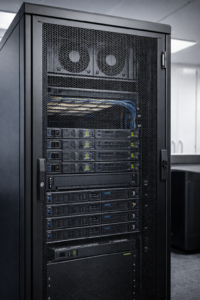
A soundproof server rack works when acoustic and mechanical design are integrated. The enclosure should function as a controlled system rather than a metal box with insulation.
Sound absorption is the first principle. Acoustic foam, composite insulation panels, and layered materials reduce reflections inside the cabinet. Instead of allowing sound to bounce and build up, absorption converts a portion of sound energy into heat. In practice, better absorption means less internal reverberation and less energy escaping the enclosure.
Vibration isolation is the second principle. Damping elements between mounting rails and the outer enclosure reduce the transfer of mechanical vibration into panels. Isolation can also be added at contact points, such as base mounts and panel interfaces, to reduce resonant response.
Airflow control completes the system. If a cabinet has vents that provide a direct sound path, noise will escape even with insulation. A well-designed acoustic cabinet routes intake and exhaust through indirect passages. Those passages allow air to move while disrupting the propagation of sound waves.
This is why a supplier’s phrase “soundproof rack including acoustic foam” is not enough to judge performance. Buyers generally get better outcomes when the design includes absorption, isolation, and controlled airflow as a single concept.
The Role of Airflow Design in Quiet Server Racks
Airflow engineering is the most critical component of a quiet server rack cabinet. Servers are designed around a predictable front‑to‑back airflow pattern. Cool air enters from the front, moves through the chassis across heat sinks, and exits from the rear. If a rack enclosure interferes with this pattern, cooling performance drops quickly.
That is why well‑designed acoustic racks never rely on insulation alone. Instead, they guide airflow through controlled intake and exhaust paths. Fresh air enters through designated intake zones that may include acoustic baffles or angled air channels. These structures reduce direct sound leakage while maintaining sufficient airflow volume for the installed equipment.
Exhaust airflow must remain efficient. Warm air leaving the servers needs a low‑resistance path out of the cabinet. Many acoustic server racks therefore include low‑noise auxiliary fans positioned to support airflow without significantly increasing sound levels.
For procurement teams comparing suppliers, airflow design is one of the most useful evaluation signals. If an enclosure description focuses only on insulation but does not explain intake and exhaust routing, long‑term thermal stability may be uncertain.
Expressing Cooling Capacity in Practical Terms
Many project teams prefer to evaluate rack cooling using a heat load (kW) reference rather than general airflow claims. This allows easier comparison between suppliers.
For example, a small office deployment with six 1U servers may generate roughly 2–3 kW of heat. A rack enclosure designed for that scenario must dissipate that load while maintaining acceptable inlet temperatures. Higher density deployments using GPU servers or storage arrays can exceed 5–8 kW depending on hardware configuration.
When reviewing acoustic rack designs, buyers often ask three practical questions:
| Evaluation Question | Why It Matters |
|---|---|
| Maximum recommended heat load (kW) | Indicates whether the rack can support real workloads |
| Airflow direction and fan assistance | Confirms compatibility with server cooling design |
| Rack inlet temperature under load | Helps verify thermal stability in real environments |
Expressing cooling capacity this way makes acoustic rack performance easier to compare across vendors and reduces uncertainty during procurement.
A Practical Way to Validate Cooling and Noise Claims
Professional projects often validate performance with two simple checks.
First, sound pressure level (SPL) is measured as A-weighted dB at a fixed distance, such as 1 meter in front of the cabinet, with a defined ambient noise level. Second, thermal performance is verified by monitoring rack inlet temperature and server component temperatures under load.
These checks do not require academic testing. They simply force performance claims to match real deployment conditions. For wholesale buyers supplying multiple sites, a repeatable validation approach reduces post-installation disputes.
Structural Design and Material Selection
The enclosure structure influences acoustic performance, durability, and shipping safety. A soundproof rack that “looks quiet” but flexes under load will eventually disappoint customers, especially in high-density installations.
Rigid frames reduce vibration transfer and improve long-term stability. Thicker panels increase acoustic mass, which helps dampen sound waves and reduce resonance. Tight panel fit and proper sealing reduce leakage paths that otherwise allow noise to bypass insulation.
Manufacturing precision matters. Laser cutting, CNC bending, and controlled welding improve structural alignment so panels fit consistently, seams are controlled, and vibration paths are minimized. Good fabrication also improves serviceability: doors align correctly, panels re-install without gaps, and the cabinet remains stable after repeated maintenance.
Material selection is typically a procurement-driven decision. Carbon steel enclosure structures are widely used for strength and cost efficiency. Galvanized steel enclosure options are often selected for better corrosion resistance, especially in industrial environments. Stainless steel enclosure designs may be preferred where hygiene, chemical resistance, or long service life is required. Aluminum enclosure solutions can reduce weight for certain transport or installation constraints.
A supplier that understands enclosure engineering can help buyers match material choice to environment and budget without sacrificing acoustic performance. YISHANG, for example, supports steel enclosure and stainless-steel enclosure fabrication for OEM projects where strength, finish, and consistency across batches are critical.
Typical Acoustic Performance Comparison
| Enclosure Type | Typical Noise Level Near Rack | What Usually Drives Performance |
|---|---|---|
| Standard rack cabinet | 65–80 dB | Open vents, thin panels, no absorption |
| Basic insulated cabinet | 50–60 dB | Some absorption, limited airflow control |
| Acoustic server rack enclosure | 35–50 dB | Controlled airflow + damping + absorption |
This table is not a guarantee, but it reflects what buyers often see when thermal performance is maintained.
When Custom Rack Designs Become Necessary
Standard racks solve standard problems. Many real-world deployments are not standard.
Distributed computing projects often combine servers, network switches, UPS units, and power distribution in one cabinet. That mixed layout creates uneven airflow and localized heat concentrations. It also changes the acoustic profile because different devices produce different noise signatures.
A custom rack enclosure allows airflow channels, insulation placement, and vent geometry to be optimized for the actual hardware layout. Rack depth can be adjusted for deep chassis servers, cable management space, and service clearances. Door construction and panel thickness can be tuned to reduce resonance while keeping weight and cost under control.
Space constraints can also drive customization. In an office corner or a lab room, placement may limit where intake and exhaust can be located. A soundproof server rack for office deployments may need intake at the base and exhaust at the top, or a side exhaust to fit room constraints.
From a procurement perspective, customization is often less about “special” and more about risk control. A cabinet engineered for the real layout reduces the chance of thermal hotspots, noise rebound, and maintenance complications.
Realistic Noise Reduction Expectations
Buyers sometimes expect a rack enclosure to make servers silent. In practice, servers rely on active cooling systems, so complete silence is unrealistic. The real objective is reducing sound levels enough that equipment can operate comfortably in workspaces without requiring a separate server room.
In practical deployments, a well‑engineered acoustic rack enclosure typically reduces sound by 15–25 dB(A) compared with a standard rack cabinet in the same environment. Because decibels follow a logarithmic scale, even a 15 dB reduction represents a noticeable difference in perceived loudness.
For example, a rack producing roughly 70 dB near the cabinet may operate closer to 45–50 dB once installed in an acoustic enclosure. That range is similar to typical office background sound.
Why dB Comparisons Can Be Misleading
Noise numbers are only meaningful when measurement conditions are clear. Professional buyers often check three details when comparing specifications:
| Measurement Condition | Why It Matters |
|---|---|
| Distance from rack (often 1 meter) | Sound pressure drops significantly with distance |
| Background noise level | Ambient noise affects measurement accuracy |
| Server workload during test | Idle systems produce much less noise than loaded systems |
For example, a measurement taken at 1 meter with servers running realistic workloads is far more useful than a measurement taken in an empty cabinet or idle environment.
For high‑density racks, stability matters more than peak numbers. A good enclosure remains reasonably quiet not only when servers are idle but also when they operate under sustained workloads.
Key Considerations for Bulk Procurement Buyers
Bulk buyers rarely purchase a cabinet; they purchase predictable project outcomes. Distributors and system integrators want fewer complaints after installation, consistent quality across shipments, and equipment that performs the same way across multiple sites.
Thermal stability is often the first screening factor. Suppliers should be able to explain the airflow path clearly and provide a basis for cooling capacity. If airflow design is unclear, the risk shifts to the buyer when hardware configuration changes during deployment.
Compatibility is the next factor. A 19‑inch acoustic rack cabinet must maintain standard mounting rails, practical cable routing, and enough service space for technicians to access equipment without dismantling the enclosure.
Durability and shipping readiness are also important. Rack enclosures are large and heavy products that often travel internationally before installation. Frame rigidity, panel alignment, and protective packaging all influence whether equipment arrives ready for deployment.
Batch Consistency in Wholesale Orders
For projects ordering dozens or hundreds of racks, manufacturing consistency becomes just as important as the initial design. Small variations in panel fit, sealing materials, or fan installation can lead to noticeable acoustic differences between units.
Experienced buyers therefore evaluate several production details before confirming a supplier:
| Production Factor | Impact on Project Deployment |
|---|---|
| Sheet metal fabrication precision | Ensures panel alignment and consistent sealing |
| Insulation material consistency | Prevents variation in acoustic performance |
| Assembly quality control | Reduces vibration and airflow inconsistencies |
| Packaging protection | Prevents transport damage in bulk shipments |
Suppliers with strong metal fabrication capabilities and structured quality control processes—such as ISO‑based inspection and repeatable assembly procedures—are typically better positioned to maintain consistent acoustic performance across large production batches. For OEM projects, YISHANG typically supports design review, fabrication, assembly, packaging, and inspection under ISO 9001 quality management, with RoHS compliance for applicable materials and components.
A Procurement-Oriented Specification Snapshot
| Item Buyers Usually Confirm | Why It Matters in Wholesale Projects |
|---|---|
| Rack height (U) and depth | Ensures equipment fit and future expansion |
| Air intake and exhaust orientation | Prevents overheating and fan noise rebound |
| Noise test reference (distance, ambient) | Makes vendor claims comparable |
| Load capacity and frame rigidity | Protects heavy equipment and transport |
| Panel sealing and service access | Reduces leakage while staying maintainable |
| Material selection (steel, galvanized, stainless, aluminum) | Matches environment, cost, and durability |
This table supports quick scanning without turning the article into a checklist.
Supporting the Next Generation of Distributed IT Infrastructure
As computing continues to shift toward the edge, server installations will increasingly appear in environments that were not designed for data center noise. That includes offices, retail backrooms, factory control areas, and research labs.
At the same time, power density is rising. AI inference and local analytics can push higher heat loads into smaller spaces, making airflow design more important than ever. This combination—servers closer to people and higher heat density—drives demand for enclosure solutions that are both quiet and thermally reliable.
For wholesale buyers, this trend affects search and sourcing behavior. Terms such as “quiet server cabinet,” “acoustic server rack enclosure,” “noise reduction server cabinet,” and “soundproof server rack for office” increasingly appear in project requirements and RFQs, because end users want professional environments without building a full server room.
A supplier focused on enclosure engineering and repeatable fabrication can help buyers scale these deployments across multiple sites. The value is not only dB reduction; it is project consistency.
Conclusion
A server rack enclosure does far more than organize equipment. Noise control, airflow stability, structural rigidity, and equipment compatibility determine whether an IT installation performs well in real environments.
For distributors, system integrators, and project buyers, the best outcomes come from an enclosure designed as a system: controlled airflow, vibration damping, and acoustic absorption working together.
If you are evaluating an acoustic server rack or planning a custom soundproof server rack for upcoming deployments, it is worth discussing the actual hardware layout and installation environment early. A short design conversation can prevent costly adjustments later.
For technical specifications, drawings, or OEM inquiries, you can reach out to YISHANG for project-based guidance.