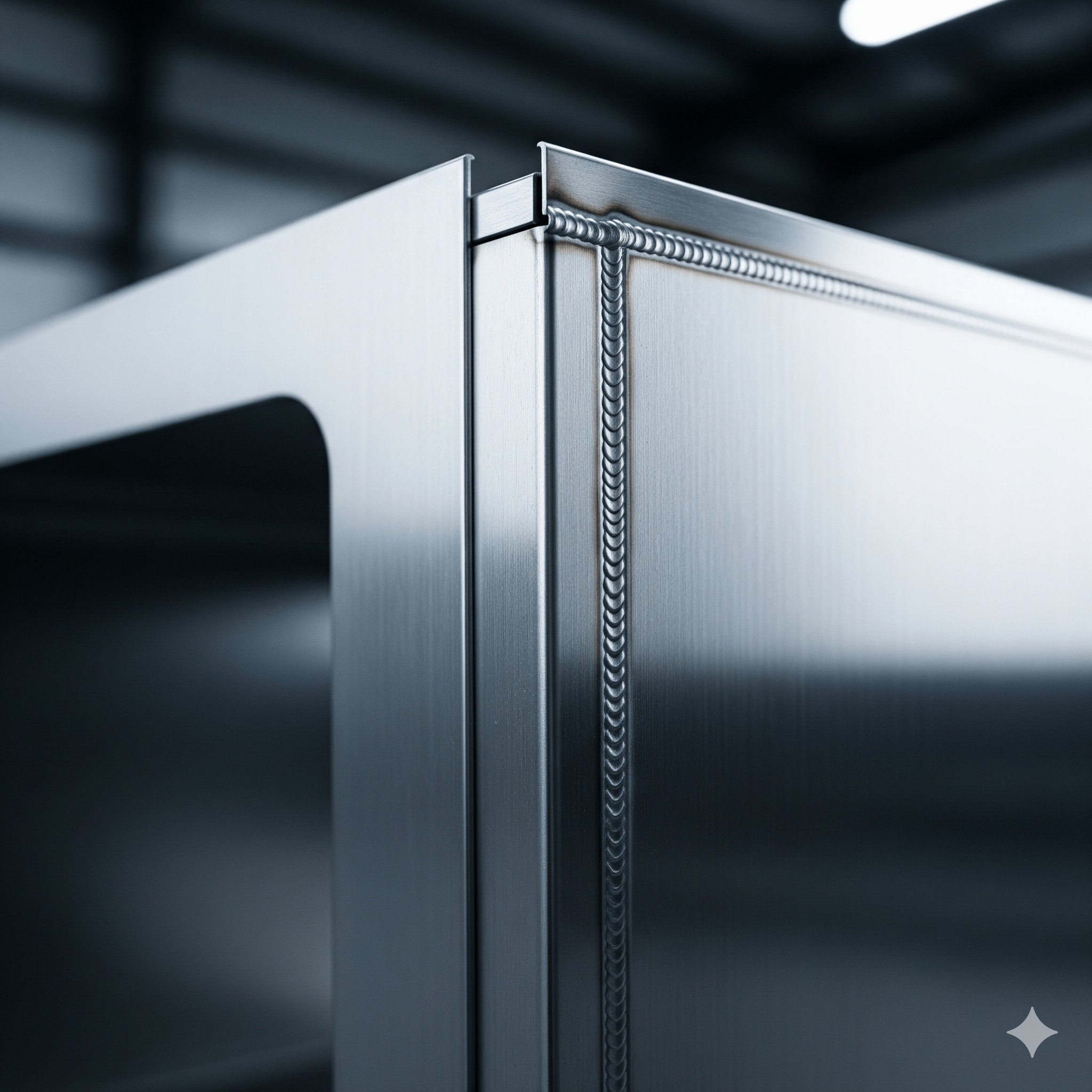
In the global industrial supply chain, sourcing high-volume steel sheet metal fabricated parts is now a high-stakes partnership. This change defines the modern manufacturing landscape. For professional procurement directors, the focus is no longer on unit price alone. Instead, they prioritize Supply Chain Resilience and Total Cost of Ownership (TCO). A minor dimensional deviation in a carbon steel enclosure can trigger a cascade of failures. Consequently, this leads to thousands of dollars in downtime.
Strategic Executive Summary:
- Material Selection: Choosing the right alloy can reduce the total life cycle cost by up to 40%. This is achieved through enhanced environmental resistance.
- DFM Optimization: Minor adjustments in bend radii and hole placement yield significant savings. Typically, these yield a 20-30% reduction in per-unit wholesale pricing.
- Compliance: Ensuring IP 66 certificate tuv and ISO 9001 compliance is a non-negotiable prerequisite. These are vital for 2026 global export and risk mitigation.
- Logistics: VCI packaging and KD designs are essential strategic tools. They mitigate moisture damage during global shipping to 50+ countries.
Part I: Strategic Metallurgy — Material Selection as a Financial Lever
For any high-volume procurement manager, material selection is the primary lever for cost-to-performance optimization. It is not a simple choice of an alloy. Instead, it is a deep-dive analysis of how that material behaves. Specifically, it must fit within the limitations in fabrication of steel sheets. YISHANG emphasizes that professional material knowledge is essential. This expertise prevents costly over-engineering.
Low carbon steel contains alloying elements that grant it exceptional ductility. Therefore, it is the premier choice for complex deep drawing and punching electrical enclosure bending sequences. The crystalline structure of mild steel allows for significant deformation. Moreover, it avoids the onset of work hardening. This is vital for high-volume stamping. However, standard carbon steel is insufficient for the oil and gas or marine sectors. Consequently, the procurement strategy must shift toward high-performance types of stainless steel.
1.1 The Stainless Steel Selection Matrix for Strategic Sourcing
In critical sectors like medical infrastructure, the choice by material stainless steel enclosure is a pivotal decision. While 304 is the benchmark for indoor retail fixtures, 316 offers enhanced protection. Specifically, it guards against chloride-induced pitting. This material stainless steel enclosure choice directly influences your product’s Landed Cost. Furthermore, it affects your long-term warranty liability.
| Feature | Stainless Steel 304 | Stainless Steel 316 | HSLA (Alloy Steel) |
|---|---|---|---|
| Corrosion Resistance | Moderate | High (Marine Grade) | Low (Requires Coating) |
| Tensile Strength | ~515 MPa | ~580 MPa | ~460+ MPa |
| Best Application | Medical Enclosures | Chemical & Oil/Gas | Solar Battery Frameworks |
| Cost Impact | Baseline | +20-35% | -15% (vs 304) |
We frequently guide clients through the complexities of types of alloy steel. Our goal is to find the “sweet spot” between structural rigidity and weight reduction. For instance, High-Strength Low-Alloy (HSLA) steels are increasingly utilized in solar battery enclosure projects. These materials facilitate thinner gauges. However, they do not compromise the load-bearing capacity required for heavy battery stacks.
1.2 Navigating the Mechanical Limitations of Steel Fabrication
A thorough understanding of the limitations in fabrication of steel sheets can save weeks of production delays. Specifically, it prevents thousands of dollars in scrap costs. High-carbon steels are prone to cracking during aggressive bending electrical enclosure bending. This happens if the material’s grain direction is not properly aligned. Therefore, professional fabricators prioritize material inspection certification electrical. This verifies that the raw stock adheres to precise mechanical limits.
By aligning material properties with the manufacturing capacity electrical enclosure, YISHANG helps wholesalers mitigate the risks of material fatigue. This applies to a steel enclosure carbon steel or a complex galvanized steel enclosure carbon. The focus is always on ensuring the material survives the thermal stresses of laster cutting electrical enclosure. Additionally, it must withstand the mechanical pressure of high-tonnage forming.
Part II: Design for Manufacturability (DFM) — The Science of Cost Reduction
The most efficient B2B procurement strategies integrate 3d design electrical enclosure collaboration from the very first draft. For the international buyer, Design for Manufacturability (DFM) is the most powerful engine for cost reduction. A minor adjustment during the technical drawing material inspection phase can be significant. For example, optimizing a bend radius can often lead to a 20% reduction in material waste.
YISHANG utilizes high-end software suites to provide comprehensive enclosure 3d design electrical support. This allows procurement teams to stress-test the design before production begins. Consequently, this preemptive approach identifies potential “interference points” in the enclosure assembling about us phase. By refining the design at the digital stage, we eliminate the need for expensive secondary modifications. This ensures a smoother manufacturing flow and faster Time-to-Market (TTM).
2.1 The Physics of Bending and Bend Allowance Mastery
A common error in technical drawing material inspection is the miscalculation of the K-Factor. This factor determines the location of the neutral axis during a bend. If this factor is ignored, the dimensions of a steel enclosure galvanized steel will not align. This leads to assembly failure. For wholesale buyers, this translates to wasted inventory. Moreover, it results in broken delivery promises to end-users.
We advocate for simplifying bend sequences. This is a primary method for reducing labor-intensive setups. Every additional bend direction in an enclosure electrical meter box requires a specialized tool change. Therefore, this adds significant incremental cost to the manufacturing process. Our engineering team at YISHANG often suggests “unfolding” complex parts. We replace multi-part welded assemblies with a single, intelligently folded part. This reduces the risk of leak paths.
2.2 Advanced Hole Placement and “Zero-Waste” Nesting
In the engineering of sheet metal fabricated parts, hole placement is a non-negotiable rule. Specifically, holes must not be too close to bend lines. If a cutout is placed within the deformation zone, it will elongate during the forming process. Consequently, this compromises the push button enclosure aesthetics and function. Our protocols enforce a “2x thickness” safety rule. This ensures every cutout remains dimensionally perfect across thousands of units.
Furthermore, AI-driven nesting is how YISHANG maximizes your material ROI. We intelligently orient different components on a standard 5×10 sheet. As a result, we can often achieve material utilization rates exceeding 92%. This level of efficiency is not just an environmental goal. In addition, it is a direct financial benefit. It allows us to keep your wholesale prices stable despite fluctuations in raw material markets.
Part III: Advanced Manufacturing — Scalability and Technical Precision
Manufacturing capacity electrical enclosure is the foundational requirement for any global distribution partnership. To meet the demands of rapid deployment, YISHANG has invested in state-of-the-art fiber laster cutting electrical enclosure technology. This allows for significantly faster cycle times. Furthermore, it creates a narrower “kerf” compared to traditional CO2 lasers. This is critical for the dense hole patterns required in modern electrical meter box designs.
| Feature | Fiber Laser Cutting | CO2 Laser Cutting | CNC Punching |
|---|---|---|---|
| Precision | ± 0.1 mm | ± 0.2 mm | ± 0.3 mm |
| Speed (Thin Sheet) | 3x Faster | Baseline | Fast (Repetitive) |
| Material Range | SS, CS, Al, Cu | SS, CS | CS, Al |
| Edge Quality | High (Minimal HAZ) | Moderate | High (Sheared) |
The production flow typically transitions from precision cutting to enclosure punching electrical enclosure. Then, it moves into the bending electrical enclosure bending stage. Each phase is overseen by our quality control process enclosure. We ensure that dimensional tolerances remain strictly within the ISO 2768-m “fine” category. For the buyer, this level of precision ensures that internal electronics fit seamlessly. This remains true regardless of the batch size.
3.1 High-Performance Welding and Joining Strategies
Joining is the stage where many steel sheet metal fabricated parts suffer from quality drift. This is often due to poor thermal management. Whether the project involves enclosure welding electrical enclosure for a structural frame or spot welding, consistency is the goal. We employ both manual TIG/MIG and robotic welding. This achieves the specific structural penetration required for demanding oil and gas applications.
Robotic welding offers the repeatable accuracy essential for high-volume enclosures solar battery enclosure orders. It eliminates the variables of human fatigue during long production shifts. Therefore, it ensures that the 1,000th weld bead is identical to the first. This consistency is a prerequisite for obtaining the tuv ce certificate support. This is necessary for entry into the European and North American markets.
3.2 Secondary Finishing: Polishing, Wire Drawing, and Foaming
A professional, high-end finish is what distinguishes a premium enclosure cleaning electrical enclosure. After the welding phase, components undergo rigorous enclosure polishing electrical enclosure. This eliminates burrs or heat-induced discoloration. For medical-grade stainless steel enclosure galvanized applications, we offer enclosure wire drawing electrical. This creates a sophisticated, anti-fingerprint surface that is easy to disinfect.
For outdoor infrastructure, an enclosure foaming electrical enclosure is a critical value-add. This CNC-controlled process applies a seamless polyurethane gasket directly to the door. Consequently, it ensures the unit adheres to ip 66 certificate tuv standards. This level of protection is mandatory for any electrical enclosure foaming electrical. It is designed for exposure to high-pressure water jets or coastal humidity.
Part IV: Quality Control and Global Compliance Framework
For an international procurement team, a factory’s certification is the ultimate trust signal. YISHANG operates under a robust quality control process enclosure. This is fully validated by certification iso9001 certificate ip and ul certification iso9001 certificate. We understand that compliance is not just a badge. Instead, it is your legal shield against operational risks.
The quality journey begins with the material inspection certification electrical. It concludes only after the final enclosure packaging inspection report is signed off. Specifically, every critical batch undergoes dimensional verification using calibrated CMM equipment. This data-driven approach ensures that our manufacturing capacity electrical enclosure remains reliable. It serves as a benchmark for global wholesale standards.
4.1 Achieving IP 66 and NEMA Performance Ratings
The enclosure certification ul certification is often a non-negotiable requirement for outdoor infrastructure. An ip 66 certificate tuv ce certifies that the enclosure is dust-tight. Moreover, it can withstand heavy seas or powerful jets of water. This is the baseline for enclosures solar battery enclosure and electrical meter box applications. In these cases, internal circuitry must remain dry and functional in all conditions.
To further ensure longevity, we conduct salt spray testing (ASTM B117). This verifies the level of corrosion resistance for maritime or high-pollution environments. By validating these performance metrics in-house, we provide the verifiable data you need. This information is included in your resource catalog download and inspection report resource catalog. This radical transparency is why leading global wholesalers choose YISHANG.
4.2 Comprehensive Documentation: The Procurement Paper Trail
In the professional B2B landscape, the documentation is as important as the steel itself. We provide a full technical drawing material inspection dossier with every major contract. This allows your engineering team to cross-reference dimensions. Moreover, they can verify material chemistry before the cargo is loaded. Consequently, this reduces the risk of arrival-site rejections.
In addition, our catalog download technical drawing service provides a vast digital library. We offer “ready-to-customize” designs for various industries. From packaging inspection report resource to shipping faq quality control, we provide every piece of data. This is required to facilitate a rapid customs clearance and efficient local distribution. This attention to detail reduces the administrative burden on your procurement team.
Part V: Sector-Specific Engineering and Application Depth
To truly grasp the value of steel sheet metal fabrication the ultimate, one must analyze specialized requirements. Different industrial sectors have unique needs. From enclosure electrical meter box designs to heavy-duty industrial frames, the challenges are never uniform. YISHANG’s 26 years of experience allow us to navigate these sector-specific nuances with ease.
5.1 Power Distribution and Smart Infrastructure
The global transition toward smart grids has created a massive demand for enclosure electrical meter box units. These units must be tamper-proof and weather-resistant. Therefore, we incorporate electrical enclosure wire drawing and polishing electrical enclosure. This provides a finish that resists the daily wear and tear of urban environments.
For more compact control modules, an enclosure push button enclosure is often the best solution. We often engineer these from a carbon steel enclosure aluminum hybrid. This provides a lightweight housing with excellent thermal conductivity for sensitive electronic switches. Our manufacturing capacity electrical enclosure is geared to produce these units in massive volumes. We maintain zero deviation from the technical drawing.
5.2 The Green Energy Boom: Solar and Battery Storage
The renewable energy revolution is powered by enclosures solar battery enclosure systems. These units are physically large. Consequently, they require extreme structural strength to hold heavy lithium-ion battery modules. We utilize high-strength alloy steel to construct these frameworks. They are both lightweight for shipping and earthquake-resistant for installation.
In the battery sector, enclosure foaming electrical enclosure is not just for weather-proofing. Specifically, it is for thermal management. Our quality control process enclosure ensures that the seals are airtight. This prevents thermal runaway and protects high-value battery stacks. This is a critical factor for wholesale buyers concerned about long-term reliability.
5.3 Industrial Automation and Laboratory Control
In the factory automation world, the electrical enclosure cleaning electrical process is a vital step. This occurs before units are populated with high-precision PLCs. We ensure every carbon steel enclosure aluminum is free from oils and microscopic dust. Our enclosure wire drawing electrical finish provides a sleek, lab-grade aesthetic. This is perfect for modern control rooms.
For complex wiring projects, our electrical enclosure assembling about us includes the installation of mounting plates. We also provide DIN rails as a standard service. This “Plug-and-Play” approach saves your local technicians days of work on-site. Therefore, this focus on the procurement and assembly cycle has made YISHANG a preferred partner.
Part VI: Global Sourcing and Strategic Supply Chain Logistics
Partnering with a China-based factory like YISHANG is a strategic choice. It combines world-class laster cutting electrical enclosure technology with competitive wholesale pricing. However, the true success of this partnership depends on logistics. Specifically, the about shipping faq and enclosure packaging inspection report protocols are vital. They protect your investment during transit.
We are fully aware that steel sheet metal fabricated parts are heavy. Consequently, they are prone to damage during long-distance shipping. Our packaging inspection report resource details the multi-layered protection strategy we employ. Specifically, we use VCI films and reinforced anti-vibration crates. This ensures that your order arrives in factory-fresh condition.
6.1 The “Consultative Partner” vs. The “Vendor”
A frequent mistake in the metal fabrication – industry is treating the manufacturer as a mere “black box.” At YISHANG, we operate with an open about us about communication philosophy. From the initial inquiry to the final shipping faq quality control, we act as an extension of your team. Specifically, we support your internal engineering and procurement departments.
Our support manufacturing capacity electrical enclosure includes proactive engineering advice. For example, if a design is likely to fail in a high-humidity climate, we will suggest an upgrade. Specifically, we might recommend a galvanized steel enclosure carbon solution. This consultative approach is designed to foster 20-year partnerships based on mutual success.
6.2 Masterful Lead Time and Inventory Management
Lead time is the ultimate currency of the wholesale metal business. Consequently, our manufacturing capacity electrical enclosure is finely tuned for Just-in-Time manufacturing. By maintaining a vast inventory of common steel grades, we can respond quickly. In addition, we utilize laster cutting electrical enclosure for rapid prototyping. This often shrinks the Time-to-Market by up to four weeks.
We also manage the administrative friction of international trade. Specifically, we provide the ce certificate support and tuv ce certificate documentation for your region. Whether your market is in the European Union or North America, we handle the details. Our logistics team ensures that your steel enclosure galvanized steel meets all local regulatory hurdles.
Strategic Procurement FAQ (Knowledge Center)
Q1: What is the typical lead time for high-volume wholesale orders? Typically, prototyping takes 5-7 days using laster cutting electrical enclosure. In contrast, mass production for 1,000+ units requires 20-30 days. This depends on the manufacturing capacity electrical enclosure load.
Q2: How does YISHANG ensure dimensional consistency across 10,000 units? We implement First Article Inspection (FAI). Subsequently, we use statistical process control (SPC) with calibrated CMM machines. Every batch includes an inspection report resource catalog.
Q3: Can we customize the internal 3D design electrical enclosure? Yes. We offer full enclosure 3d design electrical support. You can download technical drawing material files from our portal to start the process today.
Conclusion: Engineering Your Competitive Edge
Steel sheet metal fabrication is the structural backbone of global industry. From the precision of laster cutting electrical enclosure to the durability of a stainless steel enclosure galvanized, every detail counts. For the professional wholesaler, choosing YISHANG means choosing a legacy of 26 years.
Send your inquiry today to YISHANG. Allow our senior engineering team to optimize your next project for maximum ROI. You can also access our Resource Catalog Download for technical drawings and inspection protocols.