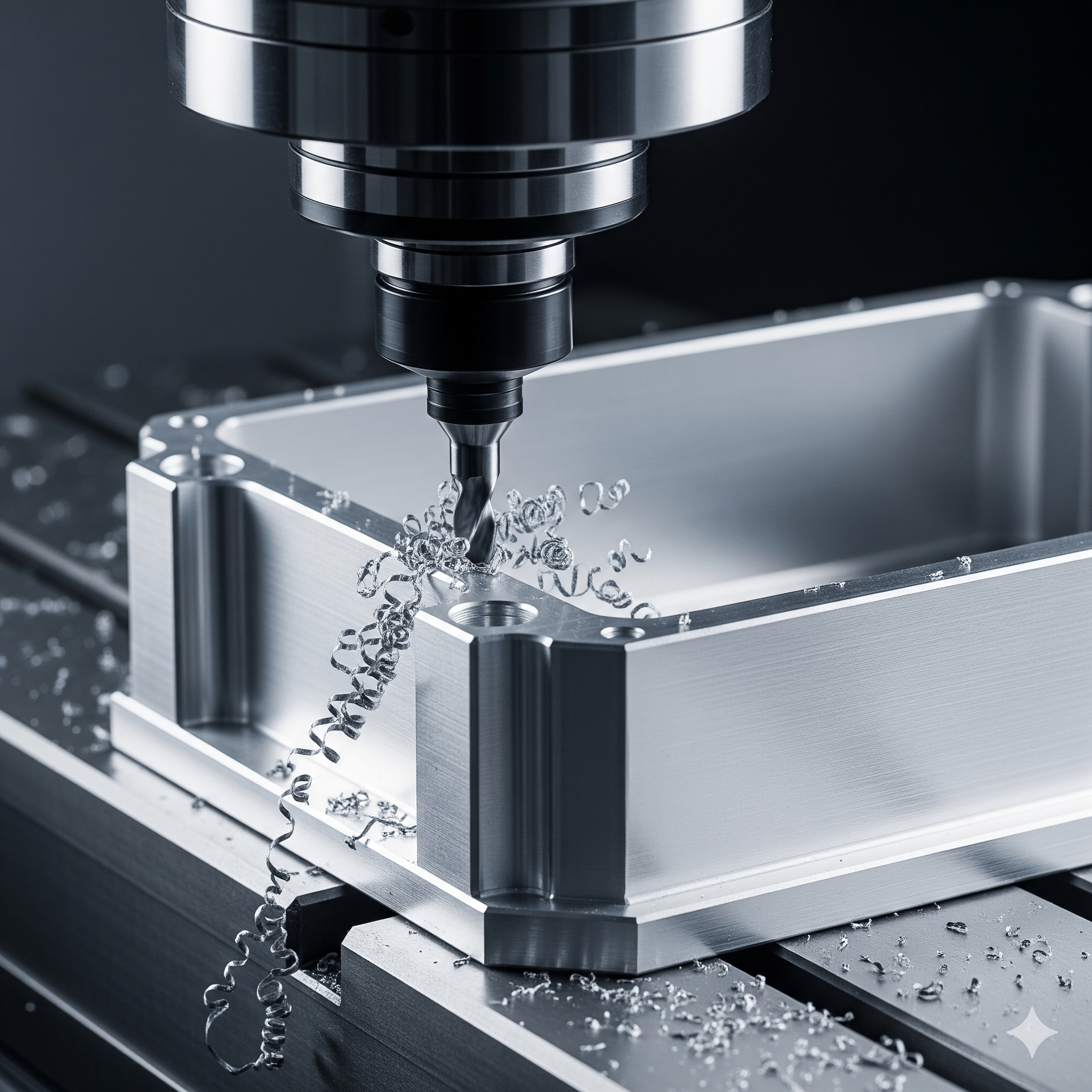
In the high-stakes landscape of modern industrial manufacturing, aluminum has transitioned from a lightweight alternative to a fundamental necessity for global supply chains. Its unique combination of a high strength-to-weight ratio and exceptional thermal conductivity makes it the bedrock of sectors ranging from aerospace to medical diagnostics. As global procurement strategies move into 2026, the demand for aluminum components is no longer just about sourcing a part.
For strategic buyers, aluminum presents a deceptive paradox. While it is celebrated as one of the most machinable metals, achieving consistent, high-volume accuracy across thousands of units is an intricate dance. This guide moves beyond surface-level definitions to explore the deep technical and commercial nuances of aluminum CNC machining. Our goal at YISHANG is to help you navigate complex design challenges and secure a competitive edge.
Core Insights for Procurement Managers:
- Material Selection: Why 6061-T6 dominates wholesale while 7075-T6 wins in high-stress roles.
- Cost Reduction: How DfM (Design for Manufacturability) can slash unit prices by 30%.
- Quality Standards: Aligning with ISO 2768 for predictable batch consistency.
- Surface Science: Choosing the right Ra (roughness) for NEMA-rated seals.
I. The 2026 Aluminum Paradox: Why Precision is the New Standard for Wholesale
The conventional wisdom in many standard machine shops is that aluminum is soft and therefore easy to cut. While it requires less cutting force than a stainless steel enclosure, this softness is precisely what makes precision machining difficult at scale. Aluminum has a high coefficient of thermal expansion—approximately 23 x 10^-6 / °C.
This thermal volatility means that even minor fluctuations in ambient temperature or friction-induced heat can cause significant dimensional shifts during a 24/7 production run. For a junction box NEMA rated project, these shifts can compromise the IP-rated seal, leading to catastrophic failure in the field. Procurement managers must understand that an easy material requires the most rigorous engineering discipline to maintain consistency.
In the 2026 manufacturing landscape, simply being within tolerance is no longer enough for professional wholesale buyers. Parts must maintain structural integrity under extreme conditions, such as the high-pressure environments of solar battery enclosures or vacuum-sealed satellite housings. We treat the workpiece as a dynamic thermal entity that reacts to every Newton of force.
By partnering with an experienced manufacturer like YISHANG, you gain access to decades of data on thermal stability. We mitigate risks by utilizing climate-controlled machining centers and real-time tool wear compensation. This proactive approach ensures that the 10,000th part is identical to the first, protecting your brand reputation and reducing the biggest challenge of quality drift in high-volume orders.
Furthermore, we account for the residual stresses inherent in raw aluminum billets. During high-speed material removal, these internal stresses can cause spring-back effects. Without a strategic roughing and finishing cycle, a large-format enclosure aluminum enclosure may warp as soon as it is released from the vacuum fixture, leading to assembly misalignments.
II. The Strategic Material Matrix: Comparing Aluminum with Steel Alternatives
Selecting the right electrical enclosure raw material is a strategic decision that impacts the entire production lifecycle and your final unit price. While aluminum is often the first choice, strategic buyers often weigh it against carbon steel enclosures or stainless steel enclosure options. Each material offers a distinct metallurgical profile that dictates its behavior during CNC operations.
Aluminum is significantly lighter, which drastically reduces shipping costs for high-volume orders—a critical factor for international wholesale. However, it is essential to recognize that while aluminum is very machinable, it may lack the magnetic shielding properties of a steel enclosure carbon based design. For control station enclosures, aluminum’s natural EMI/RFI shielding is often sufficient and more cost-effective.
1. Technical Comparison: Aluminum vs. Steel for CNC Machining
| Material Selection | Strength-to-Weight | Corrosion Resistance | Machining Speed | Typical Usage |
|---|---|---|---|---|
| Aluminum (6061-T6) | Excellent | High (Self-passivating) | Fastest | Push button enclosure, Heat sinks |
| Stainless Steel (304/316) | High | Superior | Slow | Medical, Marine, Food Grade |
| Carbon Steel | High | Low (Requires coating) | Moderate | Structural, Heavy Machinery |
| Galvanized Steel | Moderate | Moderate | Moderate | Outdoor electrical meter box |
Is aluminum a better choice than steel for your specific project? In most cases involving enclosure electrical meter designs or control station enclosures, the answer is yes. Aluminum’s faster machining speeds translate directly into lower labor costs per unit. This makes it an ideal choice for customizing our aluminum CNC orders where unit price parity is critical.
2. Beyond Weight: Thermal and Conductivity Benefits
When evaluating galvanized steel enclosure options versus aluminum, consider the long-term maintenance. Aluminum does not rust; even when scratched, it forms a protective oxide layer. For enclosures solar battery systems deployed in harsh environments, this set and forget durability is a major selling point that professional buyers prioritize to reduce warranty claims.
Beyond weight, the thermal conductivity of aluminum is vastly superior to that of carbon steel enclosure materials. Aluminum typically exhibits a conductivity of approx 167 W/m·K as detailed in the Aluminum Physical Properties Database, compared to just 50 W/m·K for carbon steel. This makes it the default choice for enclosure push button units that house heat-generating power electronics.
A well-machined aluminum chassis acts as its own passive heat sink. This reduces the need for active cooling components like fans, which are prone to failure and require regular maintenance. For wholesale buyers, this structural thermal management translates into a more reliable end-product with a lower total lifecycle cost for the end-user.
III. Advanced CNC Techniques: Engineering Consistency for Junction Boxes
To achieve the best results for large-scale aluminum CNC machining orders, the process must be tailored to the material’s specific mechanical properties. High-volume production of an enclosure aluminum enclosure requires a blend of high-speed milling and precision turning. At YISHANG, we utilize simultaneous 5-axis CNC centers to complete complex geometries.
This one-and-done approach is crucial for wholesale buyers because it eliminates the cumulative error introduced by re-fixturing. For a push button enclosure, maintaining the perfect alignment of multiple interfaces is essential for assembly speed and labor reduction at your facility. Our specialized CNC Machining Services allow us to handle everything from micro-connectors to structural frames.
1. High-Speed Milling Strategies
Milling is the primary method for creating the intricate internal cavities found in a junction box NEMA assembly. We employ High-Speed Machining (HSM) techniques that utilize light radial depths of cut combined with very high feed rates. This ensures that the heat is carried away by the chips rather than the workpiece, preserving the dimensional stability of every unit in a 5,000-piece run.
2. Precision CNC Turning and Boring
CNC turning is equally vital for cylindrical components like spacers or specialized connectors for enclosure electrical meter units. Because aluminum is prone to nesting (long, stringy chips wrapping around the spindle), our systems use high-pressure coolant and specialized chip-breakers. This automation keeps our lead times short and our prices among the most competitive for aluminum cnc order fulfillment.
3. Integrated Fabrication Solutions
Beyond basic cutting, we integrate laster cutting electrical processes and bending electrical enclosure workflows to provide a complete fabrication solution. This holistic approach means you don’t have to manage multiple vendors for punching electrical enclosure or welding electrical enclosure tasks. We streamline the entire quality control process into a single report, ensuring seamless supply chain integration.
IV. The Physics of the Cut: Solving the Biggest Challenge
The biggest challenge when machining aluminum is its chemical affinity for cutting tools. This leads to Built-Up Edge (BUE), where the aluminum welds itself to the tool edge under pressure. For a procurement manager, BUE is the silent killer of margins; it causes poor surface finish and frequent tool breakage, which drives up the cost of your aluminum cnc machining needs.
To combat this, YISHANG utilizes specialized tool geometries optimized for slicing rather than plowing. We prioritize 2-flute and 3-flute end mills because they provide the massive gullet space required to evacuate the high volume of chips. If the chips aren’t removed instantly, they are re-cut, leading to localized heat spikes that can warp an electrical meter box during production.
1. Advanced Coatings and Surface Science
We also employ advanced coatings like Diamond-Like Carbon (DLC) to provide a microscopic non-stick surface. While this increases initial tooling costs, it extends tool life by up to 300% and maintains a mirror-like polishing electrical enclosure finish. For high-volume enclosure push button orders, this consistency is vital for ensuring that every part meets your aesthetic standards without secondary manual labor.
2. Intelligent Heat Management
Heat management is the other side of the equation. We utilize both flood coolant and Minimum Quantity Lubrication (MQL) depending on the alloy. For solar battery enclosure components, MQL prevents thermal shock, leading to more stable crystalline structures. This attention to micro-level physics is what makes YISHANG the right choice for your high-precision projects where reliability is paramount.
3. Optimizing Spindle Speed and Feed Rates
By understanding the challenge when machining these sticky metals, we can optimize the spindle speed and feed rate to maximize efficiency. This technical expertise translates into a lower per-unit price for our clients. We don’t just cut metal—we manage the thermodynamics of the process to deliver parts that are is stronger and more accurate than standard job shops.
V. DfM Strategy: How Design Optimization Reduces Your Wholesale Costs
In the B2B sector, the most successful designs are those that harmonize functional requirements with manufacturing reality. Design for Manufacturability (DfM) is the most powerful tool for wholesale buyers to reduce unit costs. By optimizing the 3d design electrical aspects of a part, we can often reduce machining time by 20-30% without sacrificing performance.
One of the most common cost-drivers is specifying sharp internal corners. Since CNC tools are rotating cylinders, they cannot produce a sharp 90-degree internal corner. For an enclosure enclosure by design, specifying a radius that is 10% larger than the tool diameter allows us to maintain a constant feed rate. This prevents the tool from dwelling in corners, which causes vibration marks.
1. Pocket Depth and Aspect Ratio Considerations
Another critical factor is the aspect ratio of deep pockets. A common DfM Rule of Thumb is to keep pocket depths within 3 times the tool diameter. For control station enclosures that require deep cavities, exceeding this ratio leads to tool deflection. This necessitates multiple slow finishing passes, which can double the machining cost. We recommend adding a slight draft angle to facilitate removal.
2. Strategic Design Recommendations for Procurement
| Design Feature | Impact on Cost | YISHANG Recommendation |
|---|---|---|
| Internal Radii | High (Tooling wear) | Use R > 1.1 x Tool Radius |
| Wall Thickness | Medium (Warping) | Maintain > 1.0 mm for stability |
| Pocket Depth | High (Cycle time) | Keep Depth < 3 x Diameter |
| Thread Depth | Low (Tap breakage) | Limit to 2 x Diameter |
3. Wall Thickness and Structural Integrity
Wall thickness is equally vital for solar battery enclosure durability. While aluminum is strong lightweight and, walls thinner than 1.0 mm can flex under cutting pressure. This spring-back effect makes it nearly impossible to hold tight tolerances across a bulk batch. By maintaining a sensible wall thickness, we ensure the structural integrity of your junction box nema assembly.
4. Setup Count and Efficiency
Designers should also consider the setup count. Every time a part needs to be turned or flipped, it requires a new fixture and adds to the labor cost. By designing parts that can be machined from three or fewer sides, you drastically reduce the setup time. At YISHANG, we provide a free DfM audit for every Custom Fabrication Inquiry to help you identify these cost-saving opportunities.
VI. Post-Machining and Surface Science: Protection for Junction Boxes
For industrial aluminum products, the finish is rarely just about aesthetics; it’s about environmental survival and longevity. Whether you are ordering a push button enclosure for a factory floor or a solar battery enclosure for a desert installation, the surface treatment must match the application’s NEMA or IP rating. YISHANG provides a full spectrum of finishing services.
Anodizing is the most common treatment for aluminum cnc order fulfillment. Type II anodizing is perfect for decorative electrical meter box covers where color branding is important. However, for sliding components or gears within a control station enclosure, we recommend Type III Hardcoat. This creates a surface harder than tool steel, providing extreme wear resistance.
1. Chemical Conversion and Conductivity
For electronic assemblies where grounding is critical, we offer Alodine (Chemical Conversion) coatings. Unlike anodizing, which is an electrical insulator, Alodine maintains the surface’s conductivity while providing excellent corrosion resistance. This is the gold standard for enclosure electrical meter internal components and EMI/RFI shielding in sensitive wholesale electronics.
2. Premium Aesthetics and Mechanical Finishes
We also specialize in wire drawing electrical and polishing electrical enclosure finishes for premium consumer-facing products. If your project requires the ruggedness of a carbon steel enclosure but the weight of aluminum, we can apply high-durability powder coatings. This ensures your enclosure aluminum enclosure can withstand UV exposure and salt spray without degradation.
3. Surface Preparation and Longevity
Understanding the enclosure wire drawing and enclosure cleaning electrical processes is vital for long-term reliability. We ensure that every part is thoroughly degreased and de-oxidized before finishing. This attention to detail prevents coating peeling—a common failure in cheaper imports—and ensures that your junction box nema rating remains valid throughout the product’s lifespan.
4. Managing Surface Roughness (Ra)
Surface roughness is another critical parameter for wholesale buyers. For a junction box NEMA seal, a surface that is too rough will leak, while one that is too smooth might be unnecessarily expensive. We typically target an Ra of 1.6 um to 3.2 um for industrial seals, ensuring a perfect fit with standard gaskets without the added cost of over-polishing.
VII. Quality Control and Logistics: The YISHANG Wholesale Standard
For a global procurement manager, the part is only half the story; the other half is the inspection certification electrical and the packaging inspection report. At YISHANG, we treat quality control process enclosure management as a core engineering discipline. Every batch undergoes rigorous testing to ensure compliance with your technical drawing material specifications.
We utilize Coordinate Measuring Machines (CMM) and 3D laser scanners to verify complex geometries. For enclosure 3d design projects, this allows us to provide a digital twin of the physical part’s measurements. This transparency is why we are the right choice for your most sensitive solar battery enclosures and medical-grade components where error is not an option.
1. Comprehensive Reporting and Traceability
Our clients receive a full resource catalog download of their project’s data, including material inspection certification and quality control process logs. This level of documentation is essential for wholesale buyers who must prove compliance to their own end-customers. We don’t just say we’re ISO 9001 certified; we provide the ISO 9001:2015 Certification Details with every shipment.
- Initial Material Inspection: Verifying the alloy chemistry of the electrical enclosure raw material.
- In-Process Monitoring: Periodic checks during the aluminum cnc machining cycle using digital gauges.
- Final Dimensional Check: 100% inspection of critical NEMA or IP-rated features using high-precision CMM.
- Packaging Inspection: Ensuring the enclosure packaging inspection meets international shipping standards.
2. Supply Chain Friction Management
Logistics is the final bridge in the supply chain. We understand the nuances of shipping faq quality and international customs for various regions. Our About YISHANG Manufacturing overview details how we can even provide partial or full assembly, reducing your local labor costs. From download technical drawing support to final delivery, we manage the friction so you don’t have to.
3. Batch Traceability and Accountability
Furthermore, we offer Batch Traceability. Every part can be traced back to the specific raw material lot and the machine operator who produced it. For enclosures solar battery systems used in critical infrastructure, this level of accountability is a mandatory requirement that YISHANG fulfills as standard practice. We prioritize your peace of mind as much as the precision of the metal.
VIII. Strategic Procurement: Why YISHANG is Your Partner for the Future
Choosing a manufacturer for aluminum cnc machining is a high-stakes decision that affects your company’s bottom line and brand reputation. In the 2026 B2B environment, cheap often becomes expensive when quality failures occur. YISHANG offers more than just a range of machines; we offer a strategic partnership built on 26 years of fabrication excellence.
We bridge the gap between 3d design electrical concepts and market-ready products. Our engineers work directly with your team to optimize electrical enclosure raw material selection and DfM strategies. This collaborative approach is why we are the benchmark we strive to exceed every day. We don’t just take orders; we solve manufacturing puzzles for our clients.
1. The Value of an Integrated Factory
The most efficient procurement model is the integrated factory. When YISHANG handles the laster cutting electrical, bending electrical enclosure, and aluminum cnc machining, the risk of communication errors between vendors is eliminated. This one-stop approach reduces lead times by up to 25% and ensures that the final Custom Metal Enclosure fits perfectly every time.
2. Versatility in Metal Fabrication
Whether you need a carbon steel enclosure, a galvanized steel enclosure, or a high-precision aluminum cnc order, we have the capacity and the expertise. Our knowledge center contact is always available to help you refine your electrical enclosure 3d designs for maximum efficiency. We are here to ensure your next procurement cycle is the most successful one yet.
3. Trust Through Transparency
In a global market prone to material substitutions, our material traceability is the foundation of trust. We provide the report resource catalog and inspection report resource for every shipment, ensuring you know exactly what is going into your products. We also monitor global aluminum price indices to offer you the most stable pricing possible in a volatile market.
4. Sustainable Procurement Initiatives
Sustainable procurement is also becoming a key differentiator. At YISHANG, we recycle 100% of our aluminum chips, reducing waste and contributing to a greener supply chain. For wholesale buyers looking to meet ESG goals, our processes are designed to align with corporate responsibility standards, adhering closely to the EU RoHS Directive while maintaining peak efficiency.
IX. FAQs: Expert Answers for Wholesale Procurement
Q: Is aluminum a better choice than steel for NEMA 4X enclosures? A: For many outdoor applications, yes. While a stainless steel enclosure offers excellent protection, aluminum is lighter and provides natural corrosion resistance at a lower price point. It’s an ideal material stainless steel alternative for weight-sensitive installations in the solar and EV industries.
Q: Can you customize our aluminum CNC order with specific branding? A: Absolutely. We offer integrated fiber laser marking and enclosure wire drawing finishes. This allows you to add serial numbers, logos, and QR codes for inventory management directly onto your push button enclosure without adding a separate processing step.
Q: What is the biggest challenge in machining high-volume aluminum batches? A: Consistent thermal management and chip evacuation. By using climate-controlled centers and specialized coolant strategies, YISHANG ensures that every junction box nema part stays within tolerance, regardless of whether it’s the 1st or the 5,000th unit produced.
Q: How do you manage lead times during peak production seasons? A: We maintain a buffer of raw electrical enclosure raw material and utilize automated 24/7 machining shifts. This allows us to scale production rapidly to meet the urgent needs of our wholesale partners without compromising on the quality control process.
Q: What CNC machining tolerance standards do you follow? A: We follow the ISO 2768 standards for linear and angular dimensions. We offer Fine (f), Medium (m), and Coarse (c) classes based on the specific industrial requirements of your electrical meter box or enclosure.
X. Conclusion: The Future of Precision Manufacturing
Aluminum CNC machining is a discipline that rewards technical depth and punishes shortcuts. As we look toward the future of industrial manufacturing, the winners will be those who bridge the gap between good enough and mathematically perfect. By mastering the nuances of alloy selection, tool physics, and DfM principles, you can transform aluminum into a strategic asset for your enterprise.
At YISHANG, we don’t just cut metal; we engineer solutions. With over 26 years of experience and a commitment to ISO 9001 quality standards, we serve as the strategic partner for global industries seeking more than just a vendor. Whether you are scaling a new EV project or refining a medical diagnostic tool, we provide the stability and expertise you need to succeed in a competitive global market.
Quick Inquiry Now: Ready to optimize your next aluminum project for cost and performance? Send your inquiry today to our engineering team for a comprehensive DfM review and discover the YISHANG difference in high-precision manufacturing. Let’s build something extraordinary together.