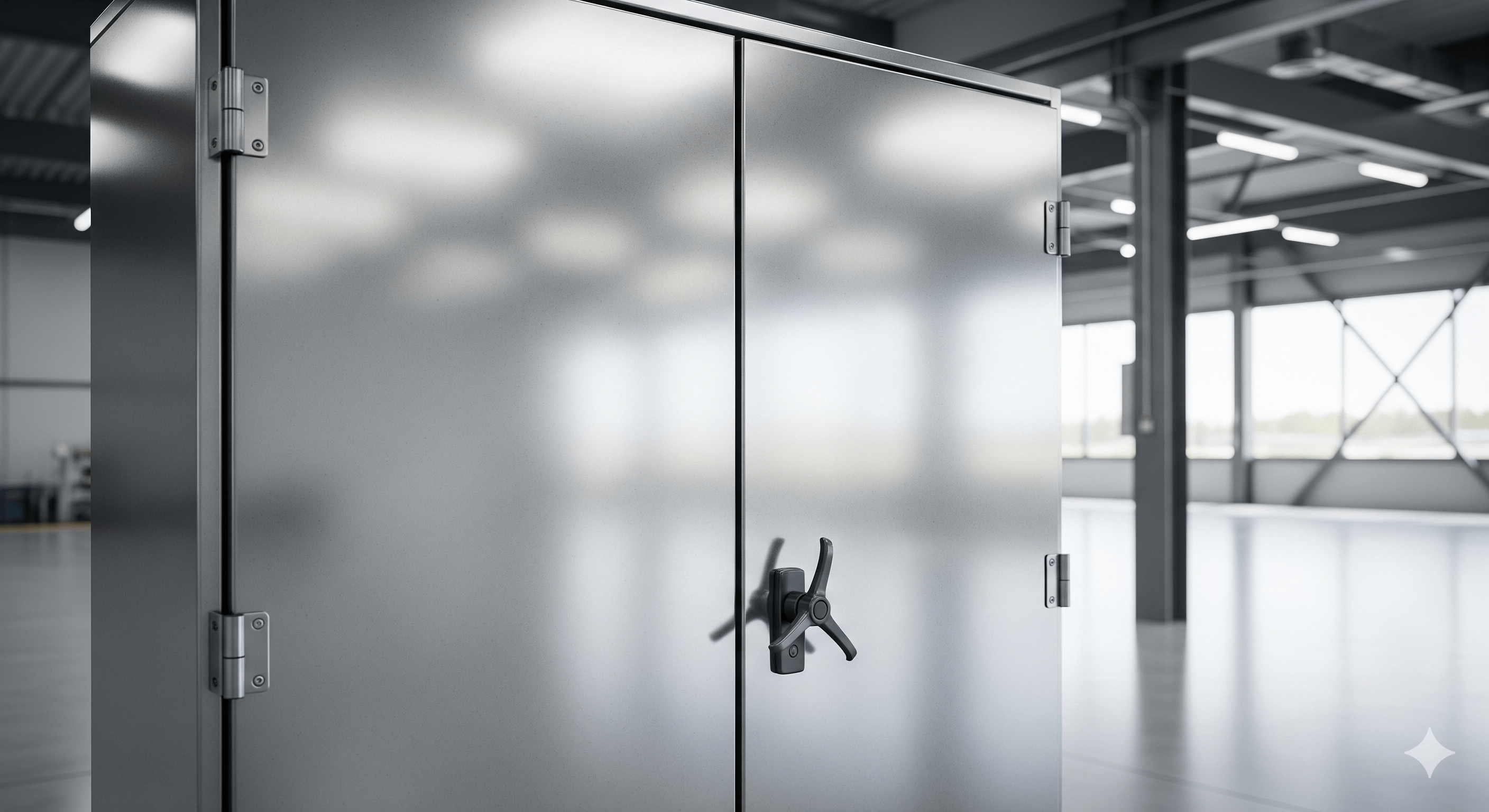
1. The Strategic Logic Behind Double Door Configurations
In the high-stakes environment of industrial infrastructure, selecting an electrical housing is far more than a routine inventory purchase. For procurement managers and project leads, the transition to a double door electrical enclosure is a strategic decision rooted in long-term risk mitigation. Consequently, as global power systems become increasingly dense, the demand for high-capacity housing has reached a critical peak. This trend is largely driven by the rapid expansion of Battery Energy Storage Systems (BESS) and industrial robotics.
1.1 Structural Load and Door Drop Prevention
The primary engineering trigger for choosing a double-door setup is typically when the internal width of the cabinet exceeds the 800mm mark. At this scale, a single-door design becomes a mechanical liability rather than an asset. For instance, the sheer gravity moment exerted on the hinges often leads to “door drop.” This phenomenon causes the door to sag over time. Ultimately, this sagging compromises the alignment of the locking system and leads to seal failure. A dual-door configuration effectively bisects these mechanical stresses. It distributes the weight across two sets of heavy-duty, reinforced hinges.
1.2 Footprint Optimization and Accessibility
Furthermore, double door free standing units provide significant advantages in terms of operational footprint within the facility. Specifically, in narrow factory corridors or mobile power containers, the reduced swing radius of a double door ensures compliance with strict safety codes. This layout also provides a “clear span” access point. This accessibility is essential when technicians need to integrate oversized modular components or busbar systems.
At YISHANG, we recognize that B2B buyers prioritize terms of accessibility to minimize maintenance downtime. A well-designed door enclosure with a wide opening allows field technicians to work more efficiently. As a result, this directly impacts the operational ROI of the entire site. For large-scale projects requiring precision, you can send an inquiry to our technical team today for a custom review.
2. Advanced Sealing: Mastering the IP65 and NEMA Standards
The vertical interface where two doors converge is often referred to as the “Central Gap.” In any industrial housing, this area is the most common point of failure for ingress protection. Unlike single-door units, a double door enclosure must create a hermetic seal against its counterpart. Specifically, achieving a true electrical enclosure ip65 or NEMA 4 rating requires sophisticated fluid dynamics. This goal cannot be met by just using thick rubber strips.
2.1 Labyrinth Path Engineering
To solve this, YISHANG utilizes a post-free, flush-fit design. This approach avoids the internal obstructions associated with a traditional removable center post. Specifically, this engineering feat requires a primary and secondary door hierarchy. The secondary door features a vertical “meeting flange” designed to create a labyrinth path. In essence, this geometry acts as a physical baffle. It forces any incoming pressurized water to change direction multiple times. Consequently, the water dissipates its kinetic energy before it can ever reach the internal gasket.
2.2 Automated Gasket Application (FIPG)
Moreover, a critical component in our manufacturing is the enclosure foaming electrical process. We utilize high-precision robotic systems for foaming electrical enclosure applications. During this process, liquid Polyurethane (PU) foam is applied directly into the CNC-machined channels. This foam expands and cures in situ. Therefore, it creates a seamless, high-elasticity barrier. Specifically, this electrical enclosure foaming method ensures zero-joint integrity.
By focusing on the ip65 enclosure hinged mechanism, we ensure that the seal is distributed uniformly. This level of precision is non-negotiable for any outdoor electrical enclosure. For wholesalers, providing an enclosure ip65 enclosure that stays sealed under stress means fewer warranty claims. In turn, this builds higher client trust in harsh industrial environments.
3. Material Science: Selecting the Right Shield for Environmental Shielding
For an international wholesaler, the geographical diversity of your client base presents a major challenge in enclosure raw material selection. Professional procurement requires “Environmental Matching.” This involves selecting the material grade that maximizes the product’s lifespan relative to its specific atmospheric chemistry.
| Material Type | Technical Category | Corrosion Resistance | Best Use Case |
|---|---|---|---|
| Stainless Steel 316L | material stainless steel | 1000+ Hours | Marine & Offshore |
| Stainless Steel 304 | stainless steel enclosure | 500-800 Hours | Food & Beverage |
| Galvanized Steel | galvanized steel enclosure | 200-400 Hours | Urban Telecom |
| Carbon Steel | carbon steel enclosure | <100 Hours | Indoor Factories |
At YISHANG, our stainless steel enclosure solutions are treated with advanced wire drawing electrical processes. These processes ensure a smooth, low-friction professional finish. For projects where cost-efficiency is vital, a steel enclosure carbon variant with UV-rated powder coating is a viable choice. Additionally, we emphasize steel enclosure galvanized materials for urban infrastructure. These materials provide “sacrificial protection” against localized scratches.
When sourcing, the by material stainless grade should be the first technical question on your RFQ. We provide a full material inspection certification (MTR) for every batch of raw metal. This transparency is why global procurement officers choose YISHANG for custom stainless steel projects. Specifically, it ensures that the raw material knowledge behind the product matches the reality of the field environment. Therefore, it prevents premature oxidation that can ruin a brand’s reputation.
4. Internal Physics: Thermal Management and Solar Dynamics
One of the most overlooked aspects of large-format housing is the internal physics of space. In a double door electrical enclosure, the massive internal volume can inadvertently create “thermal dead zones.” These are stagnant air pockets where heat accumulates away from cooling fans. Consequently, managing heat dissipation is critical for extending equipment life.
4.1 Passive Ventilation and Cooling Strategies
To combat this, YISHANG offers vented electrical enclosure designs. These incorporate strategic louver placement and enclosures solar battery ventilation kits. Specifically, the use of a vented electrical enclosure allows for natural convection currents. In addition, enclosure vented electrical accessories like breather glands equalize internal and external pressure. This equalizing is crucial in preventing the “Condensation Paradox” in solar battery enclosure systems.
4.2 Material Thermal Conductivity
In high-heat environments, an enclosure aluminum enclosure variant can be utilized. This material offers superior thermal conductivity. Specifically, aluminum pulls heat away from internal components more effectively than steel. However, for most outdoor electrical enclosure applications, a steel enclosure aluminum hybrid provides a better balance. In this setup, the body is steel for strength while the doors are aluminum for heat dissipation.
For wholesalers, selling electrical enclosures outdoor requires a deep understanding of thermal load. Our enclosure electrical meter and electrical meter box solutions are often integrated with these thermal kits. Therefore, the electronics remain within their optimal operating range. If your clients are in the renewable energy sector, ensuring the solar battery enclosure is correctly vented will prevent costly failures.
5. DFM and the Digital Twin Workflow: Reducing Sourcing Risk
In the modern modular electrical enclosures market, “time-to-market” is the most valuable currency. For wholesalers, the ability to customize a door electrical enclosures unit is a massive competitive advantage. At YISHANG, this is achieved through a comprehensive 3D design electrical workflow. Specifically, this process eliminates human error before the first sheet of metal is cut.
5.1 Digital Interference Checking
Every custom project begins with a high-fidelity enclosure 3d design model. This electrical enclosure 3d approach allows for a “Digital Interference Check.” For instance, we can simulate the door swing and internal component placement. This ensures that the enclosure with file pocket door doesn’t block access points once installed. Consequently, this digital scrutiny is essential in avoiding the high costs of onsite modifications.
5.2 Precision Bending and Tolerance Control
Furthermore, the design electrical enclosure phase optimizes the “Tolerance Stack-up.” In a modular electrical enclosures system, precision is non-negotiable. By utilizing precision enclosure bending electrical techniques, we maintain tolerances within +/- 0.2mm. As a result, every latch and hinge clicks into place with mechanical perfection. For our wholesale clients, this workflow allows for the rapid download of technical drawings. This consistency ensures that the enclosure modular electrical unit you receive is a carbon copy of the engineer’s vision.
6. Manufacturing Excellence: The Craft of Welding and Finishing
The quality of a hinged electrical enclosure is fundamentally defined by the integrity of its joints. At YISHANG, the welding electrical enclosure process is managed by certified technicians. Specifically, we use robotic TIG and MIG systems for consistent results.
6.1 Robotic Welding Precision
Precise enclosure welding electrical ensures that the seams are hermetically sealed. Consequently, the cabinet is structurally capable of supporting heavy internal sub-panels. This is a critical factor for electrical enclosures outdoor that must withstand wind-load and vibration. Moreover, the enclosure cleaning electrical phase removes any surface impurities after welding.
6.2 Surface Refinement Protocols
This is followed by enclosure polishing electrical to ensure that no sharp edges remain. For stainless steel enclosure projects, this polishing electrical enclosure step is vital for preventing “crevice corrosion.” In addition, the enclosure wire drawing and wire drawing electrical finish provides a premium aesthetic. Specifically, the attention to detail in the finishing phase reflects the overall quality of your brand. You can access our resource catalog for detailed photos of our standards.
7. Sizing and Selection Guide for Wholesalers
A critical step in the procurement of a double door enclosure is selecting the correct dimensions. For wholesalers, keeping a stock of “Standard Sizes” is the key to capturing diverse project needs. In addition, offering custom flexibility allows for specific niche applications.
7.1 Standard Dimension Framework
| Height (mm) | Width (mm) | Depth (mm) | Door Style | Mounting Style |
|---|---|---|---|---|
| 1000 | 1000 | 300 | Overlapping | Wall-Mount |
| 1200 | 1200 | 400 | Flush-Fit | Wall-Mount |
| 1800 | 1200 | 500 | Free-Standing | double door free standing |
| 2000 | 1600 | 600 | Modular | Floor-standing |
7.2 Expansion and Plinth Strategy
Specifically, always recommend a “20% Expansion Buffer” to your clients. If the current electronics require a specific volume, choosing an enclosure electrical meter with extra depth is wise. This allows for future component upgrades. Additionally, for double door free standing units, ensure the plinth height is calculated correctly. This avoids moisture contact with the base in flood-prone environments.
8. Quality Control and Logistics Intelligence for Wholesalers
For an international buyer, the enclosure packaging inspection process is the final gatekeeper of profit. At YISHANG, our control process enclosure includes a comprehensive “Squareness Test.” This ensures the cabinet remains perfectly aligned after a 30-day sea voyage.
Moreover, our inspection report resource includes a full material inspection certification. This level of detail allows wholesalers to manage their shipping queries with total confidence. We understand that while general information is important, the specific data on your batch is what matters most. Furthermore, to prevent “Racking” during transit, we use reinforced crate packaging. This ensures that even a massive electrical enclosure modular unit maintains its seal integrity upon arrival.
9. Specialized Scenarios: Custom Applications for Double Doors
Understanding the diverse applications of the double door electrical enclosure is crucial for wholesalers. Specifically, this allows you to pitch effectively to different industrial sectors.
9.1 Harsh Environments and Heavy Industry
In the heavy industrial and mining sectors, the focus shifts to protection against physical impact. These units are often placed near heavy crushing machinery. Consequently, our hinged electrical enclosure designs for this sector include heavy-duty internal bracing. In addition, we use vibration-dampening gasket mounts. This engineering detail prevents internal components from loosening over time.
9.2 High-Security and Telecommunications
Furthermore, in the telecommunications industry, these units house high-density fiber optics. Here, the modular electrical enclosures approach is favored for easy expansion. Specifically, the double-door design allows for the segregation of AC and DC power. In addition, for the vending and kiosk industry, security is paramount. We integrate multi-point linkage locks to provide high-level protection against vandalism. Therefore, the enclosure remains a sterile protector for sensitive tools.
10. Wholesaler FAQ: Addressing Core Concerns
To facilitate a smoother procurement process, we have compiled the most frequent queries we receive.
Q: What is the standard lead time for a custom project? A: Typically, the lead time is 15-20 days for the first sample. Mass production batches usually take 25-30 days. This includes the full 3d design electrical approval cycle.
Q: How do you handle high-volume orders? A: Specifically, our facility is equipped with automated robotic lines. These are designed for high-throughput consistency. We maintain a scalable model for modular electrical enclosures.
Q: Is material traceability guaranteed? A: Yes. Every shipment is accompanied by a material inspection certification. Consequently, you can verify the chromium content for SS304 or SS316L.
Conclusion: Engineering the Future of Electrical Housing
The engineering of a double door electrical enclosure is a complex balance of physics and precision. As global industries become more automated, the “standard metal box” is no longer sufficient. Modern infrastructure requires enclosures that are smart and resilient.
By choosing YISHANG, you are partnering with a team that has 26 years of experience. We are dedicated to providing the raw data and support you need to win larger contracts. In turn, this allows you to dominate your regional market. Ultimately, in the world of industrial infrastructure, durability is the only true ROI.
Summary of Technical Capabilities:
- Sealing: Automated PU foaming technology (IP66/NEMA 4X).
- Materials: Full range of material stainless steel and galvanized steel.
- Support: Professional CAD drawings and 3d design electrical feedback.
- Compliance: Material inspection certifications and RoHS compliant processes.
For a technical consultation, please contact us or send an inquiry through our official channels. We look forward to helping you solve your next integration challenge with a high-performance double door electrical solution.