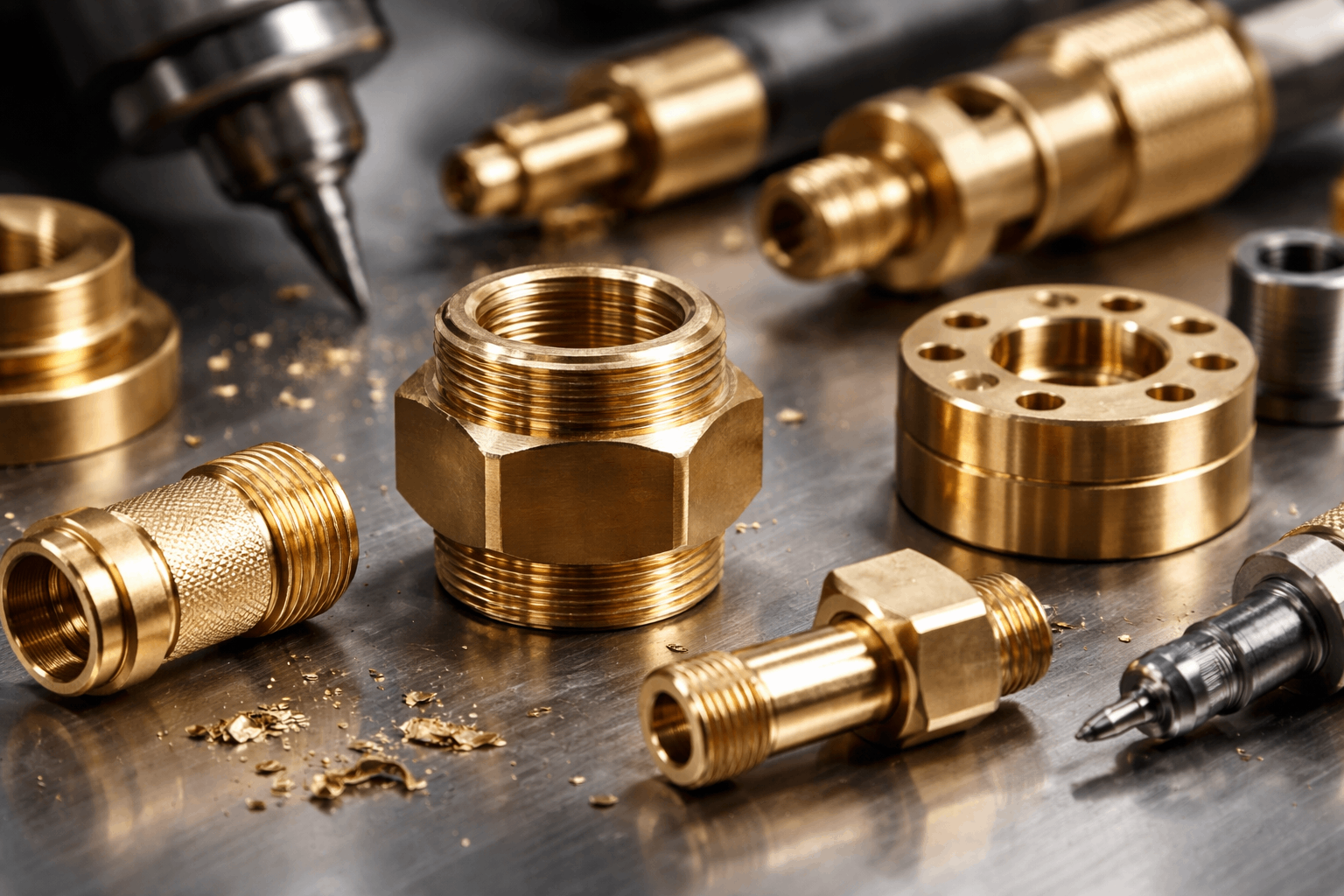
Introduction: What Overseas Buyers Usually Need to Confirm First
For overseas wholesale buyers, a blog article on brass CNC machining is rarely casual reading. In many cases it is part of supplier evaluation. Procurement managers, sourcing teams, and engineering buyers often use articles like this to confirm whether a manufacturer understands the real challenges behind machining precision brass parts at scale.
Buyers usually arrive with practical questions. Can the supplier machine the part consistently? Is the selected brass grade appropriate for the application? Will the machining process support the required tolerance and surface finish? Can the supplier maintain the same quality across repeat production orders?
Brass CNC machining continues to be widely used in connectors, threaded fittings, valve components, electrical terminals, instrumentation hardware, and decorative industrial parts. These applications require reliable conductivity, corrosion resistance, and machining precision while still supporting efficient production.
This guide focuses on the factors that matter most to professional buyers. It explains how the CNC machining process works for brass components, how to choose the right brass grade, what design features affect manufacturability, and what procurement teams should evaluate before sending an RFQ.
Why Brass CNC Machining Still Matters in Modern B2B Manufacturing
Brass remains a highly practical material in CNC production because it solves both engineering and sourcing challenges at the same time. From a machining perspective, brass offers stable chip formation, relatively low cutting resistance, and predictable dimensional behavior. From a purchasing perspective, these characteristics help suppliers maintain production efficiency and consistent quality across large batches.
In real supply chains, the most successful material is rarely the one with the most impressive specification sheet. Instead, it is the material that supports reliable production, manageable machining costs, and repeatable performance across multiple orders. Brass performs well in these areas.
- In electrical equipment manufacturing, for example, brass connectors and terminals must maintain conductivity while also allowing precise threads and consistent dimensional accuracy.
- In plumbing systems, brass fittings must resist corrosion and maintain reliable sealing surfaces.
- In instrumentation and control components, small precision features must be machined without introducing instability into the production process.
Another advantage is that brass exists in multiple grades with different machining and corrosion characteristics. This allows engineers to choose the alloy that best fits the application instead of forcing one material to solve every problem.
For wholesale buyers comparing suppliers, the most important signal is whether the manufacturer understands these practical differences. A supplier who can explain why a certain brass grade or machining approach is suitable for a specific component demonstrates stronger production awareness than one who simply lists material advantages.
Understanding the CNC Machining Process for Brass Components
The CNC machining process used for brass components relies on computer‑controlled cutting tools to remove material from a brass workpiece. CNC machines follow programmed tool paths to shape the part with precise and repeatable movements.
For procurement teams, the key benefit of CNC machining is production consistency. Once a machining program and setup are validated, the same operation can be repeated thousands of times while maintaining the same geometry and tolerance requirements.
Common CNC machining operations used in brass manufacturing include turning, milling, drilling, and threading. Turning is frequently used for cylindrical parts such as connectors, bushings, threaded inserts, and valve stems. Milling operations are applied when the component requires flats, mounting surfaces, pockets, or complex shapes.
Brass behaves predictably during machining. The material tends to produce short chips, which improves chip evacuation and keeps the cutting zone stable. Compared with harder metals such as stainless steel, brass also produces lower cutting resistance, allowing higher cutting speeds without excessive tool wear.
Heat management is another advantage. Brass has relatively good thermal conductivity, allowing heat generated during machining to disperse through the workpiece. This reduces thermal stress on the cutting tool and helps maintain dimensional stability during long production runs.
For buyers sourcing CNC machining services, process stability is one of the most important considerations. A machining process that remains stable across large batches reduces scrap rates, improves dimensional consistency, and supports predictable delivery schedules.
Why Brass Is a Strong Material Choice for CNC Machining Projects
Brass is widely recognized as one of the most machinable copper alloys used in industrial manufacturing. Its machining characteristics allow suppliers to produce precision parts efficiently while maintaining consistent quality.
One major advantage is machinability. Free‑cutting brass alloys allow tools to move through the material smoothly with minimal resistance. Lower cutting forces reduce tool wear and support faster machining speeds, which improves productivity and keeps manufacturing costs predictable.
Brass also offers good electrical and thermal conductivity. This property makes it suitable for electrical connectors, switch components, and conductive hardware where reliable current transfer is required.
Corrosion resistance is another important benefit. Components used in plumbing systems, fluid fittings, and valves must withstand moisture exposure over long periods. Brass performs well in these environments and maintains sealing surfaces without rapid degradation.
Although brass is easier to machine than many metals, it still provides sufficient mechanical strength for numerous industrial applications. This balance between machinability and strength allows manufacturers to produce durable components while maintaining efficient machining cycles.
Finally, brass works well with secondary [surface finishing processes]. Depending on the application, parts can be polished, plated, or powder coated to improve corrosion resistance or visual appearance.
Choosing the Right Brass Grade for the Application
Material selection plays a critical role in CNC machining projects. Different brass grades offer different balances of machinability, corrosion resistance, and mechanical performance.
The table below summarizes several commonly used brass grades in CNC machining projects.
| Brass Grade | Key Property | Typical Use | Buyer Tip |
|---|---|---|---|
| C360 Free Cutting Brass | Excellent machinability | Connectors, fittings, threaded inserts | Best for high‑volume precision turning |
| C260 Cartridge Brass | High ductility | Electrical components, formed parts | Useful when forming is required after machining |
| Naval Brass | Strong corrosion resistance | Marine components, outdoor hardware | Suitable for humid or saltwater environments |
| Lead‑Free Brass | Compliance focused | Plumbing and regulated applications | Required for drinking water systems in many markets |
C360 brass is the most widely used grade in CNC machining because it allows fast and stable cutting conditions. For precision turned components such as valve fittings or connector pins, this alloy often provides the most efficient production route.
Cartridge brass may be selected when a part requires additional forming operations after machining. Naval brass is often chosen for applications exposed to moisture or marine environments.
For buyers supplying regulated markets, lead‑free brass may be required to meet safety and compliance standards. In these cases the material decision is driven not only by machining efficiency but also by regulatory requirements.
Design Factors That Affect Brass Machining Accuracy and Production Stability
Even when brass is highly machinable, component design still plays a major role in production efficiency. Design decisions influence machining stability, inspection complexity, and overall manufacturing cost.
Wall thickness is one of the most important design considerations. Extremely thin walls may introduce vibration during machining operations and reduce dimensional stability. Maintaining balanced wall sections allows the cutting tool to operate more smoothly and improves repeatability.
Thread design also deserves attention because many brass parts include threaded features. Standard thread geometries typically produce better machining results and easier inspection compared with custom thread profiles.
Hole depth is another factor. Deep holes can complicate chip evacuation during drilling operations. When design allows more accessible hole geometry, machining tends to be more stable.
Tolerance selection should also reflect the functional needs of the component. Very tight tolerances increase machining time and inspection requirements. Applying tight tolerance only where it is functionally necessary usually results in better cost efficiency.
Suppliers who provide design‑for‑manufacturing feedback often help buyers optimize part designs before mass production begins. This collaboration can reduce production risk and improve long‑term consistency.
Brass Compared With Other Common CNC Machining Materials
Buyers frequently compare brass with other machining materials before confirming the final specification. The following comparison highlights how brass performs relative to common alternatives.
| Material | Machinability | Corrosion Resistance | Typical Use |
|---|---|---|---|
| Brass | Excellent | Good | Connectors, fittings, valves |
| Aluminum | Very good | Moderate | Lightweight housings, brackets |
| Stainless Steel | Moderate | Excellent | Structural parts, harsh environments |
| Bronze | Good | Good | Wear‑resistant components |
Compared with aluminum, brass offers stronger thread durability and better electrical conductivity. Compared with stainless steel, brass is generally easier to machine and may reduce machining cost where high structural strength is not required.
Bronze can offer better wear resistance in certain applications, but brass often provides a better balance between machinability and cost for precision fittings and connectors.
Typical Brass Machining Parameters
Machining parameters influence surface finish, dimensional accuracy, and cycle time. While exact values vary depending on equipment and tooling, the following ranges are common in brass CNC machining.
| Parameter | Typical Range |
|---|---|
| Spindle Speed | 1000–3000 RPM |
| Feed Rate | 0.05–0.30 mm/rev |
| Depth of Cut | 0.5–3.0 mm |
| Cutting Speed | 90–210 m/min |
Actual machining settings depend on factors such as brass grade, tool material, coolant strategy, and part geometry. Precision components with small diameters or fine threads may require different cutting parameters than larger valve bodies or fittings.
Understanding these parameters helps buyers evaluate whether a supplier has real machining expertise rather than simply marketing machining services.
Quality Control, Production Capacity, and Delivery Reliability
For overseas buyers, these operational factors often matter more than the material description itself. Reliable CNC suppliers must maintain consistent inspection processes, sufficient production capacity, and dependable delivery performance.
Quality control for brass CNC parts typically includes dimensional inspection, thread verification, surface finish checks, and material certification where required. Inspection may involve gauges, micrometers, coordinate measuring machines, or specialized thread gauges.
Production capacity involves more than machine quantity. Setup planning, operator experience, fixture design, and inspection resources all influence the supplier’s ability to maintain consistent output.
Delivery reliability is also essential. Buyers managing global supply chains often coordinate machining schedules with assembly production or distribution timelines. Suppliers who provide realistic lead times and stable delivery performance help reduce supply chain risk.
Surface Finishing Options for Brass Components
Surface finishing is often required to improve corrosion resistance, durability, or product appearance. Several finishing options are commonly used for brass components.
Polishing enhances the natural metallic appearance of brass and is frequently used for decorative hardware. Nickel plating improves corrosion resistance and surface durability, making it suitable for electrical components.
Chrome plating can provide additional hardness and a bright reflective finish. Powder coating may be applied when parts require additional protection or a specific color finish.
Selecting the appropriate surface finishing method depends on the functional requirements of the product and the environmental conditions in which it will operate.
Buyer Checklist Before Sending a Brass CNC Machining RFQ
Before submitting a quotation request, many buyers prepare a short checklist to ensure suppliers receive clear technical information. Providing complete project details usually results in faster and more accurate quotations.
| Information to Prepare | Why It Matters |
|---|---|
| Technical drawings or 3D files | Defines geometry and tolerance requirements |
| Material specification | Confirms the correct brass grade |
| Surface finish requirement | Determines secondary processing steps |
| Estimated order quantity | Helps suppliers plan production capacity |
| Target delivery schedule | Supports realistic production planning |
Providing this information early helps both the buyer and supplier evaluate the feasibility of the project and avoid unnecessary revisions during quotation.
Conclusion
Brass CNC machining remains a reliable method for producing precision components used in electrical equipment, plumbing systems, industrial hardware, and many other applications. The material combines machinability, corrosion resistance, and conductivity while supporting efficient production.
For wholesale buyers, the most important factors usually include alloy selection, machining capability, inspection processes, production capacity, and delivery reliability.
Understanding these factors helps buyers select the right supplier and reduce risk in long‑term manufacturing partnerships.
If you are reviewing a custom brass machining project, sharing drawings, material requirements, finishing specifications, and expected order volumes usually leads to faster quotation and smoother project planning.
Frequently Asked Questions
Is brass suitable for CNC machining?
Yes. Brass is widely considered one of the easiest metals to machine because it provides stable cutting performance and good dimensional accuracy.
What brass grade is most commonly used for machining?
C360 free‑cutting brass is commonly used because it offers excellent machinability and efficient chip formation.
Why is brass often used in electrical components?
Brass provides good electrical conductivity while allowing precise machining of connectors, terminals, and switch components.
What should buyers evaluate in a brass CNC machining supplier?
Buyers typically review machining capability, material expertise, inspection systems, production capacity, and delivery reliability before selecting a supplier.