
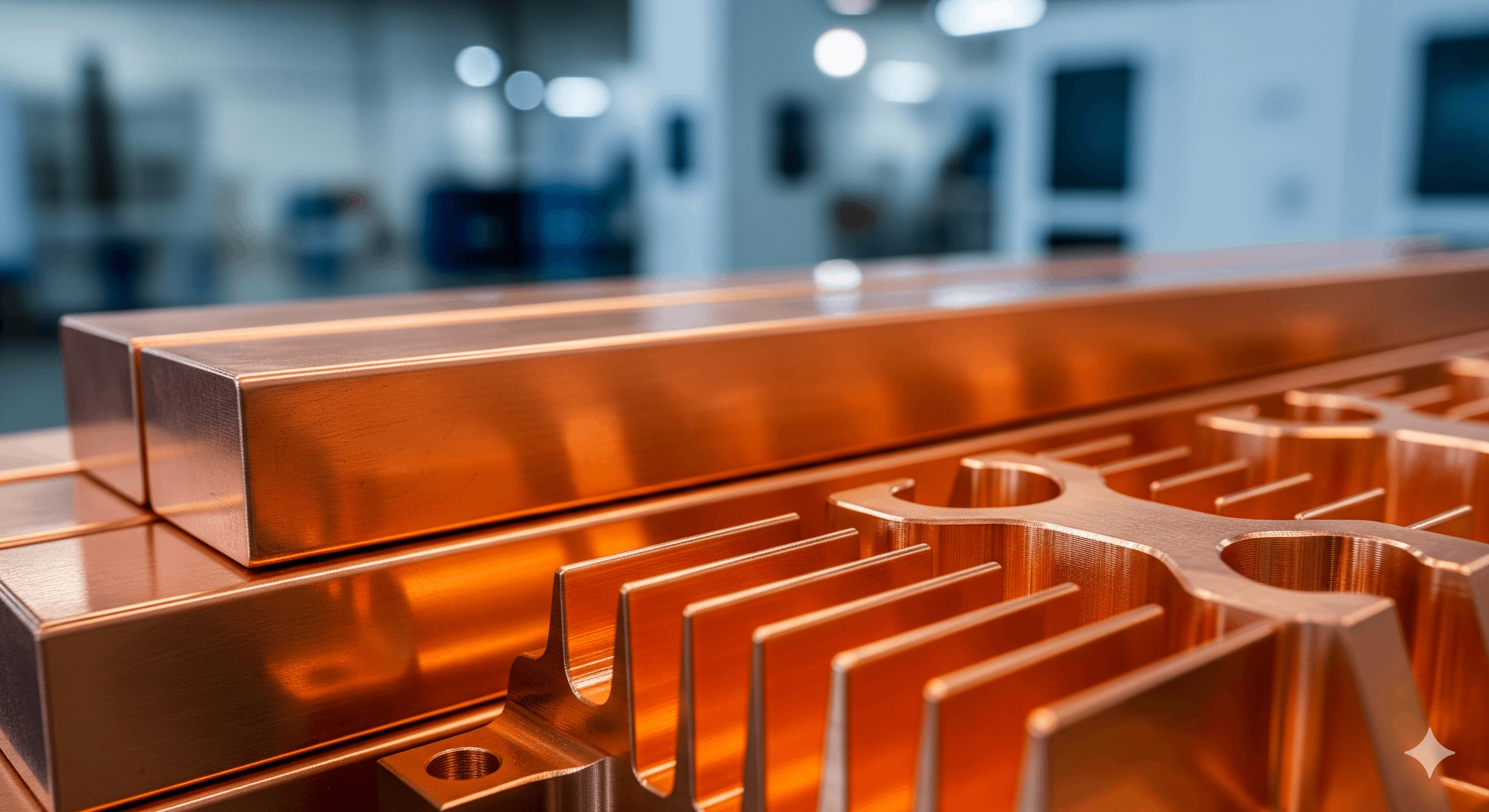
I. The Strategic Imperative: Why Custom Copper is the Backbone of Modern Infrastructure
The global industrial landscape is experiencing a fundamental shift in how power and thermal loads are managed. As we progress into 2026, the demand for precision copper components has moved beyond simple electrical wiring into high-complexity engineering assets. For overseas wholesale buyers, copper is no longer a mere commodity; it is a strategic material that dictates the efficiency of 800V electric vehicle (EV) architectures and AI-driven data centers.
However, this surge in demand has highlighted the “Copper Paradox”: while copper is indispensable for its conductivity, it is notoriously difficult to process to sub-millimeter tolerances. In B2B manufacturing, copper presents challenges that off-the-shelf components cannot address. Whether it is a liquid-cooled cold plate for a server rack or a complex busbar for a renewable energy system, the integrity of the end product depends on the fabricator’s skill.
For a procurement officer, the primary goal is a supply chain that guarantees precision at scale. A deviation of just a few microns in a contact surface can lead to catastrophic thermal runaway or significant power loss. At YISHANG, we recognize that our clients are not just buying metal; they are investing in the long-term reliability of their own brand reputation. This requires a partner who understands the metallurgy as deeply as the manufacturing.
This guide serves as a technical roadmap for sourcing precision copper components in a volatile market. We will explore how material science, advanced manufacturing, and strategic design-for-manufacturability (DFM) converge to meet 2026 industrial standards. By understanding the nuances that differentiate a generalist shop from a specialist like YISHANG, you can effectively mitigate supply chain risks and ensure maximum system efficiency.
II. Strategic Material Selection: Optimizing Unit Cost and Electrical Performance
Selecting the right copper grade is the most critical decision in the custom fabrication cycle. Wholesale buyers often face the dilemma of balancing material costs with long-term performance benchmarks. In custom-fabricated copper parts, we focus on the “Red Metals” family, where conductivity is prioritized alongside machinability and environmental resistance. Choosing the wrong alloy can lead to premature failure in a push button enclosure or control station.
1. C11000 (ETP) vs. C10100/C10200 (Oxygen-Free): The High-Voltage Logic
The workhorse of the modern electrical industry is C11000, known as Electrolytic Tough Pitch (ETP) copper (standardized under ASTM B152). With a 101 percent IACS conductivity, it is the standard for solar battery enclosures and standard busbars. However, ETP copper contains trace amounts of oxygen. This becomes a liability during high-temperature brazing or welding in reducing atmospheres, potentially leading to “hydrogen embrittlement.”
For high-vacuum environments or medical imaging equipment where structural integrity under heat is paramount, procurement teams must pivot to Oxygen-Free Copper (OFC). OFC grades like C10100 provide 99.99 percent purity and eliminate the risk of embrittlement. While the material cost is higher, it serves as an essential risk-mitigation strategy for aerospace power distribution where field failure is not an option.
2. Copper vs. Aluminum & Brass: The Value Engineering Decision
A frequent question from procurement managers is when to opt for copper over cheaper alternatives like aluminum or brass. While aluminum offers weight advantages, copper’s superior thermal conductivity (390 W/m·K versus 237 W/m·K) allows for much smaller enclosure footprints. This is critical for control station enclosures where internal space is at a premium and heat density is high.
Brass, while easier to machine, offers only about 28 percent of copper’s conductivity. This makes custom fabricated copper the only viable choice for high-current applications. Understanding these material trade-offs is essential for B2B buyers looking to optimize the Total Cost of Ownership (TCO) without compromising on the NEMA interface or junction box nema safety standards.
Table 1: Technical Comparison of Industrial Copper Alloys (ASTM Standards)
| Alloy Grade | % IACS Conductivity | Machinability | Thermal Conductivity (W/m·K) | Primary Industrial Applications |
|---|---|---|---|---|
| C11000 (ETP) | 101% | 20% | 388 | Power distribution, solar battery enclosure components |
| C10100 (OFC) | 101% | 20% | 391 | Vacuum electronics, high-power RF, medical systems |
| C14500 (TeCu) | 85-90% | 85% | 355 | Complex CNC connectors, specialized machined terminals |
| C17200 (BeCu) | 22-25% | 20% | 105 | High-stress springs, aerospace contact probes, bushings |
III. Overcoming Fabrication Bottlenecks: Precision in the Modern Workshop
Fabricating copper requires specialized equipment that differs significantly from what is used for a standard steel enclosure or aluminum enclosure. Because copper is a superior conductor of heat and highly reflective to light, it resists traditional manufacturing processes. Overcoming these bottlenecks requires a blend of high-end technology and the iterative craftsmanship found at YISHANG.
1. Managing Reflectivity in High-Power Laser Cutting
One of the most persistent challenges in copper fabrication is laser cutting. Copper reflects up to 95 percent of infrared light from CO2 lasers and significant portions of fiber laser energy. In early fabrication, this “back-reflection” could destroy the laser head. For wholesale buyers, this historically meant higher scrap rates and inconsistent edge quality on electrical meter box components.
Modern precision shops now utilize high-power fiber lasers with beam modulation and protective optics. However, cutting is only half the battle; the “heat-affected zone” (HAZ) must be strictly controlled. Because copper dissipates heat rapidly, edges can become ragged if gas pressure and pulse frequency are not synchronized. Achieving a burr-free edge on a 10mm copper busbar requires advanced process control to prevent re-melting.
2. Advanced CNC Machining: Tooling for “Gummy” Materials
In CNC milling, copper’s ductility often leads to the “sticky tool” phenomenon, especially when creating custom fabricated copper components for control station enclosures. Standard tool paths result in microscopic burrs that damage dimensional integrity. To combat this, YISHANG uses high-shear tool geometries with diamond-like carbon (DLC) coatings and high-pressure cooling to evacuate chips instantly.
Preventing work hardening is equally critical. If a tool dwells too long, the copper’s surface hardness increases locally, leading to tool breakage. We use adaptive clearing strategies to maintain a constant load, ensuring that parts meet the tightest tolerances for flatness. This is vital for liquid cooling plates where a flat surface is the only way to ensure proper thermal contact with semiconductors.
3. The Science of Joining: Welding vs. Induction Brazing
Joining copper is arguably the most technically demanding part of the cycle. Traditional TIG or MIG welding often fails because copper’s thermal conductivity pulls heat away from the weld zone too fast. This results in “cold welds” with poor penetration—a risk wholesale buyers cannot afford in mission-critical hardware like power inverters or enclosures solar battery systems.
The modern solution involves Induction Brazing or Laser Welding. Induction brazing allows for localized heating, ensuring filler metal flows perfectly into the joint via capillary action without deforming the component. For EV busbars, laser welding is the industry standard, offering deep penetration and minimal porosity. This process is essential for maintaining low electrical resistance across the assembly, as any void can lead to localized heating and failure.
IV. DFM (Design for Manufacturability): Strategies for Scalability and Cost Reduction
For wholesale buyers, the transition from a prototype to a million-unit run is where the real value is created. Design for Manufacturability (DFM) in copper fabrication focuses on balancing technical requirements with the physical limitations of the material. A design not optimized for the shop floor will inevitably lead to higher rejection rates and inflated lead times.
1. Corner Radii, Tool Access, and Material Flow
Copper is crystalline, and its properties can be anisotropic depending on the rolling process. In sheet metal fabrication, grain direction must be considered before bending. Bending across the grain is safer, while bending parallel to the grain can lead to stress cracks. Furthermore, sharp internal corners are a recipe for failure in copper components intended for a galvanized steel enclosure environment.
YISHANG typically recommends a minimum bend radius based on the material’s temper. Designing for tool access in CNC milling can also reduce the number of setups required. Every time a part is repositioned, the risk of dimensional error increases. By optimizing the design for a single-setup approach, procurement teams can achieve higher accuracy and significantly lower unit costs over a long-term wholesale contract.
2. Thermal Management Geometry and Structural Integrity
In thermal management, surface area is king, but geometry is the crown. Engineers often design ultra-thin fins for heat sinks to maximize surface area. However, if fins are too thin, they lose structural integrity during cleaning or plating. This can lead to “fin folding,” which restricts airflow and reduces cooling efficiency in high-load server environments.
We advocate for a “thermal-mechanical balance.” This involves optimizing fin density for convective airflow while maintaining enough thickness for conductive heat transfer. This ensures that the final product is both thermally efficient and robust enough for industrial handling. For buyers, this means fewer damaged parts during transit and a more reliable end-use performance.
3. Strategic Nesting: Reducing Waste in High-Value Alloys
Copper is one of the most expensive metals in the workshop. Therefore, the DFM process must include strategic nesting for sheet metal parts. By optimizing how parts are laid out on a sheet, we can often reduce waste by up to 20 percent. This is particularly important when comparing copper to cheaper materials like carbon steel enclosure or stainless steel enclosure components.
Given that copper is 100 percent recyclable, managing the scrap loop efficiently is core to sustainable manufacturing. For the wholesale buyer, this means a professional fabricator can offer more competitive pricing through credit-back mechanisms for recovered scrap. This directly impacts your Total Cost of Ownership (TCO) and makes custom copper a more viable long-term solution for large-scale projects.
V. Surface Integrity: Protecting Long-Term Electrical Reliability
Copper’s high conductivity is its greatest strength, but its chemical reactivity is its weakness. Left unprotected, copper oxidizes rapidly, forming a dark patina that increases contact resistance. Surface treatment in custom fabrication is not just about aesthetics; it is a critical engineering requirement for long-term reliability in the field, especially for enclosure solar battery applications.
1. The War Against Oxidation: Passivation and Conversion
For indoor applications, simple passivation or an anti-tarnish coating is often sufficient for the assembly phase. However, these are temporary measures. For parts exposed to harsh environments, such as offshore wind turbines or outdoor charging piles, more robust solutions are needed. Chemical conversion layers provide protection without significantly impacting electrical properties.
The challenge for the manufacturer is applying these treatments uniformly across complex geometries without leaving “dead zones.” At YISHANG, our surface treatment protocols ensure that every millimeter of the component is shielded. This is essential for maintaining the NEMA rating of the final enclosure and preventing premature failure due to environmental corrosion.
2. Plating Selection: A Balance of Cost and Performance
Plating is the most common method to enhance copper’s surface properties. For a procurement manager, choosing the right plating is a balance of functional requirements and budget:
- Tin Plating: The most cost-effective solution for preventing oxidation and improving solderability. It is widely used in power distribution. However, in high-precision electronics, we must manage the risk of “tin whiskers.”
- Silver Plating: Offers the lowest contact resistance. It is the preferred choice for high-frequency RF components and EV charging terminals where minimizing power loss is the top priority.
- Nickel as a Barrier Layer: Before applying gold plating, a nickel underplate is mandatory. Without this, copper atoms will migrate into the gold layer through solid-state diffusion, causing the surface to lose conductivity and tarnish.
3. Dielectric Insulation for High-Voltage Safety
As EV and Energy Storage (ESS) systems move toward 1500V DC, busbars must be insulated to prevent arcing. Traditional heat-shrink tubing often fails at sharp corners and adds significant bulk. The high-performance alternative is Epoxy Powder Coating. This process provides a uniform, durable dielectric layer that can withstand high temperatures and vibration.
Applied via an electrostatic process and then heat-cured, epoxy coating allows for much smaller clearances between conductive parts. This is essential for the compact design of modern battery packs and solar inverters. For the buyer, this means a safer, more compact product that meets stringent international safety standards while reducing the overall footprint of the electrical assembly.
VI. Quality Assurance in the “Zero-Defect” Era: Proof of Capability
When a copper component is destined for a medical diagnostic machine or a subsea cable, there is no room for error. Quality control (QC) in copper fabrication must be multi-dimensional, verifying the shape, the internal structural integrity, and the electrical performance. For wholesale buyers, this section represents the “Proof of Capability.”
1. Dimensional Precision with CMM and Optical Inspection
For complex 3D copper busbars, manual measurement is insufficient. YISHANG utilizes Coordinate Measuring Machines (CMM) to verify that every bend angle and hole location meets the specified tolerances, often as tight as plus or minus 0.05mm. Automated optical inspection (AOI) is also used to detect surface defects like scratches that could act as stress concentrators.
This data-driven approach ensures that the 10,000th part is as accurate as the first. For a wholesale buyer, this consistency is the key to a smooth assembly process. When parts arrive on your production line, they must fit perfectly without the need for manual adjustment, which is the primary cause of bottlenecking in large-scale industrial projects.
2. Non-Destructive Testing (NDT) for Internal Integrity
“Hidden” defects—such as internal voids from casting or microscopic cracks from improper bending—can only be detected through non-destructive testing (NDT). Eddy current testing is a standard method used to verify conductivity across the batch, ensuring the material meets the IACS requirements specified in the design phase.
For joined assemblies, micro-ohm resistance mapping ensures that welds and brazed joints provide a seamless path for current. Any spike in resistance is a red flag for potential joint failure under load. This level of scrutiny is what allows YISHANG to support high-stakes industries where the cost of a single component failure can reach hundreds of thousands of dollars in downtime.
3. Compliance, Traceability, and Global Standards
In today’s market, RoHS compliance and ISO 9001 certification are the baseline. However, true quality assurance involves a robust material traceability system. Every batch of custom copper parts should be accompanied by a Mill Test Report (MTR), confirming the chemical composition and physical properties of the raw material.
Following ASTM standards for copper fabrication ensures that products meet internationally recognized benchmarks for safety. This level of transparency is critical for procurement managers in highly regulated industries like aerospace and medical manufacturing. It provides the legal and technical “paper trail” required to protect your supply chain from sub-standard materials and counterfeit alloys.
VII. The Strategic Sourcing Logic: Managing the Transition to Scale
Successful sourcing of custom copper parts requires a partner who can manage the entire lifecycle of a product. Many shops can make one or two prototypes using manual methods, but few can transition those designs into high-volume, cost-effective mass production while maintaining the same level of precision and material integrity.
1. Scaling Production: From CNC Machining to Stamping
Early-stage prototypes are often machined using CNC or laser-cut to allow for quick iterations. However, for wholesale orders of 10,000 pieces or more, CNC is often too slow and expensive. A strategic fabrication partner like YISHANG will guide you toward Progressive Die Stamping or specialized forming tools once the design is finalized.
This shift requires a significant upfront investment in tooling, but it can reduce the per-part cost by 40 to 70 percent in the long run. The key is to ensure the initial DFM was done correctly so that the transition does not require a complete redesign. This foresight saves thousands of dollars in development costs and ensures that your product hits the market on schedule.
2. Pricing Dynamics and LME Surcharges
For high-volume wholesale buyers, pricing transparency is non-negotiable. Copper is a traded commodity, and its price is tied to the London Metal Exchange (LME). At YISHANG, we provide a transparent pricing model that accounts for the base metal cost plus a fabrication surcharge.
This approach protects both the buyer and the seller from extreme market volatility. By understanding how the “Copper Surcharge” works, procurement teams can better predict their quarterly budgets and avoid the hidden costs often associated with fixed-price contracts for long-term projects. This financial clarity is a key pillar of our B2B partnership model.
3. Global Logistics and Anti-Oxidation Packaging
Copper’s sensitivity to the environment doesn’t end when the part is finished. During international shipping—which can involve weeks of exposure to humid salt air—copper parts are at high risk of oxidation. A professional exporter will utilize VCI (Vapor Corrosion Inhibitor) packaging to protect the “red metal” during transit.
VCI bags release a harmless vapor that forms a molecular layer on the copper, preventing oxygen and moisture from reaching the metal. This ensures that parts arrive at their destination in over 50 countries in the same pristine condition they left our floor. This attention to detail in the “last mile” of production is what ensures a smooth, interruption-free supply chain for our global partners.
VIII. Sustainability and ESG in Copper Fabrication
Modern procurement protocols increasingly require suppliers to meet Environmental, Social, and Governance (ESG) standards. Copper is naturally one of the most sustainable materials in the workshop. It can be recycled infinitely without any loss of performance, making it the ideal choice for “Green” industrial projects.
At YISHANG, we integrate sustainability into our workflow by utilizing high-efficiency fiber lasers that consume less power and implementing closed-loop scrap recovery systems. Choosing a sustainable fabrication partner not only helps you meet your corporate ESG targets but also ensures a more stable, long-term supply of material as the world moves toward a circular economy.
IX. Conclusion: The Future of Copper in a Sustainable Industrial Loop
As we look toward the future, the role of copper will only continue to grow. Its 100 percent recyclability makes it a cornerstone of the circular economy, aligning with the sustainability goals of the world’s leading corporations. In 2026 and beyond, the winners in the industrial sector will be those who can most efficiently manage the “Copper Paradox” through advanced engineering.
The most successful projects are those where the procurement team and the fabricator work in tandem, treating the material with the respect its metallurgy deserves. By understanding the nuances of copper grades and mastering the physics of fabrication, we can push the boundaries of electrical and thermal engineering.
At YISHANG, we view every busbar, heat sink, and connector as a critical component in the global technological evolution. Our 26 years of experience are dedicated to ensuring that your custom copper components serve you well from the prototype stage to global mass distribution.
Frequently Asked Questions (FAQ)
1. Should I go for stock parts or custom-fabricated copper parts for my project? Stock parts are ideal for basic grounding where geometry is simple. However, for applications requiring specific thermal management (heat sinks) or complex geometries for tight enclosures (like EV battery packs), custom fabrication is essential. Custom parts allow for optimized conductivity, better space utilization, and significantly lower total assembly costs.
2. How do I choose the right copper alloy for my application? The choice depends on conductivity requirements (ETP vs. OFC), the manufacturing process (machining vs. bending), and the operating environment. For most electrical applications, C11000 ETP is the most cost-effective. For vacuum or high-power brazed assemblies, C10100 Oxygen-Free is mandatory. Consult with the YISHANG team during the DFM phase to avoid over-specifying.
3. What is the typical lead time for custom-fabricated copper parts? Lead times vary based on complexity and surface treatments. Prototyping typically takes 1-2 weeks. For mass production, including material sourcing and specialized plating, the lead time is usually 4-6 weeks. Using a factory with an integrated supply chain can significantly reduce these timelines by minimizing inter-facility handling.
4. How does RoHS certification impact my international order? RoHS compliance ensures that your copper parts do not contain restricted hazardous substances. This is a mandatory requirement for products sold in the European Union and North America. Working with an ISO 9001 certified factory that provides RoHS documentation and material Mill Test Reports (MTR) ensures your products will not face legal hurdles at customs, safeguarding your supply chain stability.
Ready to optimize your copper supply chain?
Send your inquiry today to discuss your project requirements with the YISHANG engineering team.