
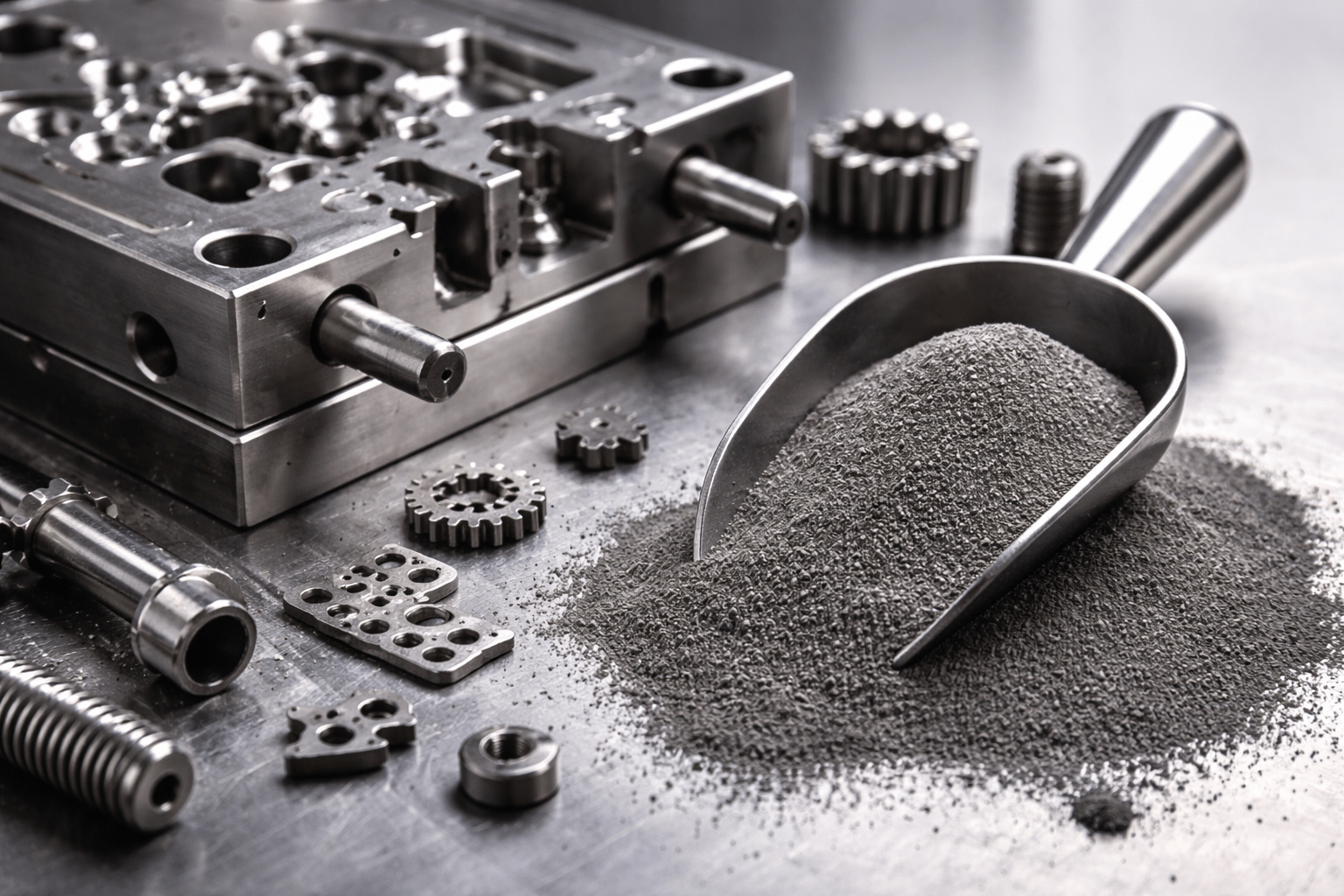
For overseas wholesale buyers, a supplier blog is often part of supplier screening rather than casual reading. Buyers usually want to know whether a manufacturer understands stable volume production, repeatable quality, lead-time risk, and total landed cost. That is why metal powder in injection molding deserves a practical explanation. In this process, powder is not only a raw material. It affects molding behavior, sintering stability, dimensional control, and how much corrective work is required later.
In practice, buyers rarely compare MIM with an ideal process in theory. More often, they compare it with machining , casting, or multi-part assembly under real sourcing pressure. The more useful question is not simply whether powder injection molding works. It is when the process improves procurement outcomes. That usually depends on geometry, order pattern, tolerance expectations, and how much downstream work can be removed.
The discussion below focuses on process evaluation rather than general product education. It shows where the process creates practical value, where it reduces risk, and what procurement teams should pay attention to before moving from quotation to production.
What Metal Powder Actually Changes in the Injection Molding Process
It changes how the part is formed
In conventional machining, the starting material is solid stock. In the injection molding process used for metal parts, the starting point is a feedstock made by blending fine metal powder with a binder system. That difference changes the manufacturing logic from the first step. Flow behavior, particle size distribution, purity, and packing all influence whether the feedstock can fill thin walls, ribs, small holes, and other intricate details without creating unstable density. For a buyer, this matters because it affects whether the quoted design can move into stable production without turning into a secondary-processing problem.
It changes how the part behaves after molding
The powder also determines what happens after molding. A molded green part is only an intermediate stage. During debinding and sintering, the part must shrink in a controlled way while developing density and structural integrity. This is where metal powders in injection molding differ sharply from both plastic injection molding and many traditional manufacturing methods. If the powder system is inconsistent, the same mold can still produce different outcomes in dimension, surface condition, or part strength.
That difference becomes even more important in cross-border sourcing. A small variation that seems manageable inside a workshop can become expensive once parts are packed, shipped, and scheduled for downstream assembly. Rework, sorting, delayed launches, and replacement orders all increase the actual cost of the program. This is why experienced buyers often look past broad claims such as high precision or improved design flexibility and instead ask whether the process is repeatable under production conditions.
It changes the economic model
The commercial logic changes as well. In machining, value is created by removing material with precision. In powder injection molding, value is created by forming geometry close to the final shape so that less drilling, grinding, fitting, and polishing are required later. This shift is the foundation behind the main advantages discussed below. It does not make MIM the right answer for every part, but it explains why the process can outperform traditional metal processing methods when a project combines small size, complex geometry, and repeated demand.
How Metal Powder Creates Commercial Value for Wholesale Buyers
Complex geometry becomes easier to source at scale
The first major advantage is geometric practicality. Many manufacturing methods can produce intricate shapes in theory, but fewer can do so consistently in repeat supply. By using metal powder, manufacturers can form complex geometries with high precision that would otherwise require multiple machining operations or multi-part assemblies. This includes thin walls, internal features, small openings, threads, and complex contours. For a buyer, the gain is not simply enhanced design freedom. It is the ability to source a part that does not need to be simplified merely to fit the manufacturing route.
That difference can affect the whole product structure. When one molded part replaces several machined or stamped pieces, assembly steps may be reduced, tolerance stack-up becomes easier to control, and part management becomes simpler for both the supplier and the buyer. In that sense, geometric capability is not only a design issue. It is also a supply-chain and manufacturability issue.
Near-net-shape production changes the cost structure
The second advantage is cost structure. Buyers often compare MIM with machining or casting because they want to know where total cost really changes. In many cases, the strongest savings do not come from the molding step itself. They come from reducing the need for secondary operations. Near-net-shape forming means less drilling, less grinding, less polishing, and less manual fitting after sintering. This does not automatically mean lower upfront tooling costs, but it can mean a lower total production burden when the part is complex enough and the order volume is high enough to justify tooling.
Better material use supports more stable long-run economics
The third advantage is material efficiency. In subtractive manufacturing, waste and scrap are built into the method. The process starts with more metal than the final part needs, and the excess becomes removed material. By contrast, the use of metal powder brings the feedstock much closer to the target shape from the beginning. That reduces unnecessary removal and can improve cost control, especially for stainless steel and other value-added materials. For procurement teams comparing long-run supply options, lower scrap rates can also support more stable pricing over time.
Powder quality affects the final part, not just the raw material stage
The fourth advantage is performance after sintering. Enhanced material properties do not come from alloy selection alone. They also depend on powder purity, particle distribution, and densification behavior. When the powder system is well controlled, manufacturers can achieve stronger density, better wear resistance, and more reliable service performance in suitable parts. This is one reason why [metal injection molding](https://www.mpif.org/IntrotoPM/Processes/Met is used for function-critical precision hardware rather than only decorative components. In practical sourcing terms, a part with good as-sintered structure is less likely to create field failures, warranty issues, or inconsistent assembly behavior.
Stable feedstock supports stable supply
The fifth advantage is production stability. Procurement teams usually care less about one successful sample than about stable output over repeated lots. In MIM, stable feedstock supports more consistent cavity filling and more predictable shrinkage, which usually improves batch-to-batch control. That reduces hidden costs associated with line stoppage, incoming inspection escalation, and corrective actions. When buyers search phrases such as higher production efficiency or production cycle times, what they often mean is not simply faster machine time. They mean a smoother path from approved sample to repeat shipment.
Taken together, these points show why metal powder matters beyond the material level. It affects manufacturability, total cost, waste control, part performance, and supply stability at the same time. That combination is what makes MIM commercially attractive for the right category of parts.
Why Surface, Cycle Time, and Secondary Work Matter More Than They First Appear
Surface quality is really a workflow issue
A superior surface finish is often presented as a cosmetic benefit, but for wholesale procurement it is more useful as a workflow benefit. When the surface finish of the molded parts is more consistent, there is usually less polishing, deburring, or cosmetic correction before packaging and shipment. That reduces handling steps and lowers the chance of mixed-quality lots. It can also improve predictability in downstream assembly, where even a small variation in fit or finish can slow operators.
Dimensional stability reduces supply friction
The same logic applies to dimensional control. In the production of small precision parts, repeatable dimensions matter because supply programs are rarely evaluated one piece at a time. They are evaluated in terms of line-side performance, incoming quality burden, and how often a buyer has to chase a supplier for corrective action. When the powder system is stable and the thermal cycle is well controlled, the process is more likely to support consistent results lot after lot.
The real cycle time is the full program cycle
Cycle time should also be understood in a broader way. Articles about shortened production cycle or faster output can become misleading if they focus only on the molding press. In real procurement, the overall production timeline includes tool readiness, qualification, debinding, sintering, inspection, rework, and packing. A process that eliminates the need for extensive secondary operations can shorten the actual program cycle even if the molding stage itself is not dramatically faster than another route.
This is why experienced buyers tend to focus on the full manufacturing path rather than a single process metric. They want to know whether the process will reduce inspection load, labor intensity, rework, and delivery friction for a specific part family. Seen from that perspective, surface quality and cycle time are not side benefits. They are part of the larger question of how smoothly the supply program can run.
Where Buyers Should Look for Risk, Fit, and Supplier Readiness
A strong process still needs the right application
Because the process can sound highly capable on paper, blog content can easily become too broad. The more useful approach is to ask where the advantages become commercially relevant and where they can be overstated. A lower unit price does not always mean lower total cost if tooling is heavy and annual volume is low. Likewise, the ability to produce complex shapes does not mean every geometry is equally safe in debinding and sintering. Buyers usually gain more confidence from an article that explains boundaries than from one that only repeats benefits.
A good fit for MIM usually has four characteristics. The part is small enough for efficient molding, complex enough that machining or assembly would otherwise be costly, stable enough in design to justify tooling, and ordered often enough to benefit from repeatable production. That is why the process is often attractive for wholesale programs involving hardware, equipment components, locking parts, appliance mechanisms, connectors, and other precision metal items where cumulative manufacturing burden matters as much as unit price.
Supplier readiness matters as much as process capability
Supplier readiness is just as important as process capability. Strong suppliers are usually able to discuss feedstock consistency, debinding control, dimensional risk, and inspection planning in clear language. They can also explain what kind of part is not a good fit. That kind of communication reduces uncertainty during RFQ review because it shows that the supplier understands execution, not just theory.
The table below summarizes how buyers often compare MIM with a machining-led route when deciding whether the process is commercially attractive.
| Factor | Machining-Led Route | Powder Injection Molding |
|---|---|---|
| Starting form | Solid stock | Powder-binder feedstock |
| Best fit | Low volume, larger parts, frequent design changes | Small complex parts with repeat demand |
| Material efficiency | Lower due to higher removal | Higher due to near-net-shape forming |
| Secondary work | Often extensive | Often reduced |
| Upfront tooling | Lower | Higher |
| Batch repeatability | More dependent on setup and operator control | Stronger when feedstock and thermal control are stable |
| Buyer value driver | Flexibility | Repeatability and lower downstream burden |
A second practical reference is process control. While exact values vary by alloy and part design, buyers usually benefit from understanding which variables most influence final output.
| Process factor | Why buyers should care |
|---|---|
| Particle size distribution | Affects mold filling and density consistency |
| Powder purity | Influences defect risk and final performance |
| Feedstock homogeneity | Supports repeatable lots and dimensional stability |
| Debinding control | Reduces cracking, distortion, and hidden rejects |
| Sintering profile | Drives shrinkage behavior and structural outcome |
| Tool design | Affects gating balance and repeat production quality |
The buying decision usually turns on risk reduction
These factors are often more useful than broad claims about innovation because they connect directly to quotation accuracy, sample approval, pilot runs, and steady supply after launch. In practice, buyers usually want fewer surprises, fewer corrective actions, and a smoother path from RFQ to repeat delivery. That is also why a focused technical blog can work well on a supplier website: it helps buyers evaluate fit before the RFQ stage and supports better-quality inquiries.
Questions Procurement Teams Usually Ask Before Choosing MIM
Procurement teams usually move quickly from general advantages to more specific questions. Is MIM more economical than machining for this part? Will it really reduce secondary work, or only shift cost into tooling? Is the geometry complex enough to justify the process? And if the sample looks good, will repeat lots stay equally stable after production starts?
In practice, procurement teams are rarely looking for a broad explanation of technology alone. They want to know whether the process improves sourcing outcomes for a specific part family. The most useful questions usually focus on process fit, total manufacturing burden, and whether repeat production will remain commercially stable after launch.
A useful rule of thumb is simple. MIM is usually a stronger fit when the part is small, geometry-intensive, repeat-ordered, and expensive to machine or assemble through conventional routes. It is usually less attractive when the part is large, very simple, still changing frequently, or ordered in volumes too low to recover tooling efficiently. Buyers do not need a universal claim. They need a process fit decision they can trust.
Conclusion
The real advantage of metal powder in MIM is not that it sounds advanced. It is that it can improve manufacturability, reduce downstream work, control scrap, and support stable repeat supply when the part is a good fit for the process. For overseas wholesale buyers, that combination matters because it reduces uncertainty across pricing, production, inspection, and delivery.
If you are comparing MIM with machining or other routes for a small complex metal part, YISHANG can help review the design and discuss whether powder injection molding makes commercial sense for your program. A practical RFQ starts with the right process choice, and that decision is easier when the manufacturing logic is clear.