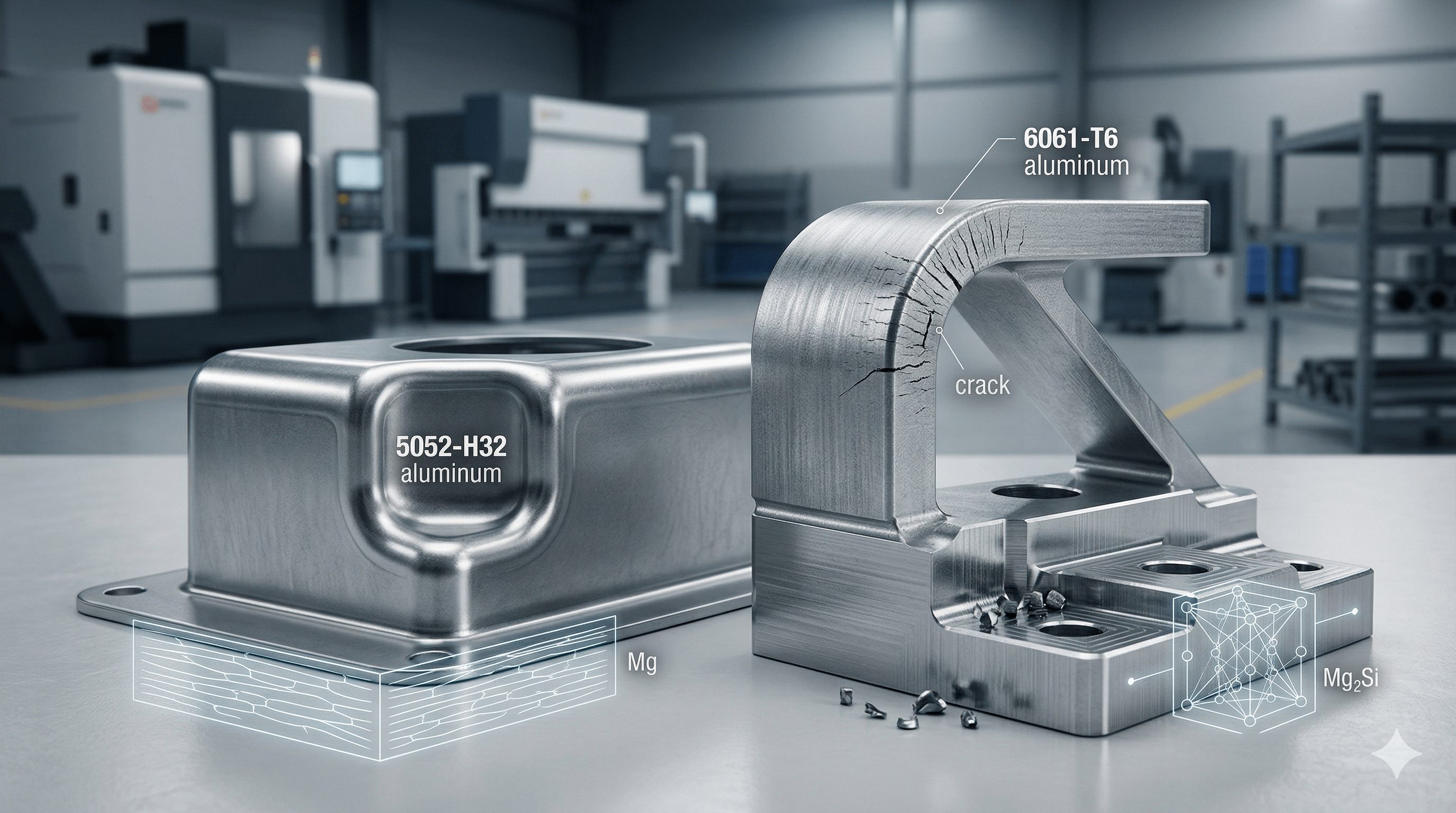
In the precision-driven world of industrial manufacturing, selecting between 5052 and 6061 aluminum is a strategic decision. Consequently, this choice dictates long-term project ROI and supply chain resilience. For overseas wholesalers and OEM procurement managers, this choice transcends simple material cost. Ultimately, it is about mitigating the risk of batch-wide mechanical failure. Miscalculating the temper or alloy choice often results in catastrophic downstream costs. These costs include structural frames cracking during high-volume production or enclosures failing in corrosive environments.
Strategic sourcing requires looking beyond basic datasheets. Specifically, you must understand how these alloys interact with specific custom metal fabrication processes. While both are industry workhorses, they occupy distinct niches. For example, one is the master of cold-formability and chemical resilience. In contrast, the other is the undisputed standard for structural rigidity and precision CNC machining. At YISHANG, we prioritize material intelligence. This ensures that every high-volume order is optimized for both durability and manufacturing efficiency.
Quick Comparison: 5052 vs. 6061 at a Glance
| Feature | 5052 Aluminum (H32) | 6061 Aluminum (T6) | Best For |
|---|---|---|---|
| Primary Strength | Fatigue Resistance | Structural Yield Strength | 6061 for Load-bearing |
| Formability | Excellent (Tight Bends) | Poor (Tends to Crack) | 5052 for Complex Enclosures |
| Weldability | Superior (Stable HAZ) | Good (Strength loss in HAZ) | 5052 for Pressure Vessels |
| Machinability | Fair (Gummy) | Excellent (Clean Chips) | 6061 for CNC Parts |
| Corrosion | Marine Grade (Best) | Good (General Industrial) | 5052 for Saltwater/Coastal |
1. Metallurgical Foundations: Understanding the Chemical Catalyst
The performance divergence between 5052 and 6061 begins at the molecular level. Notably, the chemical composition of 5052 vs 6061 aluminum dictates their reaction to thermal and mechanical stress. Aluminum 6061 is a Magnesium-Silicon hybrid belonging to the 6xxx series. Its hallmark is its heat-treatable nature. It is typically supplied in the T6 temper. Through precipitation hardening, Magnesium Silicide (Mg2Si) precipitates “lock” the aluminum matrix. Consequently, this provides a superior yield strength essential for structural frameworks.
Chemical DNA and Hardening Processes
On the other hand, the properties of 5052 aluminum prioritize ductility and fatigue resistance. As a Magnesium-based 5xxx series alloy, it is non-heat-treatable. Instead, it gains its strength through work hardening (H32 temper) rather than thermal processing. This chemical simplicity ensures that the material remains stable during high-speed laser cutting or intensive welding. For procurement teams, 5052 alloy has a modulus of elasticity that allows for significant plastic deformation. Accordingly, it avoids the microscopic fracturing that plagues the more brittle 6xxx series during aggressive forming.
Strategic procurement also involves analyzing material traceability and temper standards. For example, using 6061-O (annealed) might solve a bending issue. However, it will result in a part with extremely low strength. Conversely, 5052-H32 strikes the perfect balance for an enclosure aluminum enclosure project. It provides enough rigidity to maintain NEMA ratings while remaining flexible enough for precision press brake work. At YISHANG, we evaluate these metallurgical profiles against your CAD designs. This process helps prevent “yield gap” errors before they reach the factory floor.
2. Fabrication Physics: Minimizing Scrap Rates and Processing Costs
On the workshop floor, the properties of 5052 and 6061 aluminum dictate the scrap rate. Ultimately, this influences the final per-unit cost. The most critical technical hurdle for any procurement manager is the minimum bend radius. In our experience at YISHANG, the most frequent cause of batch rejection is micro-cracking in 6061-T6 after a 90-degree bend. Because 6061 is pre-hardened, it lacks the elongation capacity required for tight corners. Consequently, using it is risky for a complex electrical meter box or a delicate enclosure push button.
Bending Mechanics and Scrap Reduction
In contrast, a significant benefit of aluminum 5052 is its predictable springback rate and high elongation. This property allows our CNC press brakes to maintain high-tolerance dimensions across thousands of units. Specifically, it supports the production of specialized control station enclosures systems. This formability ensures that the material can stretch around tight radii without compromising structural integrity. For high-volume manufacturing, 5052 is the safer bet for custom enclosures. It drastically reduces the “hidden cost” of material waste during deep drawing or intricate multi-stage bending.
CNC Machining and Tooling Considerations
Machinability is where the hierarchy shifts for precision components. 6061 aluminum alloy has a higher raw hardness. This allows it to produce “clean chips” that break away easily from the cutting tool during CNC milling. However, 5052 tends to be “gummy” under a high-speed tool. This can lead to tool clogging and smeared surface finishes if not managed properly. Therefore, for a precision-machined junction box nema faceplate, 6061 provides a superior finish. It also enables faster machining cycles, which directly impacts the throughput of a large-scale OEM project.
The choice of alloy also influences the assembly phase, particularly welding. While both 5052 and 6061 are weldable, the Heat Affected Zone (HAZ) in 6061-T6 is sensitive. It experiences a localized loss of temper, which can reduce joint strength by up to 40%. This occurs if post-weld heat treatment is not applied. Furthermore, 5052 is far more stable in the welding booth. It maintains its mechanical properties more consistently across the welded assembly. Consequently, this makes it the preferred choice for a sealed solar battery enclosure where joint integrity under vibration is paramount.
3. Environmental Longevity: NEMA Standards and Corrosion Resistance
For overseas wholesalers, environmental durability is a primary concern for risk mitigation. 5052 aluminum alloy is exceptionally resistant to salt water corrosion. Therefore, it earns the “Marine Grade” classification compliant with ASTM B209 standards. This property is vital for a solar battery enclosure installed in coastal regions. Similarly, it is essential for an electrical meter box exposed to harsh industrial chemicals. Its magnesium content forms a self-healing oxide layer. This prevents pitting corrosion that often compromises structural integrity in maritime environments.
Marine Grade Performance and Surface Finishes
While 6061 offers sufficient protection for inland settings, it is more susceptible to salt water pitting. This is due to trace amounts of copper and silicon. However, 6061 offers superior anodizing consistency. Because the material is harder and more homogeneous, it accepts Type II and Type III anodic coatings effectively. For a high-end enclosure aluminum enclosure that requires a vibrant decorative color, 6061 remains the premium substrate. Specifically, it is ideal for aesthetic and surface-hardening treatments on premium push button enclosures.
When comparing 5052 vs 6061, many procurement managers also evaluate material stainless steel options. While a stainless steel enclosure offers the ultimate protection, it is often a “spec-heavy” choice. Notably, it increases project weight and cost by 60-70%. A material comparison shows that 5052 aluminum provides 80% of the corrosion resistance at a fraction of the cost. This “value engineering” is essential for large-scale galvanized steel enclosure replacements. Ultimately, reducing the total project weight is a key constraint for installation efficiency.
At YISHANG, our expertise in aluminum alloys helps you find the most efficient path. Whether you are replacing a heavy carbon steel enclosure or a prone-to-rust galvanized unit, we analyze the NEMA rating requirements. For a junction box nema 4X rating, 5052 is almost always the superior choice over 6061. This is due to its superior sealing properties and corrosion resistance. Consequently, these features ensure that internal components remain protected for decades, not just years.
4. Strategic Procurement: Optimizing the Total Cost of Ownership
The strategic procurement rule of thumb for B2B professionals is simple. Build your skeleton with 6061 and your skin with 5052. 6061 is more readily available in extrusions and heavy structural plates. As a result, it is cost-effective for the internal framework of large control station enclosures. However, in the sheet metal domain, the “hidden costs” of 6061 are significant. These include higher scrap rates and lower bending speeds. These factors often make 5052 the more economical choice for large-scale OEM projects.
Cost-efficiency in metal fabrication isn’t just about price-per-pound. Instead, it is about process yield and shipping logistics. A lightweight enclosure made from 5052 can reduce international freight costs significantly. Furthermore, 5052 has a higher fatigue strength than 6061. This means it can withstand millions of vibration cycles in transportation without failing. Ultimately, this reduces the long-term warranty claim risk for wholesalers.
Finally, we must consider the modulus of elasticity and thermal conductivity. 6061 has a higher thermal conductivity than 5052. This is an advantage for heat dissipation in a high-power electrical meter box. However, for most mount electrical enclosure units, the difference is negligible. The structural benefits of 5052’s formability are usually more important. By focusing on these procurement-ready data points, YISHANG helps you move to a precise alloy selection. This drives overall project success.
5. Engineering FAQ: Failure Analysis and Professional Troubleshooting
Why is my 6061-T6 aluminum cracking during a 90-degree bend?
This is typically due to an insufficient bend radius or bending parallel to the grain direction. 6061-T6 has low elongation. Consequently, increasing the radius or switching to 5052-H32 is the industry-standard fix for high-yield production.
Can you weld 5052 to 6061 aluminum?
Yes, dissimilar welding between 5052 and 6061 is common using 4043 or 5356 filler metal. However, the joint strength will be limited by the HAZ of the 6061 side. This technique is often used at YISHANG for mounting 5052 enclosures onto 6061 structural frames.
Is 5052 aluminum good for machining?
While 5052 is “gummy” and harder to machine than 6061, it is still feasible for simple holes and cutouts. For complex CNC parts with tight tolerances, 6061-T6 remains the preferred alloy. This is due to its superior chip-breaking characteristics.
How does thickness affect the choice between 5052 and 6061?
For thin-gauge sheet metal (under 3mm), 5052 is almost always preferred due to its formability. As thickness increases (above 6mm), 6061 becomes more viable for structural plates. This is because the relative bending strain decreases while the need for structural rigidity increases.
In summary, the choice between 5052 and 6061 is a dialogue between Form and Framework. By aligning your material selection with the fabrication realities of bending and welding, you minimize production risks. Ultimately, you maximize product longevity. Contact YISHANG today to request a free consultant and optimize your next high-volume metal fabrication project.