
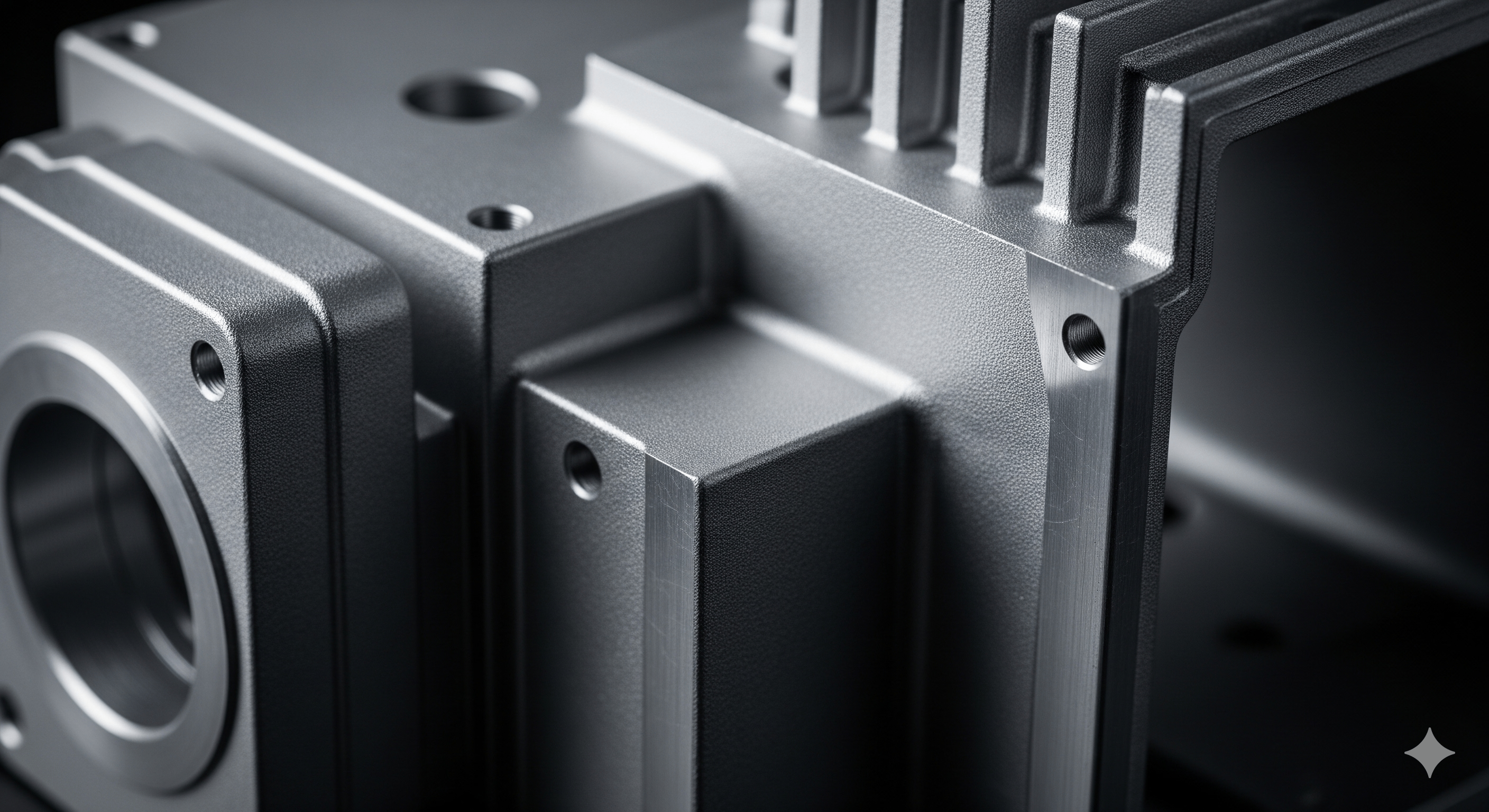
In the often-unforgiving world of industrial procurement, selecting a material is rarely just a box-ticking exercise. It is, perhaps more accurately, a high-stakes commercial pivot that directly shapes your Bill of Materials (BOM) and, ultimately, the very margins of your project. For the professional wholesale buyer, ADC12 Aluminum Alloy (JIS H 5302) isn’t just another option—it has effectively become the “workhorse” of high-pressure die casting (HPDC), favored for its uncanny balance between cost and raw performance.
As a brand with a 26-year legacy in the trenches of manufacturing, YISHANG doesn’t just supply parts; we help global partners navigate the friction of supply chain risks. This guide offers a deeper look into aluminum alloy adc12—not just the data, but the strategic logic behind using it to shore up your asset reliability.
Strategic Takeaways for Procurement Managers
- The Versatile Choice: Ideal for those complex, thin-walled geometries often found in electrical enclosure raw materials and automotive housings.
- The Performance Edge: You’re looking at high fluidity, dependable Dimensional Stability, and—crucially for electronics—natural EMI Shielding.
- The Bottom Line: It offers a cost-to-scale ratio that makes mass production viable, fully backed by ISO 9001 and RoHS compliance.
1. Metallurgical DNA: Where Reliability Begins
The true value of this aluminum alloy lies in its chemical precision. In the B2B sphere, elemental stability is often the thin line between a high-yield production run and a logistical nightmare. It stands to reason that buyers should prioritize suppliers who treat raw material knowledge with the rigor of a laboratory; after all, minor inconsistencies tend to snowball into major mechanical failures once you hit high volumes.
The Silicon Threshold: Fighting Scrap at the Source
The defining trait of adc 12 aluminum is its high silicon content—typically hovering between 9.6% and 12.0%. We often call silicon the “fluidity architect” of the alloy. Under the immense pressure of a die, the adc12 maintains a lower viscosity, allowing it to navigate intricate cavities and thin walls that might otherwise suffer from “cold shuts” or incomplete fills.
For a wholesale buyer, this isn’t just a technical detail; it translates directly into higher first-pass yields. Furthermore, because this concentration brings the melting point down to roughly 515-580°C, it tends to be gentler on the molds themselves. At YISHANG, we’ve observed that consistent silicon levels can stretch mold life by as much as 15%, which, in a long-term contract, is a significant win for the per-part cost.
Copper and Iron: The Strength-to-Tooling Trade-off
While silicon handles the flow, copper (at 1.5%–3.5%) steps in as the backbone, providing that necessary mechanical grit. This makes the aluminum alloy a natural fit for structural parts that simply cannot afford to flex. Interestingly, a controlled amount of iron (up to 1.3%) is also a strategic necessity in any die casting process.
Iron acts as a sort of “release agent” in the DNA of the metal, preventing the molten aluminum from essentially welding itself to the steel die—a headache known as “die soldering.” Without this careful iron management, a factory line might face constant halts for cleaning. As your partner, YISHANG balances these ratios to ensure the parts meet RoHS standards while remaining, quite frankly, a joy to machine.
2. Engineering Behavior: Navigating the “Hidden” ROI
Casting is only the prologue of a component’s life. Procurement managers often find that the “hidden costs” of a project tend to crawl out during enclosure 3d design tweaks or CNC machining. While aluminum alloy is often touted as “easy to process,” the reality is that it presents specific challenges that require a bit of seasoned expertise to navigate profitably.
Dimensional Stability: Predictability is a Currency
Wholesale buyers don’t just buy parts; they buy predictability. The adc12 aluminum is known for a very steady linear shrinkage rate—usually between 0.5% and 0.7% as it solidifies. This predictability is what allows designers to plan those complex assemblies where every micron counts.
In sectors like medical tech or telecommunications, where accuracy isn’t optional, a stable adc12 aluminum grade can drastically cut down on the need for expensive post-casting fixes. It’s also quite resilient to hot cracking, meaning parts with varying wall thicknesses are far more likely to maintain their structural soul. At YISHANG, we lean on this stability during the 3d design electrical phase to flag risks long before the first shot is fired.
The Machining Paradox: A Tooling Strategy for the Long Haul
There is a bit of a paradox with adc12 aluminum: it is categorized as “machinable,” yet that same 12% silicon content is notoriously abrasive on standard steel tools. In the world of high-volume CNC machining, this can lead to a creeping overhead as tools dull prematurely. We generally recommend—and use—Polycrystalline Diamond (PCD) tools.
This approach keeps the edges sharp and the surface finishes consistent, which is key to preventing “price creep” over time. After all, if you are sourcing a push button enclosure or a high-visibility control box, you need that unified brand look across every single batch, year after year.
3. Strategic Sourcing: The Decision Matrix
In B2B sourcing, the hurdle is often justifying a material choice to internal engineering stakeholders. Understanding how of aluminum adc12 stacks up against its global cousins is, in our view, vital for long-term risk mitigation.
| Technical Property | ADC12 (JIS H 5302) | A380 (ASTM B85) | ADC10 (JIS H 5302) |
|---|---|---|---|
| Silicon (Si) % | 9.6 – 12.0 | 7.5 – 9.5 | 7.5 – 9.5 |
| Copper (Cu) % | 1.5 – 3.5 | 3.0 – 4.0 | 2.0 – 4.0 |
| Castability | Excellent | Very Good | Good |
| Tensile Strength | ~310 MPa | ~320 MPa | ~330 MPa |
| Primary Benefit | Intricate detailing | Impact resistance | Structural Load |
Navigating the “Equivalents” Minefield
While adc12 aluminum alloy and A380 are often treated as twins, they are more like cousins. The higher silicon in ADC12 gives it the upper hand when the walls get thin. A380 might have a slight lead in impact ductility, but for most wholesale buyers, the choice usually depends on how complex that part geometry really is.
If your design involves deep cooling fins or internal baffles, the fluidity of adc 12 aluminum is going to be your best friend. At YISHANG, we often suggest that buyers bring us into the technical drawing material review early. Sometimes, a subtle shift in the spec can save a project’s budget before a single mold is cut.
A Note on Corrosion and Transparency
True partnership requires transparency. As a matter of fact, because of its copper content, aluminum alloy adc12 isn’t naturally invincible against salty, harsh environments. However, this is rarely a deal-breaker. With the right electrophoresis or powder coating, you can stretch the life of these parts considerably.
A supplier worth their salt will proactively talk about these solutions based on your enclosure raw material needs. Whether we are looking at a carbon steel enclosure or its stainless steel enclosure counterpart, we aim to provide the data you need to balance your immediate budget against the long-term durability of a galvanized steel requirement.
4. Industry Solutions: Putting the Alloy to Work
The real test of what is adc12 comes down to how it survives out in the wild. For a wholesale buyer, seeing how an alloy performs in mature, real-world cases is the best yardstick for a supplier’s capability.
Electrical and Telecom: The Shielding Factor
In the electrical world, things like the junction box nema and the electrical meter box don’t just need to look good; they have to seal. ADC12 can be cast as a single, seamless unit, which is a massive advantage when you’re aiming for an IP65 rating on an outdoor enclosure electrical meter.
There’s also the “Faraday Cage” effect. Electronics in 5G base stations are notoriously sensitive. The natural EMI Shielding of an enclosure aluminum enclosure protects those delicate circuits from signal noise, which is precisely why it remains the go-to for control station enclosures and push button enclosure units.
The Race for Range: Energy and Transport
In the EV world, everyone is chasing range, and range is a function of weight. The adc12 aluminum has become the industry standard for engine brackets and battery frames because it lets manufacturers shed kilograms without losing that superior mechanical properties edge.
By casting large assemblies as a single piece, OEMs can cut down on assembly time and simplify their BOM. Whether it’s for enclosures solar battery units or a complex steel enclosure aluminum hybrid, YISHANG provides the enclosure 3d design insight to make sure the project doesn’t just work—it excels.
5. Quality Assurance: Beyond the Packing Slip
In large-scale procurement, the nightmare is the “silent failure”—the defect that only rears its head after the shipment has crossed an ocean. At YISHANG, we believe in a “trust architecture.” You can download technical drawing files or a report resource catalog from our knowledge center contact portal, but the real work happens on the floor.
Gas Porosity: The Silent Enemy
The most frequent gremlin in die casting is Gas Porosity. These are the tiny, invisible air pockets that can hollow out a part’s strength. We tackle this with a dual approach: vacuum-assisted casting to pull air out of the die, and nitrogen degassing to clean the molten metal before it ever enters the shot sleeve.
When you’re vetting a supplier, ask about their degassing logs. It’s the kind of technical depth that ensures a push button enclosure doesn’t fail under pressure.
Verification You Can Lean On
A B2B supplier should provide more than just a box of parts. We think buyers should insist on Spectrometer Reports for every single batch to verify the aluminum alloy composition. Combined with X-ray checks and CMM testing, this creates a quality loop you can actually rely on. Even in 2026, with the focus on ESG, using recycled ADC12 can drop your carbon footprint by 90% without costing you a shred of performance.
Conclusion: Securing Your Supply Chain
At the end of the day, ADC12 aluminum alloy is more than just a commodity—it’s a precision engineering platform. When it’s backed by 26 years of factory-floor wisdom, it becomes a tool to drive down your TCO and ramp up your efficiency.
As you look at your sourcing strategy, look for partners who don’t shy away from technical transparency. YISHANG is here to build the kind of supply chain that doesn’t just deliver parts, but delivers peace of mind.
Contact YISHANG today to see how we can optimize your next project.