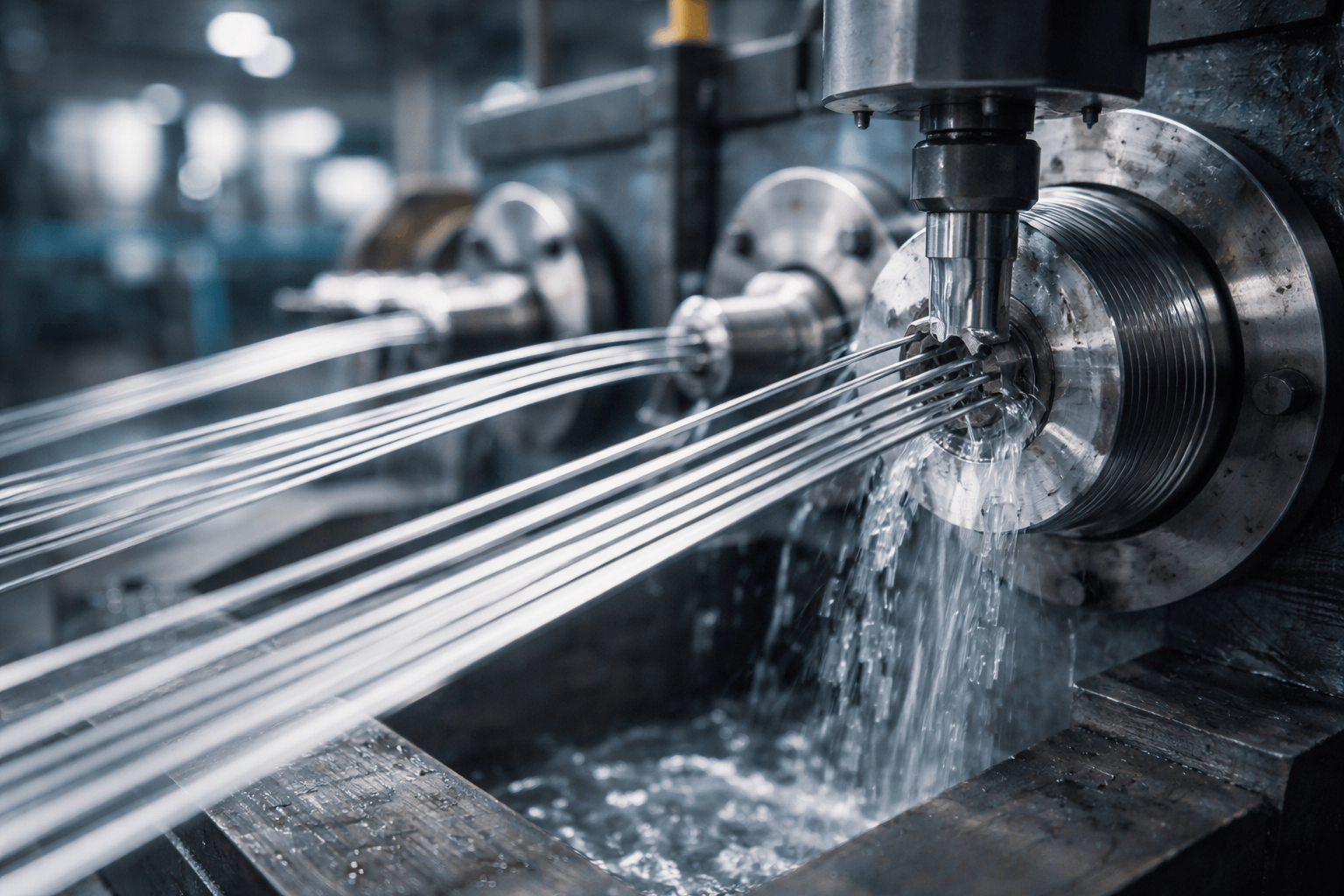
Introduction — Why Buyers Look Beyond the Drawing Result Itself
When overseas buyers search for aluminum wire drawing or wire drawing aluminum, they are usually not looking for a textbook-style explanation. In most cases, they are trying to screen suppliers and decide who is worth contacting. They want to know whether a factory can turn the wire drawing process into stable production quality, hold wire diameter tolerance across batches, and deliver material that remains suitable for coating, insulation, bending, or assembly.
That is why this topic belongs on a supplier website. The most useful article is one that helps buyers see how a manufacturer thinks about process control, defect prevention, and downstream manufacturability. For wholesale procurement teams, that tells them much more than a broad quality claim or a generic list of applications ever could.
A Quick Definition and Process Snapshot
In simple terms, aluminum wire drawing is the process of pulling aluminum stock through one or more dies to reduce diameter under controlled conditions. In most industrial lines, the route includes surface preparation, lubrication, pointing, one-pass or multi-pass drawing, optional annealing, and final inspection. Buyers searching for the aluminum wire drawing process usually want this basic sequence first, but the real value lies in how consistently each stage is controlled.
What Aluminum Wire Drawing Actually Changes
At its core, aluminum wire drawing is a cold working process in which aluminum stock is pulled through a drawing die so the diameter decreases and the length increases. That is the most visible result, but it is only one part of the story. In real production, geometry, material response, and surface condition all change together.
The geometric change is easy to see. Diameter becomes smaller, cross-sectional area is reduced, and the wire is easier to handle on coils or spools. For buyers, this matters because dimensional control is directly linked to tolerance consistency. A supplier that can hit a target size once is not automatically a supplier that can maintain the same tolerance across a full shipment.
The second change is material behavior. During the aluminum wire drawing process, strain accumulates and the metal work-hardens. Strength and hardness may rise, while ductility tends to decline. That shift affects how the wire behaves in later forming, insulation, welding, or assembly. If the route is too aggressive, the material may meet the print but become less reliable in the next operation.
The third change is surface condition. Die contact, lubrication, drawing speed, stock cleanliness, and temperature all influence surface finish. A wire may look acceptable and still carry drag marks, scoring, or uneven deformation history that reduces downstream reliability. Good aluminum wire drawing does not only make wire smaller. It shapes whether the wire stays usable in real manufacturing.
Why Similar Aluminum Can Produce Very Different Results
This is where buyer questions usually become more practical. Two suppliers may start with similar aluminum stock and target the same final size, yet still produce very different results in surface finish, tolerance stability, and batch-to-batch consistency. The reason is simple: the wire drawing process is never controlled by one factor alone. The result depends on how several variables interact.
Friction is one of the most important variables. When the wire-die interface stays stable, draw force is easier to control and the process remains more forgiving. When friction rises too far, heat builds faster, lubricant performance weakens, die wear accelerates, and surface defects become more likely. That is why wire drawing lubrication cannot be treated as a side issue. It affects finish quality, die life, and line stability all at once.
Die condition matters just as much. The draw die does more than reduce diameter. Entry angle, bearing length, surface condition, and wear all influence metal flow and dimensional consistency. In practice, many problems that appear to be material problems are actually die-related. A supplier with real process understanding will explain die condition in connection with quality, not as an isolated equipment topic.
Reduction planning is the next major factor. If too much reduction is attempted in one stage, the process window narrows and defect risk rises. Multi-pass drawing is often more stable because it balances productivity with material response. This is also where annealing in wire drawing may become necessary. Used correctly, it helps recover ductility and supports later passes. Used poorly, it becomes a correction for an unstable route rather than part of a sound one.
For buyers, the commercial meaning is clear. Two suppliers may quote similar capability, but the one with better friction control, die discipline, and pass planning is usually the one more likely to deliver repeatable quality in real production. In many projects, that matters more than a small unit-price difference.
Process Factors Buyers Should Watch
| Process factor | Why it matters in procurement | What can go wrong |
|---|---|---|
| Stock cleanliness | Affects finish and die life from the start | Surface damage, unstable drawing |
| Lubrication control | Supports finish, heat control, and consistency | Scoring, overheating, short die life |
| Die condition | Affects tolerance and surface quality | Drift, marks, inconsistent sizing |
| Pass schedule | Balances output and material stress | Breakage, hardening, narrow process window |
| Coil handling | Influences shipment and later processing | Deformation, poor spool condition |
This is why experienced buyers often pay close attention to how a supplier explains process variables. They are not only checking technical knowledge. They are checking whether the supplier understands production risk and can manage it consistently.
Where Good Results Are Won or Lost
Once those variables are clear, the next question is where the process usually starts to go right or wrong. In many cases, instability begins earlier than expected. Before the wire reaches its final size, the line is already creating either stable conditions or future defects.
Surface preparation is the first control point. Oxide, residue, and contamination make it harder to maintain stable lubrication and increase the chance of drag marks or die wear. In larger production runs, even small contamination can reduce yield enough to create visible variation between coils. For wholesale buyers, that means more incoming inspection, more sorting, and less predictable performance.
Lubrication deserves the same level of attention. Good lubrication does more than reduce friction. It helps carry heat away, supports a cleaner surface, and protects die life during longer runs. This is one reason experienced manufacturers monitor lubrication as a process variable rather than treating it as a routine consumable. Better lubrication control usually supports better consistency from the first coil to the last.
Pointing and feeding also play an early role. If the leading end is not prepared correctly, instability can begin before the line reaches steady operation. Once that happens, variation can continue through later passes. The same principle applies to route planning and annealing. A good route respects material history instead of forcing stock toward the next size without enough margin for control.
What buyers care about in the end is the practical result of those details.
- Will the shipment arrive with consistent spool build?
- Will tolerance hold across the lot?
- Will the wire remain suitable for bending, insulation, coating, or assembly?
That is the point where a technical process becomes a procurement issue.
Surface Finish, Defects, and What They Mean for Buyers
Surface finish is often the first visible signal of process control. Scratches, die lines, roughness, and streaking are not merely cosmetic issues. They usually indicate unstable friction, poor cleaning, worn tooling, or weak heat control somewhere in the line. Buyers who read about wire drawing defects are often trying to assess more than appearance. They want to know whether a supplier can recognize the root cause behind a visible problem.
A smooth-looking wire is not always proof of a good process. A coil may look clean and still carry excessive work hardening, unstable tolerance, or limited downstream formability. This matters for OEM and contract manufacturing buyers because the wire still has to perform after delivery. If the product will be insulated, bent, welded, or assembled into another component, surface condition has to be linked to function, not appearance alone.
That is why defect analysis should not stop with a list of common problems. A better approach connects visible symptoms to likely process causes and then to practical review points. That helps procurement teams see whether a supplier thinks in terms of process logic rather than isolated troubleshooting.
Typical Symptoms, Likely Causes, and First Checks
| Visible symptom | Likely cause | First review point |
|---|---|---|
| Surface scratches | Dirty stock, poor lubrication, worn die | Stock cleanliness and lubricant condition |
| Diameter drift | Die wear, tension instability | Die inspection and line settings |
| Wire breakage | Excessive reduction, hardening | Pass schedule and annealing timing |
| Poor spool condition | Unstable take-up or handling | Coil handling and winding control |
| Weak downstream formability | Too much cold work | Material condition after drawing |
In many sourcing projects, these issues translate directly into cost. More incoming inspection, more downtime, more sorting, or more downstream rejects can quickly outweigh a lower unit price. This is why professional buyers often prefer suppliers whose technical content explains the logic of quality control clearly instead of relying on broad claims.
Standard-related language can also matter. Depending on the project, references such as ASTM B230, ASTM B609, ASTM B398, or ASTM B193 may be relevant. Even when a project follows customer-specific requirements instead of those exact standards, the principle is the same: quality should be supported by measurable criteria, not appearance alone.
How Buyers Can Judge a Supplier’s Aluminum Wire Drawing Capability
By this point, the central question becomes more practical: how should a buyer judge whether a supplier’s aluminum wire drawing capability is actually reliable? The strongest supplier content usually answers that directly. It does not just say the process exists. It shows how the process is controlled.
A good starting point is tolerance consistency. Buyers generally want to know whether the supplier can maintain dimensions across a full lot, not only on a sample piece. The next question is surface stability. A supplier that understands the process well will connect surface finish to die condition, lubrication control, and downstream usability rather than treating finish as a cosmetic issue.
Repeatability is another critical factor. A process that works once under close attention is not the same as a process that can run consistently in real production. This is why batch consistency, inspection discipline, and route stability matter so much in supplier evaluation. For wholesale procurement, repeatability is often more valuable than a narrow claim about machine capability.
Downstream manufacturability should also be part of the assessment. In many projects, drawn aluminum wire is not the final product. It may still require coating, insulation, bending, forming, welding, or final assembly. A supplier that reaches size at the expense of later processability is not really creating value. The best route is usually the one that balances quality, stability, and production efficiency while protecting what comes next.
Questions Buyers Can Ask Before Approving a Supplier
Before placing an order, many buyers want a fast way to verify whether a supplier’s stated capability is likely to hold up in real production. A few practical questions can reveal a lot: What diameter tolerance can be maintained across the full lot? How is die wear monitored during longer runs? When is annealing used in multi-pass wire drawing? How are surface defects and spool condition checked before shipment? These questions are useful because they move the conversation from general capability to controllable quality.
For many procurement teams, this kind of verification matters as much as price or lead time. A supplier that answers with clear process logic, measurable checks, and realistic production language usually inspires more confidence than one that relies on broad claims. In B2B sourcing, trust often starts with how specific the technical discussion becomes.
What Stronger Technical Content Shows Buyers
Many supplier articles explain the sequence of wire drawing, but fewer explain the trade-offs inside the process. That difference matters. Buyers usually trust technical content more when it shows how lubrication affects heat and finish, how die condition affects tolerance, and how pass planning affects work hardening and stability. That kind of explanation feels grounded in real process understanding rather than surface-level description.
In practical sourcing, buyers often compare several supplier websites before moving to RFQ or sample review. The content that helps most is usually the content that answers real manufacturing questions clearly: how surface defects are controlled, how repeatability is maintained in multi-pass drawing, and how process decisions affect downstream use. When an article explains those points well, it becomes more than background reading. It becomes part of supplier evaluation.
The most effective technical content stays focused on the reader’s problem first. Clear process logic, realistic quality language, and procurement relevance usually build more trust than overly promotional messaging.
Conclusion — Good Aluminum Wire Drawing Is About Control, Not Just Reduction
Aluminum wire drawing is often introduced as a diameter-reduction method, but in real manufacturing it is better understood as a controlled deformation process. The visible task is to make the wire smaller. The more important task is to control friction, die behavior, reduction strategy, lubrication, and material response so that dimensions, surface finish, and downstream usability remain stable.
That is why the better question is not whether a supplier can draw the wire to the correct size once. It is whether the process can hold quality across production, protect later manufacturing steps, and deliver repeatable results from order to order. When that happens, drawn aluminum wire becomes more than a processed material. It becomes a dependable product for industrial procurement.
If you are reviewing suppliers for custom aluminum wire or related metal fabrication work, it is worth comparing not only quoted specifications, but also how each supplier approaches process control, surface quality, and batch consistency. YISHANG welcomes your inquiry if you would like to discuss a project in more detail.