
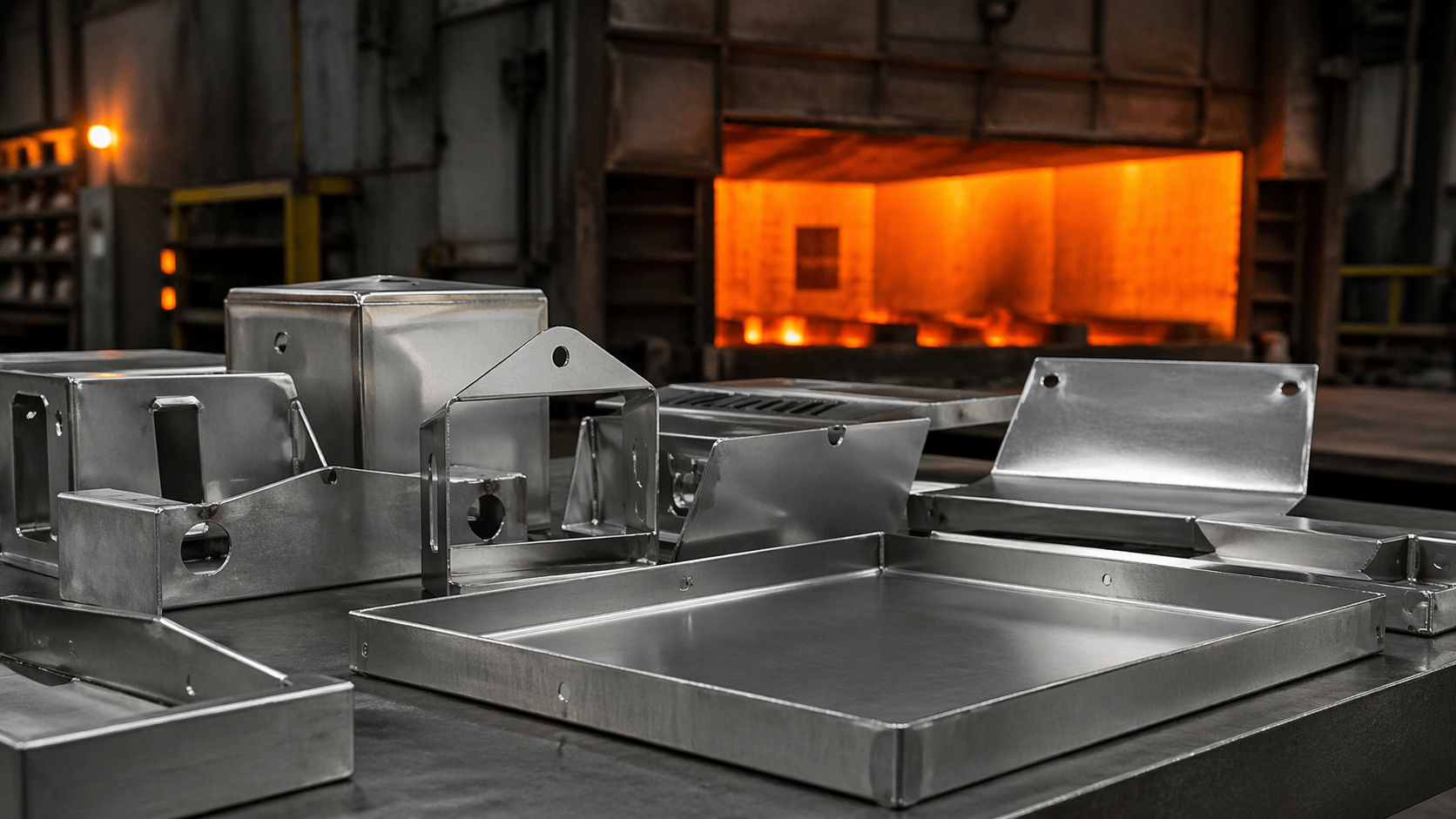
When overseas buyers search for 309H stainless steel or stainless steel 309H, they usually have a very practical question in mind. They are trying to work out whether this grade fits the actual service condition and whether a supplier can turn it into stable, repeatable fabricated parts at scale.
That is why a useful article on stainless steel grade 309H needs to go beyond chemistry tables and broad application claims. Buyers want to know why this grade gets chosen, where it creates real value, how it compares with nearby options such as 309H and 309S, and what should be confirmed before an order is placed for fabricated parts or components.
For a B2B supplier website, that kind of content works better for a simple reason. It helps buyers make a faster, more confident judgment instead of forcing them to sort through broad material claims that do not answer real sourcing questions.
Why 309H Stainless Steel Gets Specified in Real B2B Projects
It Solves a Service Problem, Not a Naming Problem
At first glance, 309H stainless steel looks like one more heat-resistant stainless alloy in a long list of industrial grades. In real projects, teams usually turn to it when standard stainless no longer gives them enough margin over time. Heat alone rarely drives the decision. More often, it is heat combined with oxidation, long exposure, dimensional stability demands, and the risk of slow distortion in service.
That difference matters because wholesale buyers are not really buying metal by grade name alone. They are buying finished-part performance. If the selected material does not match the actual working condition, the problem often shows up later as shorter service life, warped parts, unstable tolerances, repeat replacement demand, or unnecessary warranty pressure. In that sense, choosing steel grade 309H is part technical judgment and part commercial risk control.
Buyers Care About Finished-Part Performance
This is where 309H separates itself from more general stainless options. It does more than tolerate a high temperature for a short period. Buyers choose it because it offers a better balance of oxidation resistance, elevated-temperature strength, and long-term shape stability when a fabricated part must stay in hot service. That is the reason engineers and sourcing teams usually assess applications of 309H by service behavior rather than by industry name.
This is usually the point where supplier content either earns trust or loses it. B2B buyers rarely read every line from top to bottom on the first pass. They scan headings, check a few key paragraphs, and look for signs that the supplier understands what happens after laser cutting, bending, welding, and assembly. A page that connects the grade to fabrication reality feels much more convincing than one that only says the material is “widely used.”
Composition, Performance, and the Difference Between 309H and 309S
What the Chemistry Does in Service
The chemistry of stainless steel grade 309H only becomes useful when you tie it to performance. The grade commonly contains elevated chromium and nickel, with carbon in the range of 0.04 to 0.10. Chromium supports oxidation resistance in hot oxidizing environments. Nickel helps maintain the austenitic structure. Carbon, at the higher level associated with 309H, contributes to better elevated-temperature strength and creep-related performance over time.
That is why buyers often specify this grade for heat-exposed fabricated assemblies instead of limiting it to general corrosion service. The real value of the chemistry is not that it looks impressive on paper. Its value is that it affects how the finished part behaves after long thermal exposure. For wholesale buyers, that is far more useful than a standalone composition table.
| Element | Typical Range | Practical Meaning |
|---|---|---|
| Chromium | 22.0–24.0% | Supports oxidation resistance in hot service |
| Nickel | 12.0–15.0% | Helps maintain a stable austenitic structure |
| Carbon | 0.04–0.10% | Supports elevated-temperature strength over time |
| Manganese | Up to 2.0% | Part of the overall alloy balance |
| Silicon | Up to 1.0% | Contributes to oxidation resistance |
| Iron | Balance | Base alloy matrix |
How Buyers Usually Compare 309H and 309S
In sourcing discussions, the comparison that comes up most often is 309H and 309S stainless. Buyers are usually less interested in an academic distinction than in what the difference means for fabrication, service life, and specification risk. In simple terms, 309S is the lower-carbon version and is often considered when fabrication and welded-condition priorities matter more. 309H becomes more attractive when long-term hot-service strength carries more weight.
So the real decision between 309H and 309S is not about which grade sounds higher-end. It comes down to which risk matters more in the application. If the greater concern is prolonged heat exposure, dimensional stability, and creep-related performance, 309H is often the better fit. If fabrication convenience and lower-carbon behavior are more important, 309S may deserve a closer look.
Mechanical Data Still Matters in Early Screening
A grounded mechanical reference still has value during early supplier evaluation. Typical room-temperature values for SS grade 309H often include tensile strength in the range of 520–720 MPa, yield strength of about 205 MPa minimum, elongation of 40% minimum, and hardness near 90 HRB depending on condition. Those numbers help with context, though they do not tell the whole story in high-temperature procurement.
| Property | Typical Value |
|---|---|
| Tensile Strength | 520–720 MPa |
| Yield Strength | 205 MPa minimum |
| Elongation | 40% minimum |
| Hardness | About 90 HRB |
What buyers usually care about more is how the material behaves after the part has been cut, welded, installed, and exposed to heat for long periods. That is where the practical meaning of 309H becomes much clearer than any single property table can show.
Where 309H Works Well — and Where Buyers Should Be Careful
Service Conditions That Usually Justify 309H
A strong supplier article should explain where a grade performs well, but it should also make the limits clear. That is especially important for 309H stainless steel, because high-temperature stainless grades are sometimes described as though they are universal upgrades. In reality, a grade can be highly effective in one kind of severe service and still be the wrong answer in another.
309H performs well when the service condition combines elevated temperature, an oxidizing atmosphere, and the need for long-term stability in the fabricated part. That is why the main applications of the grade are usually linked to furnace internals, heat-treatment fixtures, burner-related components, retorts, trays, supports, and other fabricated parts exposed to prolonged hot service. What these products share is not an industry label. It is a service pattern built around heat, atmosphere, time, and the need to maintain geometry.
This way of explaining the material is much more useful to buyers than a broad list of industries. It helps them judge whether their own product belongs to the same service family. A component in one sector may have more in common with a furnace support in another sector than with other products in its own market. When applications of 309H are explained through service conditions, the grade becomes easier to assess in a realistic way.
Where Buyers Should Slow Down and Recheck the Fit
At the same time, buyers should be careful not to stretch the material’s reputation too far. Good high-temperature oxidation behavior does not automatically make the grade the right answer for every corrosive environment. Wet corrosion conditions, chloride-heavy exposure, carburizing atmospheres, thermal cycling, and specific process chemistry can all change whether 309H is appropriate. That does not reduce its value. It simply means the grade should be selected for the right problem rather than treated as an all-purpose upgrade.
That kind of boundary-setting usually builds more trust with professional buyers. Procurement teams usually respond better to technical content that narrows choices than to content that tries to make one material sound perfect for everything. On a supplier website, that tone feels more credible and far less promotional.
What Buyers Should Verify Before Ordering 309H Fabricated Parts
Check Standards Before You Compare Quotes
Once a buyer sees that 309H may fit the service condition, the next step is verification. This is often where a supplier page either becomes genuinely useful or starts to feel generic. If the article only repeats broad claims, it does not move the reader much closer to an ordering decision. If it connects the grade to fabrication, standards, and document requirements, it becomes much more valuable.
The first thing to check is standards and designation. Buyers frequently search phrases such as standard for grade 309H, for grade 309H, SS grade 309H, or other standard designation specifications because they need to connect the material name to a product form and a clear document trail. In many projects, the most relevant references include UNS S30909, AISI 309H, and common product standards such as ASTM A240 or ASME SA240 for suitable forms.
| Standard / Designation | Practical Meaning for Buyers |
|---|---|
| UNS S30909 | Common identifier for 309H stainless steel |
| AISI 309H | Widely used commercial designation |
| ASTM A240 / A240M | Typical reference for sheet, plate, and strip |
| ASME SA240 | Often relevant in pressure-related procurement |
| EN equivalents | Useful when cross-checking regional supply routes |
These references matter because they connect the alloy name to product form, inspection expectations, and certificate language. In wholesale procurement, the ability to discuss standard designation specifications clearly often signals that the supplier understands not only the material, but also the compliance side of sourcing.
Confirm the Fabrication Route Early
Another point buyers usually check is fabrication practicality. Buyers ordering fabricated parts want to know not only what material is used in making the product, but whether the chosen grade is likely to create avoidable cost or lead-time instability. Austenitic stainless grades can work harden. Welding details affect final performance. Heat history influences the finished condition. Those are not abstract technical notes. They directly affect repeatability in production.
A useful supplier explanation should therefore address forming, welding, machining, and post-fabrication handling in realistic terms. A part that looks acceptable right after production may behave differently after prolonged hot service if fabrication variables are not controlled properly. For sourcing teams, this is one of the clearest ways to tell the difference between a capable fabrication partner and a supplier that only knows how to quote raw material names.
Match the Grade to the Finished Part
The last point is application fit at the part level. Buyers do not place orders for abstract alloys. They place orders for covers, trays, guards, welded supports, internal housings, thermal assemblies, and other fabricated items with drawings, tolerances, and quantity targets. The more directly a supplier can connect 309H stainless steel to finished-part behavior, the more confidence the page creates.
At that stage, buyers usually do not need a long sales pitch. If you are reviewing a heat-exposed fabricated part and want to confirm whether 309H stainless steel is the right fit, send your inquiry to YISHANG with the drawing, service condition, quantity, and target market. A clear technical review at the start usually saves much more time later.