
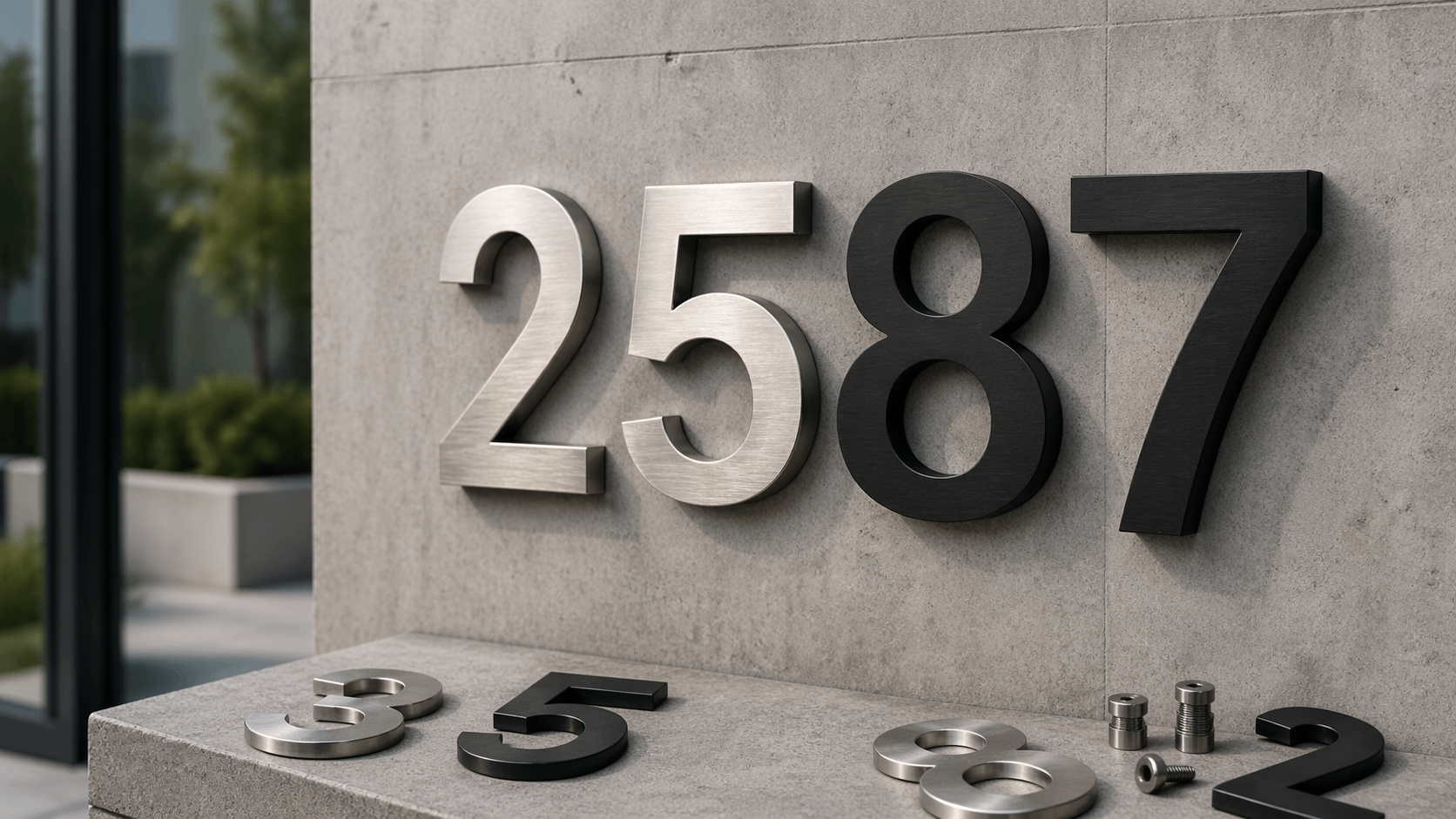
Custom metal numbers look simple. Real projects rarely are.
For overseas wholesale buyers, the key question is not whether the numbers look attractive in a photo. The real question is whether a team can define them clearly, produce them with stable quality, install them without trouble, and reorder them later without visible differences. A sample can look convincing and still become the wrong choice once it reaches the job site.
In commercial sourcing, custom metal numbers usually belong to a larger system. Buyers use them as metal house numbers in residential programs, room numbers for hotels and apartments, wayfinding signs for offices, or identification parts on an electrical enclosure, an electrical meter box, a push button enclosure, or control station enclosures. Across all of these uses, appearance matters, but it is only one part of the decision. Buyers also think about readability, service life, installation reliability, and how easily the product will move through approvals, site work, and repeat orders.
This article stays close to that procurement reality. It treats metal numbers as fabricated components that need to perform well in a specific environment and move smoothly through a real supply chain.
Why Wholesale Buyers Look Beyond Style
Procurement questions come before design preference
Retail buyers often start with visual preference. Wholesale buyers usually start with risk. They want a specification that reduces confusion during sampling, production, and installation. That shift leads to practical questions about material choice, finish stability, mounting method, packaging, replacement matching, and whether the same custom metal numbers will still match months later.
That difference matters because supplier content often stays too broad. Many articles explain what metal numbers are, show a few style options, and mention indoor or outdoor use. That information is not wrong. It just does not answer the questions project buyers actually care about. Importers, distributors, contractors, and OEM sourcing teams are trying to avoid rework, late changes, and quality inconsistency. They are not simply browsing for ideas. They are judging whether a supplier understands procurement pressure and project execution.
Application type changes what matters most
The applications themselves make this clear. Exterior address numbers and metal house numbers need to stay legible from the real viewing distance. Looking attractive up close is not enough. Number sets used in apartments, hotels, and office corridors need unit-to-unit consistency, because even small variation becomes obvious when the product repeats across a large project.
Numbers on a junction box NEMA housing, a solar battery enclosure, or other fabricated equipment play a different role. In those cases, the number may support service identification, location control, or maintenance clarity. Finish durability and mounting compatibility matter more than decorative effect.
Operational cost matters more than first impressions
Commercial buyers also think in terms of operational cost. A specification may look impressive on paper and still create installation trouble, return claims, or replacement mismatch. That is not real cost efficiency. Experienced buyers value what they can control. They look for clear drawings, sensible material logic, finishes that suit the use environment, and a supplier who understands how custom metal numbers behave across architectural panels, fabricated housings, carbon steel enclosure assemblies, and stainless steel enclosure projects.
The buying process becomes much more confident when the discussion moves away from vague product language and toward measurable decisions. A number may be small, but it can still affect project perception, installation speed, maintenance expectations, and future reorder accuracy. For a wholesale buyer, those points carry more weight than a generic claim that the product is stylish or durable.
What Actually Determines Whether Custom Metal Numbers Perform Well
Once that buying perspective is clear, the next question becomes practical: what makes custom metal numbers perform well after installation?
In most B2B projects, four factors shape the result: visibility, material-and-finish fit, mounting logic, and production consistency. These factors connect closely. A weak choice in one area usually creates pressure somewhere else.
Visibility must work in the real setting
Visibility comes first because the number still has a job to do. For exterior building numbers, gate signs, and metal address numbers, readability depends on stroke width, size, spacing, contrast, and actual viewing distance. A thin, elegant design may look modern in a rendering. On a textured wall or under strong daylight, it can lose strength fast. A slightly bolder profile may seem less special in a close-up sample. Once installed, it often performs far better.
Good specification starts by matching the number to the way people will actually see it. Placement matters just as much as the number itself. Exterior numbers that sit behind trim, plants, shadows, or decorative elements often fail even when the material and finish are correct. As a rough project rule, buyers usually need larger number heights as viewing distance increases. They should also think about night visibility if the site relies on evening traffic, deliveries, postal workers, or emergency access.
Material and finish should be specified together
Material and finish work best when buyers specify them together, not as separate choices. Stainless steel numbers remain popular because they balance appearance, fabrication stability, and corrosion resistance. In many commercial projects, 304 stainless steel is sufficient. In more aggressive environments, 316 stainless steel is often the safer option.
Aluminum works well when a project needs lower weight, efficient coating, and corrosion resistance together. That is especially true for larger architectural number sets. Carbon steel can also be a valid choice in protected conditions or where the project calls for a coated industrial appearance. For exposed outdoor use, buyers need to specify it carefully.
Form choice matters too. Flat laser cut metal numbers often give buyers the best mix of cost control, repeatability, and clean modern presentation. Raised or more dimensional numbers create stronger presence and shadow. That effect can work well for architectural signage or premium commercial interiors. Neither format is automatically better. The better choice depends on the viewing conditions, the finish, and how much visual depth the project really needs.
Finish can either strengthen the result or quietly work against it. Brushed surfaces usually control glare better and keep edge definition clear. Mirror-polished numbers can look premium, but they may reflect too much light and become more sensitive to maintenance. Powder-coated numbers often work well when color consistency, contrast, and branding alignment matter. This matters even more when the numbers are part of a broader fabricated system, such as a galvanized steel enclosure, a carbon steel enclosure, or a coated utility cabinet. No single finish is always best. What matters is whether the finish supports the use case rather than competing with it.
Mounting affects both installation and long-term stability
Mounting deserves the same level of attention. Stud mounting, screw fixing, spacer mounting, and adhesive application each solve different problems. The right method depends on the substrate, environmental exposure, layout tolerance, site labor conditions, and future replacement needs.
For decorative interiors, adhesive mounting may be efficient and clean. For exterior commercial applications or repeated installations, mechanical fixing often gives buyers more long-term confidence. This matters even more when numbers go on equipment surfaces, an electrical enclosure, an electrical meter box, or a push button enclosure, where service access and durability matter.
In larger rollout projects, installation templates and surface preparation can matter as much as the fixing hardware itself. A good template reduces alignment variation between installers. Proper surface preparation improves bond strength and cuts early failures. Buyers managing apartment projects, hospitality corridors, or multi-site commercial programs usually benefit when they think about installation control at the same time they confirm the number design.
Batch consistency is where supplier capability becomes visible
Production consistency is where supplier capability really becomes visible. A first sample can look good almost every time. The harder question is whether the supplier can hold the same thickness tolerance, edge quality, finish tone, and fixing pattern across hundreds or thousands of pieces.
That matters in apartment numbering, hotel projects, building signage programs, and OEM identification systems alike. When a project uses custom metal numbers across multiple locations or phases, repeatability often matters more than the appearance of a single approved sample.
The table below summarizes the main buying checkpoints in a format that procurement teams can review quickly:
| Decision Area | What Buyers Usually Check | Why It Matters |
|---|---|---|
| Visibility | Size, contrast, stroke width, viewing distance | Supports readability and reduces site complaints |
| Material & Finish | Corrosion resistance, glare control, coating suitability | Affects service life and visual fit |
| Mounting | Substrate match, fixing method, layout tolerance | Influences installation speed and long-term stability |
| Batch Control | Repeatability, finish consistency, replacement matching | Protects future orders and multi-site projects |
Even a small part can trigger expensive correction when buyers ignore these areas. Teams that define them early usually move through sampling and approval with fewer surprises.
How Smart Buyers Align Product Choice With Procurement Risk
After the technical factors become clear, buyers usually make better decisions when they tie them to risk rather than to appearance alone. Different projects create different kinds of risk.
A distributor supplying residential signage dealers may care most about finish consistency, packaging protection, and reorder simplicity. A contractor working on a hospitality project may care more about installation speed, unit-to-unit uniformity, and replacement matching during later phases. An OEM buyer sourcing numbers for a stainless steel enclosure, a solar battery enclosure, or control station enclosures may focus more on attachment method, environmental durability, and drawing control.
The best buying question is not only about appearance
The most useful sourcing question is rarely just, “Which number looks best?” A better question is, “Which option is easiest to approve, install, maintain, and reorder for this project type?”
That is also closer to the way professional buyers search. They often use terms such as custom fabrication, stainless steel numbers, outdoor metal numbers, laser cut numbers, building signage numbers, or enclosure identification numbers. They are trying to solve a project requirement, not browse a design gallery.
Perceived quality still affects commercial value
Quality perception still matters because it has commercial value. Numbers that feel premium are usually not the most complicated ones. Buyers tend to value numbers with the right proportion, clean edge finish, stable surface treatment, and consistent mounting.
By contrast, numbers tend to feel cheap when spacing is weak, finish control is unstable, or the fixing method interrupts the design. For wholesalers, that affects resale confidence. For contractors and OEM buyers, it affects how the final installation reflects on the broader project.
Supplier evaluation should connect product details to project use
This is where supplier evaluation becomes more meaningful. A capable supplier should explain why one finish suits a coastal facade better, why one mounting method works better for repeated installations, or why a certain thickness fits a carbon steel enclosure program better than a decorative interior sign.
A supplier who can only describe appearance is harder to trust than one who can connect custom metal numbers to service conditions, packaging logic, and reorder control.
Better input usually leads to better quotations and samples
A clear inquiry usually leads to better results than a very general request. It helps to share the application, substrate, material preference, finish target, size range, and expected volume. It also helps to mention whether the numbers will be used as metal house numbers, room numbers, building identifiers, or labels mounted on fabricated equipment.
If the project is for exterior use, placement conditions and expected viewing distance are worth sharing too. The more clearly the project context is defined, the easier it becomes to recommend a practical solution and produce a sample that reflects the real requirement.
If your team is reviewing custom metal numbers for wholesale distribution, project installation, or OEM use, YISHANG can support the discussion from both a fabrication and a procurement perspective. A short inquiry with drawings, finish targets, and estimated quantities is usually enough to start a more precise conversation.
In B2B sourcing, the strongest outcome usually comes from a specification that buyers can approve easily, installers can execute cleanly, and teams can repeat later. That tends to be the real benchmark for custom metal numbers.