
In the high-stakes world of industrial metal fabrication, the initial choice of stamping methodology is often the single greatest predictor of a project’s long-term profitability. While both transfer die and progressive die stamping have served as the backbone of precision manufacturing for decades, selecting the wrong path during the initial inquiry can lead to catastrophic cost overruns. For overseas wholesale buyers and procurement managers, this decision is far more than a technical preference; it is a strategic maneuver that dictates the Total Cost of Ownership (TCO) and structural integrity of the final product.
At YISHANG, we have seen time and again that maintaining a resilient and competitive supply chain requires looking past raw speed. It requires a deep dive into the physics of the die stamping process to find where efficiency meets engineering reality. Whether you are looking to mount electrical enclosure units or develop a custom solar battery enclosure, aligning the fabrication method with the part’s geometry is the fundamental step toward procurement success. This guide explores the technical thresholds that define when a project needs to break away from continuous strips and embrace the independence of a transfer system.
Quick Comparison: Progressive vs. Transfer Die at a Glance
| Feature | Progressive Die Stamping | Transfer Die Stamping |
|---|---|---|
| Ideal Volume | 500,000+ units (Ultra-high) | 100,000+ units (Medium to High) |
| Part Complexity | Moderate (Tethered to strip) | High (Independent manipulation) |
| Max Draw Depth | Typically less than 2 inches | Unlimited (Station-dependent) |
| Material Thickness | Usually less than 4.0mm | Can exceed 6.5mm |
| Secondary Operations | Often required post-press | Highly integrated (In-die) |
The Mechanical Philosophy: Continuity vs. Independence
Standing at the crossroads of stamping logic, you are essentially choosing between the rhythm of speed and the freedom of versatility. Progressive die stamping operates on a continuity principle where the material strip remains attached throughout the sequence. Think of it as the Formula 1 of manufacturing, designed for relentless efficiency in high volume production environments. The material moves like a racer on a track, never stopping, with each stroke of the press adding another layer of form to the tethered workpiece.
Procurement specialists need to look closely at the physical constraints of this continuous flow. Because the part never leaves the strip until the final cut, there are hard limits to how much the metal can be manipulated. For a project involving a complex junction box nema standard enclosure, the rigid nature of a progressive strip might actually prevent the deep-draw features from forming correctly. The tension of the carrier strip can cause tearing or warping if the geometry demands too much displacement from the center line.
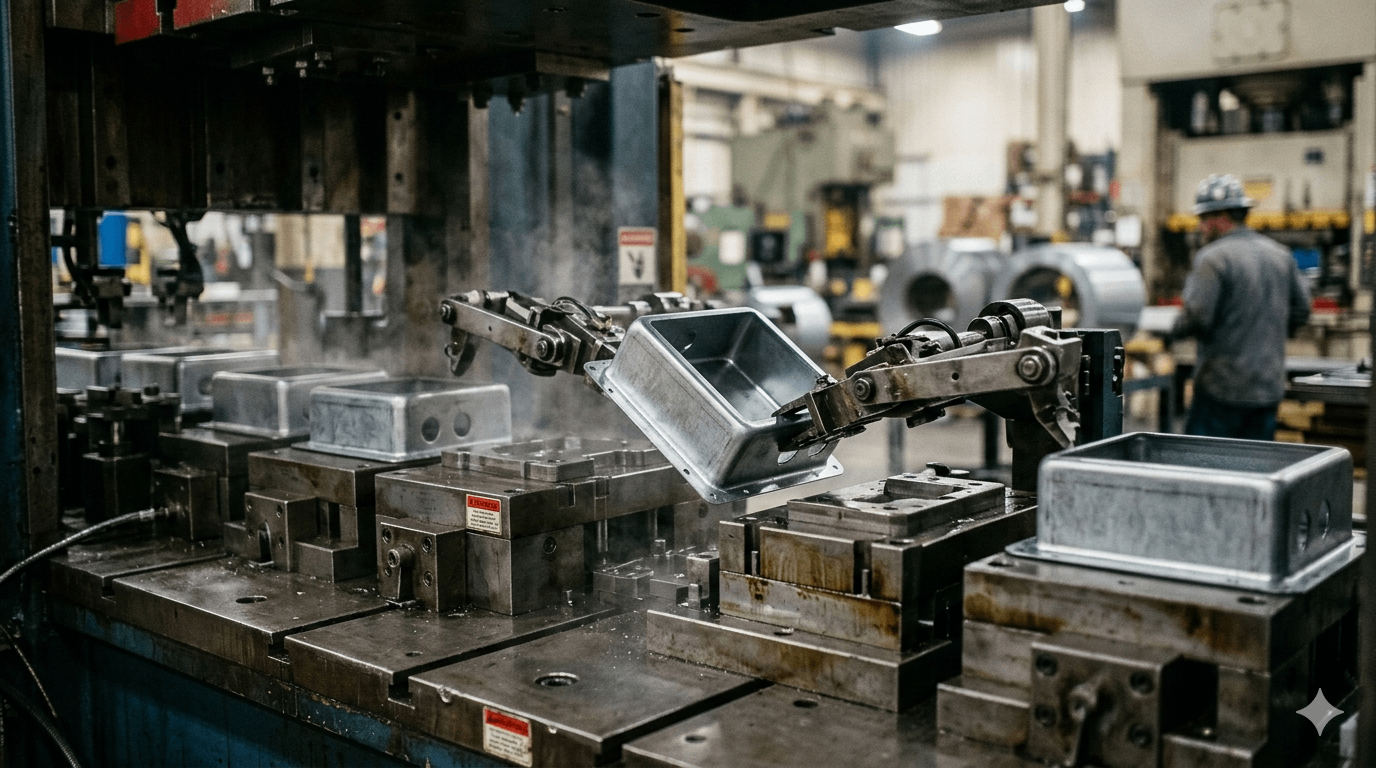
Transfer die systems offer what we call “mechanical freedom.” By detaching the part at the first station, a transfer system moves each workpiece between different die stations using specialized mechanical bars. This independence allows for complex manipulation, such as flipping or rotating the part 90 degrees mid-process. Such maneuvers are critical when you need to ensure consistency and quality across thousands of units with features on multiple planes. At YISHANG, we often see that while progressive dies boast a higher stroke rate, the flexibility of the transfer die frequently yields a lower unit price by eliminating the need for separate manual drilling or deburring stations.
Material Economics: Maximizing Yield in Enclosure Fabrication
For high-volume wholesale orders, material costs typically account for 50 percent to 70 percent of the total unit price. This is where the choice of stamping method directly hits your profit margins. In a progressive setup, the carrier strip—the bridge that holds the parts together—is essentially sacrificial waste. When you are working with expensive stainless steel enclosure requirements, this “strip tax” adds up to a significant overhead that serves no functional purpose in the final product.
We analyze factors such as material utilization to determine if a pivot to transfer stamping could protect your margins. Since the transfer die stamping process blanks the part independently at the start, we can implement nesting optimization. This allows us to extract more parts from the material coil by staggering the layout, a technique known as zig-zag feeding. For carbon steel enclosure and galvanized steel enclosure projects, this can improve yield by 15 percent to 20 percent, effectively shielding you from raw material price volatility.
Material behavior also changes under stress. Stainless steel, for instance, is notorious for work hardening during aggressive forming. A transfer die allows our engineers to apply localized lubrication and set specific dwell times at different die stations—luxuries that a continuous, high-speed progressive strip cannot afford. This ensures that a steel enclosure galvanized or steel enclosure carbon unit maintains its structural integrity without the microscopic stress fractures that often lead to premature failure in the field. Our DFM (Design for Manufacturability) analysis focuses on making the process as lean as possible, ensuring that your enclosure aluminum enclosure or galvanized steel enclosure is a masterpiece of efficiency rather than a byproduct of waste.
Technical Thresholds: Complexity, Gauge, and Draw Depth
A common inquiry in our engineering office involves the balance between part size and complexity. For small, simple components, progressive dies are almost always the standard. However, as the footprint and the depth of the draw increase, progressive die stamping eventually hits a physical wall. If you are procuring control station enclosures or large-scale enclosures solar battery units, the physical dimensions alone often necessitate the move to a transfer press.
The complexity of the part dictates the number of stations required to reach the finished state. Large-scale steel enclosure aluminum or carbon steel enclosure products often require side-piercing or internal threading that a progressive strip simply cannot support because the part cannot be reoriented. You need the versatility of a transfer arm to rotate the part, allowing for secondary operations to be integrated directly into the press cycle. This “press-ready” approach is what separates a strategic manufacturing partner from a basic parts supplier.
Tooling lead times and long-term maintenance also factor into the procurement roadmap. While the initial setup and tooling for a transfer system might seem more complex, its modular nature allows for much faster maintenance. If one station experiences wear, it can be serviced without dismantling the entire tool. This ensures consistency and quality over long production runs, providing the supply chain stability that wholesale buyers depend on. Every part is monitored by high-speed sensors to ensure proper placement, a level of oversight that is non-negotiable in modern die stamping process management.
Operational Reliability: Maintenance and Risk Mitigation
Beyond the production metrics, the reliability of the tooling is the silent guardian of your delivery schedule. We practice what we call forensic maintenance—the continuous monitoring of tool wear, alignment, and thermal expansion. Progressive dies face higher risks because their integrated nature means that a failure in a single station often forces the entire multi-ton tool to be pulled from the press. This leads to hours of downtime and missed shipping windows.
YISHANG mitigates this risk by utilizing high-grade tool steels like D2 and DC53. Because transfer die stations are independent, targeted maintenance can be performed without disturbing the rest of the line. This is a critical advantage when you are on a tight schedule for electrical meter box or control station enclosures shipments. The die protection systems in our facility detect factors such as double-feeds or misalignments in milliseconds, stopping the press before catastrophic damage can occur.
The modularity of transfer dies also offers a degree of future-proofing. If your solar battery enclosure design requires a minor engineering change, such as a different hole placement, we can often modify a single station rather than rebuilding a complex progressive tool. This adaptability drives down reduced secondary operations costs and keeps your product competitive. Integrating tasks like in-die assembly—automated insertion of nuts or studs—into an aluminum enclosure further streamlines the project. It is this combination of technical depth and risk management that makes YISHANG a preferred partner for complex steel enclosure carbon and enclosure push button projects.
Strategic Conclusion: Your Roadmap to Procurement Excellence
The choice between progressive and transfer die stamping is not a binary one; it is a sophisticated calculation involving geometry, volume, and material physics. For small, high-speed runs, progressive dies are unbeatable for pure throughput. But as you move toward size and complexity in carbon steel enclosure or stainless steel enclosure fabrication, the transfer system offers a vastly superior ROI.
Aligning with a manufacturer who understands the die stamping process from an engineering perspective is the most reliable way to optimize your procurement. We invite you to leverage our 26 years of industrial experience for your next project. If you want to ensure that your next order of junction box nema units or solar battery enclosures is optimized for both quality and cost, a quick inquiry today is the best place to start. Let YISHANG help you turn these engineering challenges into a streamlined, profitable reality for your business.