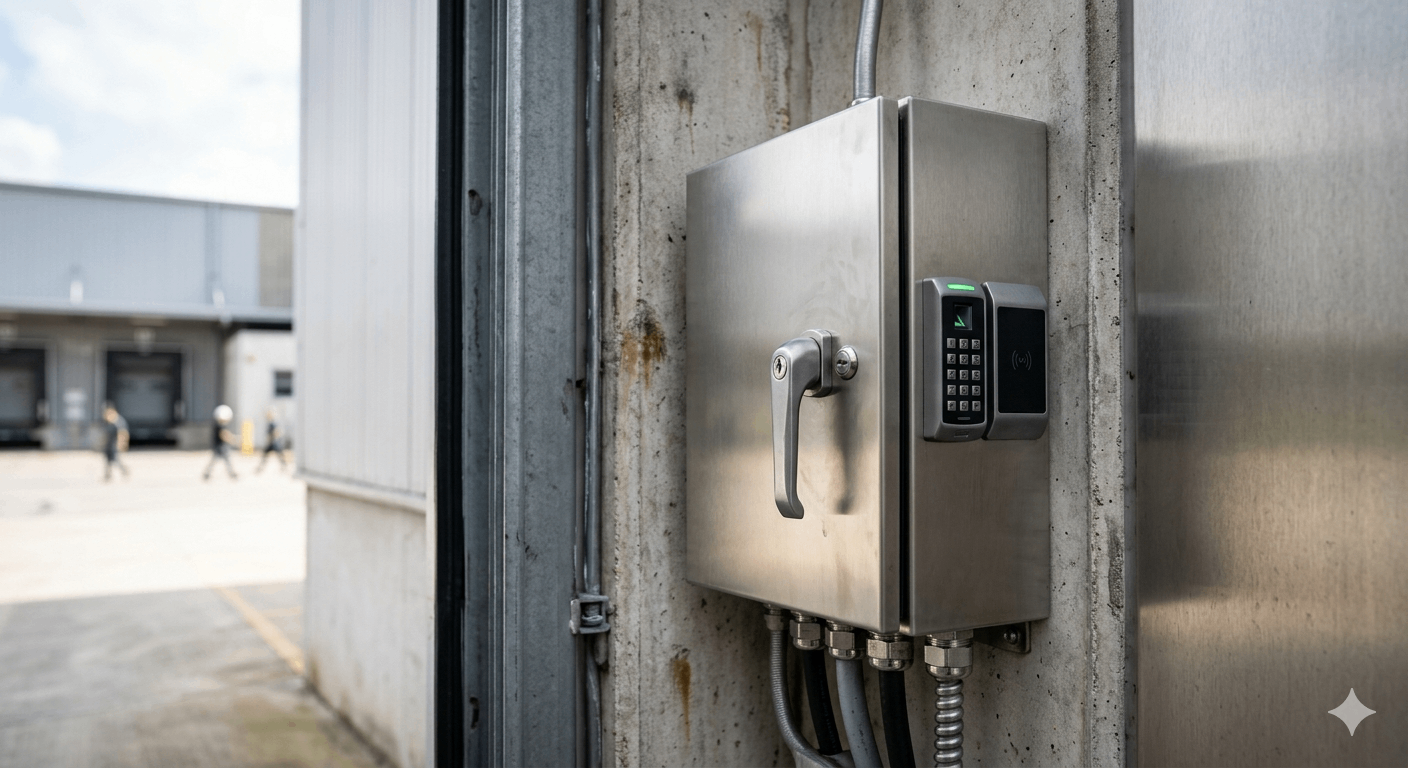
Engineering Resilience: The Strategic Physics of Access Control Enclosures for Global Wholesalers
In the world of international security distribution, it is easy to dismiss a metal box as a simple protective shell. But for those who have managed multi-million dollar infrastructures, the reality is quite different. An access control enclosure is a critical component. Indeed, it often dictates the long-term survival of the entire system. For global wholesalers and professional integrators, procurement has moved far beyond comparing unit prices. It is now about a sophisticated Total Cost of Ownership (TCO) model. At YISHANG, we’ve learned that the structural integrity of a housing doesn’t just protect electronics. Specifically, it protects your profit margins by silencing the constant buzz of warranty claims and field service calls.
1. The Economics of Ingress: Mitigating Hidden Risks in High-Value Electronics
For high-volume buyers, an Ingress Protection (IP) rating is essentially a financial insurance policy. Entry-level suppliers will promise “waterproof” seals all day long. However, they often overlook the microscopic physics that actually destroy hardware.
Hidden Threats: Electrochemical Migration
Specifically, electrochemical migration (ECM) is a major concern. This phenomenon occurs when moisture vapor enters poor gasket systems. It quietly facilitates the growth of conductive “dendrites” across internal PCBs. Over time, these microscopic bridges cause frustrating, intermittent short circuits. These issues are notoriously hard to diagnose. Consequently, the result is repeated, expensive technician dispatches. This quickly erodes an integrator’s bottom line.
The Vacuum Effect in Outdoor Environments
Our 26 years in precision manufacturing have taught us another lesson. Specifically, the “Vacuum Effect” is perhaps the most overlooked driver of outdoor access control failures. Imagine a sealed box baking in the sun. Then, it is suddenly hit by a cold rainstorm. The internal pressure drops instantly. This creates a suction force that draws humid air through gaskets. These seals were often only tested for static splashes. At YISHANG, we don’t just build boxes; we engineer micro-environments. By preserving the dielectric strength of sensitive controllers, we ensure the equipment remains a reliable asset rather than a nagging liability.
Streamlining Diverse Project Requirements
Wholesalers often manage a chaotic mix of project requirements. These range from a basic light junction box to a complex street light junction. Furthermore, you might handle a fully integrated electrical meter box. Success in these high-stakes sectors requires a supplier capable of unifying these needs. Therefore, we use one rigorous manufacturing standard for everything. By focusing on gas-tight integrity and structural sealing, we minimize the risk of moisture-related returns. It’s about de-risking your supply chain, plain and simple.
In the specialized world of traffic cabinet emc box and distribution box traffic projects, precision is everything. We ensure that our cabinets street light and mcc electrical cabinets are produced with absolute batch consistency. In a rollout of a thousand units, even a 1% failure rate is a disaster. This reliability is why veteran integrators prioritize YISHANG. Moreover, they choose us when they need a fiber distribution box or a junction box fiber setup that strictly adheres to NEMA standards. Ultimately, we help our clients avoid the astronomical costs of sending a crew to a remote site just to replace a corroded housing.
2. Material Metallurgy: Strategic Selection for Global Climates
A strategic procurement partner knows that material “over-specification” is a waste of budget. Conversely, “under-specification” is a death sentence for a brand’s reputation. In metal fabrication, the choice between alloys is often a game of trade-offs. These decisions are dictated by the specific environmental stressors of the site. Whether your project demands a stainless steel enclosure, a galvanized steel enclosure, or an aluminum enclosure, that initial choice will drive the project’s ROI.
Precision Material Comparison: Solving the Durability Equation
Technical Attribute | Stainless Steel Enclosure (316) | Aluminum Enclosure (5052) | Carbon Steel Enclosure (Q235) | PVC or Polycarbonate |
|---|---|---|---|---|
Pitting Resistance (PREN) | ~24.0+ (Superior) | Moderate | Low (Requires Coating) | N/A |
Thermal Conductivity | ~15 W/m·K | ~138 W/m·K | ~50 W/m·K | Extremely Low |
Salt Spray Test (ASTM B117) | 1000+ Hours | 500+ Hours | 200+ Hours (Coated) | N/A |
Commercial Application | Coastal/Chemical | Pole-Mount/High-Heat | Indoor/Industrial | Residential/Basic |
The Science of Stainless Steel
For coastal environments or chemical plants, the material stainless steel is the only non-negotiable standard. Grade 316 is fortified with molybdenum. Consequently, it resists that localized “pinhole” corrosion that can breach a security seal in months. On the flip side, in the rapidly expanding Smart City sector, a steel enclosure aluminum or a pure aluminum enclosure is often the smarter play.
Optimizing Logistics with Aluminum
Aluminum’s exceptional thermal conductivity is a major advantage. It allows the entire housing to act as a massive passive radiator. This is an essential feature for dissipating heat from high-speed biometric processors. Moreover, aluminum’s reduced density can lower international freight costs by as much as 25 percent. This is particularly true for bulk shipments of street light junction components. At YISHANG, we guide our clients through these metallurgical trade-offs. Our goal is maximum profit potential with zero field failures.
3. Managing the Thermal Paradox: Solving Heat and Condensation
In the B2B world, “Install and Forget” is the dream. However, the “Dew Point Paradox” often turns that dream into a nightmare. This is especially true for outdoor access control equipment. Physics plays a tricky role here. Internal components generate heat. As internal components like PoE switches and RFID controllers warm up, the internal air expands.
Combating the Dew Point Paradox
When temperatures plummet overnight, moisture condenses on the cold internal metal walls. This essentially creates “internal rain” that drips directly onto the electronics. Paradoxically, a perfectly hermetic seal can actually accelerate this failure. To solve this, YISHANG integrates hydrophobic pressure compensation vents into our junction box nema and control station enclosures. These breather plugs allow the housing to equalize pressure. At the same time, they maintain a strict IP66 rating. This stops the active “pumping” of humid air into the unit. Furthermore, it lets trapped vapor escape before it can liquefy.
Thermal Throttling Solutions
We also tackle the challenge of thermal throttling in enclosures solar battery and traffic cabinet emc box units. In high-heat regions like the Middle East, internal temperatures can easily exceed 70 degrees Celsius. This causes AI-driven controllers to down-clock and lag. Similarly, solar radiation can warp low-quality housings. Our enclosures utilize strategic solar shields and passive convection paths to keep things cool. Consequently, this ensures that access and intrusion systems remain snappy and responsive.
Whether your inventory requires a push button enclosure or an enclosure push button unit, thermal management should never be an afterthought. We also offer emc box mcc and box mcc electrical solutions for environments where electromagnetic interference threatens data integrity. Partnering with YISHANG gives you access to 26 years of specialized experience. Ultimately, we ensure that every access control cabinet or access control system you distribute is protected by the most advanced safeguards available today.
4. Scalability and Field Serviceability: The Wholesaler’s Competitive Edge
From a wholesaler’s perspective, the “Installer-Friendly” nature of a product is a massive selling point. Think about it: if a technician can install an enclosure in 15 minutes instead of 45, that integrator is realizing significant labor savings. Our design philosophy at YISHANG is human-centric.
Technician-Friendly Design
We focus on reducing those field hours by incorporating features that standard manufacturers tend to overlook. Specifically, we include things like removable gland plates and modular internal rails. By utilizing high-precision CNC laser cutting and automated TIG welding, we guarantee that every batch of access control enclosure units is identical. This consistency is vital for large-scale fiber distribution box or box fiber distribution rollouts. Standardized installation is a must in these cases.
DFM for Mass Production
Our focus on Design for Manufacturing (DFM) ensures that your custom designs are optimized for both strength and cost. By reducing unnecessary weld lines and optimizing material usage, we help our partners maintain healthy margins. This is true even in the most competitive bidding environments. Whether you are looking for a junction box fiber solution or a comprehensive access control cabinet for a government tender, YISHANG provides the engineering support needed to win.
Wholesale Procurement Checklist: Key Factors for Decision Makers
Batch Consistency: Does the supplier use CNC precision to ensure unit 1 and unit 10,000 are identical?
Installation Speed: Are there pre-punched removable knockouts to prevent on-site drilling?
Lead Time Reliability: Can the factory actually manage the scale of a distribution box traffic municipal project?
Compliance Certification: Does the housing meet IK10 impact ratings and NEMA 4X standards?
5. Frequently Asked Questions (FAQ)
What NEMA rating is required for outdoor access control enclosures?
Specifically, for most outdoor environments, a NEMA 4 or 4X rating is essential. NEMA 4 provides protection against windblown dust and rain. However, NEMA 4X adds protection against corrosion. Consequently, it is the ideal choice for a stainless steel enclosure in coastal or industrial settings.
Can metal enclosures interfere with wireless access control signals?
Indeed, standard metal cabinets can create a “Faraday cage” effect. This can block NFC, Bluetooth, or cellular signals. However, YISHANG solves this by offering specialized enclosure push button designs with RF-transparent windows. Furthermore, we can integrate external antenna mounts to ensure seamless wireless connectivity.
Why is Grade 316 preferred over Grade 304 for security housing?
While both are durable, Grade 316 contains molybdenum. Therefore, it provides superior resistance to chloride-induced pitting. If your access control system is located within 5 miles of a coastline, 316 is the only reliable option. Inland projects might find Grade 304 sufficient, but coastal durability requires the 316 standard.
How does thermal management affect the lifespan of internal controllers?
Excessive heat causes “thermal throttling,” which slows down biometric processing. Moreover, constant temperature swings cause component fatigue. By using aluminum enclosure designs or strategic venting, you can extend the MTBF (Mean Time Between Failures) of your electronics. Ultimately, this reduces long-term maintenance costs for the wholesaler.
If you are looking to upgrade your supply chain with high-performance, engineer-led solutions, the technical team at YISHANG is ready to assist. We excel at transforming complex access control requirements into scalable, high-resilience hardware. We invite you to reach out and discuss your upcoming project specifications with our consultants. Please send your inquiry now to receive a comprehensive quote and a complimentary DFM review for your custom access control enclosure needs.