
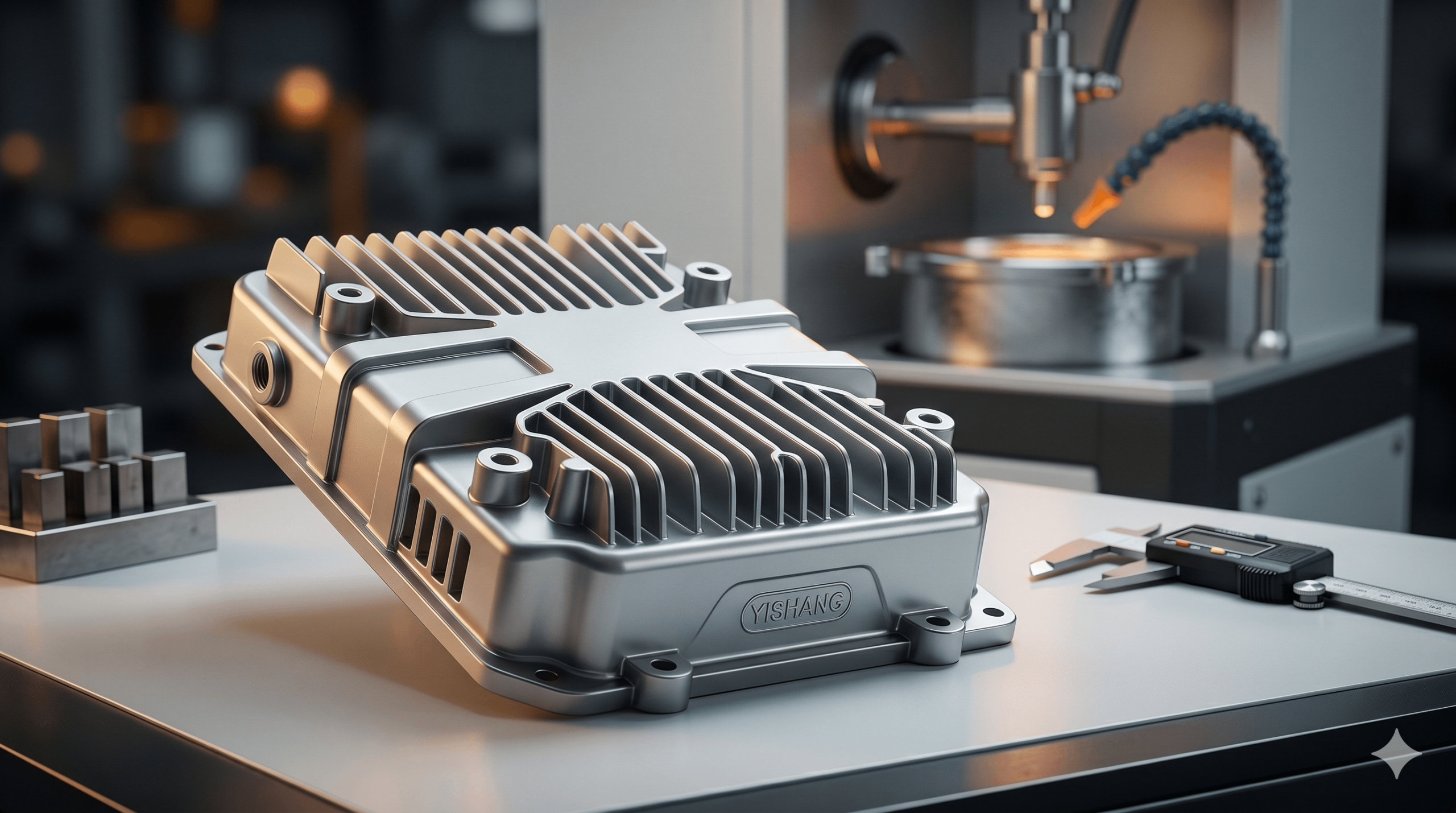
In the high-stakes world of volume manufacturing, a single second can often define your profit margin. For procurement managers and wholesalers looking abroad, choosing a process isn’t just about shaping metal—it is a strategic play for supply chain stability. Among the myriad of options, hot chamber die casting stands out. It is, in many ways, the most fluid and efficient method for creating those intricate, high-integrity components that modern industry demands. At YISHANG, we tend to look beyond the surface; we prioritize the engineering variables that dictate your final ROI, ensuring that every cycle hits that sweet spot of dimensional stability and material purity.
The core logic here is a masterclass in thermal balance. Unlike its cold chamber alternative—where metal has to be heated elsewhere and ladled in, shot by shot—the hot chamber approach keeps the injection system right where it belongs: submerged in molten metal. This effectively kills off “dry cycle” lag. Heat loss? In this setup, it is almost a non-factor. Consequently, what you get, quite simply, are significantly higher throughput rates. It’s why this method has become the go-to for manufacturing industrial parts at a scale that others struggle to match.
From a procurement standpoint, the math is straightforward. There are clear, undeniable advantages in unit cost and lead times. By building the furnace right into the machine, we cut the energy footprint of every single part. For us at YISHANG, this isn’t just an engineering choice; it is, in fact, a way to offer a more competitive wholesale price without ever having to gamble with the structural integrity of the final product.
The Submerged Logic: Anatomy of Injection and Material Purity
Eliminating Atmospheric Contamination
At the heart of it all lies the gooseneck and plunger, sitting deep within the molten reservoir. This submerged setup is designed to draw metal from well beneath the surface—a technical detail that matters more than you might think. By drawing from the bottom, the dross and oxides that naturally float to the top stay right there on the surface. As a result, they never touch the casting. The outcome is a molten stream that remains remarkably uncontaminated, shot after shot.
For those of you sourcing solar battery enclosure units, material purity is everything. It is, quite literally, the difference between long-term outdoor survival and premature failure. Contaminants are the hidden enemies that lead to micro-cracks or weakened corrosion resistance. In our experience, using this submerged method is the only real way to ensure the injection remains free from those pesky impurities. Moreover, this leads to a superior surface finish, which—as any pro will tell you—is critical for secondary steps like powder coating on a stainless steel enclosure.
Real-Time Pressure and Machine Longevity
The injection stroke is a fast, high-pressure event—blink and you’ll miss it. As the plunger drops, metal is forced through the nozzle at pressures typically ranging from 15 to 25 MPa. Specifically, this pressure is held steady until the metal solidifies, serving as the primary defense against internal shrinkage. At YISHANG, we watch these pressure profiles in real-time. It’s how we make sure that a junction box NEMA or an electrical meter box reaches the density required for a true NEMA 4X or IP65 rating.
Perhaps most importantly, this setup takes some of the strain off the machine itself. Because the metal is held at a consistent, optimal temperature, the gooseneck assembly avoids the harsh thermal shocks seen in other processes. In addition, this reliability acts as the backbone of mass production. It’s what allows YISHANG to maintain the kind of long-term stability that wholesale partners need when managing massive construction or infrastructure projects.
Comparison: Hot Chamber vs. Cold Chamber for Wholesalers
| Feature | Hot Chamber (Zinc/Magnesium) | Cold Chamber (Aluminum/Brass) | Wholesale Impact |
|---|---|---|---|
| Cycle Speed | 15 to 20 cycles per minute | 2 to 5 cycles per minute | Faster lead times, lower labor costs |
| Tolerance Ability | +/- 0.02mm to +/- 0.05mm | +/- 0.1mm to +/- 0.2mm | High precision, less CNC rework |
| Tooling Life | 1,000,000+ shots | 100,000 to 150,000 shots | Lower long-term amortization |
| Surface Finish | Ra 0.8 to 1.6 micrometers | Ra 1.6 to 3.2 micrometers | Better aesthetics and plating quality |
Fluid Dynamics and Thermal Control: Achieving NEMA-Grade Integrity
Balancing Flow for Surface Integrity
Moving from raw molten metal to a finished enclosure is, in a sense, a race against time and temperature. You need enough velocity to prevent “cold shots,” but you have to keep things controlled enough to avoid turbulence. Turbulence is the enemy; notably, it traps air, creates gas porosity, and can ruin an enclosure electrical meter housing or a push button enclosure before it even leaves the shop floor.
The engineering answer lies in the venting and gating. At YISHANG, we lean on specialized overflow wells and vacuum-assist tech to manage that air displacement. As a direct consequence, we can push the limits of thin-walled design—sometimes as thin as 0.4mm. You get the strength of solid metal without the unnecessary weight. Whether you are looking at a galvanized steel enclosure or one made of carbon steel, the goal remains the same: uniform thickness and rock-solid dimensional stability.
Strategic Heat Exchange Management
Then there is the thermal side of the house. A die casting machine is, for all intents and purposes, a high-speed heat exchanger. We map internal cooling lines with surgical precision to pull heat out at just the right rate. This allows the material to freeze fast without locking in internal stress. In other words, this delicate balance is exactly what enables the high cycle speeds our B2B buyers have come to expect. For us, it’s the secret sauce behind a competitive pricing model for mass-produced enclosure galvanized steel.
When we’re working on a steel enclosure aluminum assembly, we have to account for thermal expansion down to the last micron. Furthermore, our team calculates these variables to ensure the die holds its tolerances—often +/- 0.05mm—even after hours of non-stop operation. This obsession with precision is why we’ve become a preferred source for control station enclosures. Ultimately, by mastering the solidification curve, we often eliminate the need for expensive secondary CNC machining altogether.
Financial Lifecycle: Tooling Amortization and ROI for Wholesalers
Beyond the Initial Capital Expenditure
For a seasoned procurement manager, a die isn’t just an expense; it’s an investment in the project’s overall financial health. Yes, the upfront cost for hot chamber die casting can look significant; however, the ROI usually tells a much better story. It’s all about material efficiency and cutting out those labor-heavy secondary steps. Indeed, the method is so widely used because it delivers “near-net-shape” parts—meaning what comes out of the machine is often 98 percent ready to go.
Speed aside, material utilization is the real hero here. In our process, runners and gates are instantly recyclable. We pop them back into the furnace and remelt them without losing a bit of their metallurgical soul. Consequently, this zero-waste approach works beautifully with zinc alloys, which have lower melting points. It allows YISHANG to keep prices stable even when the broader markets for stainless steel or galvanized steel start to get a bit volatile.
Tooling Longevity and Supply Chain Reliability
The life of the tool itself is another win. Zinc is far less abrasive than aluminum, so the die doesn’t suffer as much from thermal fatigue or “heat checking.” It is not uncommon for a single tool to churn out well over a million high-precision parts. For a wholesaler, this means much lower long-term amortization costs and a supply chain you can actually trust.
Beyond these technical savings, we like to help our clients look at the numbers before the first block of steel is ever cut. If you’re planning a high-volume run of a galvanized steel enclosure or a carbon steel housing, the hot chamber method is almost always the winner for anything over 50,000 pieces. We focus on the Total Cost of Ownership—factoring in the savings from faster assembly and perfect material yield. Ultimately, your inquiry will always get a deep cost-benefit analysis from our senior team.
Strategic DFM: Optimizing Design for Scalable Manufacturing
Precision Cooling and Wall Consistency
Successful mass production usually starts long before the machines turn on—it starts at the Design for Manufacturing (DFM) stage. A few small tweaks at the beginning can save a fortune over a 100,000-unit run. In this world, the golden rule is consistent wall thickness. If your walls vary too much, you get uneven cooling, sink marks, or warping. Specifically, at YISHANG, we jump in early to make sure your enclosure electrical meter or solar battery units are designed to freeze exactly as they should.
Draft angles are another big one. While we can hit some incredible precision, you still need a slight taper—maybe 1 or 2 degrees—to safely eject the part without scuffing the finish. This is especially true for aesthetic pieces like a customized aluminum enclosure. By getting these angles right, we can crank up the cycle speed and sleep better knowing there won’t be any mechanical hiccups during the final ejection.
Material Fluidity and Complex Integration
Finally, there’s the material choice. Zinc alloys like Zamak 3 are the workhorses here, thanks to their incredible fluidity and impact strength. For parts that need to go everywhere—from medical housings to building hardware—zinc delivers a finish that’s hard to beat with minimal prep work. In addition, it’s why it has become the standard for so many products here at YISHANG.
Compared to traditional sheet metal, die casting offers a level of complexity that’s in another league. We can build in internal threads, logos, and cooling fins that would be impossible—or at least incredibly expensive—to weld onto a carbon steel enclosure. Whether it’s a precision electrical meter box or a custom steel enclosure aluminum housing, we’re ready to take those technical requirements and turn them into a scalable, high-margin reality.
Conclusion: Hot chamber die casting is more than just a mechanical process; it’s a calculated balance of thermodynamics and material science. For a global wholesaler, the value lies in that predictability and the ability to scale without losing quality. At YISHANG, we focus on the engineering logic that drives your ROI and keeps your reputation solid. Send your inquiry today or reach out for a quick inquiry now—let’s see how we can optimize your next big project.