
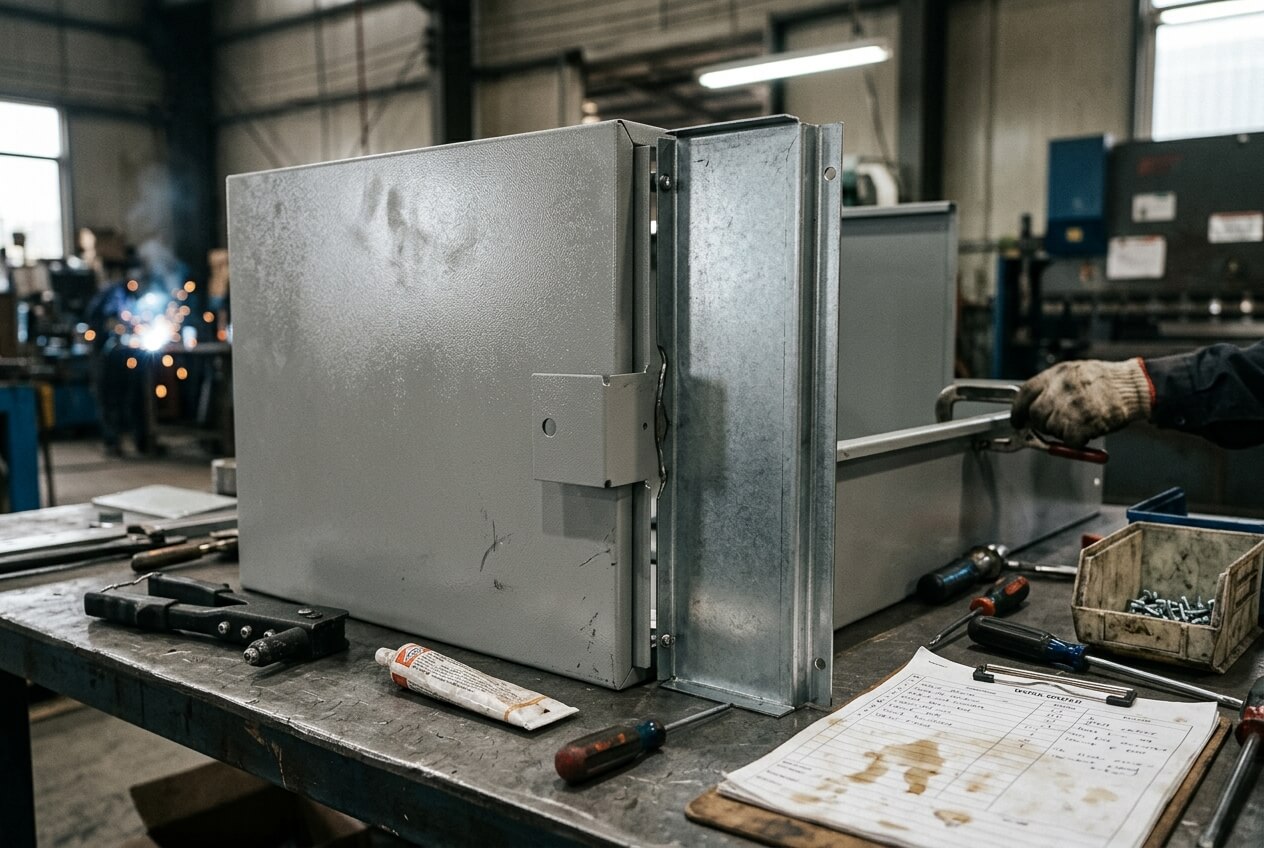
An OEM buyer sends drawings for a powder coated control enclosure and receives three similar prices. Each supplier confirms the laser cut, bent, and welded dimensions. The first shipment looks clean at incoming inspection. Then the door rubs, hinge screws bind, PEM nuts need chasing, and an internal bracket will not slide into place.
The metal parts may not violate the bare drawing. The failure starts earlier, inside the RFQ. The buyer treated powder coating as a color note. The suppliers treated coating thickness, masking, hanging, and after-finish inspection as assumptions. Those assumptions changed the final assembly fit.
This article focuses on one procurement risk: RFQ ambiguity that lets powder coaters and sheet metal fabricators quote different finished conditions for the same part. The risk does not only affect appearance. It affects hole clearance, threads, grounding pads, gasket surfaces, door gaps, installation force, rework cost, and batch consistency.
Buyers can reduce this risk before price comparison. They need to define which features must work after coating, which areas need protection, and which checks should happen after finishing. Without that clarity, the lowest quote may simply include fewer controls.
Where the RFQ Turns Coating Into a Hidden Fit Assumption
Powder coating adds material to the part. A common film build may add about 60–100 microns per side, and some industrial requirements can run heavier. That number sounds small until it appears on both sides of a slot, inside a hinge leaf, around a locating hole, or across two mating flanges.
The problem grows when the drawing controls only the fabricated metal condition. A laser cut panel can pass inspection before coating. A bent enclosure body can meet the drawing. A welded frame can sit inside the stated tolerance. After coating, the same parts may no longer assemble without force.
The clearance loss buyers often miss
Consider a cabinet door with a narrow reveal, two hinges, a latch, and a gasket. The door and body may both meet their pre-coating dimensions. If the hinge holes receive powder, the door flange gains film, and the latch area has no finished clearance note, the door can bind during installation. The buyer sees a defective assembly. The supplier sees a drawing that never defined the required post-coating fit.
A second example appears in adjustable brackets. A slotted hole may fit the screw during prototype fabrication. After coating, powder reduces the slot width and builds on the washer contact face. The installer tightens harder, scratches the coating, and loses adjustment range. The bracket was not simply finished poorly. The RFQ failed to say whether the slot size applied before or after powder coating.
Buyers should identify functional interfaces before requesting prices. These areas include hinge holes, sliding slots, locating holes, threads, PEM hardware, grounding pads, gasket channels, mounting feet, and mating flanges. If the part must fit after coating, state that requirement in the RFQ and drawing notes. Do not leave the issue for final assembly.

Why Similar Quotes From Powder Coaters Can Price Different Finished Parts
Two quotes can look close while covering different work. One supplier may mask threaded holes, plug PEM nuts, protect grounding pads, and check fit after coating. Another may coat all surfaces unless the drawing says otherwise. A fabricator may size holes for bare metal inspection. Another may adjust clearance for the finished assembly.
A finish note such as powder coat black, RAL 9005, semi-gloss gives only part of the requirement. It does not tell powder coaters whether M6 threads must remain ready for assembly. It does not protect a gasket surface, a conductive bonding point, or a sliding bracket face. It also does not explain where hook marks may appear.
Quote gaps caused by missing finish instructions
Masking adds labor. Thread plugging adds handling. A clean visible face may require a different hanging method. Outdoor use may change pretreatment, powder chemistry, film thickness, and inspection. Tight functional holes may need masking, reaming after coating, or a revised hole size before cutting. Each choice changes cost and lead time.
When the RFQ does not name these choices, suppliers fill the blanks differently. The lowest price may not represent better efficiency. It may omit the controls that keep assembly moving. The buyer then discovers the gap after parts arrive, when schedule pressure makes rework expensive.
A finish map can make quotes more comparable. It does not need to cover every square centimeter. It should mark visible faces, masked threads, bare grounding pads, acceptable hook locations, no-build contact areas, and fit-critical holes. For an enclosure, the map can show exterior cosmetic zones, hinge protection, latch clearance, and internal mounting points. For a frame, it can show mounting feet and mating plates that must hold final height after finish.
Yishang often reviews fabrication drawings together with finish expectations because the sequence affects cost and function. Laser cutting, bending, welding, polishing, powder coating, and assembly checks create one finished part. If the RFQ shows only a color, a practical review should ask which areas must still fasten, conduct, slide, seal, or align.
Geometry That Makes Coating Assumptions Expensive During Assembly
Some sheet metal parts tolerate coating variation better than others. A flat cover with open clearance holes gives powder coaters fewer places to create fit risk. A welded enclosure with return flanges, deep corners, hinges, threaded inserts, and internal brackets creates more hidden interfaces.
Holes near bends show this risk clearly. Bending can move or distort a hole slightly. Powder then adds film inside the hole. If the mating screw already has little clearance, the assembly may fail even when each process looks acceptable on its own. Hole position, bend tolerance, coating thickness, and hardware choice all stack together.
Welded assemblies create another chain. Welding heat can pull brackets out of position. Grinding and spatter removal can alter local contact areas. Powder coating can hide small manual corrections made during a prototype. If production fixtures do not repeat those corrections, the finished frame may look good but sit out of plane on the machine base.
Recessed areas force a coverage-versus-clearance decision
Recessed corners, boxed sections, and narrow slots can suffer from the Faraday cage effect. Charged powder may not enter those areas evenly. To improve coverage, the coater may adjust technique or add film. That decision can protect corrosion resistance but reduce assembly clearance in the same area.
A display rack offers a common example. Shelves may plug into coated slots on a welded side frame. During prototype review, one technician may file a tab or clean a slot. In production, coated slots close slightly, tabs thicken, and installers start using mallets. The coating chips at contact points. The buyer now has both a fit problem and a cosmetic complaint.
Small design changes often prevent this chain. A slot can gain clearance. A hole can increase before coating. A thread can be added after finish, or masked before finish. A mating face can remain uncoated if corrosion and appearance requirements allow it. These choices belong before quotation, not after a batch needs hand fitting.
Material and thickness also matter, but they should not become a separate buying checklist. Thin sheet may distort more during forming, welding, curing, or packing. Stainless, galvanized, and mild steel may require different pretreatment plans. The procurement point stays the same: the RFQ should connect material, geometry, coating, and final fit where the assembly depends on it.

Why a Coated Sample Can Hide Batch-Production Fit Drift
A buyer may approve one coated prototype and still receive a batch with rubbing doors or tight brackets. The sample proves that one part can work. It does not prove that the supplier captured the process conditions that made it work.
Prototype parts often receive extra attention. A technician may hand-mask a hinge hole, clean a thread, choose the best hanging point, or touch up a difficult corner. These actions may never appear in the inspection record. When production starts, the team may use a faster route that changes coating build, hook marks, or protected areas.
Approval should capture the route, not only the appearance
Buyers should ask what made the sample acceptable. Which holes were masked? Were threads protected or cleaned after coating? Where was the part hung? Did the supplier check the door, latch, gasket, and internal hardware after finish? Did anyone record the powder type, film range, curing conditions, and visible surface standard?
Color changes can also create drift. An enclosure family may use black, white, and textured gray versions. Different powders may build differently or hide surface marks differently. The fit issue is not the color itself. The risk appears when masking, film range, and inspection stay undefined across colors.
Batch quantity affects the same risk. Ten samples may move through coating with careful handling. Five hundred parts need repeatable loading, masking, hanging, curing, inspection, and packing. If the RFQ pays for only visual inspection, functional problems may travel through production unnoticed.
For a metal enclosure, sample approval should include door movement, hinge screw fit, latch engagement, gasket compression, and internal mounting plate installation after coating. For a bracket, test the real screw, washer, mating rail, and adjustment range. For a welded frame, check mounting hole alignment and foot flatness after coating and curing.
Yishang can record prototype findings as production notes when buyers share mating parts, samples, photos, and installation concerns. These notes help prevent the supplier from treating a successful sample as only a color approval.
What to Lock Before Release So Finish Does Not Become Rework
Before releasing a batch, buyers should treat powder coating as part of the functional specification. That does not mean over-specifying every hidden surface. It means locking the details that affect alignment, fastening, grounding, sealing, and installation time.
Start with the drawing. Mark dimensions that apply after coating, especially holes, slots, door gaps, hinge points, gasket channels, mounting feet, and mating faces. If inspection should occur before coating for one feature and after coating for another, say so. Otherwise, supplier and buyer may measure different conditions and both believe they are right.
Then connect the finish requirement to cost and lead time. Masking, plugging, controlled hanging, heavier corrosion protection, rework prevention, and assembly-fit checks all consume time. A clear RFQ lets suppliers price those controls honestly. It also reduces late change orders, sorting, repainting, and line stoppages.
Supplier communication should focus on consequence, not only preference. Instead of saying that a hole should be clean, state that an M6 screw must install by hand after coating. Instead of asking for a nice door gap, state the acceptable finished gap and whether rubbing is allowed. Instead of noting a grounding area, show the pad size and whether it must remain bare metal.
Repeat orders need controlled references. A golden sample, approved finish map, first article inspection report, or assembly photo can prevent drift. If the buyer changes powder color, material thickness, hardware, quantity, or mating parts, the team should review the fit risk again before production.
If you are comparing sheet metal suppliers or powder coaters for enclosures, cabinets, racks, brackets, frames, or welded assemblies, send the information that controls final fit before choosing a quote. Share drawings, material requirements, quantities, tolerances, finish expectations, coating thickness needs, color or texture, masking areas, mating part photos, and prototype feedback. Yishang can review the fabrication and finishing sequence around fit-critical areas before pricing or batch release. Send project files through Yishang and mark where holes, threads, bends, doors, panels, brackets, grounding pads, or mounting faces must still work after powder coating.
Frequently Asked Questions
Should critical sheet metal dimensions apply before or after powder coating?
Fit-critical dimensions should usually apply after powder coating. This includes hinge holes, locating slots, mating flanges, gasket channels, and mounting feet. The drawing can still show bare metal dimensions for fabrication control, but the RFQ should state which features must meet the final assembly condition after finish.
What should buyers tell powder coaters about threads and PEM hardware?
Buyers should mark every thread, PEM nut, stud, insert, and tapped hole that must remain usable without chasing. The RFQ should state whether hardware goes in before or after coating, and whether masking or plugging is required. This avoids disputes when coated threads slow assembly or damage fasteners.
Why can two powder coating quotes differ even when the color is identical?
The same color can include different process assumptions. One quote may include masking, controlled hanging, film thickness checks, pretreatment, and after-coating fit inspection. Another may include color application only. A finish map and functional notes make the price comparison more accurate.
How can a prototype fit while the production batch fails?
A prototype may receive manual care that production does not repeat. A technician may clean holes, adjust masking, select a better hanging point, or test assembly by hand. Buyers should record those details during sample approval so the batch follows the same functional route.
Which project types face the highest coated-fit risk?
Assemblies with tight interfaces face the highest risk. Examples include control enclosures, cabinets with doors and gaskets, adjustable brackets, display racks with tabs and slots, and welded frames with mounting feet. The risk increases when holes, slots, hinges, or grounding pads sit close to the coating build.
What should an RFQ include for a powder coated sheet metal assembly?
The RFQ should include drawings, material requirements, quantities, tolerances, finish expectations, coating thickness range, color or texture, masking needs, visible surface requirements, mating part photos, and prototype feedback. It should also identify which features must be inspected after coating.