
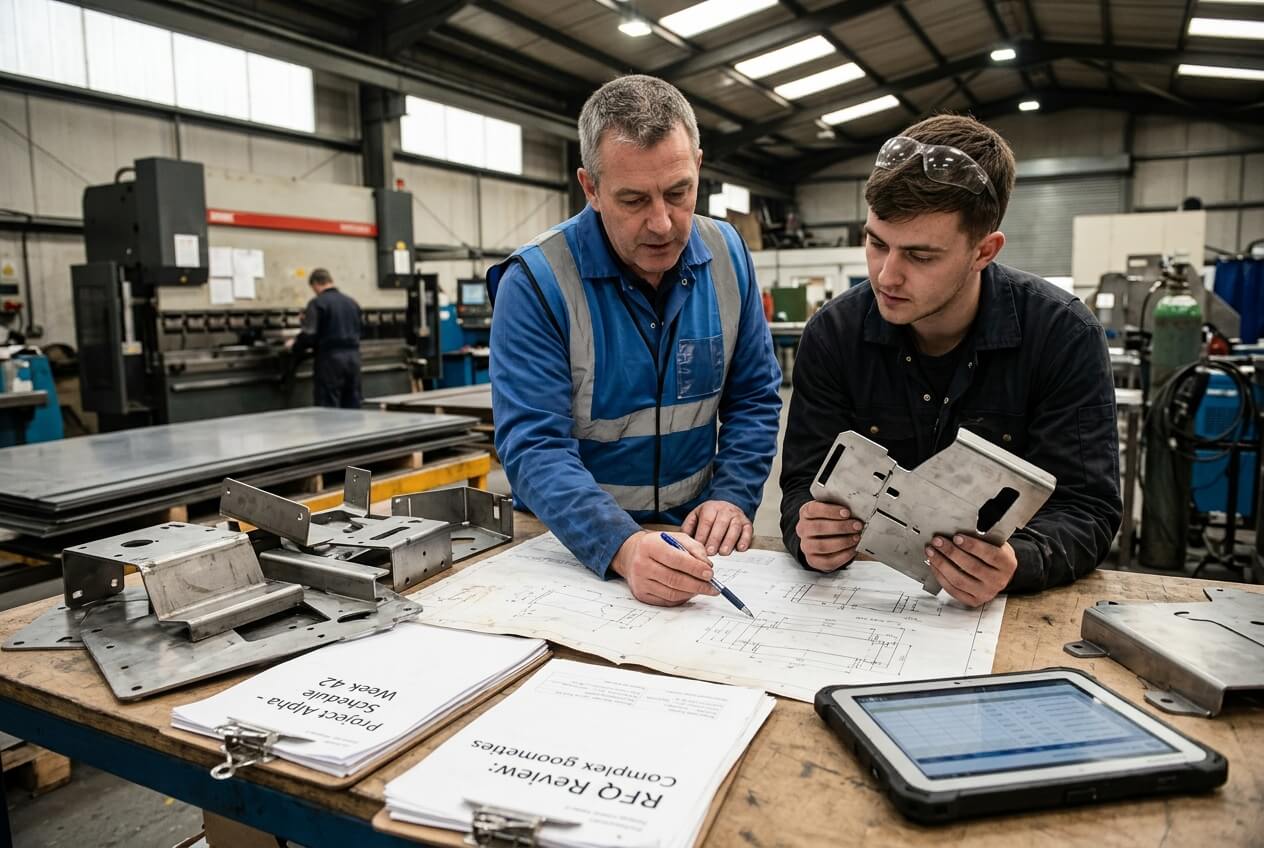
An OEM buyer sends an RFQ for a powder-coated control enclosure, two bent brackets, and a stainless front panel with narrow connector slots. The drawing includes one short note: “EDM if required.” One supplier quotes wire EDM for the slots. Another quotes laser cutting with deburring. A third asks whether the sharp internal corners are functional. The buyer sees three prices, but those prices do not describe the same job.
This is the real procurement risk behind the question, “what is electric discharge machining?” Electric discharge machining, or EDM, removes conductive material with controlled electrical sparks. Wire EDM can cut fine profiles and sharp internal features. Sinker EDM can form cavities. EDM drilling can create small holes. The process can support high-precision work, but that does not mean every sheet metal feature with a sharp corner needs it.
In custom sheet metal fabrication, the danger starts when the RFQ does not explain why EDM appears on the drawing. Suppliers then fill the gaps with different assumptions about cutting, tolerances, finishing, inspection, and assembly fit. The result can be non-comparable quotations, late clarification loops, outsourced processing, prototype-to-batch changes, and delivery dates that move after the purchase order.
Buyers do not need to become EDM specialists. They need to control the assumptions that sit behind the EDM note. A clear RFQ should tell suppliers which features drive function, which dimensions apply after finishing, which tolerances matter after bending or welding, and whether the production route must match the prototype route.
Where an Unclear EDM Note Starts to Break Quote Comparisons
The problem rarely starts with the EDM machine. It starts with a drawing note that hides a functional decision. A model may show zero-radius internal corners because the CAD file allows them. A title block may apply tight tolerances to every slot. A finish note may say “black powder coat” without showing coating buildup on connector openings. When those details stay vague, suppliers quote different levels of risk.
One fabricator may assume laser cutting with standard deburring. Another may include wire EDM for every narrow profile. A third may plan laser-cut prototypes and EDM batch production if the first samples fail. Procurement may read the quote spread as a pricing difference. In reality, each supplier has quoted a different manufacturing route.
The hidden decision behind “EDM if required”
EDM can make precise conductive parts, including hardened tooling components, fine slots, and difficult internal shapes. Sheet metal parts usually pass through a broader route: laser cutting or punching, bending, welding, grinding, finishing, assembly, and inspection. EDM becomes relevant only when a feature truly needs its accuracy or geometry.
A stainless front panel for an industrial controller may show sharp corners in every connector opening. The connector may only need clearance after powder coating. If an R0.5 internal radius still allows the plug to fit, laser cutting may support the requirement. If the connector body locks against a square corner with little clearance, wire EDM may deserve review. The RFQ must state which condition applies.
Without that note, the buyer cannot compare quotes fairly. The low quote may omit a required precision operation. The high quote may include unnecessary EDM outsourcing. Both outcomes create risk. One can fail assembly. The other can inflate cost and add time with no product benefit.
Why EDM Assumptions Change Cost and Lead Time After Sourcing
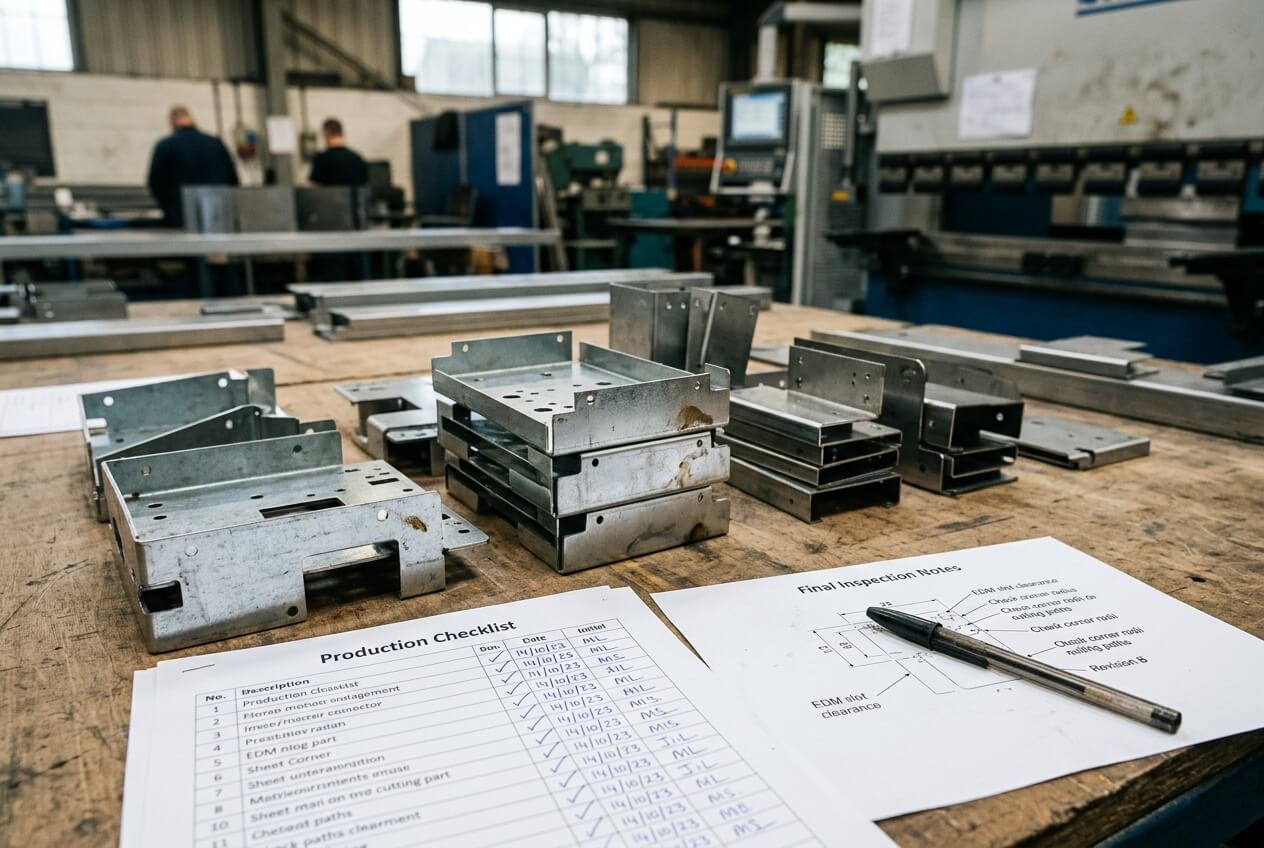
A vague EDM note can move a normal fabrication order into a mixed-process schedule. That shift affects more than the cutting price. It can add supplier coordination, separate machine queues, handling between shops, extra inspection, and revised sequencing around finishing or welding. These steps often appear after sourcing, when the buyer expects the supplier to start production.
Wire EDM can run slowly when a path is long, the sheet is thick, or the feature needs multiple skim cuts. Sinker EDM may require electrode design and electrode manufacturing before the burn begins. Even when the EDM time looks small, planning time can grow. The supplier must decide datum references, fixture strategy, inspection stage, and whether EDM happens before or after another fabrication step.
Project example: powder-coated enclosure panel
Consider a 1.5 mm aluminum enclosure cover with USB, switch, and display openings. The CAD model shows square corners. The drawing adds “no burrs” and “EDM if required.” One quote includes laser cutting, deburring, and powder coating. Another includes wire EDM for the connector openings after cutting. A third asks for the mating connector drawings.
The key risk is not whether EDM can cut the openings. It can. The risk is that nobody has defined the required after-coating opening size. Powder coating reduces clearance on cut edges. A precise EDM opening can still fail if the coating thickness closes the slot. The buyer should clarify connector clearance, acceptable corner radius, coating thickness expectations, and inspection after finishing before comparing prices.
Project example: welded frame with locating slots
A welded equipment frame may include narrow locating slots for a removable tray. The prototype fits because the supplier hand-adjusted the slots after welding. Before batch production, the buyer tightens the slot tolerance and adds an EDM note. That change forces a route decision. The supplier may EDM the slots before welding, machine them after welding, or redesign the locating feature.
Each option carries a different consequence. EDM before welding may lose accuracy when heat pulls the frame. Machining after welding may require special fixturing. A design change may protect fit with less processing. Procurement should ask which dimension controls the tray fit and when inspection must occur. That question prevents a late fight over whether the quoted route matches the approved sample.
How Tolerance and Finish Ambiguity Turn EDM Into the Wrong Solution
EDM looks attractive when a drawing shows tight dimensions. However, sheet metal failures often come from forming, coating, welding, or assembly variation rather than cutting accuracy. If the RFQ treats every dimension as equally critical, suppliers may focus on the most expensive process instead of the real fit risk.
A bracket hole may drift after bending because the hole sits too close to the bend line. A cabinet door may bind because hinge holes stack up across the welded enclosure. A powder-coated panel may fail because coating covers a grounding area that should have remained masked. EDM will not solve those issues. It may only make the pre-bend or pre-finish feature more precise.
Separate model geometry from functional geometry
Buyers should tell suppliers which features can change for manufacturability. For example, a note can say, “Connector cutouts may use R0.5 internal corners if plug clearance remains after powder coating.” Another note can say, “Slot width applies after coating; masking is acceptable if required.” These statements convert a process assumption into a functional requirement.
The same logic applies to tolerances. A default ±0.05 mm tolerance on every profile may force suppliers to consider EDM. If only two locating edges control assembly, the drawing should identify them. General features can use fabrication tolerances. Critical features can use tighter tolerances with datums, inspection stages, and acceptance criteria.
Finish details also need clear timing. State whether dimensions apply before finishing, after powder coating, after brushing, or after final assembly. Mark cosmetic faces, grounding areas, masked holes, and acceptable edge condition. “No burrs” may mean safe handling on a bracket, clean visible edges on a display panel, or a measured edge requirement on a sliding contact surface. Those are not the same requirement.
When buyers ask Yishang to review drawings for custom sheet metal parts, the most useful files include the 2D drawing, 3D model, material grade, finish requirement, mating-part details, and any prototype feedback. That package helps separate necessary EDM from avoidable EDM assumptions.
Why Prototype Approval Can Hide a Production Route Mismatch
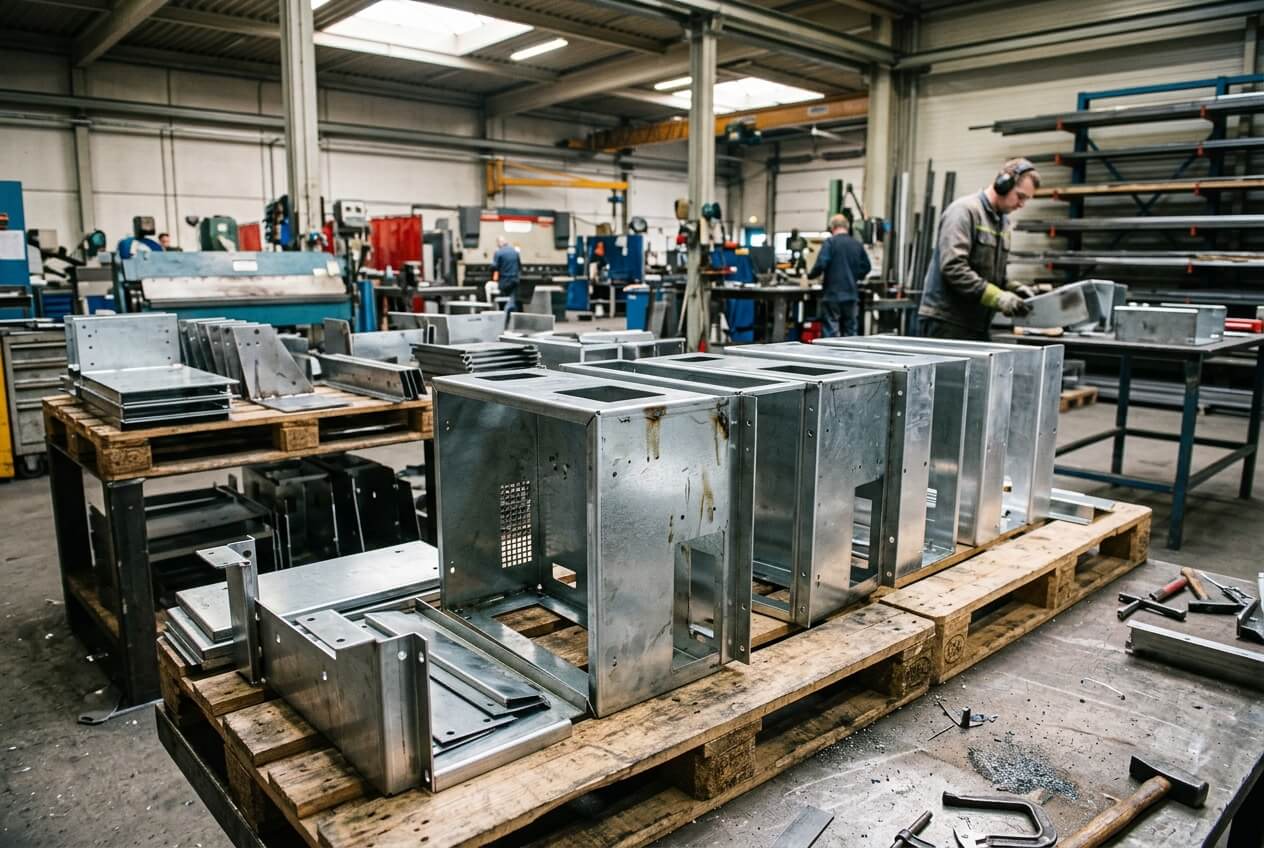
Prototype approval can create false confidence when the RFQ does not lock the manufacturing route. Sample parts often receive extra manual work. A technician may open a slot slightly, hand-deburr a connector edge, adjust a bend angle, polish a visible surface, or rework a welded corner. The sample then passes assembly, but the production method remains unclear.
EDM adds another variable to this gap. A prototype may use laser cutting because the quantity is low and timing is urgent. The batch may switch to wire EDM because the supplier worries about repeated slot accuracy. The reverse can also happen. A prototype may use EDM to guarantee fit, while the batch switches to laser cutting for cost or capacity. Both changes can alter edge texture, corner radius, inspection results, and fit with purchased components.
Freeze the route before the sample becomes the standard
Buyers should not approve a prototype only by appearance or first-fit success. They should ask the supplier to document the intended production route. That record should cover cutting process, bend tooling, weld sequence, finishing method, masking points, inspection stage, and any manual rework used on the sample.
This matters for sheet metal enclosures, brackets, frames, cabinets, and welded assemblies. A control box cover may fit during prototype assembly because one operator hand-finished each switch opening. A batch of 500 parts may fail because the quoted route does not include that rework. A stainless sensor bracket may pass slot inspection before bending, then move out of position after forming. EDM may have made the slot accurately, but the route still failed the assembly need.
Procurement should clarify whether prototypes and batch parts must use the same process. If the supplier plans to change routes, ask what dimensions or inspection results may change. Also ask whether the quoted lead time includes any outsourced EDM capacity. These questions protect batch consistency before the project reaches the most expensive stage.
What Buyers Should Clarify Before They Compare EDM-Related Quotes
A strong RFQ does not need a long manufacturing essay. It needs a few precise decisions that stop suppliers from guessing. The buyer should define the feature purpose, the acceptance stage, and the allowed manufacturing flexibility. Those details make quotes comparable and reduce the chance of late technical negotiation.
Start with the features that triggered the EDM note. Identify whether each one controls assembly fit, sealing, location, cosmetic appearance, grounding, or only model shape. Then state whether EDM is mandatory, optional after review, or not required if another process meets the functional result. This keeps suppliers from pricing hidden routes.
Next, connect tolerances to fabrication reality. Mark critical-to-function dimensions and datums. Separate general laser-cut profiles from assembly-critical holes or slots. State whether tolerances apply before bending, after bending, after welding, after coating, or after assembly. If powder coating or plating affects fit, define after-finish dimensions or masking requirements.
Quantity also changes the risk. A one-off prototype can absorb more handwork. A batch order needs repeatable processes, stable inspection, and clear acceptance standards. If the product will move from samples to production, ask suppliers to quote the intended batch route, not only the fastest sample route.
Cost drivers should appear openly in the quote. Ask suppliers to call out outsourced EDM, special fixtures, extra inspection, coating masks, manual deburring, polishing, or assembly checks. A higher quote may be the better quote if it includes real requirements. A lower quote may be valid if a small radius change removes unnecessary EDM. The buyer needs enough detail to know which case applies.
If your RFQ includes “EDM if required,” narrow slots, sharp internal corners, tight connector openings, coated fit surfaces, or prototype-fit concerns, send the drawings to Yishang before the delivery plan is fixed. Include drawings, material requirements, quantities, tolerances, finish expectations, mating-part information, and sample comments. Yishang can review whether EDM is necessary, whether laser cutting or a design adjustment can meet the function, and which assumptions should appear in the quote.
Frequently Asked Questions
What is electric discharge machining in a sheet metal RFQ?
Electric discharge machining is a spark erosion process for conductive materials. In a sheet metal RFQ, it usually matters when a slot, hole, or internal corner appears to need accuracy beyond laser cutting or punching. Buyers should ask which feature requires EDM and why that feature is functional.
Does “EDM if required” make supplier quotes harder to compare?
Yes. The note leaves the process trigger unclear. One supplier may include wire EDM, another may quote laser cutting, and another may plan a route change after prototypes. Define whether EDM is mandatory, optional after review, or only allowed when a named tolerance cannot be met another way.
When can laser cutting replace wire EDM for enclosure openings?
Laser cutting may work when a small internal radius is acceptable, the connector has clearance, and the after-finish opening size is controlled. Wire EDM needs review when the geometry directly controls location, sealing, locking, or another critical assembly function.
Why can a precise EDM opening still fail after powder coating?
Powder coating adds thickness to cut edges and can reduce clearance. If the drawing defines only the before-coating opening, the finished part may become tight. Specify whether the critical dimension applies before coating, after coating, or after masking.
How can prototype approval hide an EDM-related batch risk?
Prototype parts often receive hand deburring, slot adjustment, or more flexible inspection. Batch parts need a repeatable route. If the process changes from laser to EDM, or from EDM to laser, corner radius, edge condition, and inspection results may change.
What should buyers send for an EDM note review?
Send the 2D drawings, 3D models if available, material grade, thickness, quantities, tolerance priorities, finish expectations, mating-part details, and prototype feedback. These details help the supplier judge whether EDM is necessary or whether a fabrication-friendly change can protect fit and delivery.