
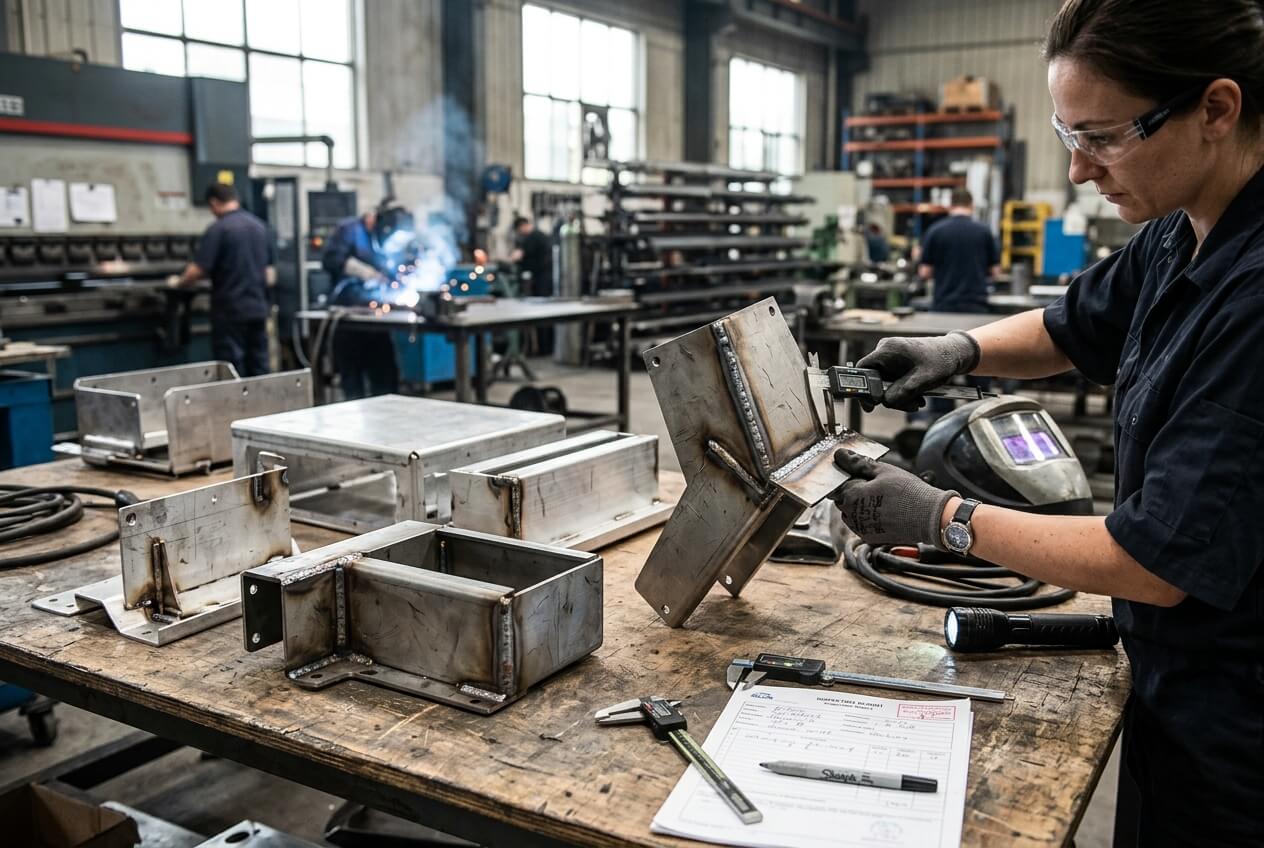
A buyer sends one enclosure drawing to three sheet metal fabricators. The outside dimensions match. The material callout looks clear. The quantity looks simple. Yet the returned prices sit far apart. One supplier assumes tack welds and light touch-up. Another prices continuous welds, grinding on visible seams, and fixture time. A third expects the welding team to close every small gap by hand.
The drawing did not change. The welding joints did. That gap between what the buyer intended and what each supplier assumed creates the real procurement risk. It turns quote comparison into guesswork, then moves the same uncertainty into production. The lowest quote may only look low because it excludes weld length, access limits, cosmetic cleanup, or post-weld correction.
For cabinets, brackets, frames, enclosures, and welded assemblies, joint definition shapes cost and repeatability. It also affects assembly fit, powder coating results, inspection time, and lead time. Buyers do not need to over-specify every seam. They do need to remove the assumptions that make one quote impossible to compare with another.
Where vague welding joints turn one RFQ into three different prices
RFQ ambiguity often starts with a drawing that shows shape but not welding intent. A butt joint, lap joint, tee joint, corner joint, or edge joint can all join sheet metal parts. They do not create the same work. Each one changes edge preparation, clamp access, heat input, weld sequence, grinding, and inspection.
A supplier must fill the missing detail before pricing. If the drawing says only “weld here,” the estimator may choose the fastest reasonable method. Another estimator may protect against risk and include more weld length, more fixturing, and more cleanup. Both quotes can look professional. They still describe different manufacturing routes.
The price gap usually hides in scope, not margin
Consider a wall-mounted electrical enclosure with a visible front frame. The buyer wants clean external corners after powder coating. The drawing shows the formed panels and front opening, but it does not identify which seams need continuous welding or flush grinding. One supplier quotes short welds on hidden areas and minimal dressing. Another quotes full corner welds, controlled squareness, and cosmetic finishing on the front face.
The second quote costs more because it includes the buyer’s real expectation. The first quote may trigger a change request later. If the buyer selects it on price alone, production will expose the missing scope. The result can be rework charges, finish defects, delayed approval, or arguments over whether the supplier misunderstood the drawing.
The same risk appears on a welded equipment frame. A tee joint on an internal rail may only locate a shelf, while a corner joint on the outer frame may control squareness. If the RFQ treats both joints the same, suppliers will not price them the same way. The buyer then compares different weld lengths, different fixture strategies, and different inspection levels without knowing it.
How quote assumptions become assembly fit and batch consistency problems
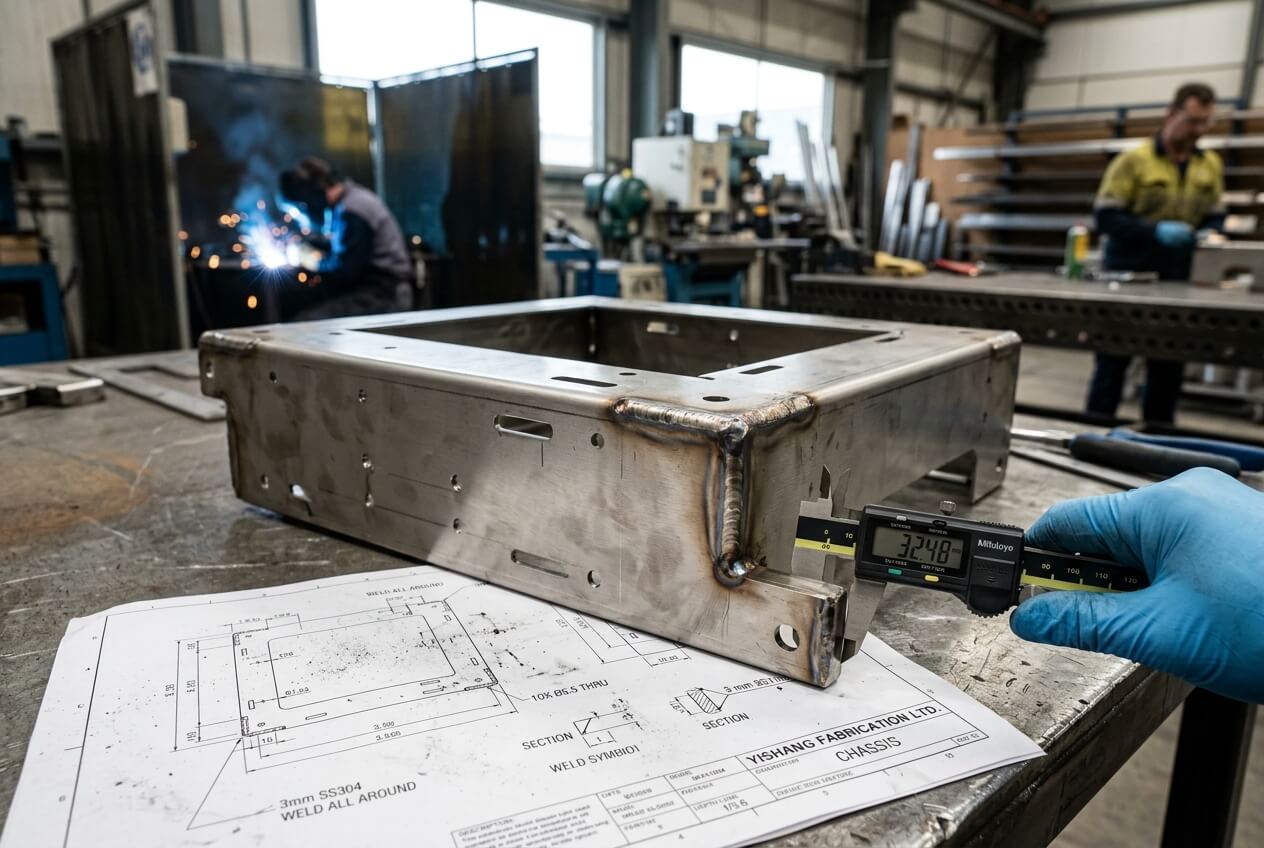
Welding assumptions do not stay inside the quote. They show up in the finished assembly. Thin sheet metal moves under heat. Joint location decides where that movement appears. A corner joint near a door gap can pull the opening out of square. A lap joint near a mating surface can add thickness and reduce clearance. A tee joint on a support rail can twist a frame enough to disturb shelf spacing.
The procurement risk grows when the drawing defines the outside size but not the functional fit. A supplier may build to the outer dimensions and still deliver a part that creates assembly trouble. Door gaps, hinge alignment, mounting holes, slots, and mating brackets often carry more risk than the overall cabinet size.
Fit-critical features need protection before welding starts
A bracket set offers a common example. The buyer needs a formed sheet base welded to a tube support. The assembly bolts to a larger machine frame, so hole position matters. The drawing calls out the holes and general dimensions, but it does not state whether weld distortion near the base must stay away from the mounting face. During production, heat pulls the base slightly. The bracket still looks acceptable, but bolts no longer drop in without forcing.
That problem begins before the first production part. The RFQ did not connect the welding joints to the mounting function. The quote also did not include controlled fixturing or a post-weld check on the mounting face. By the time assembly fails, the buyer has already approved price, schedule, and supplier selection based on incomplete assumptions.
Clamp access creates another hidden chain. If a flange, channel, or deep return blocks the torch, the welder may reposition the part several times. That adds time and variation. If the quote assumed easy access, the supplier may rush the sequence or rely on manual correction. Batch consistency then depends on individual skill instead of a stable process.
Mixed-thickness assemblies add more risk. A thick plate welded to a thin formed panel can look strong on the outside while the thin side distorts or the root condition remains unclear. Buyers should flag which side carries the load, which face must stay flat, and which surfaces must mate with other parts. Those notes let suppliers price welding joints around function, not just geometry.
Why prototype approval can hide welding-joint risks in production
A good prototype proves that the concept can work once. It does not prove that the same welding joints will repeat across a batch. Skilled welders can hand-fit early samples, close gaps, adjust sequence, and spend extra time on cleanup. Production removes much of that freedom. Fixtures, cycle time, and repeatable inspection become more important than individual correction.
This difference matters when buyers approve a sample without asking how the supplier achieved it. A prototype cabinet door may close cleanly after the welder adjusts the frame and dresses the corner welds. The buyer sees an acceptable part. In a batch of fifty cabinets, the same joint design may pull latch gaps in different directions. Doors rub, hinge holes need chasing, and powder coating exposes uneven seam cleanup.
Sample quality must connect to the production method
A retail display rack shows the same issue. The first welded assembly stands level because the shop spends extra time aligning each shelf rail. The RFQ does not mention fixture repeatability, shelf spacing tolerance, or acceptable weld appearance. When the order moves from one sample to a batch, small gap changes at tee joints move the shelf line. The rack still passes a basic visual check, but the customer rejects it during final assembly.
The consequence chain starts with incomplete prototype review. The buyer approves the visible result, not the process behind it. The quote may not include fixture design, weld sequence control, or post-weld dimensional checks. Later, the supplier must either slow down production or ship parts with wider variation. Both outcomes affect cost and lead time.
Buyers can reduce this risk by asking practical questions before sample sign-off. Which joints required hand fitting? Which surfaces needed correction after welding? Did the sample use the same fixture planned for batch production? Which dimensions moved after welding? These questions do not slow the project. They prevent a sample from becoming a false promise.
When Yishang reviews welded assemblies for manufacturability, the useful discussion often focuses on this transition. The team can compare weld access, fixture needs, cosmetic cleanup, and assembly clearance before production release. That review helps the buyer decide whether to adjust the joint, loosen a non-critical requirement, or control a fit-critical feature more tightly.
What buyers should clarify before comparing welding-joint quotes
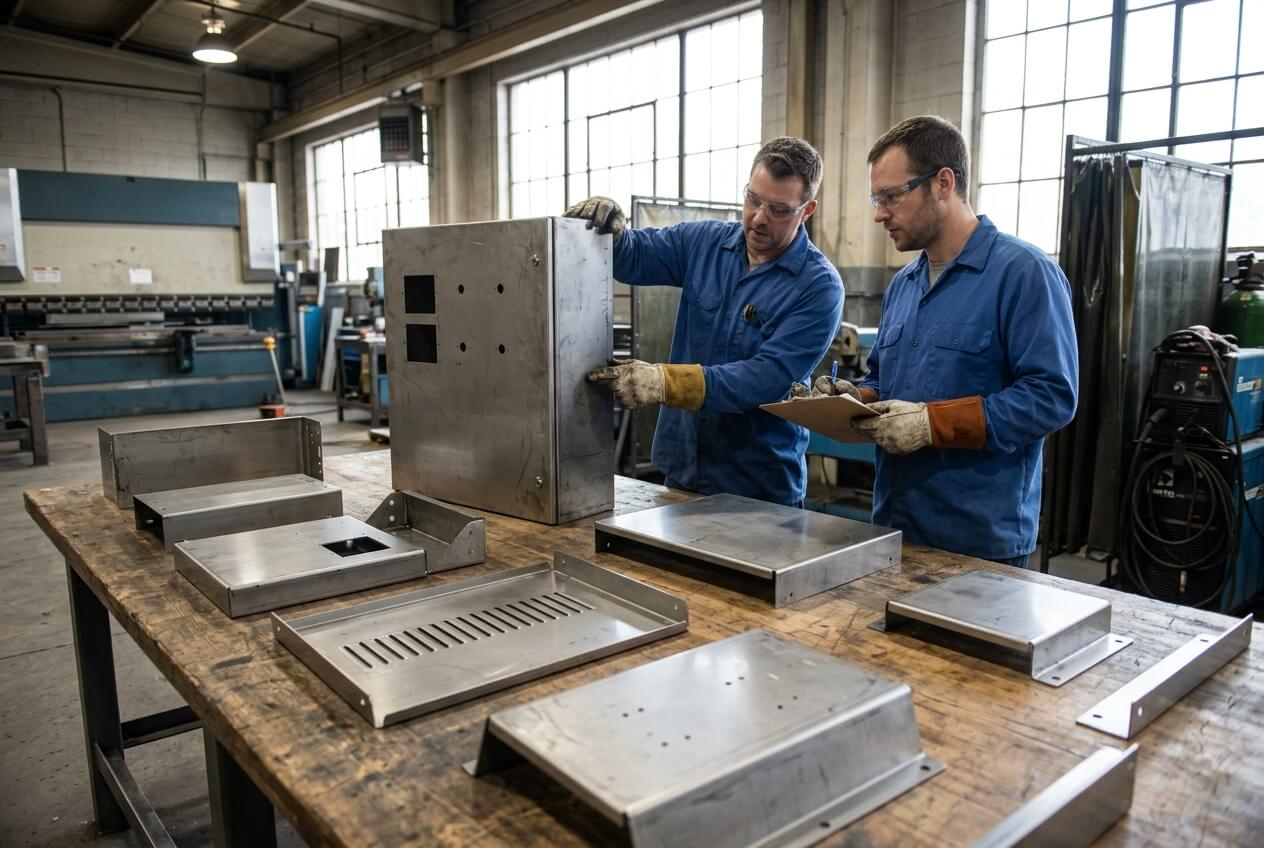
Buyers do not need a drawing package that tells the welder how to breathe. They need enough information to make each supplier quote the same manufacturing expectation. The goal is not longer documentation. The goal is fewer hidden assumptions around weld scope, part function, and finish impact.
Start by separating joints by purpose. Some welding joints carry load. Some seal a seam. Some locate a bracket. Others sit on a visible face and mainly affect appearance. If the drawing treats every weld the same, the supplier must guess where to spend time. That guess affects unit price, rework risk, and production stability.
Clarify the details that change real production cost
Weld length matters first. A continuous weld costs more than an intermittent weld, but it may also reduce gaps or improve sealing. An intermittent weld may work for a hidden support tab, yet fail on a visible enclosure corner. Buyers should mark continuous welds, stitch welds, tack locations, and no-weld zones near holes, slots, hinges, or mating faces.
Access comes next. Deep channels, narrow corners, closed boxes, and short returns can block the torch. If access looks tight, ask suppliers to confirm the weld path before quoting. A design that seems simple in CAD may require slow sequencing or special fixtures on the shop floor. That time belongs in the quote, not in a later surprise.
Finish expectations also belong in the RFQ because they change weld cleanup. Powder coating can hide minor color variation, but it will not hide poor seam dressing on a front face. Grinding every weld flush can improve appearance, but it adds labor and may thin sheet metal if overdone. Buyers should mark visible surfaces, acceptable bead appearance, and areas that must remain flat for assembly.
Tolerances need the same practical treatment. Tight numbers near welded areas should relate to function. If a latch gap, mounting hole pattern, or shelf level drives final assembly, call it out clearly. If a hidden dimension can float slightly without affecting performance, avoid forcing unnecessary weld correction. Suppliers can then price control where it matters instead of padding the whole job.
Material thickness and quantity complete the picture. Thin sheet needs careful heat control. Thicker parts may need more weld prep or different access planning. A batch of ten parts may tolerate more manual setup than a repeat order of five hundred. Include material requirements, expected quantities, prototype needs, and any known assembly checks when asking for pricing.
How to compare supplier responses without rewarding missing assumptions
Once quotes arrive, the buyer should look beyond the final unit price. A quote that does not mention weld length, cosmetic cleanup, fixture approach, or inspection scope may not offer savings. It may simply leave risk outside the number. The safest comparison asks whether each supplier priced the same welding joints in the same way.
A strong supplier response should confirm the joint approach, not merely repeat the drawing title. It should identify visible seams, access concerns, tolerance-sensitive areas, and any production limits. It should also raise questions before quoting if the drawing leaves critical weld details open. Clear questions at the RFQ stage usually cost less than corrections after powder coating or assembly.
Use exceptions and assumptions as quote comparison tools
Ask each supplier to list assumptions in the quote. This request protects both sides. If one supplier assumes stitch welds and another assumes continuous welds, the buyer can normalize the scope before choosing. If one quote excludes grinding and another includes it, the price difference becomes explainable. The buyer can then decide based on function, appearance, and risk instead of guessing.
Lead time also deserves attention here. Extra fixture development, weld sequence trials, first article checks, and cosmetic grinding all add time. They may also reduce batch risk. A shorter lead time can make sense for a simple hidden bracket. It may not make sense for a visible welded enclosure with tight door fit and powder-coated seams. The schedule should match the joint risk.
Supplier communication matters most when it exposes assumptions early. Buyers should welcome practical questions about weld access, tolerances, finish, and assembly fit. Those questions do not signal weakness. They show that the supplier plans to build the part, not just price the drawing.
If your quotes for welded enclosures, cabinets, frames, brackets, or welded assemblies vary widely, ask for a focused drawing review before awarding the order. Send Yishang your drawings, material requirements, quantities, tolerances, finish expectations, prototype photos, and assembly notes through https://zsyishang.com/. The review can identify where welding joints, access, cleanup, or fit-critical features are creating hidden quote assumptions.
Frequently Asked Questions
Why do welding joints cause different sheet metal fabrication quotes?
They create different assumptions about weld length, access, fixturing, cleanup, and inspection. If the drawing does not define the joint purpose and finish expectation, each supplier may price a different production method.
What welding-joint details should buyers add to an RFQ?
Buyers should mark joint type, weld length, visible faces, no-weld areas, fit-critical features, tolerance targets, material thickness, finish expectations, and quantity. These details help suppliers quote the same scope.
Can a lower quote mean the supplier missed welding scope?
Yes. A low quote may exclude continuous welds, grinding, fixture control, or post-weld checks. Ask suppliers to list their assumptions so you can compare equivalent welding joints and production expectations.
Why can a prototype pass while the welded batch fails?
A prototype can rely on hand fitting, extra correction, or one skilled welder. Batch production needs repeatable fixtures, weld sequence control, and consistent inspection. Sample approval should confirm the process, not only the appearance.
How do welding joints affect powder-coated enclosures?
Powder coating can highlight uneven seams, grinding marks, distortion, and poor corner alignment. Buyers should identify visible faces and cosmetic weld areas before quoting, especially on front panels and door frames.
When should buyers request manufacturability feedback on welded assemblies?
Request feedback before supplier selection when the part has tight assembly fit, visible seams, limited weld access, mixed thicknesses, or planned batch production. Early review helps prevent quote gaps and production rework.