
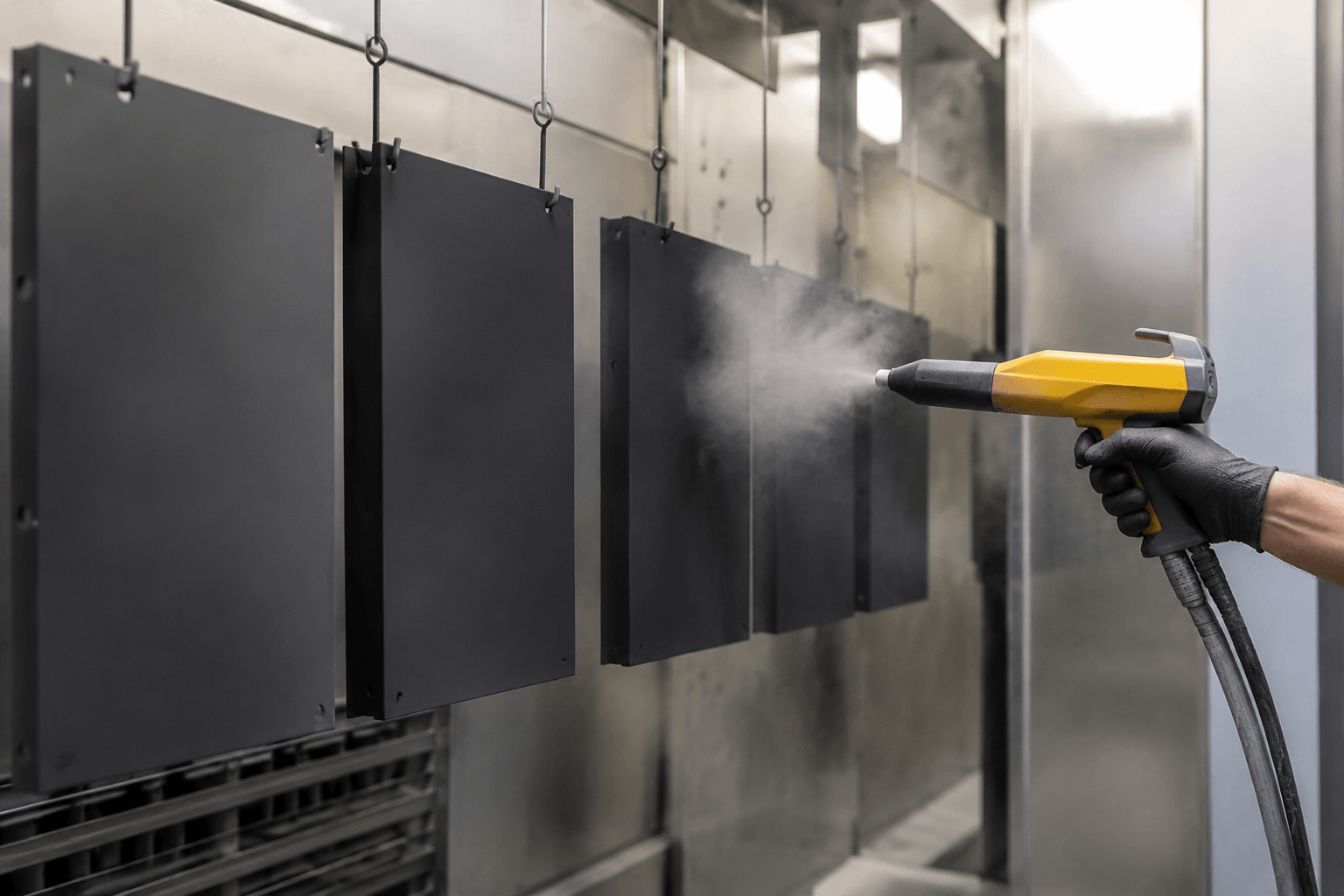
To powder coat it means to apply a dry powder coating to a prepared metal surface and heat the part until the powder melts, flows, and forms a continuous protective and decorative film. Unlike liquid paint, powder coating uses no liquid solvent carrier during application.
For a buyer reviewing a bracket, enclosure, cabinet, frame, or machine cover, powder coating follows cutting, forming, machining, welding, or other fabrication operations. It does not replace them. The substrate, surface preparation, powder system, application method, curing cycle, part design, and inspection requirements all influence the final finish.
How powder coating is applied
Spraying represents only one stage of the process. Preparation, drainage, fixture contact, oven loading, cooling, and inspection can all determine whether the finished component will suit assembly and service requirements.
- Surface preparation: The finishing operation removes oil, grease, mill scale, oxides, dust, weld residue, and other contaminants. Depending on the substrate, preparation may combine mechanical cleaning, alkaline or chemical cleaning, rinsing, and drying.
- Chemical pretreatment: The coater may apply a suitable conversion coating or other pretreatment to support adhesion and protect the substrate beneath the finish. Aluminum, galvanized steel, stainless steel, and carbon steel can require different treatment.
- Drying: The part must dry fully before powder application. Seams, folds, hollow sections, and weld areas can trap moisture or residue that contributes to blistering, pinholes, poor adhesion, or corrosion beneath the film.
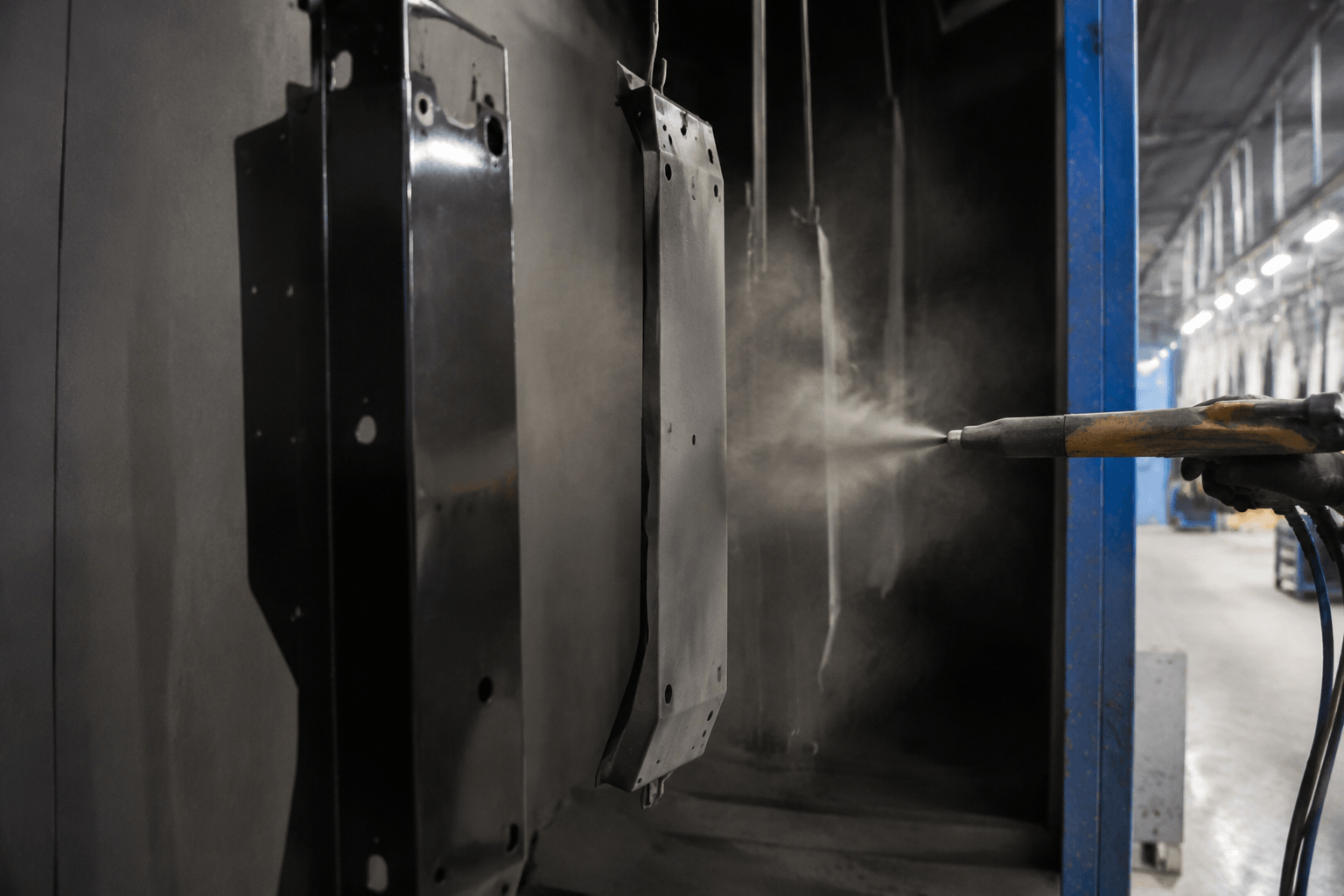
- Powder application: In the common electrostatic spray process, the equipment charges the powder particles while a fixture grounds the electrically conductive workpiece. The electrical field attracts the particles to the surface before curing.
- Heating and curing: The coated part enters an oven, where the powder melts and flows into a film. A thermosetting resin then cross-links during curing. Process control should focus on the temperature of the metal part and the time it remains at that temperature, not on oven air temperature alone.
- Cooling and inspection: The part cools before handling, assembly, packaging, or final inspection. The project specification may require checks for appearance, color, gloss, coverage, film thickness, adhesion, or other defined characteristics.
Fluidized-bed coating provides another powder application method. In this process, the operator generally preheats the workpiece and immerses it in a bed of powder, which melts onto the hot surface. This method can suit particular coating materials and heavy film requirements, while electrostatic spraying remains common for fabricated metal parts.
Selecting the powder system
A request to “powder coat it” does not identify the coating chemistry. If the finished part will face weather, chemicals, impact, repeated cleaning, or a defined temperature range, review the powder system before fabrication.
Thermosetting powder melts during heating and then undergoes a chemical cross-linking reaction. After proper curing, it does not normally remelt into its original form. Manufacturers use thermosetting powders for many general metal-finishing applications, with options for color, gloss, and texture.
Thermoplastic powder melts and flows when heated but does not cross-link in the same way. Depending on its formulation, it can provide different combinations of toughness, thickness, chemical resistance, and flexibility.
Selection depends on indoor or outdoor exposure, humidity, ultraviolet exposure, contact with oils or cleaning agents, impact risk, appearance, substrate, and the temperature limits of the complete part. A finish intended for an indoor equipment frame may not suit an exterior enclosure or a component exposed to aggressive chemicals.
Substrate and part design considerations
Many electrically conductive metals can accept powder coating, but each substrate presents different cleaning, pretreatment, heating, and inspection needs. Achieving the same color and finish on different metals may require different process conditions.
- Cold-rolled or mild steel: Address rust, oil, cutting residue, weld spatter, and sharp edges before coating. Where corrosion protection matters, review pretreatment and edge coverage carefully.
- Stainless steel: Natural corrosion resistance does not eliminate the need for cleaning and adhesion preparation. Heat tint, fingerprints, grinding contamination, and weld areas may require specific treatment.
- Aluminum: Aluminum develops a natural oxide layer. Cleaning and pretreatment should suit the alloy and adhesion requirement. Its thermal behavior also affects how quickly the part reaches curing temperature.
- Galvanized or zinc-coated steel: Preparation must suit the zinc surface. Entrapped gases, contamination, or unsuitable heating conditions can contribute to pinholes or bubbling.
Thickness, alloy, mass, and geometry influence the heating cycle. A thin bracket and a heavy welded frame may enter the same oven but reach the required metal temperature at different rates. The coating schedule should account for the actual part rather than relying only on a standard oven setting.
Geometry also affects preparation, powder application, and inspection. Sharp edges may receive less coating coverage than broad faces, so edge breaking or radiusing can help when it remains compatible with fit and function. Welded joints should be reasonably clean and free from excessive spatter, oil, and residue. Lap joints, gaps, porous welds, folded channels, enclosed tubes, and box sections can retain cleaning chemicals or moisture.
Openings may support cleaning, rinsing, drying, and air release, but their size and location must still meet structural, sealing, safety, and appearance requirements. Threads, bearing seats, press-fit areas, sliding interfaces, grounding points, and precision mounting faces often require masking because coating build can alter fit or block electrical contact.
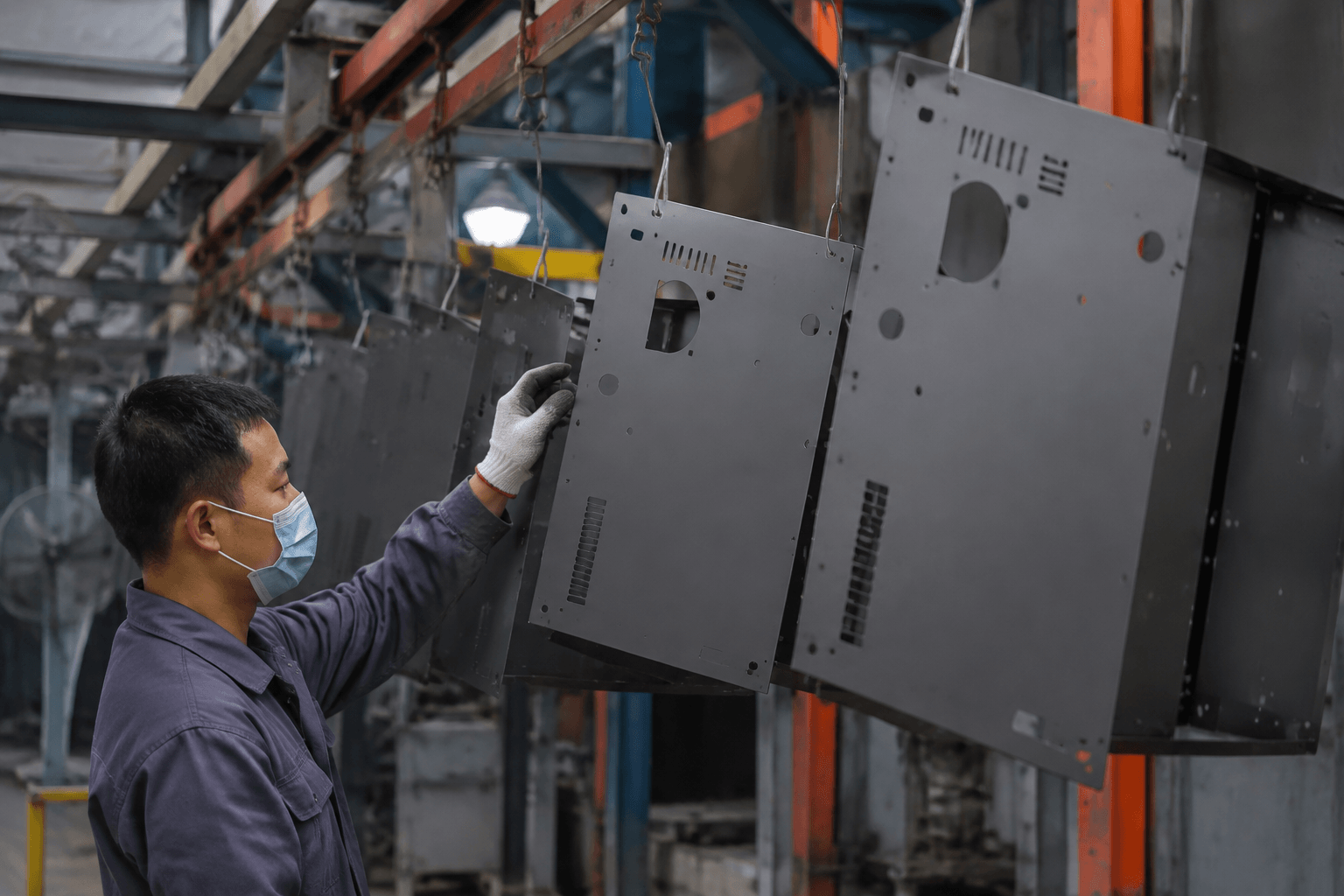
Racks and fixtures usually suspend parts during application and curing. Their contact points can leave a small uncoated mark or hanging trace, so place them away from visible or functional areas when geometry allows. Large cabinets and welded assemblies also require review of oven capacity, internal coverage, handling, and possible heat-related distortion. Access, masking, heat-sensitive components, and appearance requirements may determine whether to coat individual components before assembly or coat the completed assembly.
Consider a welded steel frame with machined mounting pads and threaded holes. A practical coating plan would identify the pads and threads for masking, choose rack points on noncritical surfaces, check whether enclosed sections can drain and vent, and confirm that the frame can tolerate the curing cycle without compromising assembly interfaces.
For an outdoor aluminum enclosure, the review would focus on a powder system compatible with exterior exposure, preparation appropriate for the alloy, drainage around folded seams, coverage at edges, and masking for grounding or gasket-contact areas. These project conditions matter more than a color-only instruction such as “black powder coat.”
Powder coating or liquid painting?
Both methods can suit metal parts, but they impose different requirements on the component and production process. A useful comparison includes curing temperature, repair needs, masking, handling, appearance, and order quantity.
| Consideration | Powder coating | Liquid painting |
|---|---|---|
| Application form | Dry powder applied electrostatically or through another powder process | Liquid coating applied by spray, brush, dip, or a related method |
| Typical strength | Efficient for repeatable batches of conductive metal parts that require a durable decorative film | Flexible for color matching, repairs, touch-up, and some heat-sensitive applications |
| Heat requirement | Requires an appropriate curing cycle that the substrate and assembled components can tolerate | May use ambient or lower-temperature curing, depending on the coating system |
| Design considerations | Requires planning for masking, grounding, oven size, internal coverage, and hanging points | Requires control of overspray, solvent handling, dry-film build, flash-off, and ventilation |
| Decision basis | Material, quantity, environment, appearance, geometry, and curing compatibility | Material, color system, repair needs, temperature limits, environment, and production method |
Powder coating does not automatically offer the lowest cost for every order. A repeat batch of similar metal parts may use the process efficiently, while a one-off part with frequent color changes, extensive masking, or difficult handling may carry a different cost structure. Preparation, fixtures, setup, coating, curing, inspection, packaging, and rework all contribute to total cost.
Specify the finish for production
“Black powder coat” usually provides too little information for a controlled manufacturing order. Before requesting a prototype or production quotation, define the finish on the drawing, purchase specification, or approved sample.
- Substrate: State the metal, alloy where relevant, thickness, and whether the part includes welding, galvanizing, machining, or preassembled components.
- Color, gloss, and texture: Identify an approved color reference or physical sample. State the gloss level and whether the surface should appear smooth or textured.
- Film thickness: Define a target or permitted range that reflects the coating system, substrate, drawing, and functional requirements. Account for build on tolerance-critical features.
- Coverage and masking: Clarify requirements for internal faces, hidden faces, edges, holes, and weld areas. Mark surfaces that must remain uncoated and identify acceptable fixture locations.
- Cosmetic limits: Define acceptance criteria for runs, craters, pinholes, orange peel, inclusions, scratches, bare areas, color mismatch, and handling marks. Include inspection distance and lighting when visual consistency matters.
- Testing: When the project requires adhesion, hardness, corrosion, or chemical-resistance testing, state the test method and acceptance criteria before production.
For an application review, send the drawing, material, quantity, tolerance-critical surfaces, and finish requirement together. Include prototype status, masking requirements, cosmetic expectations, and inspection needs. Yishang can use this information to clarify manufacturability and quotation assumptions before fabrication begins.
When outsourcing is practical
Small parts can sometimes be powder coated in-house, but the operation requires suitable surface preparation, grounding, application equipment, masking supplies, an appropriate curing oven, ventilation, handling procedures, and inspection methods.
Outsourcing may make sense for production quantities, large enclosures, welded assemblies, controlled colors, internal coverage, repeated batches, or documented inspection. Compare preparation labor, fixtures, powder use, oven capacity, rework, packaging, and rejected-part costs. The central question is whether the selected process can prepare, coat, cure, inspect, and deliver the component with the required appearance and function at a repeatable total cost.
Frequently Asked Questions
What coating thickness details should buyers define before requesting a quote?
Buyers should define the functional requirement, drawing notes, critical dimensions, material or process expectations, and any inspection points related to coating thickness. This helps suppliers quote the same manufacturing scope instead of making different assumptions.
How can masking areas affect cost, fit, or lead time?
masking areas can change tooling, forming, welding, finishing, inspection, or rework requirements. If buyers do not clarify it early, two supplier quotes may look comparable while covering different production risks.
Why should powder coating be reviewed before prototype approval?
powder coating may look acceptable on a single sample but become harder to control during batch production. Buyers should confirm whether the prototype reflects the same process, finish, and inspection conditions expected for production.
What inspection points matter most for powder coat it projects?
Important inspection points usually include fit-critical dimensions, holes or mating areas, cosmetic surfaces, finish build-up, welded or formed features, and any dimensions that affect downstream assembly. These points should appear in the RFQ or drawing notes.
How can buyers reduce assembly clearance risk before batch production?
Buyers can reduce risk by clarifying drawings, locking key material and finish assumptions, defining inspection timing, approving a representative sample, and confirming which dimensions or surfaces require tighter process control.
How can Yishang help review powder coat it requirements?
Yishang can review drawings, RFQ notes, material requirements, tolerance expectations, finish details, samples, and assembly needs to identify unclear assumptions before quoting or batch production.