
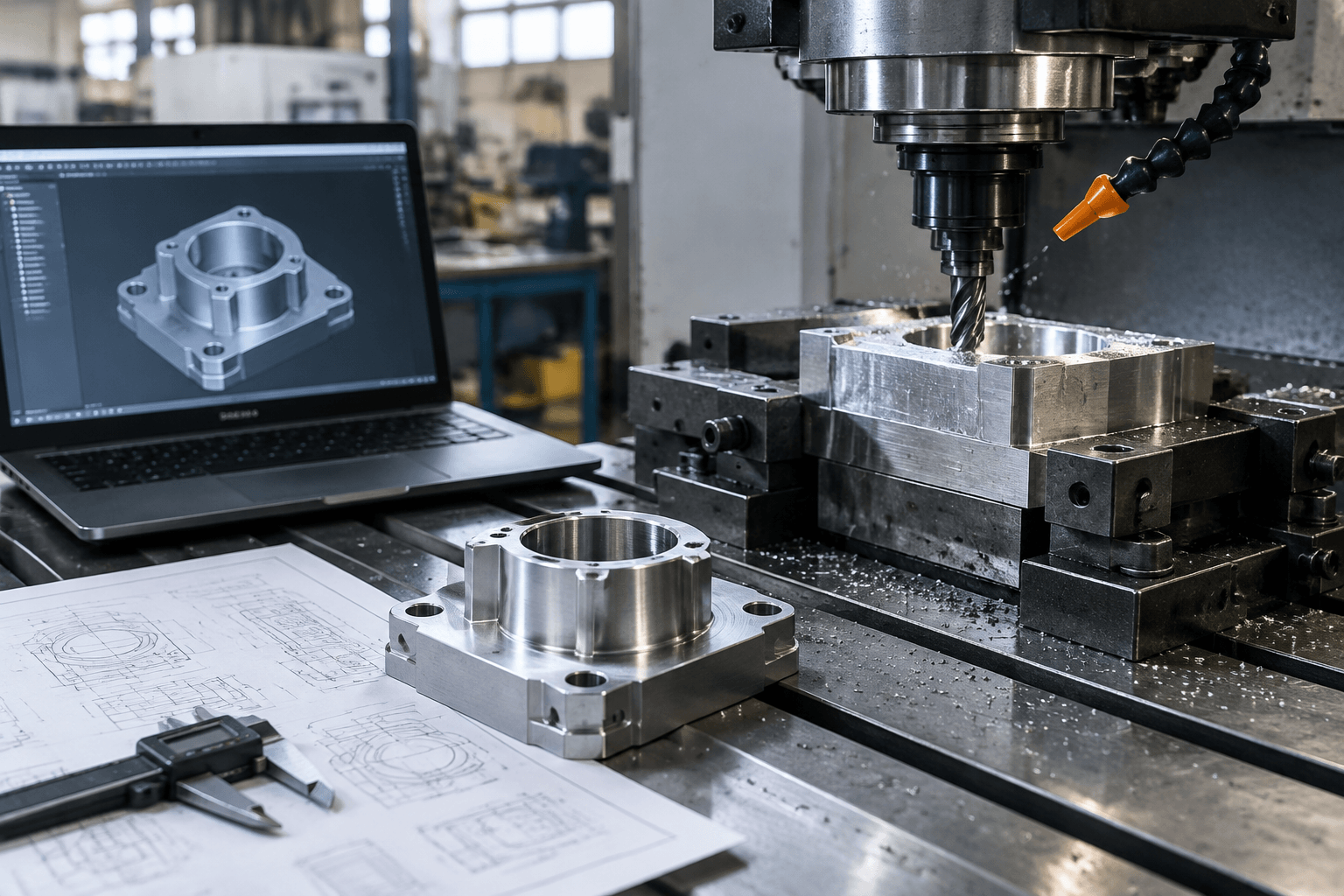
CNC precision machining services are subtractive manufacturing services that remove material from a solid workpiece according to CAD data and 2D drawing requirements, with defined inspection requirements used to verify the finished part. They are intended for custom parts whose geometry, material, tolerances, and functional interfaces require a controlled milling, turning, or related CNC route rather than a generic fabrication process.
Quick answer: CNC precision machining can produce prismatic, rotational, and contoured components, but the correct process depends on feature geometry, material, workholding, tool access, quantity, and drawing requirements. A useful supplier review therefore needs more than a 3D model: it also needs tolerances, datums, material grade, finish, inspection expectations, and delivery information.
The supplier does not quote from the keyword alone. The drawing and its revision control the feasibility review, while the manufacturing route determines setup complexity, machining time, quality risks, and the documentation needed for release.
What CNC precision machining services deliver
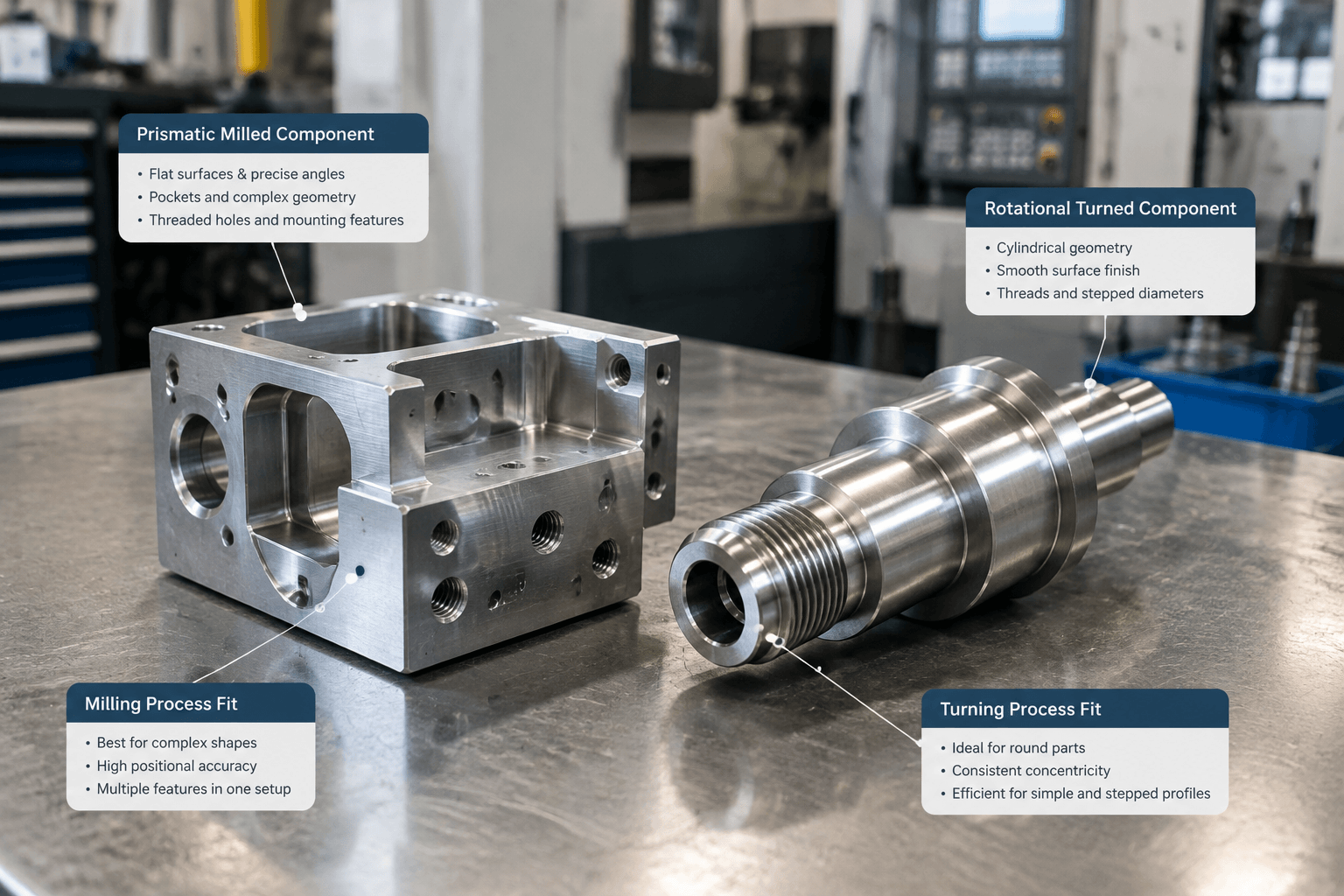
CNC machining uses programmed toolpaths to cut stock material into a defined shape. The workpiece may be metal, plastic, or another approved material, and the finished part can include flat faces, holes, pockets, slots, bores, threads, shoulders, and three-dimensional contours. Precision is not one universal service number; it is a feature- and drawing-specific result confirmed through suitable inspection.
| Part type | Typical features | Initial process question |
|---|---|---|
| Prismatic component | Flats, pockets, holes, slots, angled faces, and contours | Can milling reach the required faces and hold the feature relationships? |
| Rotational component | Diameters, bores, shoulders, grooves, and external or internal threads | Is turning the primary route, with secondary operations if needed? |
| Contoured or combined part | Blended surfaces, multiple orientations, or turned and milled features | How many setups and datum transfers are required? |
Machining is different from sheet metal cutting and forming. A thin-gauge enclosure may be better suited to a sheet metal route, while a solid block with integral pockets may justify milling. For early form validation, 3D printing can be useful, but it does not automatically represent the production material, surface condition, strength, or dimensional behavior of a machined part. A custom CNC machining service overview can provide general context, but the actual drawing still controls the review.
Choose milling, turning, or routing by geometry
| Process | Best-fit geometry | Material and route considerations |
|---|---|---|
| CNC milling | Blocks, brackets, housings, plates, pockets, holes, slots, and contoured faces | Requires stable workholding and access to the required faces. Multiple setups may be needed for a multi-sided part. |
| CNC turning | Shafts, pins, bushings, spacers, adapters, bores, grooves, and shoulders | Primarily suited to rotational symmetry. A turned part may need later milling, drilling, or other secondary work. |
| CNC routing | Planar profiles, through-cut apertures, and large sheet or plate features | Often considered for suitable plastics, composites, plate, or other application-specific materials. Accuracy, rigidity, thickness, and finish must be reviewed. |
A part with a turned outside diameter and a milled keyway may require more than one process. A large plastic panel may be a routing candidate, whereas a rigid metal housing with deep pockets may require milling. The best route depends on symmetry, feature access, workholding, material behavior, quantity, and the supplier’s actual process scope. Never assume that a supplier offering CNC milling also offers turning or routing.
Turn a CAD model into a manufacturable drawing
A CAD model defines form, but the 2D drawing explains what is functionally important. It should identify critical dimensions, allowable variation, surface requirements, threads, datums, and inspection intent without applying unnecessarily tight controls to every surface.
- Tolerances and GD&T: Separate mating, sealing, locating, and motion-critical features from general dimensions. GD&T can describe feature relationships more clearly than a collection of unrelated plus-or-minus dimensions, but the callouts must match the functional design intent.
- Datums and setups: Select datums that represent how the part locates in the assembly and how it can be inspected. Poor datum choices can create ambiguity, extra setups, or disagreement over which surface controls a measurement.
- Walls and deep features: Thin walls may deflect or vibrate during cutting. Deep pockets and holes can require long-reach tools, additional operations, chip evacuation planning, and more careful inspection.
- Radii, holes, and threads: Internal corners naturally reflect tool geometry. A practical internal radius is usually easier to produce than a sharp corner. Specify thread size, depth, relief, and access, especially for blind or deep threads.
- Workholding and orientation: A feature hidden from the cutting tool may require another setup. Each setup introduces alignment, clamping, and datum-transfer considerations.
During design review, ask which characteristics truly control assembly or performance, whether the inspection method can access them, and whether the chosen tolerance is justified. Precision should be concentrated where it creates value rather than spread across every face.
Align material, finish, and application requirements
Material selection affects cutting behavior as well as finished-part performance. Strength, weight, corrosion resistance, wear, thermal behavior, machinability, and operating environment should be considered together. A material description such as aluminum, stainless steel, or engineering plastic may be incomplete without the exact grade, temper, condition, or specification.
| Decision | What to define | Why it affects the job |
|---|---|---|
| Grade and temper | Exact material designation, temper or condition, and any hardness or application requirement | Changes machinability, mechanical behavior, material availability, and substitution risk. |
| Application environment | Load, temperature, moisture, chemicals, wear, electrical, or cosmetic requirements | Prevents a material that machines easily from being selected when it cannot perform in service. |
| Finish and edge condition | As-machined appearance, deburring, masking, cosmetic zones, coating, plating, anodizing, or another treatment | Secondary operations may affect appearance, edge definition, surface condition, or final dimensions. |
Machining and finishing are separate activities. Deburring removes unwanted edges but should not erase a functional chamfer or alter a critical feature. A coating or treatment may add thickness or require masking, so the drawing should state whether dimensions apply before or after finishing. If the specified material is unavailable, a substitution should be documented and approved before production rather than made informally.
Understand the cost and schedule behind a CNC quote
Two suppliers can quote the same nominal part differently because the price reflects an engineered production route, not just cutting time. A drawing-based quotation normally considers the following hierarchy:
- Programming and setup: CAM preparation, workholding, fixture design, and the number of orientations or setups.
- Cycle time and tooling: Material removal, tool changes, difficult materials, deep features, special tools, and tool-life assumptions.
- Material and yield: Stock size, grade availability, purchasing conditions, and the amount of material lost during preparation.
- Quantity and repetition: A one-off part, prototype batch, repeat low-volume order, and larger production program can justify different setup and process decisions.
- Quality and secondary work: Tight critical features, special finishing, inspection reports, traceability, packaging, and conformity documentation add planning or processing requirements.
Schedule is also affected by material availability, engineering questions, approval cycles, outside finishing, inspection workload, packaging, and shipping. An expedite request may change the available route or commercial terms. Because machine rates vary by region, equipment, overhead, process, and job conditions, a generic hourly price cannot replace a drawing-based quotation. Ask each supplier to state assumptions, exclusions, revision, quote validity, and whether shipping or secondary operations are included.
Build a complete CNC machining RFQ package
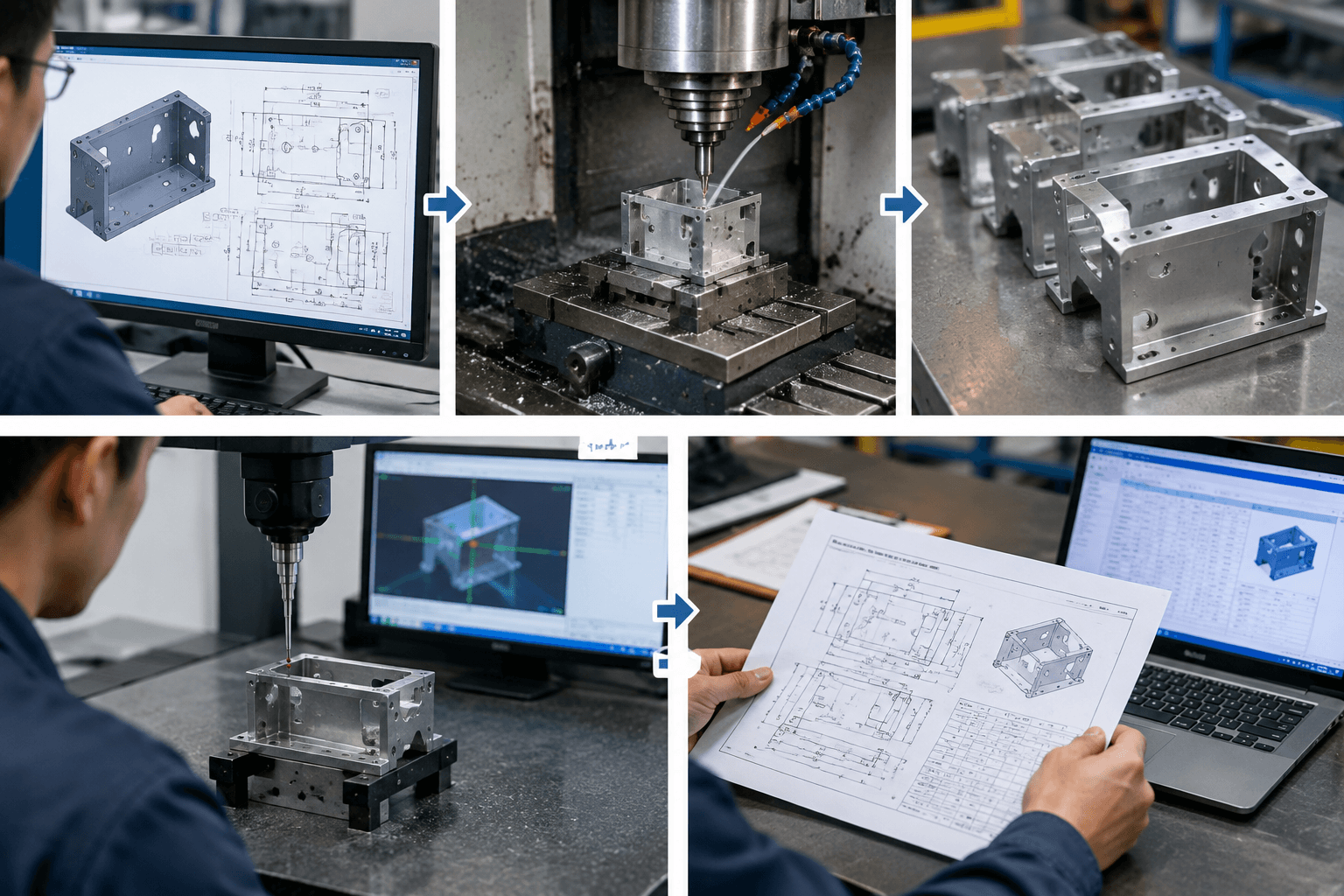
A useful RFQ lets the supplier evaluate process fit before assigning a price. Send the 3D CAD model together with the matching 2D drawing, revision level, quantity or forecast, material, finish, and target delivery window. The files should identify the part number and any controlled configuration.
- Mark critical dimensions, GD&T callouts, datum references, threads, sealing surfaces, and appearance zones.
- State the exact material grade and temper, and identify whether alternatives may be considered.
- Define the expected finish, deburring standard, masking, cosmetic inspection, and packaging method.
- Specify inspection level and acceptance criteria, including any required measurement report, material certification, traceability record, or Certificate of Conformance.
- Agree how revisions, deviations, substitutions, approval samples, and nonconforming parts will be handled before production starts.
CNC machining RFQ matrix: provide the detail that changes the quote
| Input to provide | Decision it affects |
|---|---|
| 3D CAD model and 2D drawing | Geometry interpretation, programming, feature definition, and drawing-model conflict resolution. |
| Revision and part identification | Configuration control and prevention of obsolete production. |
| Quantity, batch size, or forecast | Setup economics, repeatability planning, material purchasing, and possible process changes. |
| Material grade and temper | Machinability, stock availability, performance, and substitution approval. |
| Finish and edge requirements | Deburring, masking, secondary treatment, cosmetic review, and dimensional allowances. |
| Critical tolerances, GD&T, and datums | Manufacturing route, workholding, measurement access, and inspection effort. |
| Delivery target and packaging | Planning sequence, outside processing, shipping assumptions, and commercial scope. |
| Inspection and documentation | Sampling, reports, material certification, traceability, and conformity records to be supplied. |
Need a feasibility-focused review? B2B OEM and ODM buyers can send a 2D drawing, 3D CAD model, quantity or production forecast, specified material grade and temper, finish, critical tolerances, GD&T and datum requirements, plus inspection reports, material certification, traceability, conformity documentation, packaging, and delivery expectations. A request through Yishang’s CNC machining overview is most useful when these technical assumptions are included, allowing the quotation to address the actual part rather than promise universal capability.
Frequently Asked Questions
What is the difference between CNC machining and CNC precision machining?
CNC machining describes computer-controlled material removal. The word precision emphasizes the need to control specified features, relationships, and inspection requirements; it does not create one universal tolerance level. The drawing, material, geometry, process route, and measurement method determine the practical result.
When should a part be milled instead of turned?
Milling is usually the starting point for non-rotational parts with flats, pockets, holes, slots, and multi-face features. Turning is better suited to parts organized around a rotational axis, such as shafts, pins, bushings, and bores. Combined geometry may require both processes.
What determines CNC machining cost, and why is there no universal hourly price?
Cost depends on programming, setup count, cycle time, tooling, material, quantity, finishing, inspection, packaging, and delivery conditions. Hourly rates also vary by location, equipment, overhead, and commercial assumptions, so a drawing-based quote is more meaningful than a generic rate.
Can a supplier review very tight tolerances or GD&T requirements?
A supplier can determine whether a requirement is suitable for its process only through a drawing-specific engineering review. The review should examine datum strategy, workholding, tool access, material behavior, measurement capability, and acceptance criteria. Do not assume a standard service tolerance covers a special callout.