
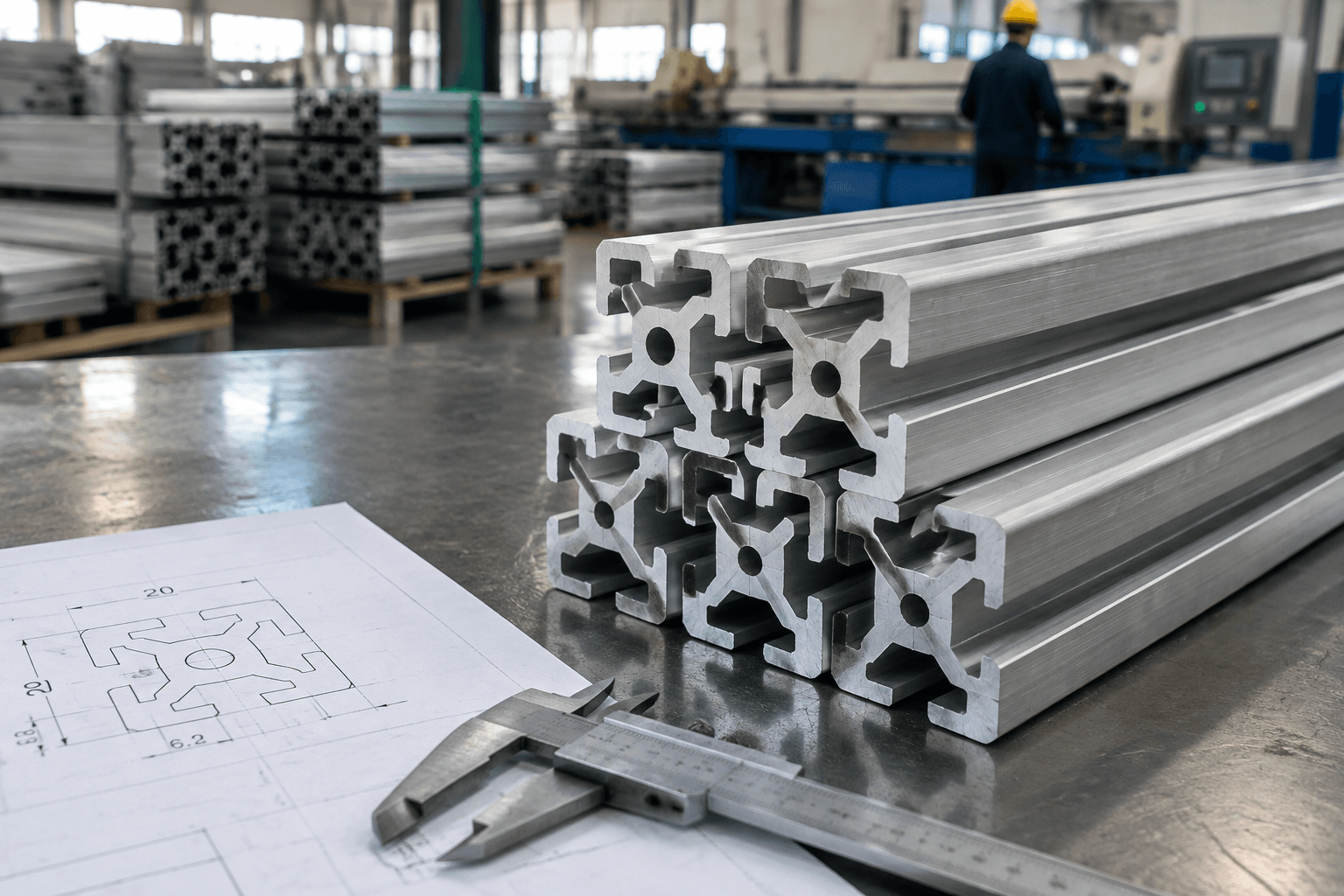
2020 aluminum extrusion is a compact structural profile with a nominal cross-section of 20 × 20 mm. It is commonly used with T-slot fasteners, brackets, panels, and other modular components, but the 2020 designation does not by itself define the alloy, wall thickness, slot geometry, mass, or dimensional tolerance.
For that reason, selecting a 2020 profile involves more than checking its outside dimensions. The profile must also match the required connector system, load and span conditions, machining plan, surface finish, and purchasing specification. The following guide explains how 2020 aluminum extrusion is made and what should be verified before it becomes part of an OEM assembly.
What is 2020 aluminum extrusion?
Aluminum extrusion is a forming process in which an aluminum billet is forced through a shaped die. The opening in the die determines the profile cross-section. After leaving the die, the extruded section is cooled, straightened as required, cut to length, and prepared for shipment or further processing.
In a 2020 profile, the name generally refers to a nominal 20 × 20 mm outside section. The profile may contain one or more longitudinal T-slots so that nuts, bolts, brackets, and joining plates can be installed without drilling through the entire section. A 6 mm-wide slot is often associated with compact 2020 profiles, but the actual slot opening and internal geometry must be confirmed from the supplier drawing.
Commercial listings commonly describe 2020 profiles using alloys and tempers such as 6063-T5. That designation should be treated as a specification to verify, not an automatic property of every 2020 extrusion. Likewise, approximately 0.65 kg per meter is sometimes published for an open 2020 profile, but the actual mass changes with wall thickness, slot design, alloy, and profile geometry.
A requested length such as 2000 mm describes a cut or stock-length requirement; it does not define the profile itself. The buyer should therefore separate three items in the purchase description: the cross-sectional profile, the material condition, and the supplied length.
How the extrusion process affects the finished profile
The die is the central tool in the extrusion process. A different die can create a different arrangement of slots, ribs, cavities, and outer walls even when two profiles have the same nominal external size. This is why two products described as 2020 aluminum extrusion may not accept the same nuts or connectors.
Several production stages influence the final part:
- Billet and material selection: The alloy and temper affect the material specification that appears on the technical documentation.
- Die design: The die controls the outside section, slot opening, internal cavities, and wall distribution.
- Cooling and straightening: These operations influence the condition of the long section before it is cut.
- Cutting: Stock lengths may be supplied as bars or cut to drawing dimensions. Cut-end requirements should be stated separately from the extrusion profile.
- Surface treatment: A finish such as mill finish, anodized, or another specified coating changes the appearance and may affect interface dimensions.
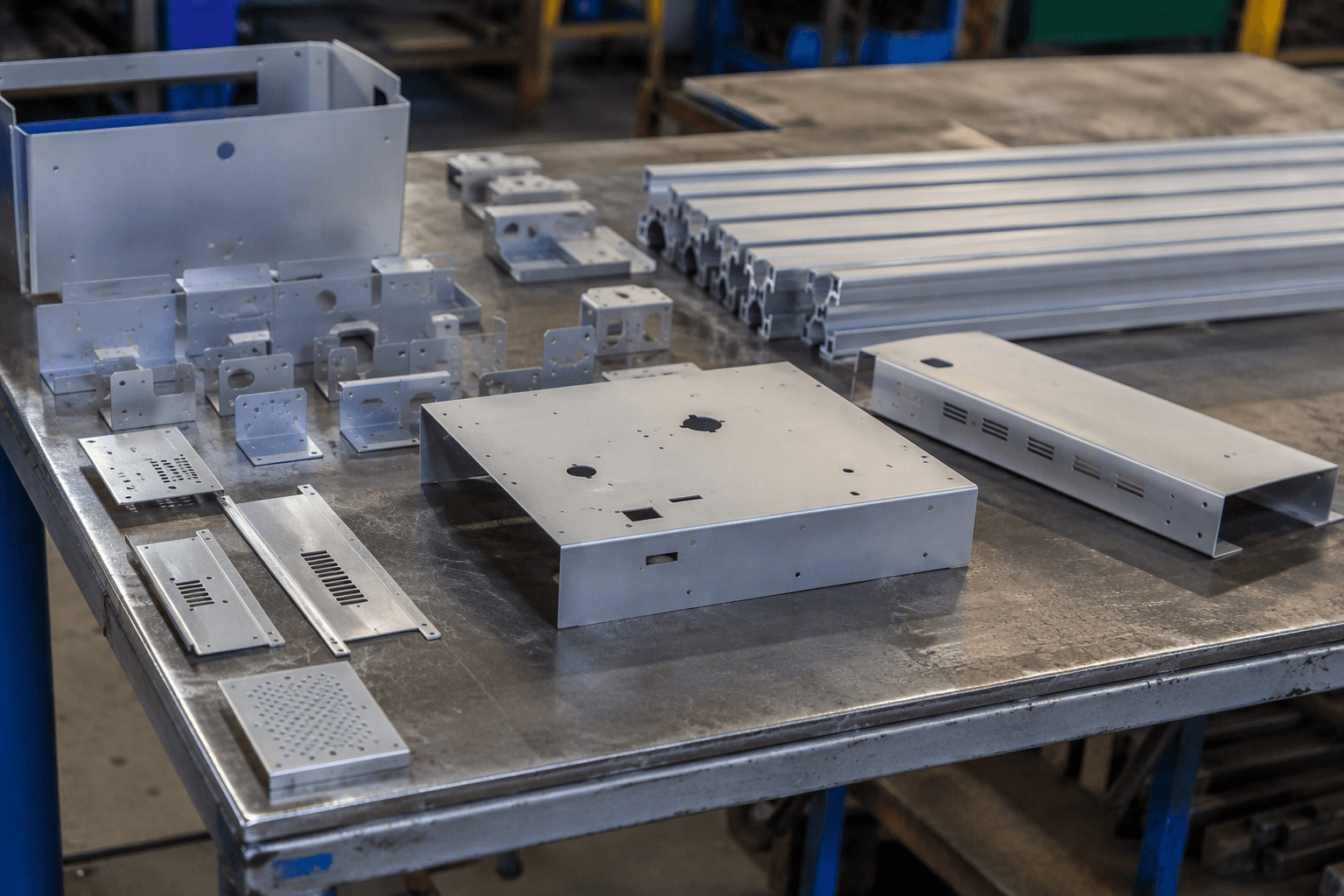
Extrusion does not automatically produce a completed assembly. Saw cutting, drilling, tapping, countersinking, milling, and pocketing are secondary operations. If the profile must connect to a sheet metal bracket or machined plate, those interfaces should be reviewed as a combined design. Hole position, fastener access, slot orientation, and cut-end squareness can matter more than the nominal 20 × 20 mm size.
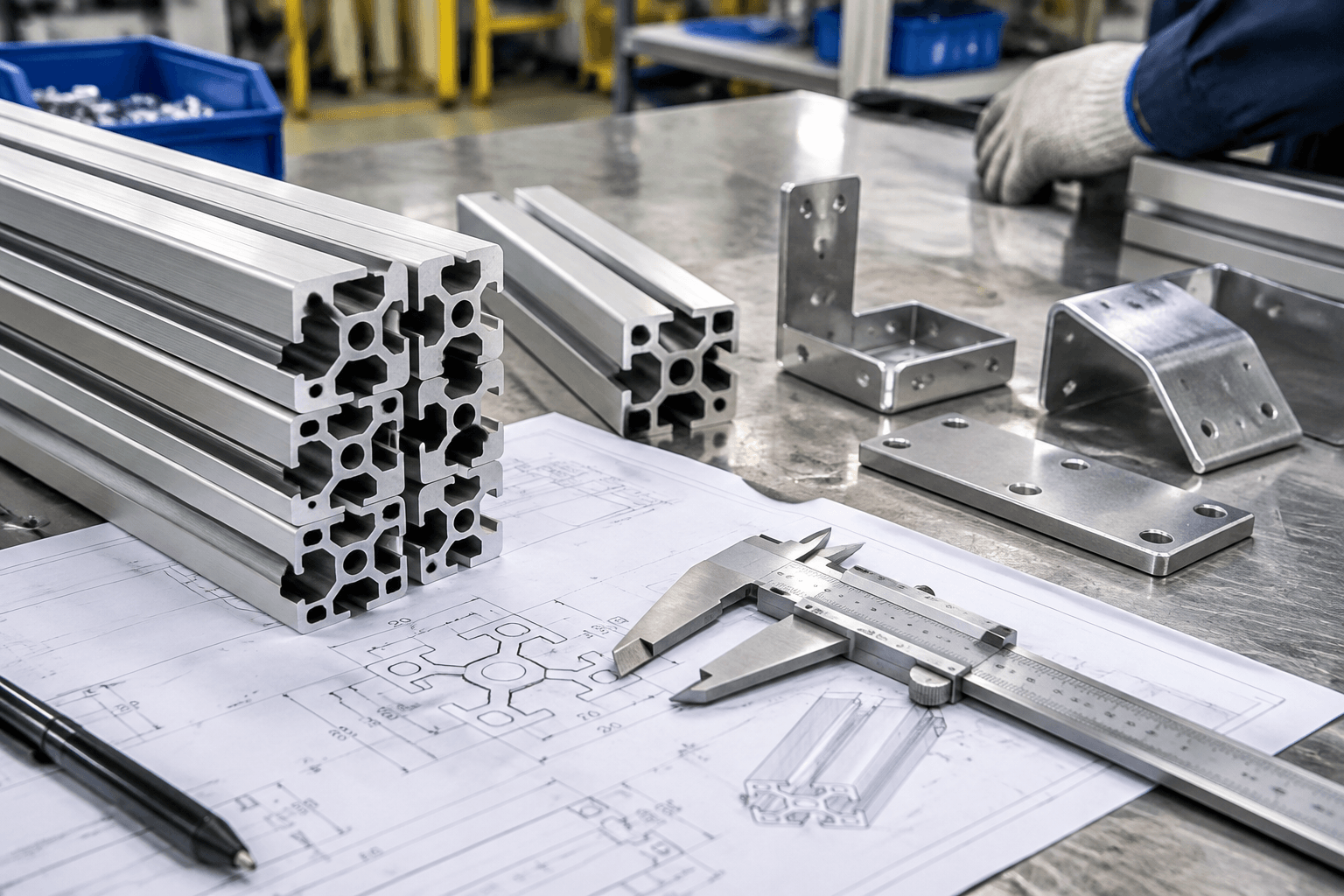
Key 2020 aluminum extrusion dimensions to verify
A useful drawing or product data sheet should identify more than the profile name. The following checks help prevent an apparently compatible extrusion from becoming a difficult assembly item.
| Specification | What to confirm | Why it matters |
|---|---|---|
| Outside section | Nominal 20 × 20 mm size and the supplier’s dimensional drawing | Confirms whether the profile fits the intended frame, cover, or bracket envelope |
| T-slot geometry | Slot opening, internal neck, depth, and compatible nut size | Determines whether existing fasteners and accessories can be reused |
| Alloy and temper | The required material designation, rather than only the word aluminum | Prevents substitution between profiles with different material specifications |
| Mass per meter | Published mass for the exact section | Supports handling, shipping, and preliminary weight calculations |
| Length and cutting | Stock length, finished cut length, quantity, and end treatment | Separates extrusion supply from secondary cutting requirements |
| Surface finish | Mill finish, anodizing, coating, or another stated requirement | Aligns appearance and interface expectations across the assembly |
Accessory compatibility deserves particular attention. A connector advertised for 2020 aluminum extrusion may fit only one slot opening or one internal thread system. Corner brackets, joining plates, sliding nuts, hinges, and linear sliders should be checked against the actual profile drawing. The terms T-slot and V-slot are not interchangeable: a V-slot profile is shaped for a different wheel or guide interface, while a T-slot is normally selected for captive nuts and modular fastening.
If a 3D model is used for layout, request the current model for the exact profile and finish. A generic 2020 model may show the outside envelope but omit slot details, corner radii, wall thickness, or coating allowance.
2020 compared with 2040, 3030, and 8020 profiles
Profile selection is often described as a choice between 2020 and a larger alternative. The correct comparison should be based on the actual cross-section and accessory system, not only on product names.
| Profile reference | Typical selection question | Important caution |
|---|---|---|
| 2020 | Is a compact 20 × 20 mm section adequate for the envelope, attachment method, and expected loading? | Compact size does not guarantee suitability for every span or cantilever |
| 2040 | Would a nominally deeper rectangular section provide a better fit for the frame geometry? | Confirm the actual slot pattern and connector family; the name alone is incomplete |
| 3030 | Is a larger square section more appropriate for the available space and joining arrangement? | Check the increased envelope, mass, fastener system, and cost against the design need |
| 8020 | Which exact manufacturer profile or product family is meant by 8020? | 8020 can refer to a branded system or a broad family; it is not a single universal specification |
Some catalogs use 8020-related examples such as 25 × 25 mm, 40 × 40 mm, or larger profiles. Those examples should not be treated as an equivalent specification for every product sold under the 8020 name. Before comparing price, stiffness, weight, or accessories, obtain the exact section drawing, material information, mass per meter, and applicable dimensional data for both profiles.
There is also no universal load rating for 2020 versus 2040 or 3030. Deflection and joint performance depend on span, orientation, unsupported length, load position, connection method, and the required design limit. A larger section may change the available structural options, but the selection still requires an engineering check rather than a size-based assumption.
When a 2020 profile is a practical choice
A compact 2020 extrusion can be considered for hypothetical applications such as a small equipment guard, sensor support, lightweight fixture, access frame, instrument enclosure, or prototype structure. It is especially useful when the design benefits from modular adjustment and repeated attachment points instead of welded joints.
It may be less appropriate when the design has a long unsupported span, a significant cantilever, frequent impact, strict deflection limits, or a large panel that transfers substantial load into the frame. In those situations, compare the required section with larger or differently shaped profiles and evaluate the joints as well as the extrusion.
For production, the best design review normally combines the extrusion drawing with the mating components. A sheet metal bracket may require a specific slot direction. A machined plate may need counterbored holes or access for a sliding nut. A cover may need clearance for the extrusion corner radius and surface finish. These details affect assembly time and repeatability even when the basic profile size is correct.
Application review: If a 2020 aluminum extrusion will interface with custom brackets, covers, panels, or machined parts, share the drawing or 3D model, material requirement, quantity, tolerance, and finish. This information helps clarify manufacturability and the responsibilities between the extrusion supplier and the company producing the adjoining metal parts. For B2B OEM and ODM projects involving adjoining metal parts, Yishang can review the drawing and interface requirements; confirm the exact extrusion specification with the selected profile supplier.
Frequently Asked Questions
What is 2020 extruded aluminum?
It is a commonly used aluminum extrusion profile with a nominal 20 × 20 mm cross-section. Many versions include T-slots for modular fastening, but the alloy, temper, slot geometry, wall thickness, mass, and finish must be verified for the exact product.
What is the difference between 2020 and 8020 aluminum extrusion?
2020 normally identifies a compact nominal section, while 8020 may identify a particular branded system or a broader family of profiles. Because 8020 is not one universal size or specification, compare exact drawings, slot dimensions, material, mass, accessories, and required performance rather than comparing the names alone.
What are the key differences between 2020 and 2040 aluminum extrusion?
The main difference is the nominal rectangular envelope: 2020 is commonly a 20 × 20 mm section, while 2040 generally refers to a 20 × 40 mm format. The actual profile drawing remains essential because slot layout, wall design, connector compatibility, and available finishes can vary by supplier.
How does 2020 compare with 3030 aluminum extrusion?
3030 generally denotes a nominal 30 × 30 mm square section, making it a larger profile option than 2020. It may require different connectors and occupy more space, so the choice should consider the frame envelope, joint design, expected load, deflection requirement, and overall material and assembly cost.