
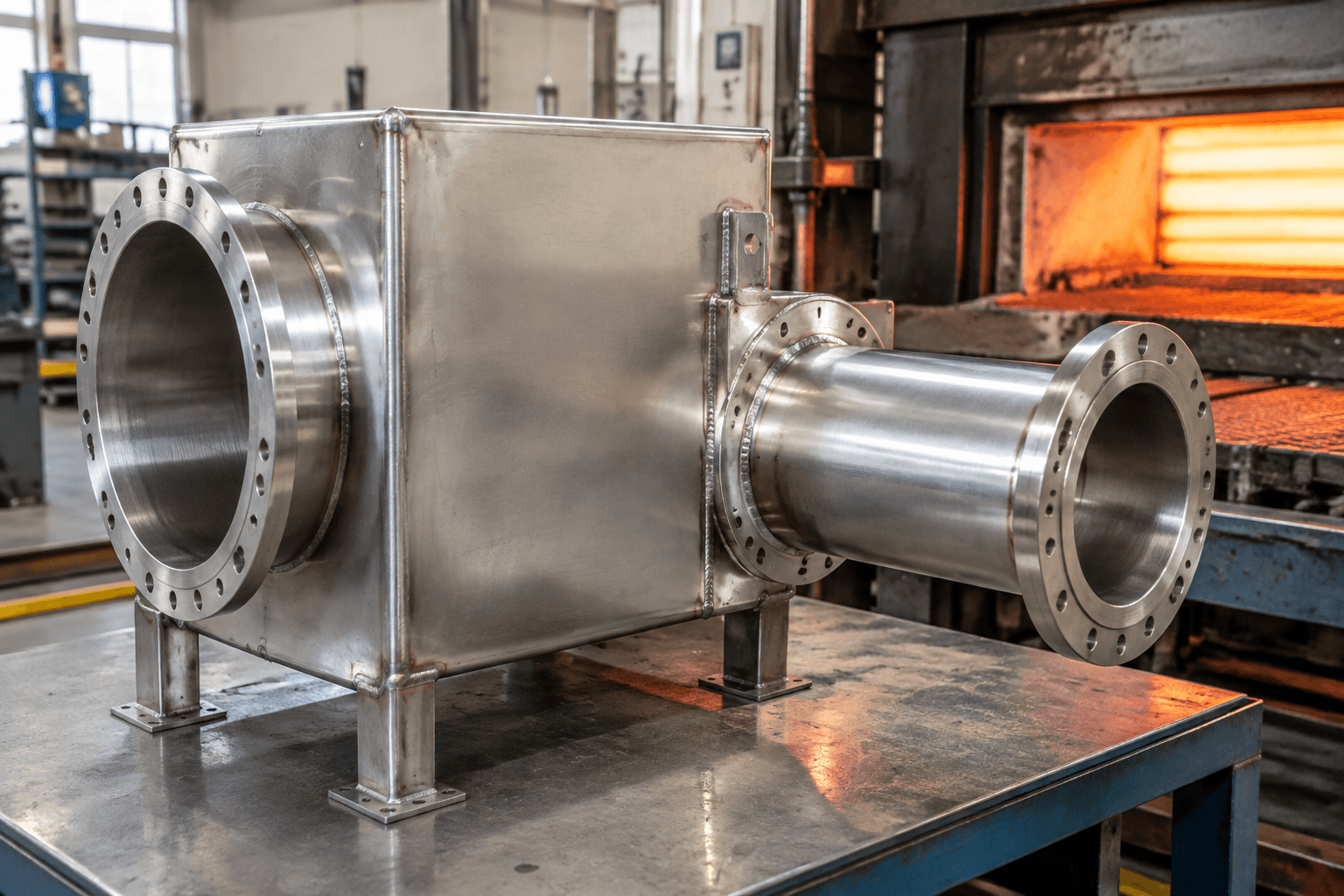
There is no single universal 304 stainless steel temperature rating. The applicable limit depends on whether the concern is oxidation resistance, retained mechanical properties, allowable design stress, corrosion performance, or repeated thermal cycling.
A published material value should not automatically be treated as the safe operating limit of a finished part. Engineers must match the value to the product form, material condition, exposure duration, environment, loading, fabrication history, and governing design requirements.
One Term Can Refer to Five Different Temperature Limits
When a datasheet, drawing, or supplier describes 304 as “heat resistant,” the statement is incomplete unless it identifies the property being evaluated. A stainless surface may remain visually free of heavy scaling while the part has already lost enough strength or dimensional stability to become unsuitable for its intended function.
| Meaning of temperature rating | What it evaluates | What must be verified |
|---|---|---|
| Oxidation or scaling resistance | How the exposed surface reacts with a hot atmosphere | Continuous or intermittent exposure, atmosphere, duration, and surface condition |
| Retained mechanical properties | Strength, stiffness, ductility, and other properties at temperature | Temperature-dependent data for the correct material form and condition |
| Allowable design stress | The stress permitted by an applicable engineering code or design method | Code edition, service category, temperature, load, duration, and safety factors |
| Corrosion performance | Resistance to attack from process media, deposits, cleaning chemicals, or the surrounding atmosphere | Actual chemical composition, concentration, temperature, contamination, and cleaning cycle |
| Thermal and dimensional behavior | Expansion, warping, joint movement, and fatigue caused by temperature changes | Temperature gradients, restraint, cycle frequency, geometry, and assembly clearances |
These limits are not interchangeable. Oxidation data do not establish allowable pressure or structural stress. Room-temperature strength values do not describe long-duration hot service. Likewise, a corrosion-resistance statement for clean air says little about exposure to chlorides, sulfur-bearing compounds, reducing gases, or process residues.
The grade designation also needs precision. 304, 304L, cast stainless grades, and materials described only as “stainless steel” must not be assumed to be equivalent. Product form and delivery condition matter because sheet, plate, bar, tubing, castings, weld metal, and cold-worked components may be governed by different specifications and property data.
Which Service Conditions Change 304’s Applicable Temperature Limit?
A usable temperature limit is a result of service conditions rather than a property of the alloy name alone. The following factors explain why 304 may be acceptable in one hot-service component but unsuitable in another.
| Service or manufacturing condition | Possible consequence | Design review question |
|---|---|---|
| Continuous versus intermittent exposure | Long exposure can make time-dependent property changes more important, while repeated heating and cooling can introduce thermal fatigue. | How long is each exposure, and how many cycles are expected? |
| Applied load at temperature | Strength and stiffness can decline with temperature; sustained loads may require assessment of creep or permanent deformation. | What loads act during heating, steady operation, cooling, and maintenance? |
| Atmosphere and contaminants | Oxidizing, reducing, chloride-bearing, sulfur-bearing, or carbon-containing environments can produce different material responses. | What gases, liquids, deposits, cleaners, and process chemicals contact the part? |
| Temperature gradients | Uneven expansion can distort panels, move holes, change gasket compression, or stress welds and fasteners. | Is the entire part heated uniformly, or is one area close to a heat source? |
| Welding and heat-affected zones | Weld metal, heat tint, local metallurgical condition, residual stress, and incomplete post-weld cleaning can affect service behavior. | Which weld procedure, filler, cleaning, and inspection requirements apply? |
| Cold forming and section thickness | Forming changes local material condition and residual stress; thin panels and heavy sections also respond differently to gradients. | Where are the tight bends, formed corners, restrained flanges, and thickness transitions? |
| Surface finish and contamination | Embedded iron, fabrication residue, rough areas, or process deposits may reduce corrosion performance as temperature changes. | What finish, cleaning method, passivation requirement, and handling controls are specified? |
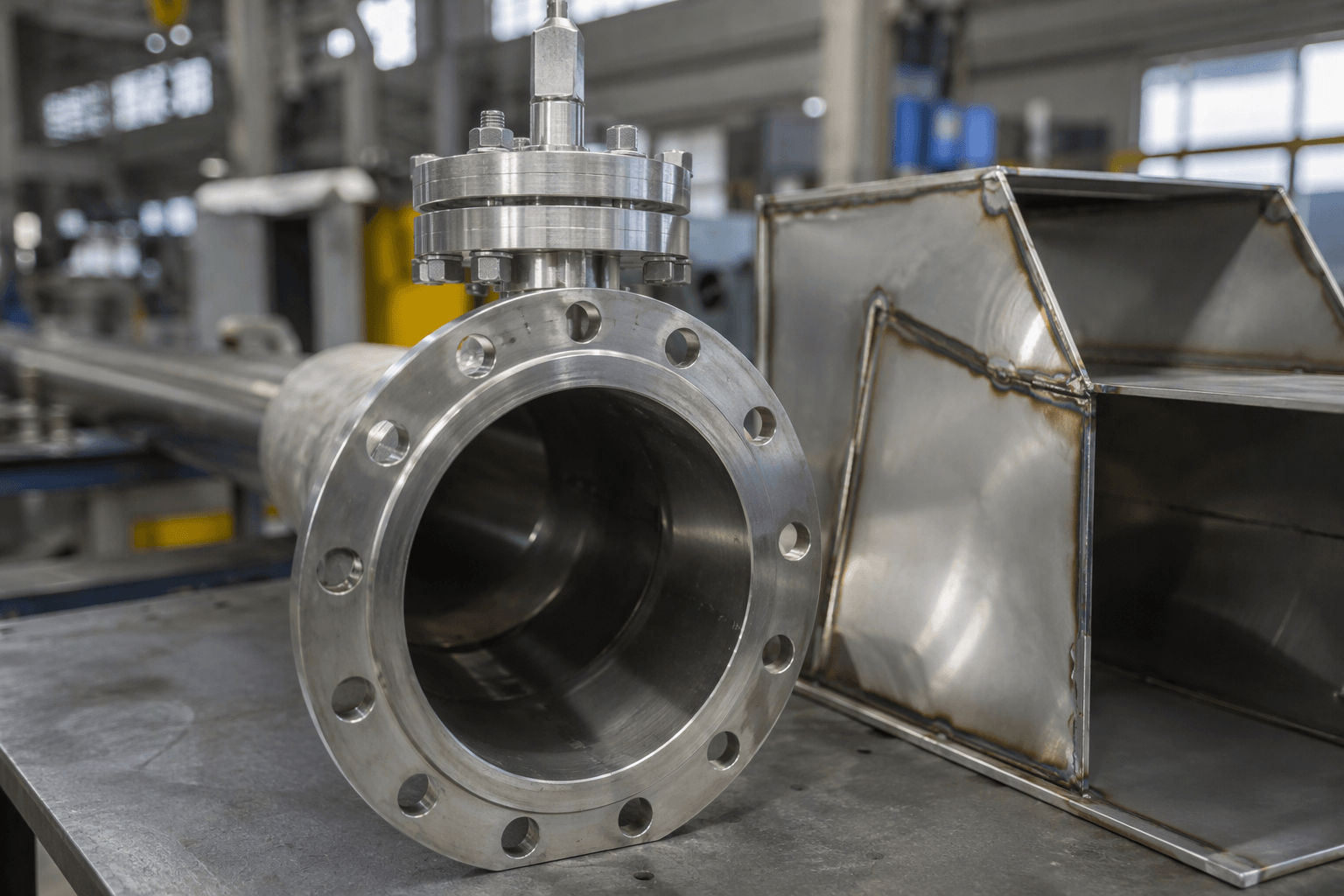
Geometry can therefore control a fabricated part even when the base material remains chemically stable. For example, a hypothetical enclosure beside a heat source could experience door misalignment because one panel expands more than its frame. The relevant issue would be the measured gradient, restraint, clearances, and assembly design—not simply an alloy datasheet’s oxidation statement. These considerations are particularly relevant to fabricated sheet metal enclosures with assembly interfaces.
Which Temperature Limit Should an Engineer Actually Use?
Use a source hierarchy rather than selecting the highest temperature found online. The controlling source may differ by industry, jurisdiction, product form, and equipment function.
- Start with the applicable code, regulation, or equipment standard. Pressure-containing, structural, fire-related, hygienic, and safety-critical equipment may have mandatory rules. An alloy name by itself does not establish compliance or suitability.
- Confirm the ordered material specification. The specification should match the grade, product form, thickness, and delivery condition. It establishes what is being purchased, but it may not provide a complete application-specific service limit.
- Review authoritative producer data. Use data for the matching material and condition. Check whether each value describes short-term testing, long-duration exposure, oxidation in a stated atmosphere, or temperature-dependent mechanical properties.
- Apply the required design allowables. Allowable stress must correspond to operating temperature, load type, exposure duration, joint design, and the governing calculation method. It cannot be replaced by an oxidation limit.
- Obtain project engineering approval. The responsible engineering authority should resolve conflicting sources and approve material suitability, especially for regulated or safety-related service.
A datasheet value is evidence about material behavior under stated conditions. An application-specific design limit additionally accounts for component geometry, welds, tolerances, environment, maintenance, inspection, consequences of failure, and required design margins. That distinction is the central safeguard when evaluating a 304 stainless steel temperature rating.
Put the Operating Conditions on the Drawing and Inquiry
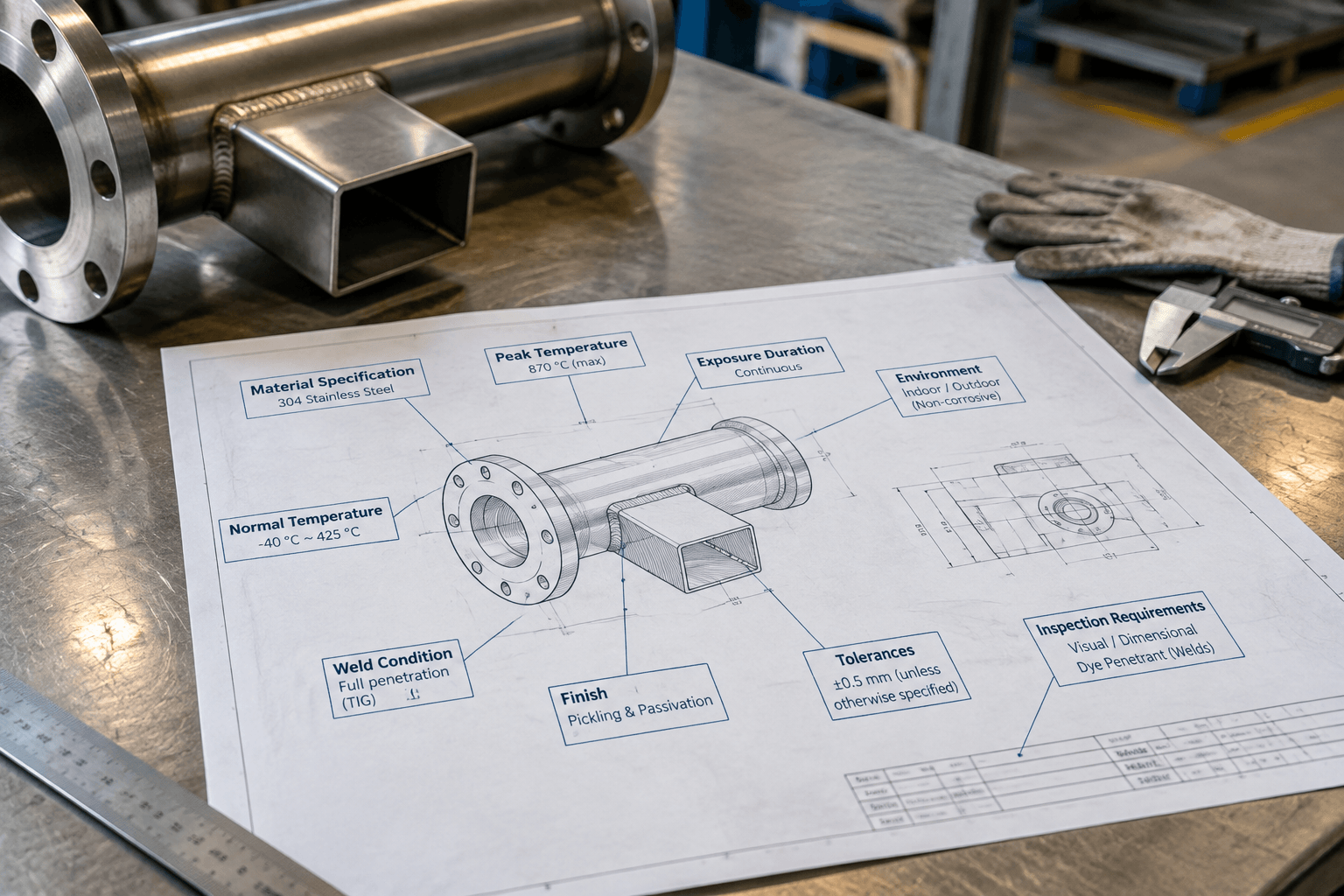
A drawing that says only “304 stainless steel” leaves important questions open. Temperature-sensitive parts should be supported by a drawing note, material specification, or project document that defines the following:
- Material identity: exact grade designation, governing material specification, product form, thickness, and required material documentation.
- Temperature profile: normal operating temperature, peak or transient temperature, units, exposure duration, heating rate where relevant, and expected cycle count or frequency.
- Environment: atmosphere, process media, humidity, contaminants, deposits, cleaning chemicals, contact substances, and whether surfaces are insulated.
- Mechanical duty: static and cyclic loads, restraint points, vibration, pressure where applicable, and load combinations during startup and shutdown.
- Fabrication condition: bend details, weld locations, joint type, filler requirements assigned by engineering, heat-tint removal, cleaning, passivation, and prohibited contamination.
- Dimensional requirements: tolerances at room temperature, functional clearances at operating temperature, flatness, hole alignment, gasket compression, and mating interfaces.
- Finish and inspection: surface finish, visual acceptance criteria, weld inspection, dimensional inspection, documentation, traceability, and any hold points.
For food and beverage equipment, operating heat cannot be separated from cleaning media, surface condition, hygiene requirements, and applicable contact rules. See this overview of custom metal fabrication for food and beverage equipment for the wider fabrication context; final material approval still belongs to the customer’s engineering and compliance authority.
Worksheet: Define the Conditions Behind the Rating
Complete this application-condition worksheet before selecting a published limit or releasing a temperature-exposed part for manufacture.
| Field | Information to record |
|---|---|
| Temperature profile | Normal, peak, and transient temperatures; units; duration; heating and cooling pattern |
| Exposure mode | Continuous, intermittent, startup-only, cleaning-cycle, or emergency exposure |
| Environment | Air or process atmosphere, chemicals, contaminants, deposits, moisture, and cleaning media |
| Mechanical conditions | Loads, restraint, vibration, pressure if applicable, gradients, and critical clearances |
| Fabricated condition | Product form, thickness, cold work, bends, welds, filler, surface treatment, and finish |
| Governing evidence | Applicable code, material specification, producer data, project requirements, and engineering approval |
| Required records | Material certificates, traceability, inspection reports, weld records, and acceptance criteria |
If a requirement cannot be supported by the governing code, matching material data, and application assessment, the next step may be to revise the design or evaluate another stainless grade. That decision should be based on documented service conditions rather than a generic comparison chart.
Frequently Asked Questions
Is the continuous-use limit the same as the intermittent-use limit?
No. Continuous exposure emphasizes duration-dependent behavior, while intermittent service introduces heating and cooling cycles, expansion mismatch, and possible thermal fatigue. Any published value must state which exposure mode and atmosphere it represents.
Does 304 lose strength before visible oxidation or scaling occurs?
It can. Mechanical properties and allowable design stress may change without obvious surface scaling. Visual appearance is therefore not a reliable substitute for temperature-dependent property data or an engineering calculation.
Do welding and cold forming change the temperature assessment?
They can. Welding introduces weld metal, a heat-affected zone, residual stress, heat tint, and local surface changes. Cold forming changes local material condition and residual stress. These areas should be evaluated together with geometry, loads, environment, cleaning, and inspection requirements.
Can a datasheet value be used directly as a finished-part design limit?
Not without verification. Confirm what the value measures, its test or service conditions, the covered product form, and whether an applicable code provides a different allowable limit. The finished-part limit must also account for fabrication, joints, gradients, loads, tolerances, environment, and required design margins.