
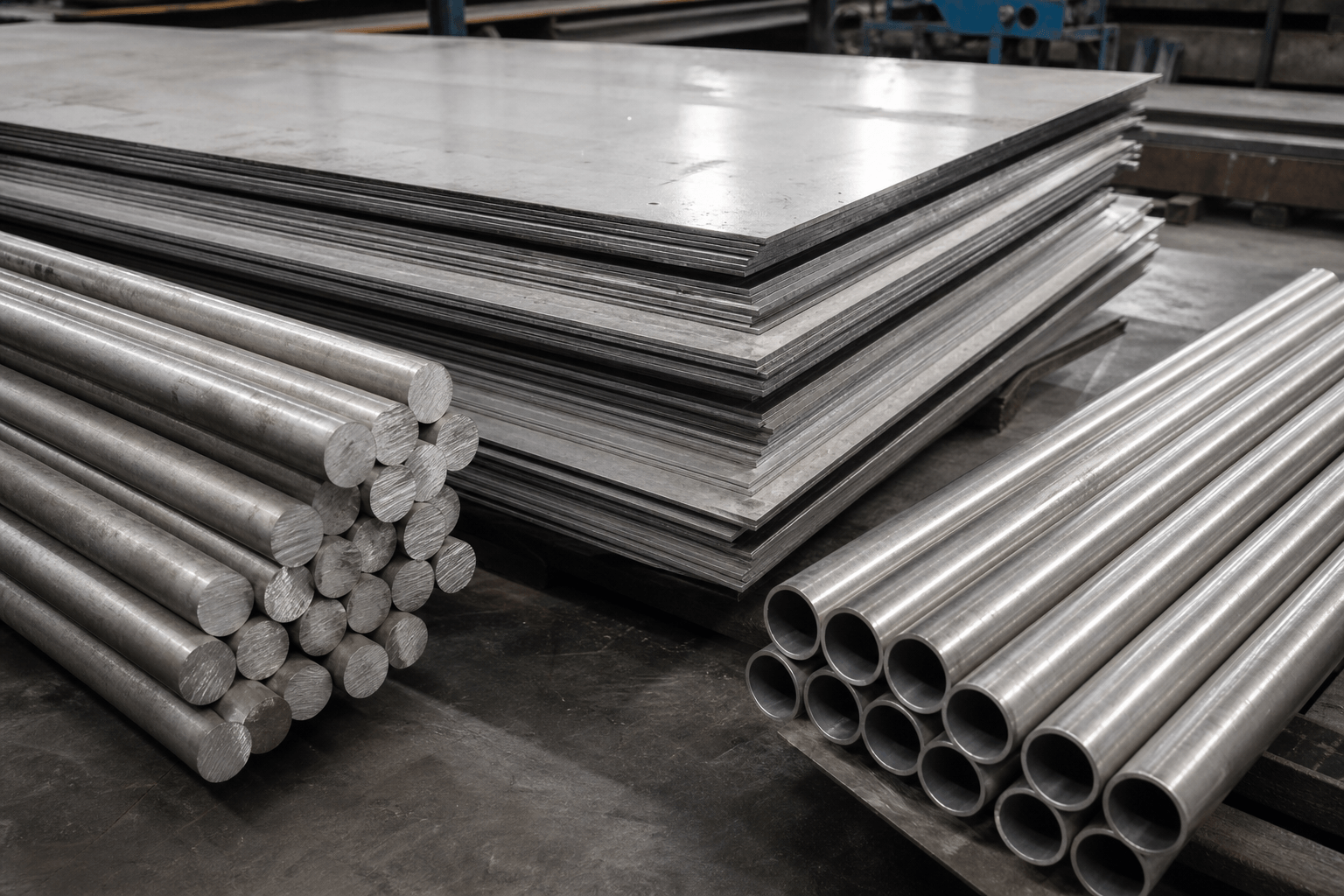
316 stainless steel does not have one universally applicable yield-strength value. For solution-annealed 316 plate, sheet, and strip supplied to ASTM A240/A240M, the commonly specified minimum 0.2% offset yield strength is 205 MPa (205 N/mm², 29.7 ksi, or about 29,700 psi). This minimum must not be applied automatically to cold-worked material, tubing, bar, or stock governed by another specification.
What Is the Yield Strength of 316 Stainless Steel?
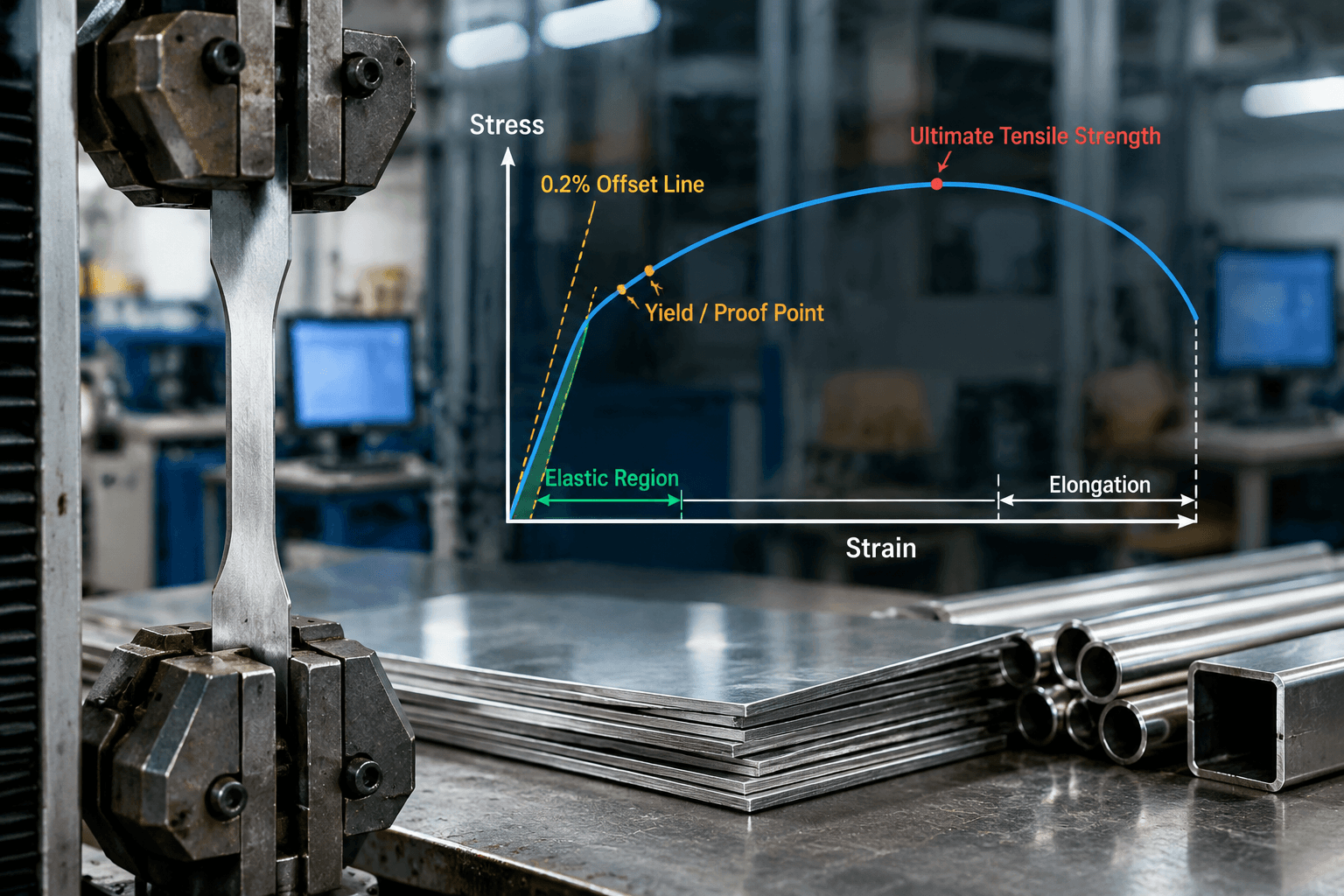
Yield strength identifies the stress at which permanent deformation begins under the specified test method. Austenitic stainless steels such as 316 do not usually show the sharp yield point associated with some carbon steels. Specifications therefore commonly use 0.2% offset yield strength, also called 0.2% proof stress: the stress producing 0.2% permanent strain after unloading.
| Material and source basis | Product form and condition | Yield strength | Value status | Applicability |
|---|---|---|---|---|
| Type 316, ASTM A240/A240M | Plate, sheet, or strip; solution-annealed condition required by the specification | 205 MPa = 205 N/mm² = 29.7 ksi ≈ 29,700 psi | Minimum 0.2% offset yield strength | Use for ordered dimensions covered by the applicable ASTM A240/A240M edition, subject to its tables and dimensional exceptions. |
| Type 316L, ASTM A240/A240M | Plate, sheet, or strip; solution-annealed | 170 MPa = 170 N/mm² = 24.7 ksi ≈ 24,700 psi | Minimum 0.2% offset yield strength | Applies to 316L flat product ordered to this specification, not automatically to 316 or to tube and bar. |
| ATI 316/316L technical data | Annealed flat-rolled 316/316L product represented in the producer datasheet | About 290 MPa = 290 N/mm² = 42.1 ksi ≈ 42,100 psi | Typical room-temperature value, not a guaranteed minimum | Illustrative only. Confirm that the datasheet revision, grade, dimensions, and condition match the purchased material. |
The first two figures are specification minima used for acceptance when the correct grade, form, dimensions, and specification apply. The producer figure describes representative performance rather than a purchasing guarantee. A mill test report may show a result above the specified minimum, but that reported heat or lot result does not redefine the minimum for every future order.
ASTM A240/A240M identifies requirements for chromium and chromium-nickel stainless plate, sheet, and strip. ASTM E8/E8M provides tensile-testing methods used to determine properties such as yield strength, tensile strength, and elongation. The governing specification and its required test basis should always take precedence over a generic online property table.
Why Do Published 316 Values Differ?
Two credible sources can report different figures without either being incorrect. The difference usually comes from what was tested and how the result is being presented.
- Minimum versus typical: A minimum is an acceptance threshold in a material specification. A typical value is a statistical or representative producer value and is not normally guaranteed unless it is incorporated into the purchase requirement.
- Annealed versus cold-worked condition: Solution annealing produces the familiar lower-strength, high-ductility condition. Cold rolling, drawing, or other plastic deformation can raise yield and tensile strength while generally reducing elongation. A cold-worked value is valid only for the defined temper or strength class.
- Product form: Sheet, plate, bar, wire, pipe, and tube may be governed by different specifications. Their manufacturing routes, heat treatments, dimensional ranges, specimen requirements, and acceptance criteria are not interchangeable.
- Thickness: A specification may change mechanical requirements, specimen geometry, or elongation rules by thickness. Thin sheet data should not be transferred to heavy plate without checking the controlling table.
- Test orientation: Longitudinal and transverse specimens can produce different results, particularly after directional cold working. The required orientation should follow the material specification or drawing.
- Temperature: Room-temperature yield strength is not a high-temperature design allowable. Elevated-temperature service requires temperature-specific data and, where applicable, code-defined allowable stresses.
A useful applicability chain is: grade → product specification → product form → thickness → material condition → test orientation and temperature → minimum or typical status. If any link is missing, the number needs qualification before it is used for design or purchasing.
304, 316, and 316L on the Same Basis
The following comparison controls the main variables by using solution-annealed plate, sheet, or strip under ASTM A240/A240M. These are room-temperature specification limits, not typical test results. The applicable edition and dimensional provisions still need to be checked.
| Grade | Minimum 0.2% yield strength | Minimum tensile strength | Minimum elongation | Maximum hardness |
|---|---|---|---|---|
| 304 | 205 MPa (29.7 ksi) | 515 MPa (74.7 ksi) | 40% in 50 mm or 2 in | 201 HBW or 92 HRBW |
| 316 | 205 MPa (29.7 ksi) | 515 MPa (74.7 ksi) | 40% in 50 mm or 2 in | 217 HBW or 95 HRBW |
| 316L | 170 MPa (24.7 ksi) | 485 MPa (70.3 ksi) | 40% in 50 mm or 2 in | 217 HBW or 95 HRBW |
On this controlled basis, 304 and 316 have the same specified minimum yield and tensile strengths. It is therefore inaccurate to say that 316 is inherently stronger than 304 without identifying another condition or specification. Selection between them is frequently driven by corrosion exposure rather than a higher guaranteed yield value.
ASTM A240/A240M gives 316L lower minimum yield and tensile requirements than 316 in this comparison. That does not mean every delivered 316L sheet is meaningfully weaker. Actual test results can overlap, and some material is dual-certified as 316/316L when it satisfies the chemistry and mechanical requirements for both designations. Dual certification must be confirmed from the material documentation rather than assumed.
The principal distinction is carbon control: 316L has a lower maximum carbon level than 316, which can be advantageous for welded construction where resistance to sensitization and intergranular corrosion is relevant. Strength, weld procedure, corrosion exposure, and any post-weld requirements should be evaluated together. For example, food and beverage metal fabrication may require strength to be considered alongside cleanability, weld condition, and the actual process environment.
Hardness, tensile strength, and yield strength describe different responses. A maximum hardness limit is not a substitute for minimum yield strength, and tensile strength is the maximum engineering stress reached during the tensile test—not the point at which permanent deformation starts.
How Fabrication Changes the Material
Cold forming
Bending, rolling, stamping, and drawing plastically strain the material. Austenitic 316 strain-hardens, so highly deformed regions can have greater local strength and hardness than the incoming annealed sheet. The increase is not uniform across a formed part: a bend radius may be heavily strained while adjacent flat material remains close to its original condition. Generic cold-worked properties should not be assigned to the whole component unless the condition and validation method are defined.
Welding
Welding introduces a fusion zone, a heat-affected region, residual stress, and geometric effects at the joint. The outcome depends on filler selection, heat input, joint design, restraint, welding procedure, and service conditions. The base-material certificate still describes the supplied stock; it does not certify the mechanical performance of the completed weldment. Where joint strength or code compliance matters, the governing design and welding requirements control.
Machining
316 can work-harden at the cutting surface when tools rub or take insufficiently controlled cuts. This local hardened layer may affect tool wear, cutting forces, and subsequent operations, but it does not increase the certified bulk yield strength of the bar, plate, or finished component.
How to Match a 316 Yield-Strength Value to Your Material
| Check | Value can be considered when… | Stop and clarify when… |
|---|---|---|
| Grade | The source and order both identify 316, or documented dual-certified material satisfies the requirement. | The drawing says only “stainless” or mixes 316 and 316L without acceptance criteria. |
| Product form | Sheet, plate, strip, bar, or tube matches the cited specification. | A flat-product value is being assigned to tube, pipe, wire, or bar. |
| Condition | Annealed, solution-annealed, or cold-worked condition is stated consistently. | The source gives cold-worked strength but the order requests annealed stock. |
| Thickness and orientation | The ordered dimensions and specimen orientation fall within the applicable requirements. | The source omits thickness or uses an unidentified test direction. |
| Test basis | The value is identified as 0.2% offset yield strength at the relevant temperature. | “Yield,” tensile strength, hardness, and proof stress are used interchangeably. |
| Source type | A specification minimum is used for acceptance, or a certified test result is used for its documented heat or lot. | An uncited typical value is treated as a guaranteed procurement minimum. |
For a drawing or calculation, begin with the governing design requirement. Then identify the material specification, grade, product form, condition, dimensions, and required documentation. If a pressure, structural, sanitary, or other design code applies, its allowable stress and safety provisions can supersede the use of generic room-temperature yield data.
An ambiguous callout is “316 stainless, yield 205 MPa.” It leaves the product specification, condition, thickness applicability, test basis, and acceptance documentation unclear. A more complete callout identifies 316 or 316L, the governing material specification and edition, product form, required condition, dimensions, and whether mechanical properties are specification minima or additional drawing requirements.
For a technical material-callout review, OEM and ODM buyers can provide Yishang with the part drawing, specified 316 or 316L grade, required product form and condition, governing material specification, and relevant service environment. The purpose of this review is to determine whether the drawing contains enough material detail for a meaningful manufacturing assessment—not to replace engineering approval or the governing design code.
Frequently Asked Questions
Is 316 stainless steel stronger than 304 in the same form and condition?
Not necessarily. In solution-annealed ASTM A240/A240M flat product, 304 and 316 share minimum values of 205 MPa yield strength and 515 MPa tensile strength. Different results are possible when product form, cold work, thickness, or specification changes, so comparisons must be like for like.
Does 316L have significantly lower yield strength than 316?
ASTM A240/A240M lists lower minimums for 316L flat product: 170 MPa yield and 485 MPa tensile strength, compared with 205 MPa and 515 MPa for 316. Actual results may overlap, however. Whether the specified difference matters depends on the design calculation, material certificate, and possibility of documented dual certification.
Can cold-worked 316 values be used for annealed sheet, plate, bar, or tube?
No. Cold work can increase strength and reduce ductility, but the result depends on the amount and direction of deformation. Use values for the stated temper, product form, dimensions, and specification. Do not transfer them to annealed material or another form.
Does machining work hardening give 316 a higher certified yield strength?
No. Machining can create a locally hardened surface, especially when cutting conditions cause rubbing, but this is not the certified bulk yield strength. Material acceptance remains based on the governing stock specification and its documented test results.