
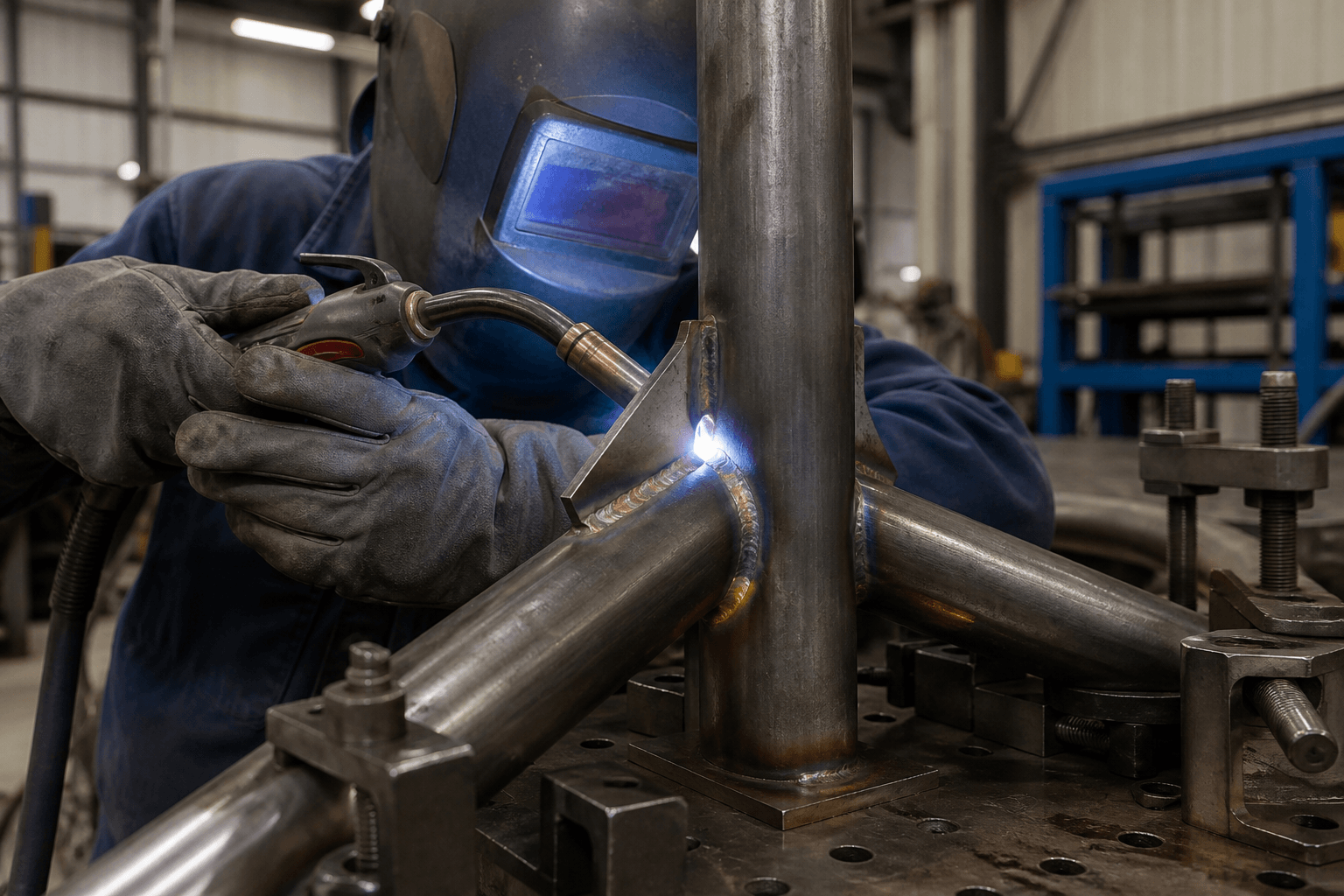
4130 steel can be welded reliably, but the correct welding process, filler metal, and heat controls depend on its current heat-treated condition, section thickness, joint restraint, service demands, and required final properties. Case-hardened or quenched-and-tempered 4130 should not be welded as-is without engineering review and an approved procedure addressing the affected material condition.
The chromium and molybdenum in 4130 improve hardenability and strength potential, but they also make heat-affected-zone behavior more sensitive than in ordinary mild steel. A suitable plan therefore begins with material identification and ends with inspection against requirements defined by the drawing, governing code, or qualified welding procedure specification (WPS).
Can 4130 Steel Be Welded Without Cracking?
Yes, although “4130” alone does not provide enough information to select a welding recipe. Its nominal carbon content is approximately 0.3%, and its response to welding depends heavily on prior heat treatment and cooling conditions. Rapid cooling can produce a harder, less ductile heat-affected zone (HAZ), while diffusible hydrogen and tensile residual stress can contribute to delayed cracking.
Before choosing TIG, MIG, filler metal, or a preheat range, establish six variables:
- Material condition: Determine whether the component is annealed, normalized, case-hardened, or quenched and tempered.
- Section thickness: A thin tube does not dissipate heat like a thick plate, boss, or tube-to-machined-fitting joint.
- Joint restraint: Rigid fixtures, closed frames, uneven sections, and poor fit-up can raise residual stress.
- Cleanliness and hydrogen control: Oil, moisture, plating, rust, paint, and improperly handled consumables increase weld risk.
- Final properties: Static strength, ductility, hardness, toughness, and fatigue performance may lead to different filler and thermal-treatment decisions.
- Production route: Welding before normalizing or quench-and-temper treatment is fundamentally different from welding a finished heat-treated part.
The practical decision flow is straightforward: verify the grade and condition, define the final property requirement, assess geometry and restraint, select a process and filler as part of a complete procedure, establish thermal controls, and specify inspection and acceptance criteria.
Identify the Starting Material Condition Before Welding
A drawing note or purchase order saying “4130 steel” is not proof of its present condition. Strength comes from thermal treatment as well as chemical composition. If the condition is uncertain, do not infer it solely from appearance, part function, or a single hardness reading.
Begin with the material certificate, heat number, applicable material specification, drawing, and heat-treatment records. Confirm whether the supplied product was annealed or normalized and whether a finished component subsequently received case hardening, flame hardening, quenching and tempering, or another local treatment. Hardness mapping and, where necessary, metallurgical examination can help investigate an unidentified component, but results should be interpreted by qualified personnel.
- Annealed 4130: Its lower starting hardness can make fabrication more manageable, but thickness, restraint, hydrogen, and the required final condition still govern the procedure.
- Normalized 4130: Frequently encountered in fabricated structures and tubing, it remains sensitive to weld heat input and HAZ cooling. “Normalized” does not automatically mean that preheat or post-weld treatment is unnecessary.
- Case-hardened 4130: Welding can destroy the local case, alter hardness gradients, and create cracking concerns. The engineering plan may require removal of the hardened condition around the joint or a different repair strategy.
- Quenched-and-tempered 4130: Welding heat can locally over-temper, reharden, or otherwise change established properties. Welding requires an engineered procedure; approved local or full annealing or normalizing may be needed before welding.
- Weldment to be quenched and tempered later: The weld deposit and HAZ must respond compatibly to the complete heat-treatment cycle. Filler selection must be based on required post-treatment properties, not merely good as-welded handling.
Local annealing, normalizing, stress relief, and full post-weld heat treatment are not interchangeable. Their feasibility depends on part size, temperature uniformity, distortion risk, furnace control, and the properties required throughout the component.
Choose the Welding Route from Condition, Properties, and Joint Scenario
| Joint scenario | Process and filler questions | Thermal and verification priorities |
|---|---|---|
| Annealed or normalized thin section | Can TIG provide the required access and heat control, or will qualified MIG production offer better consistency? Does a ductile under-matching filler still satisfy design strength? | Cleanliness, fit-up, local heat accumulation, distortion, cooling, and surface crack inspection as required |
| Thick, highly restrained, or uneven section | Which process controls deposition and fusion without excessive heat input? Is a higher-strength filler actually required? | Procedure-based preheat and interpass control, weld sequence, hydrogen control, controlled cooling, and suitable NDT |
| Assembly to be normalized or quenched and tempered after welding | Will the filler respond compatibly to the planned cycle and achieve final strength and ductility? | Full heat-treatment specification, test evidence, dimensional allowance, hardness, and mechanical-property verification |
| 4130 joined to mild steel | Can filler selection accommodate dilution and the properties of both materials without creating an unnecessarily hard deposit? | Base thermal controls on the more crack-sensitive side; inspect according to load and service |
| Repair of a heat-treated component | Can the original condition be verified, and is welding permitted by the design authority? | Complete defect removal, limits on repeat heating, restoration of properties, and reinspection |
TIG welding, or GTAW, is often considered for thin-wall 4130 tubing, short precision joints, and locations where close control of the arc and filler addition is useful. It requires excellent surface preparation, reliable shielding, sound fit-up, and an operator able to avoid both lack of fusion and unnecessary heat accumulation.
MIG welding, or GMAW, may suit repeat production and longer joints because it offers higher deposition rates. MIG welding 4130 is not automatically inferior or superior to TIG. Transfer mode, wire size, shielding gas, travel speed, joint access, heat input, and operator or mechanized consistency must all be established during procedure development.
SMAW and other applicable arc processes may also be considered for suitable section sizes and working conditions. Process selection remains separate from procedure qualification: choosing TIG or MIG does not by itself establish acceptable filler, preheat, technique, or final properties.
Common filler families considered in 4130 welding include ductile carbon-steel fillers, low-alloy fillers such as ER80S-D2, and matching-alloy 4130-type filler for certain weldments receiving subsequent heat treatment. These are options for engineering evaluation, not universal prescriptions. An under-matching filler can reduce deposit hardness and improve ductility in some joints, but it is unacceptable if the weld cannot meet required strength or fatigue performance. Overmatching can increase strength while reducing ductility and raising cracking risk. If the assembly will later be normalized or quenched and tempered, the filler’s response to that cycle—including any repeated stress-relief exposure—must be supported by procedure testing and supplier data.
Control Heat and Hydrogen Through the Whole Welding Sequence
Heat control starts before the arc is struck. Remove oil, moisture, oxide, paint, plating, cutting residue, and other contamination from the joint and adjacent surfaces. Use correctly stored filler or electrodes, maintain effective shielding, and avoid introducing moisture during handling. Joint preparation should provide consistent root geometry without excessive gaps that force additional deposition.
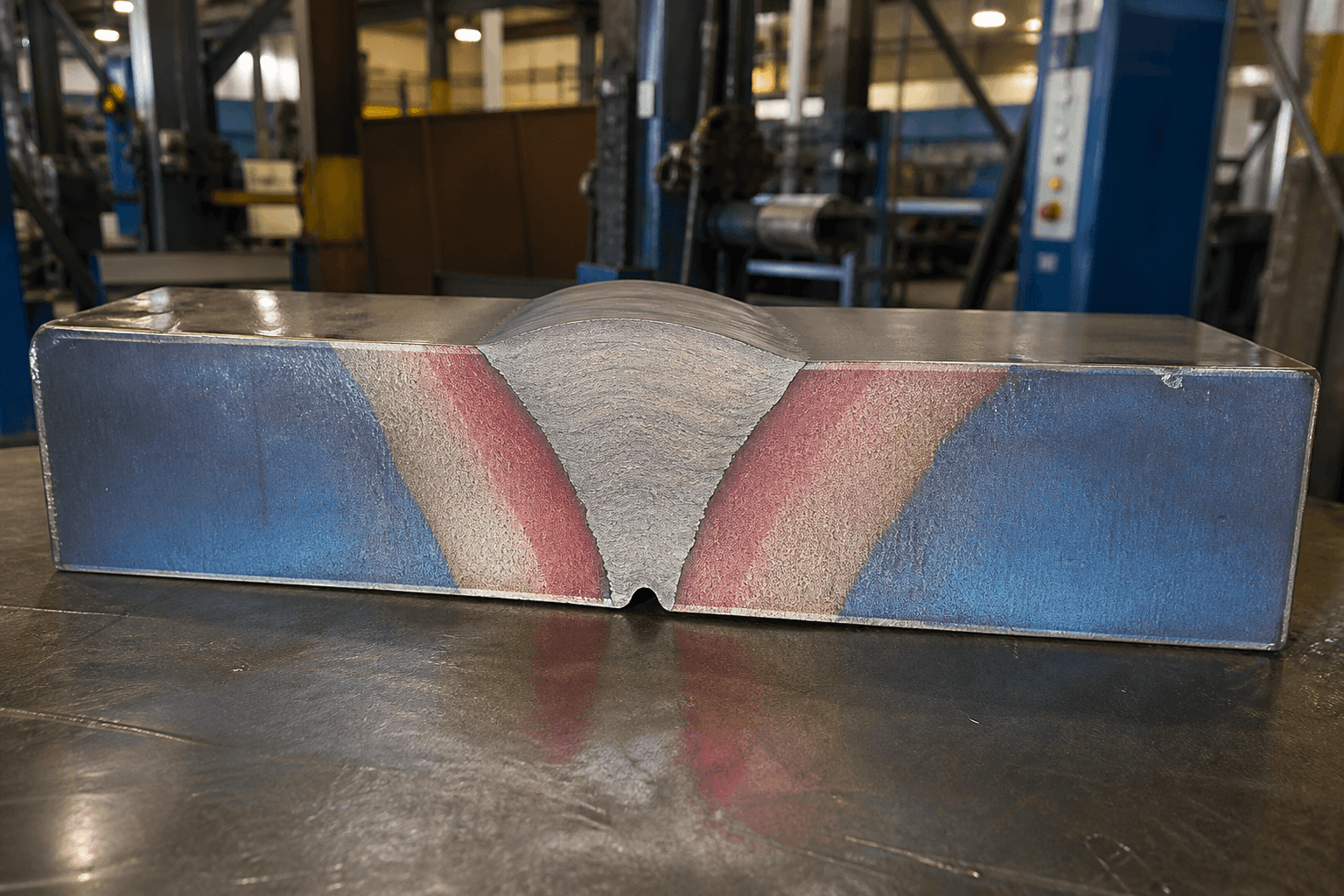
Preheat, when required, slows HAZ cooling, helps hydrogen escape, and reduces thermal gradients. However, no single preheat temperature applies to every 4130 weld. The appropriate range depends on material condition, thickness, combined section mass, carbon equivalent or hardenability, restraint, ambient conditions, filler, hydrogen level, and the applicable WPS.
During welding, monitor interpass temperature and follow the qualified bead sequence. Excessive heat may enlarge the HAZ, increase distortion, and change base-metal properties; insufficient heat or uncontrolled rapid cooling may contribute to hard microstructures or lack of fusion. Balanced sequencing and appropriate fixturing can reduce distortion, but a fixture that is too rigid may increase restraint stress.
Cooling is part of the procedure rather than an incidental final step. The WPS may require protection from drafts, insulation, controlled cooling, or transfer into a specified thermal-treatment cycle. Do not improvise slow cooling with uncontrolled heating equipment.
Stress relief can reduce residual stress and temper some hard regions, but it cannot automatically restore the original condition. Normalizing changes microstructure differently, while quenching and tempering is intended to develop a specified combination of strength and toughness. Time, temperature, heating rate, cooling method, part geometry, and furnace uniformity all matter. Published ranges are useful for planning, but they cannot replace a procedure qualified for the actual joint and required properties.
Welding 4130 to Mild Steel
Welding 4130 to mild steel is feasible in many engineered assemblies, provided the procedure accounts for the more hardenable 4130 side. Filler choice must consider dilution from both base metals, required weld strength, ductility, service temperature, fatigue loading, and any later heat treatment. Applying a mild-steel procedure to the entire joint without reviewing the 4130 HAZ can leave the more crack-sensitive side inadequately controlled.
A hypothetical example is a normalized 4130 tube joined to a mild-steel bracket in transportation equipment. The designer would need to evaluate the load path, wall-to-bracket thickness transition, restraint, filler strength, weld profile, and whether the assembly can receive thermal treatment without losing the intended properties of either material. More context on this type of production environment is available under custom metal fabrication for automotive and transportation equipment.
Inspection and Repair of 4130 Welds
Select inspection methods from the likely defect types and consequences of failure. Because hydrogen-assisted cracking can be delayed, specify inspection timing and any required delay or repeat examination in the inspection plan according to the governing requirements and approved procedure. For fatigue-critical joints, also evaluate weld profile and discontinuities against the specified fatigue-related acceptance criteria:
- Visual inspection checks profile, dimensions, undercut, overlap, visible cracking, and workmanship, but cannot prove that a weld is crack-free.
- Liquid penetrant testing can reveal surface-breaking discontinuities on clean, nonporous surfaces.
- Magnetic particle testing may detect surface and near-surface discontinuities in suitable ferromagnetic parts.
- Ultrasonic or radiographic examination may be justified for internal discontinuities, depending on geometry and the governing requirements.
- Hardness surveys can identify unexpectedly hard or softened regions when property changes are a concern.
- Dimensional inspection verifies distortion, alignment, and machining allowance. Critical interfaces may require machined joint preparation or dimensional finishing after welding.
Weld acceptance criteria must be defined by the governing code, drawing, project specification, or approved engineering disposition, with service requirements addressed explicitly. The WPS defines how to make the weld; procedure qualification alone does not establish production-weld acceptance criteria. For a repair, document the defect, remove it completely using an approved method, confirm removal before rewelding, control additional thermal cycles, and repeat the required inspection. Multiple repairs can progressively change the HAZ and local properties, so allowable repair count and final acceptance require engineering control.
Send Yishang the part drawing and joint details, material specification and available mill documentation, known starting and required final conditions, section thicknesses, expected restraint, mechanical and service requirements, inspection criteria, and any specified code, WPS, or post-weld heat-treatment requirement. Request an initial manufacturability review focused on whether the material condition, weld requirements, finishing sequence, and inspection expectations are sufficiently defined for custom production. Yishang supports B2B OEM and ODM custom manufacturing, with more than 26 years of experience producing custom sheet metal parts and metal products for customers in more than 50 countries.
4130 Versus 4140 Weldability
Both steels use chromium and molybdenum as principal alloying elements, but 4140 contains approximately 0.4% nominal carbon compared with approximately 0.3% for 4130. The higher carbon content generally gives 4140 greater hardenability and makes its HAZ more prone to high hardness and cracking under comparable welding conditions.
This does not make every 4130 weld easy or every 4140 weld impractical. Actual weldability still depends on condition, section size, restraint, hydrogen, heat input, filler, and final requirements. A procedure qualified for 4130 should not be transferred to 4140 solely because both are chromium-molybdenum steels.
Frequently Asked Questions
What filler metal should be used for welding 4130 steel?
There is no universal filler. Ductile carbon-steel, low-alloy, or matching-alloy fillers may be considered according to base-metal condition, joint strength, fatigue demand, dilution, and post-weld heat treatment. The selected classification must be confirmed through the applicable WPS and supporting test data.
Is MIG welding suitable for 4130 chromoly?
Yes, MIG can be suitable when the transfer mode, wire, shielding, joint preparation, heat input, and thermal controls are qualified for the application. It is often attractive for repeat production, but process speed does not eliminate the need to control the 4130 HAZ or verify final properties.
Can 4130 be welded directly to mild steel?
Often yes, but the procedure should be developed around the more crack-sensitive 4130 side while also considering filler dilution and the mild steel’s properties. Heat-treated components, highly restrained joints, and fatigue-critical applications need specific engineering review.
Why is 4140 generally less forgiving to weld than 4130?
4140’s higher nominal carbon content increases hardenability, so comparable welding conditions can produce a harder, more crack-sensitive HAZ. Material condition, thickness, hydrogen control, and cooling still determine the actual risk for either grade.