
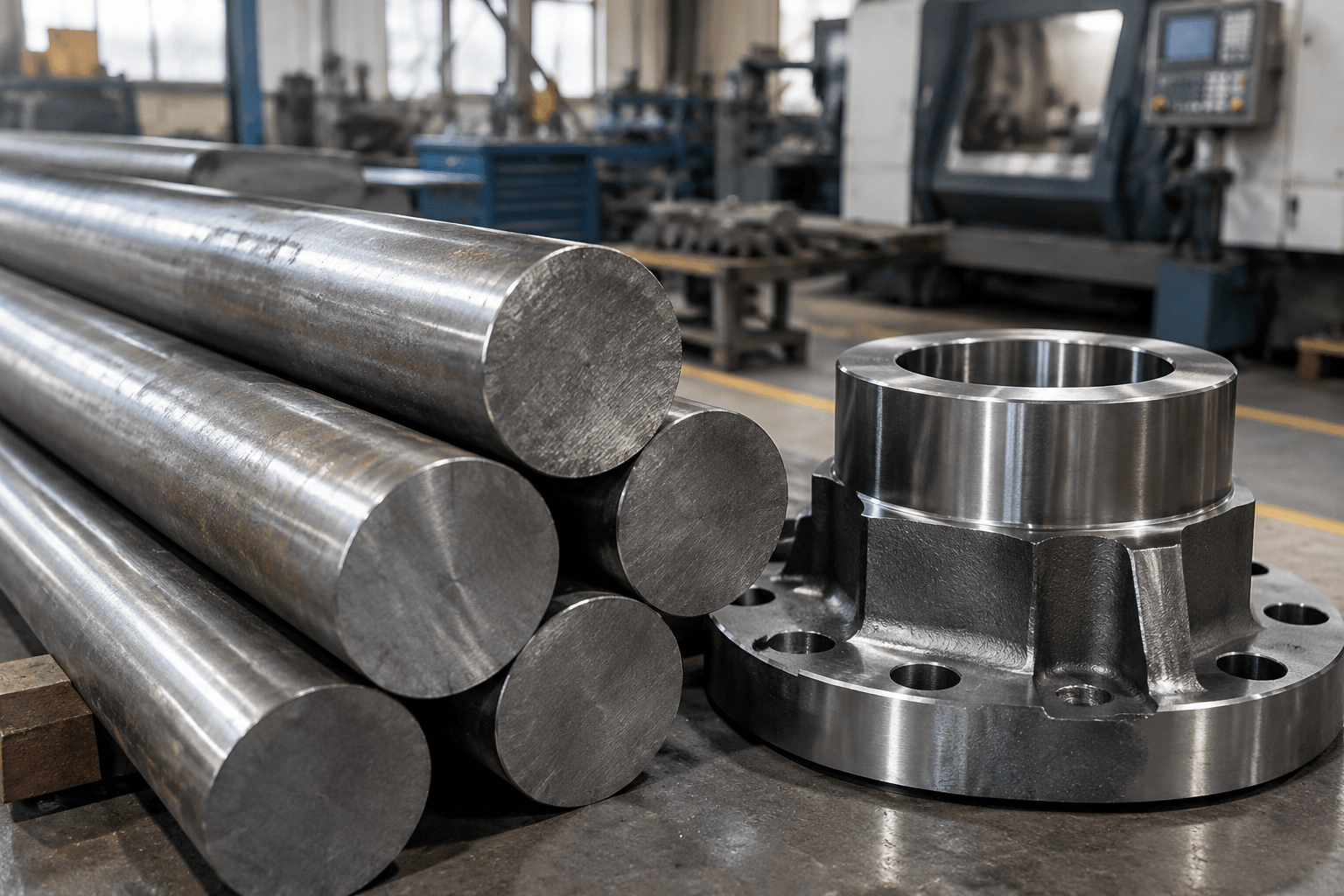
4140 chrome moly steel is a medium-carbon chromium-molybdenum alloy steel valued for its heat-treatable combination of strength, hardness, wear resistance, and toughness. It is not stainless steel, and its usable properties depend strongly on product form, section size, heat treatment, and final tempering condition.
The grade name alone therefore does not define what a buyer will receive. An annealed 4140 bar intended for machining can behave very differently from a quenched-and-tempered shaft, even though both products carry the same basic alloy designation.
What Is 4140 Chrome Moly Steel?
AISI/SAE 4140 belongs to the 41xx family of chromium-molybdenum alloy steels. “Chrome moly” or “chromoly” is an informal description derived from its chromium and molybdenum alloying additions. The final two digits indicate a nominal carbon content of approximately 0.40%, although the permitted range is controlled by the applicable material standard.
Chromium contributes to hardenability, wear resistance, and strength after heat treatment. Molybdenum also improves hardenability and helps control temper embrittlement. Carbon provides the basis for martensitic hardening. Together, these elements allow 4140 to develop useful strength through thicker sections than a comparable plain carbon steel, subject to geometry and quenching conditions.
The following ranges are from the SAE J404 chemical composition limits commonly associated with SAE 4140. A purchase order should identify the required standard and revision because limits can differ by product specification or national standard.
| Element | SAE 4140 composition, weight % | Primary metallurgical relevance |
|---|---|---|
| Carbon | 0.38–0.43 | Hardness, strength, and response to quenching and tempering |
| Manganese | 0.75–1.00 | Hardenability and deoxidation |
| Silicon | 0.15–0.35 | Deoxidation and strength |
| Chromium | 0.80–1.10 | Hardenability and wear resistance |
| Molybdenum | 0.15–0.25 | Hardenability and tempering response |
| Phosphorus | 0.035 maximum | Controlled residual; excessive content can reduce toughness |
| Sulfur | 0.040 maximum | Controlled residual that affects machinability and ductility |
Despite containing chromium, 4140 is not stainless steel. Its chromium content is far below that normally needed to form the passive surface film associated with stainless grades. Unprotected 4140 can rust in humid, wet, chemically aggressive, or salt-containing environments, so oiling, painting, plating, conversion coating, or another protection system may be necessary.
Strength and Hardness Depend on Material Condition
Published 4140 steel properties often appear contradictory because they describe different starting structures, section sizes, test specimens, or heat-treatment cycles. A tensile value for annealed bar cannot be compared directly with one from a quenched-and-tempered test coupon without examining those conditions.
The values below are commonly published room-temperature reference data for approximately 25 mm round specimens and the stated treatments. They are useful for understanding trends, but they are not universal acceptance limits. Design and purchasing values should come from the governing product standard, a qualified heat-treatment procedure, and test reports for the supplied material.
| Reference condition | Ultimate tensile strength | Yield strength | Elongation | Brinell hardness |
|---|---|---|---|---|
| Annealed at about 815°C, furnace cooled | About 655 MPa | About 415 MPa | About 25.7% | About 197 HB |
| Normalized at about 870°C, air cooled | About 1,020 MPa | About 655 MPa | About 17.7% | About 302 HB |
These representative values, widely reported in recognized 4140 material data compilations, illustrate the condition effect: normalized material can be harder and stronger but less ductile than annealed material. They should not be converted into drawing requirements without confirming specimen orientation, diameter, test method, temperature, and applicable standard.
Quenched-and-tempered 4140 covers a still broader property range. A lower tempering temperature generally retains more hardness and strength but can leave less toughness and ductility. Higher tempering temperatures usually reduce hardness while improving the balance of ductility and resistance to shock. Section size matters because the center of a large bar or forging may cool more slowly than its surface.
Toughness must also be specified carefully. A Charpy impact result is meaningful only when the specimen type, notch orientation, test temperature, location within the section, and acceptance criterion are identified. There is no responsible single impact value for every piece of 4140.
What Annealing, Normalizing, Quenching, and Tempering Do
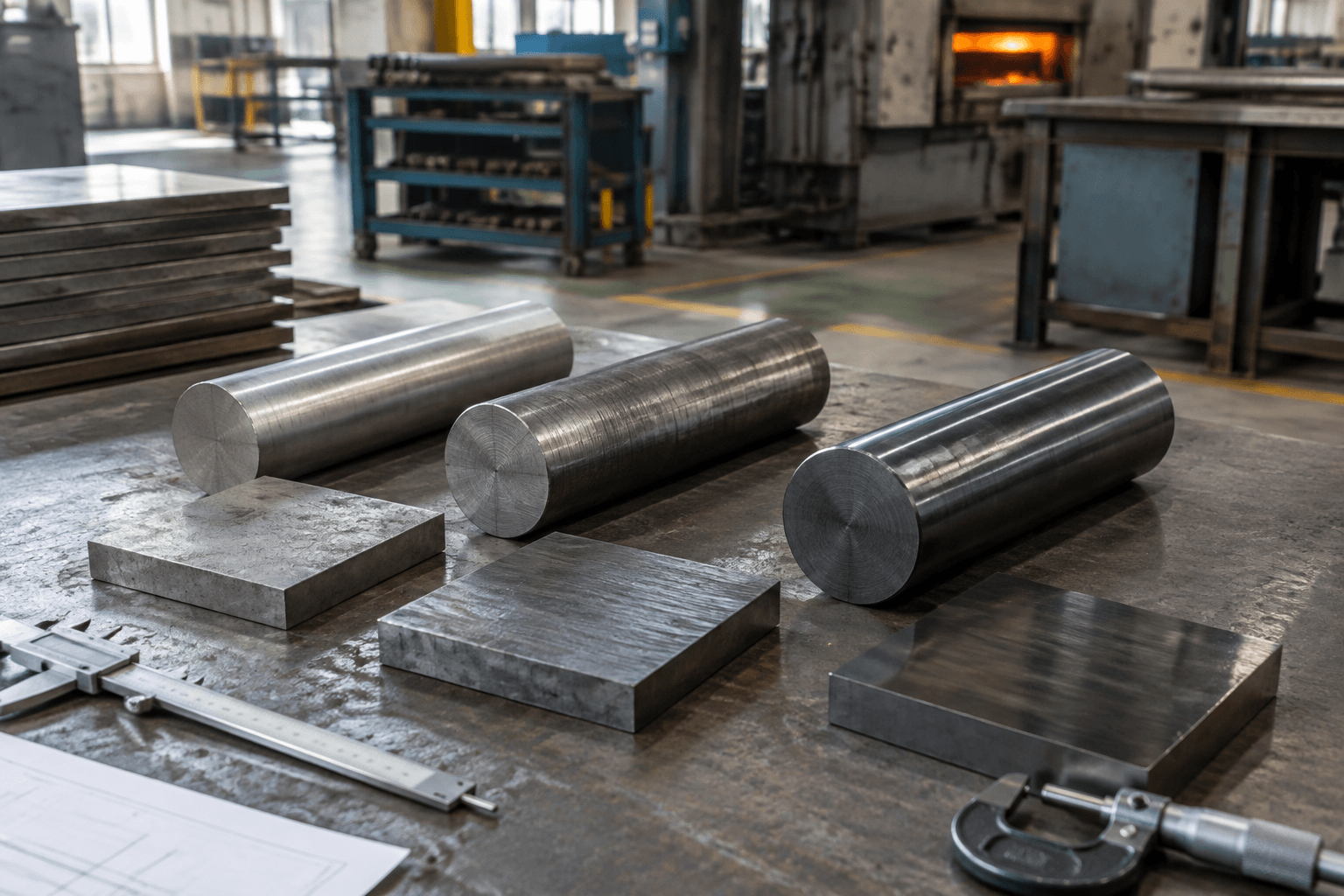
Annealing heats the steel into an appropriate transformation range and applies controlled cooling to produce a softer, more machinable structure. Annealed stock is often selected when substantial cutting is required before final heat treatment. The operation can also reduce hardness left by earlier processing, but the exact cycle must account for product form and prior condition.
Normalizing heats the steel above its critical transformation temperature so austenite forms, followed by cooling in air. The resulting refined structure is generally harder and stronger than a fully annealed structure. Normalizing can establish a more uniform starting condition before subsequent processing, although it is not a substitute for a specified final quench-and-temper treatment.
Quenching begins after austenitizing. Sufficiently rapid cooling transforms much of the austenite into martensite, producing high hardness. The objective is not simply to cool as fast as possible: excessive severity can cause distortion or cracking, while inadequate cooling can leave a softer and nonuniform microstructure. Oil, polymer solutions, water, gas, or other methods may be considered depending on section size, geometry, furnace process, hardenability, distortion tolerance, and required properties. No single quench medium is correct for every 4140 component.
Tempering reheats the quenched steel below the critical transformation range. This reduces the brittleness and residual stresses associated with as-quenched martensite and sets the required strength-hardness-toughness balance. The final result depends on tempering temperature and time as well as the prior austenitizing and quenching operations.
Machining strategy should follow this sequence. Complex features are commonly roughed in a softer condition, with allowances for heat-treatment movement, followed by finish machining or grinding where dimensions require it. Hardened surfaces increase cutting forces and tool wear. For components whose geometry and condition make machining appropriate, custom CNC machining planning should consider both incoming hardness and any post-treatment finishing allowance.
Where 4140 Is Useful—and Where It Needs Caution
| Application category | Why 4140 may be considered | Questions that remain |
|---|---|---|
| Shafts, axles, and spindles | Strength, fatigue resistance, and toughness after suitable heat treatment | Load spectrum, diameter, fillets, surface finish, and case or through-hardening requirements |
| Gears and splined parts | Core strength and potential wear resistance | Tooth geometry, contact stress, surface-hardening route, distortion, and grinding allowance |
| Pins, studs, and high-load fastener-like parts | Shear strength and resistance to repeated loading | Thread condition, stress concentrations, hardness limits, and hydrogen-embrittlement controls for plating |
| Tool holders, fixtures, and machine components | Strength, dimensional stability, and adjustable hardness | Impact exposure, precision requirements, and post-treatment finishing |
| Transportation equipment components | Potentially useful for selected highly loaded machined parts | Applicable engineering standard, fatigue validation, traceability, and vehicle-specific approval |
Another material may be preferable where high corrosion resistance, easy welding, severe cold forming, or very low weight is the controlling requirement. Welding 4140 requires more control than welding mild steel because its carbon content and hardenability increase the risk of a hard, crack-sensitive heat-affected zone. Joint restraint, thickness, hydrogen control, preheat, interpass temperature, filler selection, and any post-weld treatment should be established through an approved welding procedure.
4140 is sometimes discussed for gun barrels. Grade identity alone is not evidence of suitability. A pressure-bearing or otherwise safety-critical component must satisfy its governing specification, manufacturing route, heat treatment, dimensional inspection, nondestructive examination, proof testing, traceability, and applicable legal or industry requirements. Material selection should be approved by the responsible engineer.
How 4140 Compares with 4130, Plain Carbon Steel, and Stainless Steel
SAE 4130 and SAE 4140 are both chromium-molybdenum steels, but SAE J404 assigns 4130 a carbon range of 0.28–0.33%, compared with 0.38–0.43% for 4140. The higher carbon range gives 4140 greater potential hardness and strength under comparable processing. It does not prove that every 4140 component is stronger or tougher than every 4130 component; condition, section size, and processing can reverse a simplistic comparison.
Compared with plain carbon steel, 4140 generally offers greater hardenability through thicker sections due to chromium and molybdenum. Compared with stainless steel, it lacks inherent atmospheric and chemical corrosion resistance. Material choice must therefore address the required property combination rather than treating “chromoly” as a general synonym for superior steel.
Are 42CrMo4 and SCM440 Equivalent to 4140?
Commonly proposed international counterparts include EN 42CrMo4, material number 1.7225, and JIS SCM440. These are candidate cross-references, not automatically interchangeable grades. The purchaser must compare the current governing standards for chemistry, cleanliness, product form, dimensional range, heat-treatment condition, mechanical testing, and certification requirements.
How to Specify 4140 Beyond the Grade Name
A usable purchasing description might read:
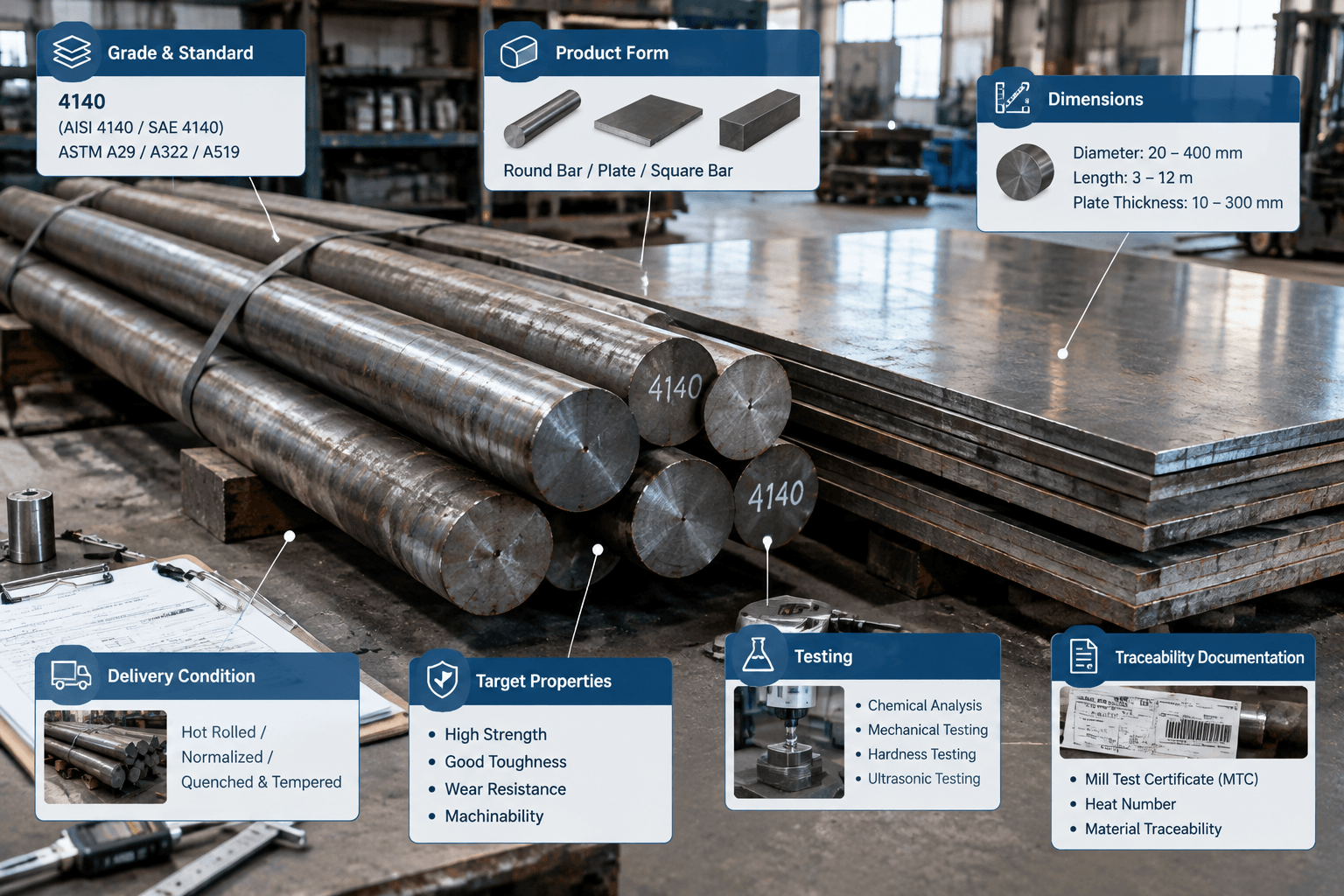
Alloy steel round bar, SAE 4140 to [named product and chemistry standard, current revision], diameter 50 mm, quenched and tempered, final hardness [engineering-approved range], mechanical properties tested in accordance with [specified test standard and sampling location], ultrasonic examination [acceptance class if required], mill test certificate with heat-number traceability, decarburization and surface-finish limits per drawing.
Each bracket marks a decision that must be completed for the actual component. At minimum, specify the governing standard, product form, dimensions and tolerances, delivery condition, target hardness or mechanical properties, heat-treatment responsibility, test methods, sampling location, inspection requirements, certification documents, and heat or lot traceability. If machining follows heat treatment, also state the final dimensional and surface-finish requirements.
Frequently Asked Questions
Is 4140 the same as chromoly steel?
4140 is one specific grade within the broader family commonly called chromoly or chrome moly steel. The term also covers other chromium-molybdenum grades, including 4130, so “chromoly” alone is not a complete material designation.
Is 4140 stainless steel, and does it resist corrosion?
No. 4140 contains chromium for hardenability and mechanical performance, but not enough to behave as stainless steel. It can corrode without suitable environmental control or surface protection.
What hardness can 4140 reach, and why is there no single HRC value?
Its achievable hardness depends on austenitizing, quench severity, section size, geometry, tempering, and test location. High as-quenched hardness is possible, but usable components are normally tempered to obtain the required balance of hardness, strength, ductility, and toughness. The drawing should specify an engineering-approved range and measurement method rather than a generic value.
Is 4140 suitable for gun barrels or other safety-critical components?
Not on the basis of the grade name alone. Suitability depends on the governing component specification, steelmaking route, heat treatment, design stresses, inspection, proof or qualification testing, traceability, and applicable regulations. Approval must come from the responsible engineering and compliance authorities.