
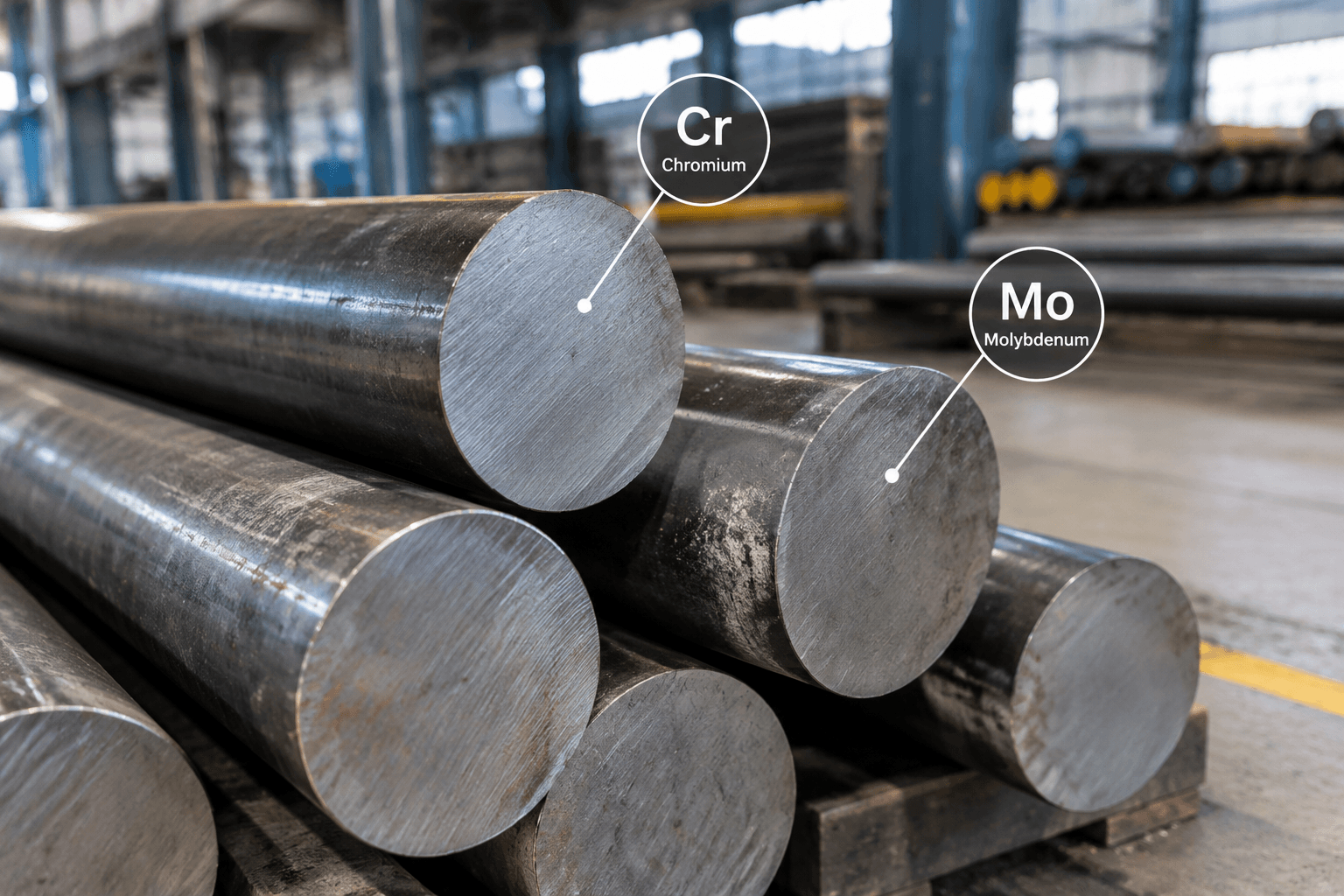
4140 chromoly steel is a medium-carbon, low-alloy steel containing chromium and molybdenum as principal alloying additions. In ordinary usage, “4140 chromoly steel” and “4140 steel” refer to the same grade; chromoly describes its alloy family, not a coating or a separate material specification.
Its properties and suitability depend on product form, governing specification, section size, and heat-treatment condition. The grade name alone does not establish tensile strength, hardness, toughness, or acceptance requirements.
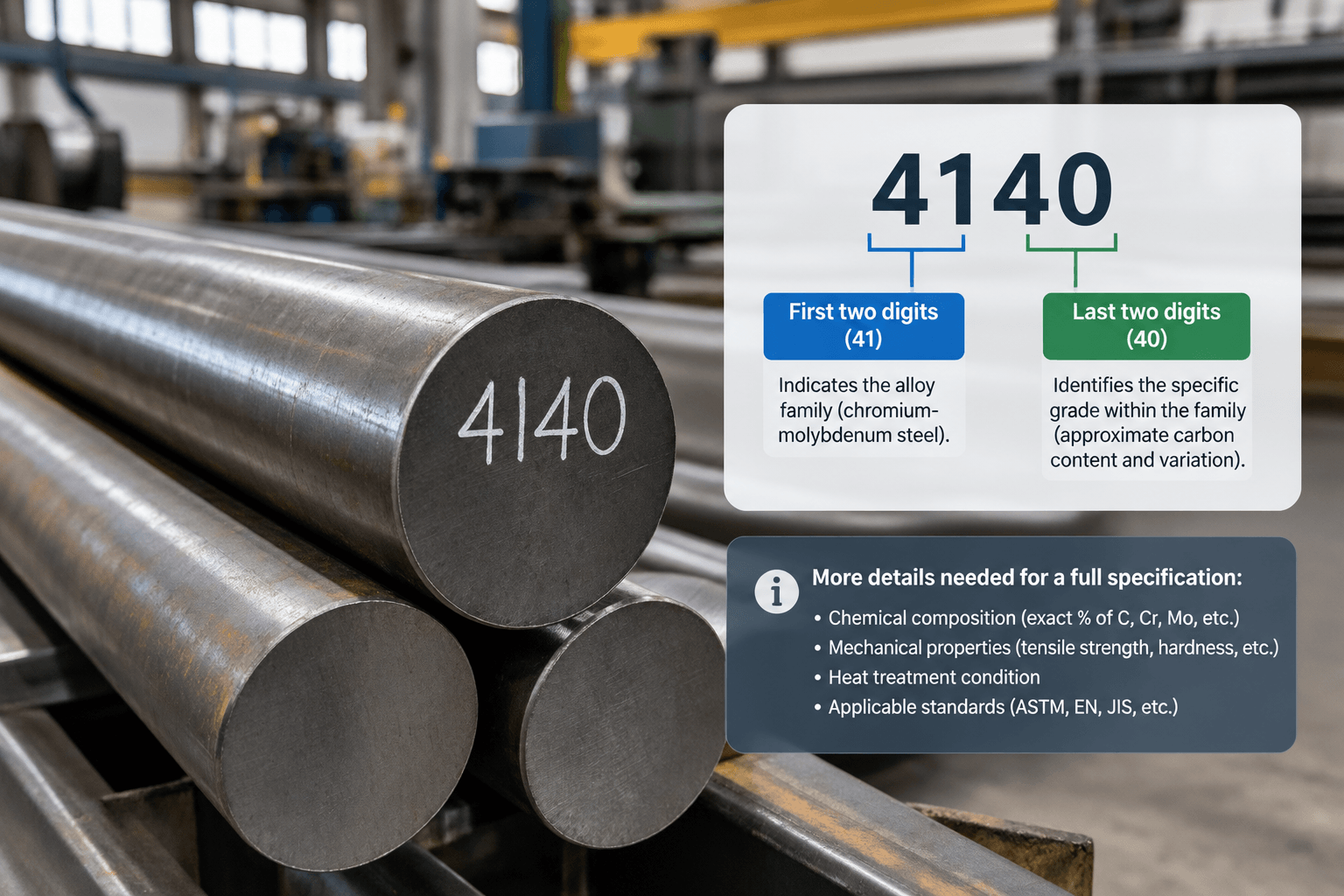
What the 4140 designation tells you
In the SAE designation system, the 41xx series identifies chromium-molybdenum alloy steels. The final two digits indicate nominal carbon content in hundredths of a percent: “40” points to approximately 0.40% carbon. This is a designation convention, not an exact chemistry requirement for every shipment.
4140 is classified as low-alloy steel because its intentional alloy additions are relatively modest compared with highly alloyed steels. “Low alloy” does not mean low carbon, low strength, or poor quality. Carbon and alloy content describe different aspects of the material.
The applicable specification establishes permitted chemistry ranges and other requirements. SAE J404 provides alloy-steel chemistry references, while procurement requirements also depend on the product specification. For example, ASTM A29/A29M addresses general requirements for hot-wrought carbon and alloy steel bars; it should not be treated as a universal specification for every 4140 product.
4140 designation decoder: grade identity versus delivery condition
- 41: Identifies the chromium-molybdenum alloy family.
- 40: Indicates approximately 0.40% nominal carbon.
- Chromoly: An informal description of chromium-molybdenum steel.
- Details stated separately: Product form, governing specification, delivery condition, dimensions, required properties, and inspection documentation.
Consequently, a drawing marked only “4140” communicates a chemistry family but leaves important production decisions unresolved. Round bar, forging, and tubing callouts require specifications appropriate to their respective forms.
What chromium and molybdenum contribute
Chromium and molybdenum help 4140 respond to heat treatment. Their effects work together with carbon content, cooling rate, and tempering; neither element independently guarantees a particular finished property.
| Element | Contribution and qualification |
|---|---|
| Chromium | Increases hardenability, helping suitable sections develop a hardened structure during quenching. It also participates in carbide formation, which can support wear resistance depending on heat treatment. |
| Molybdenum | Increases hardenability and helps resist softening during tempering. It can reduce susceptibility to some forms of temper embrittlement, but processing and impurity levels still matter. |
Hardenability means the ability to develop hardness through a section during suitable cooling. It is different from the hardness measured on a particular delivered piece. A larger section may develop a different surface-to-core property profile from a smaller section given similar processing.
Chromoly is not stainless steel. The chromium content in 4140 is far below that associated with stainless grades, so corrosion protection may still be necessary. It also does not mean chrome plating: plating is a separately specified surface treatment, whereas chromium in 4140 is part of the bulk alloy.
Why published 4140 properties differ
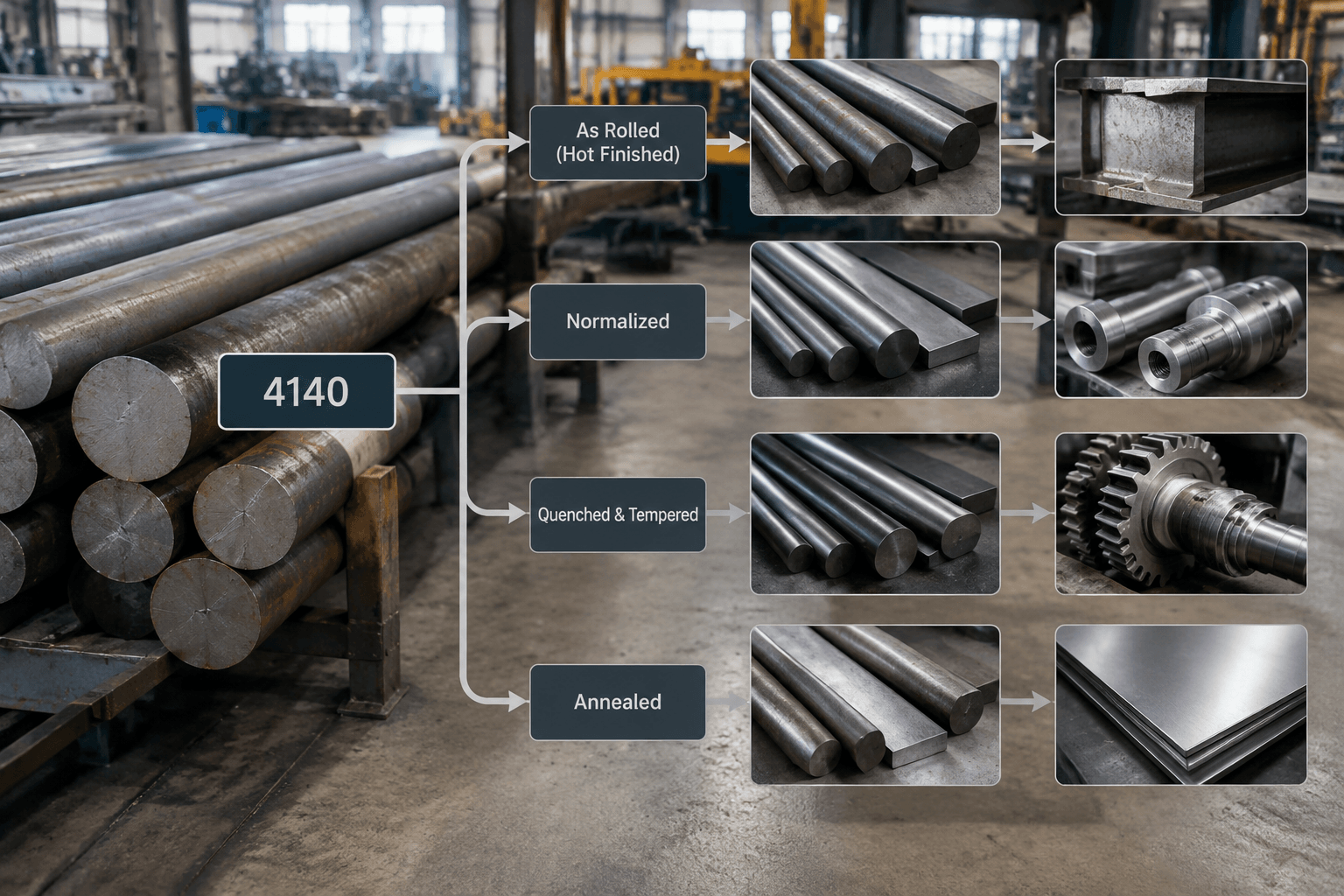
A useful 4140 chromoly steel properties table must identify the condition behind its figures. Annealed stock and quenched-and-tempered stock can share a grade designation while having substantially different strength, hardness, and machining behavior.
| Material condition | Typical relationship to properties | What needs confirmation |
|---|---|---|
| Annealed | Generally softer and more ductile than hardened conditions, often supporting machining before final heat treatment. | Annealing condition, specified hardness, and later processing requirements. |
| Normalized | Can provide a more uniform structure; properties depend on section size and cooling conditions. | Actual mechanical requirements and whether normalizing is the final condition. |
| Quenched and tempered | Can provide higher strength, with the strength-toughness balance influenced by tempering and quench response. | Required strength or hardness, toughness criteria, section size, and test location. |
| Supplier-described “prehard” | Usually indicates stock supplied already hardened and tempered for subsequent machining. | The supplier’s actual hardness range and specification; the label alone is insufficient. |
Strength and hardness often rise together within comparable conditions, but toughness does not follow a universal conversion. Toughness depends on microstructure, temperature, loading, and the test used. An impact result also needs its specimen size, orientation, test temperature, and sampling location to be meaningful.
Similarly, a tensile result from a small test specimen does not automatically establish properties throughout a thick component. Product form and manufacturing history can affect grain flow, residual stress, and consistency across the section.
Machinability ratings require context too. Harder stock generally demands different tooling and cutting conditions, while softer stock may produce less manageable chips. For custom CNC machining of parts specified in 4140 steel, confirm the incoming condition and whether final heat treatment occurs before or after machining. Post-machining heat treatment may require allowance for distortion and finishing.
Welding is a separate consideration. Carbon content, hardenability, section thickness, restraint, and existing heat treatment influence cracking risk and local property changes. A machining-friendly delivery condition does not establish weldability; the application needs an appropriately qualified welding approach.
Same-grade terminology and international equivalents
Naming misconception: “4140 chromoly” is a stronger version of “4140.” Reality: These normally name the same grade. Differences in reported performance usually reflect condition, product form, or specification rather than the extra word.
Equivalence misconception: A cross-reference proves that two grades are interchangeable. Reality: Cross-references identify comparison candidates. EN-designated 42CrMo4 and JIS-designated SCM440 are commonly compared with 4140, but their chemistry limits and product requirements must be checked under the applicable specifications.
To assess a proposed 4140 chromoly steel equivalent, compare these requirements:
- Chemistry: Permitted ranges for carbon, chromium, molybdenum, manganese, and controlled residual elements.
- Product scope: Whether the specifications cover the same form, size range, dimensional tolerances, and surface condition.
- Delivery condition: Annealed, normalized, or quenched and tempered, with any required property range.
- Acceptance evidence: Mechanical tests, sampling rules, inspection requirements, and material documentation.
If requirements differ, engineering review must determine whether the alternative meets the component’s needs. A similar name or overlapping chemistry is insufficient justification for substitution.
Consider a hypothetical shaft for equipment in an automotive or transportation assembly. Material screening would consider fatigue loading, stress concentrations, section size, and final condition. A grade suitable for one shaft design may fail another design’s requirements even when both drawings say “4140.”
Build a material callout that defines acceptance
A complete callout connects grade identity to the condition and evidence needed for the component. The following is an illustrative structure, not a finished specification:
Material: SAE 4140 round bar to [applicable product specification and revision]; supplied [specified condition]; stock dimensions [defined]; final mechanical requirements [defined, with test method and location]; inspection and material documentation [defined]; substitutions subject to engineering approval.
Replace every bracketed field before release. Specify whether mechanical requirements apply to incoming stock or the finished component. Where hardness is used for acceptance, identify the scale, measurement location, and permitted range. If toughness is necessary, define the relevant test conditions rather than requesting “high toughness.”
Documentation should match the acceptance requirements. Material certificates can establish reported chemistry, condition, and test results when those items are required. Heat or lot identification supports traceability. Chemistry verification alone cannot prove heat-treatment condition, and hardness testing alone cannot establish toughness.
For an OEM or ODM manufacturability review with Yishang, provide the part drawing, required material specification and condition, product form and dimensions, critical mechanical or inspection requirements, and expected quantity. These details support a consistent manufacturing review; material-selection approval remains with the responsible engineer.
Frequently Asked Questions
What does low alloy mean in 4140 steel?
It means 4140 contains relatively modest intentional alloy additions, including chromium and molybdenum. The term distinguishes its alloy class; it does not specify carbon level, delivered hardness, or component performance.
Is 4140 chromoly steel the same material as 4140 steel?
Yes, in ordinary usage. “Chromoly” describes the chromium-molybdenum alloy family. Confirm the governing specification and condition because informal naming does not define all purchasing requirements.
What is the tensile strength of 4140 chromoly steel?
There is no single value covering every form and condition. Use data tied to the specified heat treatment, section size, and testing requirements. Published typical values should not become acceptance limits without engineering review.
Is 4140 steel suitable for gun barrels?
The grade name alone cannot establish suitability. A qualified designer must evaluate the governing specification, material condition, pressure and fatigue loads, geometry, manufacturing route, inspection, and validation requirements for the particular application.
Before requesting a manufacturing review, check that your drawing defines both “4140” and its required condition. Include the supporting material and inspection requirements so the review can address the actual component.