
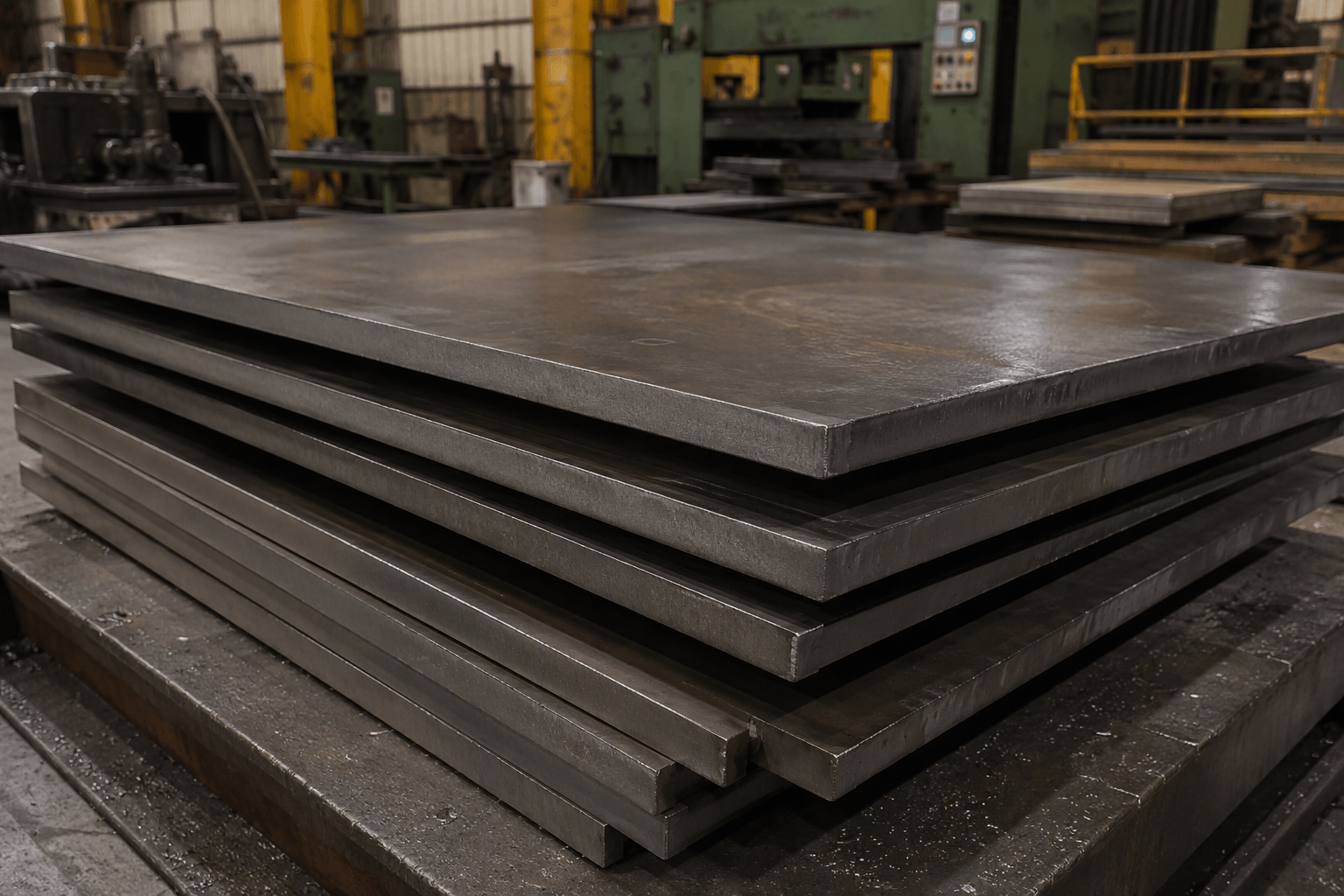
4140 yield strength is not a single fixed value. It depends chiefly on the steel’s delivery condition, heat treatment, section size, and the specification or test method used to report it. AISI 4140 is a chromium-molybdenum alloy steel, and its strength can differ substantially between annealed, normalized, and quenched-and-tempered material.
For design or purchasing, treat a published value as a reference for a stated condition, not as a guarantee for every 4140 bar, plate, or finished component. The material test report and the requirements attached to the ordered product are more relevant than a general-purpose chart.
What does 4140 yield strength mean?
Yield strength is the stress at which a material begins to deform permanently under a specified test. Below the yield point, a component generally returns toward its original shape after the load is removed, assuming it has not experienced other damage. Once stress exceeds yield, some deformation remains. The exact reported value depends on how the test defines and measures the yield point; for many steels, a specified offset method is used when there is no sharply defined yield point.
Yield strength is usually reported in megapascals (MPa) or kilopounds per square inch (ksi). As a unit conversion, 1 ksi is approximately 6.895 MPa. The conversion does not make values from different material conditions or tests directly comparable: the product condition and test basis still matter.
Yield strength is also not the same as tensile strength, hardness, or fatigue strength. Ultimate tensile strength is the maximum engineering stress reached during a tensile test; hardness measures resistance to localized indentation. Fatigue behavior concerns repeated or fluctuating loads and depends on factors including surface condition, geometry, residual stress, and loading history. A high yield-strength figure alone cannot establish that a part will resist fatigue, fracture, wear, or corrosion in service.
Why 4140 values vary by condition
4140 is a medium-carbon alloy steel containing chromium and molybdenum. Its composition supports hardening through heat treatment, but the resulting mechanical properties are not determined by the grade name alone. A 4140 product may be supplied annealed, normalized, or quenched and tempered, among other conditions. Each condition describes a different processing history and can produce a different balance of strength, hardness, and ductility.
Annealing is commonly selected to soften the material and improve workability. Normalizing uses heating and cooling intended to produce a more uniform structure than some as-processed conditions. In quenching and tempering, the steel is heated, rapidly cooled, then reheated to a lower temperature. The chosen temperatures, section dimensions, and process controls affect the final properties. A harder or stronger result is not automatically the better result: increased strength can come with reduced ductility or toughness, depending on the condition and component.
Section size matters because the core of a thick product may not cool at the same rate as its surface during quenching. The resulting through-section properties can therefore differ from those of a small test specimen or a thinner product. Processing route, product form, and the location from which a test sample is taken are relevant when interpreting reported values.
For these reasons, an unqualified statement such as “4140 has a yield strength of X” is incomplete. A useful value should be tied to the product condition and the applicable material requirements, with a test result or documented property range where needed.

Reference values are condition-specific
A commonly reported typical yield strength for annealed 4140 is approximately 415 MPa (60 ksi). This is a reference value, not a guaranteed minimum for all annealed products. Quenched-and-tempered 4140 can have substantially higher yield strength, but the value must be tied to the tempering condition and section size. Published figures vary because sources may describe different product sizes, tempering conditions, sampling locations, or acceptance requirements. A single value copied from a chart should not be used as a purchasing requirement without checking its basis.
Use the following comparison as a way to organize a material review, not as a substitute for a product specification:
| Condition | What to expect | What to verify |
|---|---|---|
| Annealed | Typically selected for workability; strength is lower than in many hardened conditions. | Product form, stated mechanical-property range, and any subsequent heat treatment. |
| Normalized | Properties differ from annealed material and depend on the normalizing cycle and section. | Whether the reported value applies to the actual supplied dimensions and requirement. |
| Quenched and tempered | Can provide higher strength, with the outcome dependent on the quench, temper, and section size. | Specified minimum or range, test evidence, hardness requirements, and sampling basis. |
Some references give high yield-strength figures for particular 4140 heat-treated conditions. Those figures should not be presented as a universal grade capability. Before using a number for design or acceptance, identify the corresponding product form, dimensions, heat-treatment condition, test method, and whether the value is a typical result or a required minimum. If these details are absent, the figure is not enough to qualify a material lot.
How to use the value in a design or purchase review
Start with the loading and failure mode. If the key concern is permanent deformation under a static load, yield strength is a relevant design input. The engineer still needs to account for stress concentrations, load direction, component geometry, temperature, and the applicable design factors. If the part sees repeated loading, impact, elevated temperature, or a corrosive environment, yield strength alone is not a sufficient selection criterion.
Next, write down the required condition rather than naming only the grade. For example, a drawing or purchase specification may need to identify whether the material is to be supplied in a defined heat-treated condition and what mechanical properties must be met. Do not assume that a supplier’s “4140” description means the same condition as the one used in a design calculation.
When reviewing a certificate or test report, check that the heat or lot identification matches the supplied material and that the reported values relate to the ordered product and condition. Confirm the units and test location if stated, distinguish specified minimums from measured results, and check that the measured values meet the ordered requirements. If the document lists hardness but not yield strength, do not treat hardness as a direct replacement unless an accepted specification or engineering method supports that conversion for the material and condition in question.
For a machined component, distinguish the properties of the starting stock from those of the finished part. Machining does not itself establish the bulk yield strength, and later heat treatment can change the material properties and dimensions.
For an application review, provide the drawing, specified material and heat-treatment condition, quantity, critical tolerances, finish requirements, and required yield strength. These details help clarify manufacturability and project requirements. State whether the strength requirement applies to the supplied stock or the finished component. Request an application review with Yishang.
Comparing 4140 with other steels
Questions such as “Is 4140 stronger than A36?” do not have a complete answer without specifying the condition and the property being compared. A36 is commonly used as a structural carbon steel designation, while 4140 is an alloy steel that is often selected for applications requiring heat-treatment options. Compare the actual yield requirements for the supplied conditions, not an alloy name against a grade name in the abstract.
The same caution applies to 4340, stainless steels, and grade 8 fasteners. Each may refer to a different composition, product form, heat treatment, and set of mechanical-property requirements. A comparison is useful only when both materials are evaluated on the same basis and for the intended service conditions. Strength is only one consideration; toughness, corrosion resistance, machinability, availability, joining method, and total processing route can change the practical choice.
Frequently Asked Questions
What is the yield strength of AISI 4140?
There is no single yield-strength value for AISI 4140. It varies with delivery condition, heat treatment, product dimensions, and test basis. Use a value tied to the actual ordered condition and verify it against the material documentation.
What is the yield strength of annealed 4140 in MPa and ksi?
A commonly reported typical value is approximately 415 MPa (60 ksi). Treat it as a reference for annealed material, not a guaranteed minimum. Confirm the applicable product specification and material test report before using it for design or acceptance.
Can hardness confirm the yield strength of 4140?
Hardness alone does not verify a specified yield strength. Hardness-to-strength correlations depend on the material and condition, and many estimate tensile strength rather than yield strength. If yield strength is an acceptance requirement, specify the required tensile-test evidence or an explicitly permitted verification method.
Does quenching and tempering always increase 4140 yield strength?
Quenching and tempering can produce higher-strength 4140 conditions, but the result depends on the process and section size. It can also change ductility and toughness. Confirm the required properties from the applicable specification or test evidence rather than assuming a guaranteed increase.