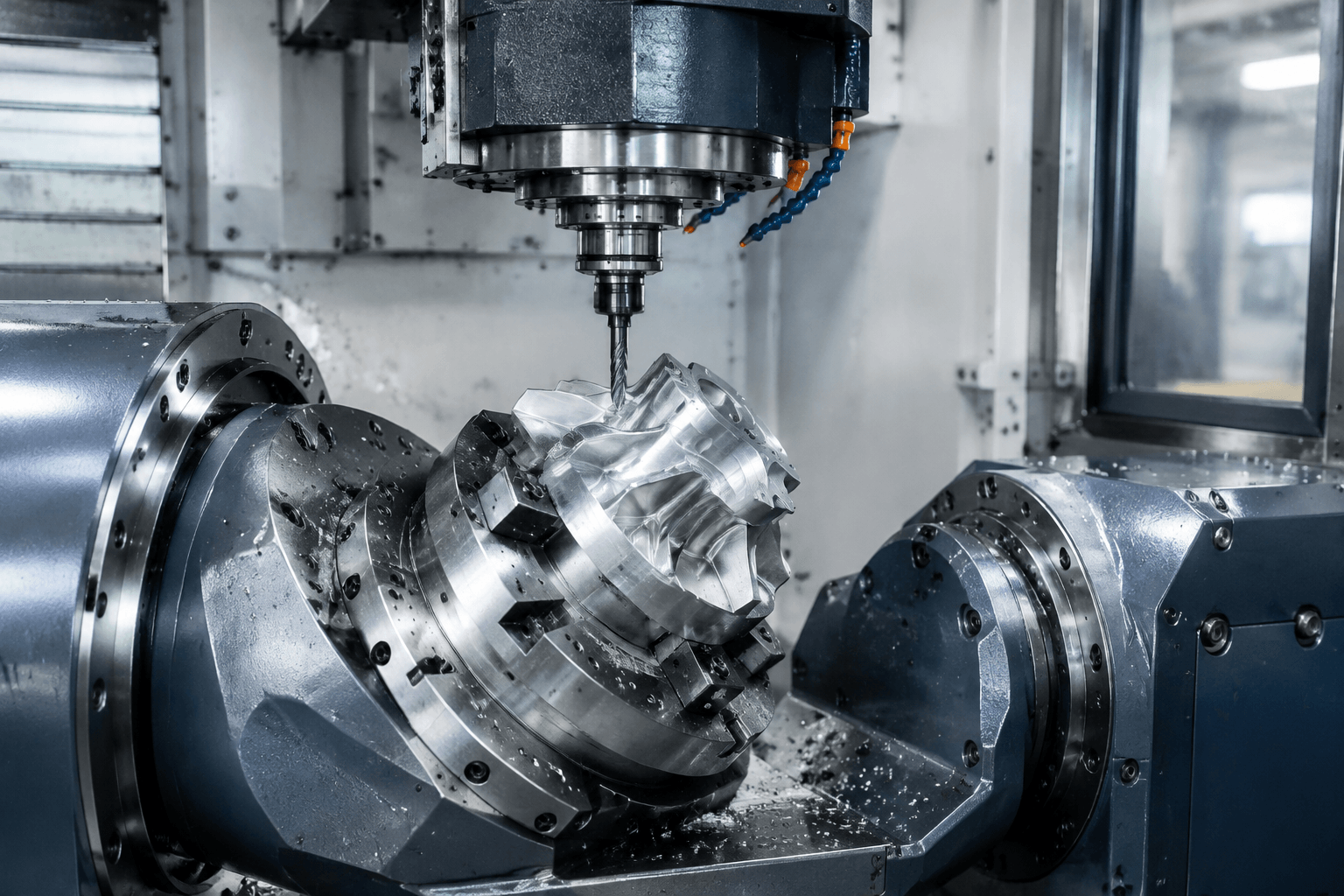
A credible 5 axis machine shop should demonstrate more than ownership of a machine described as five-axis. Buyers should verify whether the shop performs simultaneous or indexed machining, whether its work envelope and spindle configuration suit the part, how it controls tolerances and surface requirements, and whether it can support the required material and production stage.
The term identifies a machining capability, not a guaranteed result. A suitable supplier should explain its process and provide evidence that connects equipment, programming, inspection, and production control to the specific component being considered.
What the 5 Axis Machine Shop Label Actually Tells You
In practical terms, a 5 axis machine shop uses CNC equipment that can control three linear axes and two rotary axes. This allows the cutting tool and workpiece to be repositioned from multiple directions. The benefit may be better access to angled faces, deep features, contoured surfaces, and complex geometry with fewer manual setups.
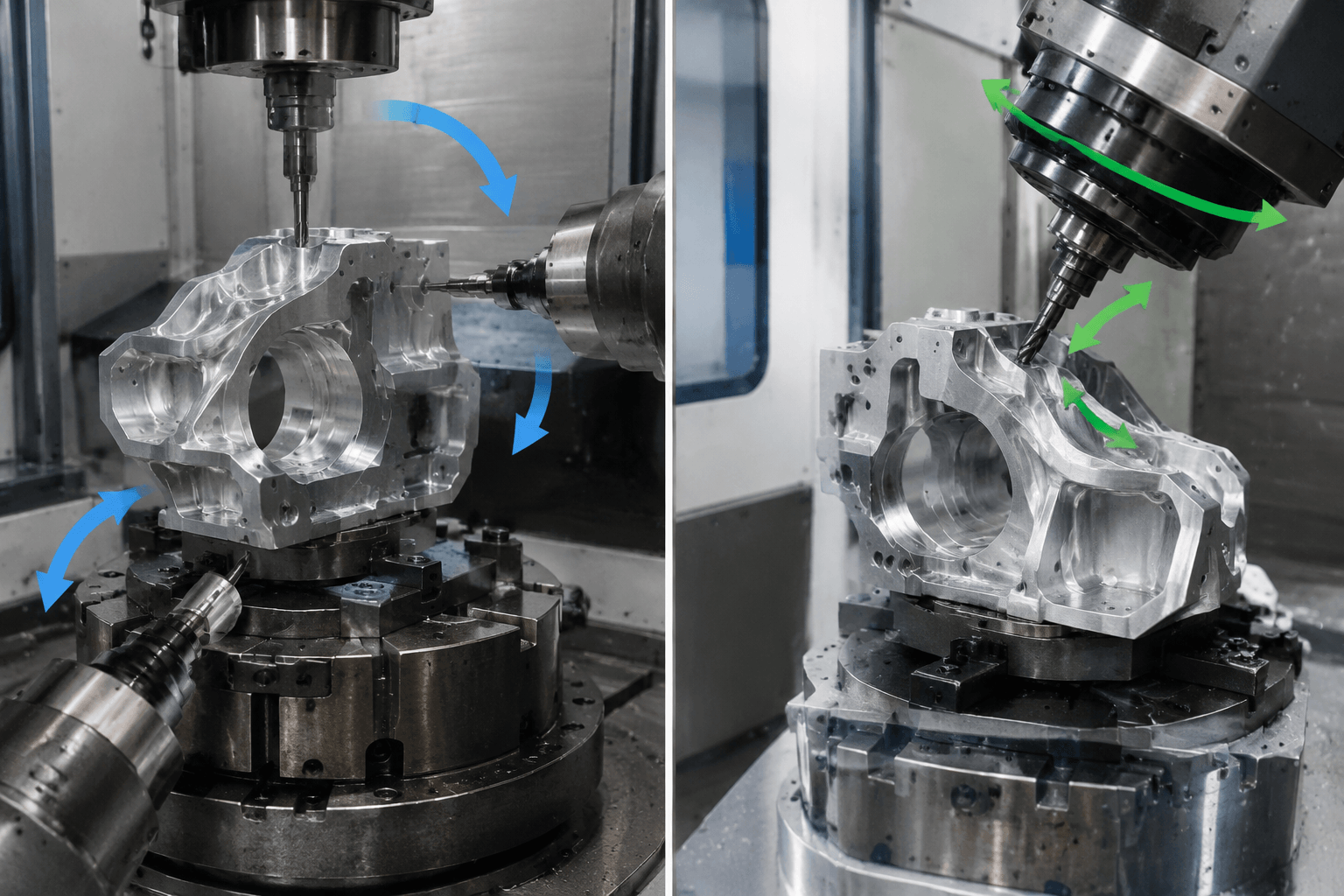
However, five-axis capability does not explain how the machine is used. Some shops use simultaneous 5 axis machining, where several axes move during the cutting operation. This approach can support continuous tool access around a contoured part and may reduce abrupt tool-angle changes. Other shops use indexed, or positional, 5 axis machining. The rotary axes position the part, then the machine cuts with the linear axes before indexing to another orientation.
Neither mode is automatically right for every part. Indexed machining may be suitable for a component with several angled faces, while simultaneous motion may be relevant to continuously curved surfaces or challenging tool access. The supplier should identify which method is proposed for your geometry and explain the expected setup strategy.
A useful capability discussion should also address part size, fixture access, tool reach, material, feature depth, and chip evacuation. Ask for generic examples of geometry the shop is equipped to handle, such as angled bores, impellers, deep cavities, compound curves, or parts requiring multiple face orientations. These are capability examples, not proof that a particular supplier has produced your component successfully.
Compare Equipment and Machining Approach on the Same Basis
Supplier websites often describe equipment inconsistently. A comparison becomes more meaningful when every shortlisted shop answers the same technical questions.
| Evidence to request | Why it matters | Buyer’s follow-up question |
|---|---|---|
| Machine configuration | Shows whether the equipment uses a rotary table, trunnion, swivel head, or another axis arrangement. | Which configuration is best suited to this part and its required access angles? |
| Simultaneous or indexed operation | Clarifies how the additional axes are used during cutting. | Will the quoted process use continuous 5 axis motion, indexed positioning, or both? |
| Work envelope and load limits | Determines whether the component, fixture, and tool clearances fit the machine. | What are the usable limits after allowing for workholding and tool access? |
| Spindle and tooling information | Relates to material suitability, cutter selection, rigidity, and achievable cutting conditions. | Is the spindle and tooling strategy appropriate for the specified alloy, hardness, and feature size? |
| Workholding and setup plan | Influences access, repeatability, distortion risk, and the number of setups. | How will the part be supported and datum-referenced between operations? |
| Programming and simulation approach | Helps identify how collision risk, tool orientation, and surface transitions are controlled. | How will the toolpath be reviewed for collisions, gouging, and inaccessible features? |
Work envelope should be treated as usable machining space, not simply the manufacturer’s headline travel. A fixture, rotary unit, toolholder, and part orientation can reduce practical access. The supplier should confirm clearance around the largest feature and explain how the component will be loaded and referenced.
Spindle speed alone is not a sufficient comparison. Rigidity, torque, tooling, coolant strategy, material condition, and the geometry of the cut all affect the process. Ask the shop to review the drawing or 3D model before making a capability statement.
Keep process boundaries clear when comparing offers. 5 axis machining normally refers to CNC milling and does not automatically include CNC turning. Turning uses a rotating workpiece and cutting tool arrangement and may be the better process for cylindrical shafts, sleeves, or rotational features. A part may require both milling and turning, but the supplier should state which operation is performed in-house and which is subcontracted, if relevant.
The same distinction applies to other services. Sheet metal fabrication generally involves cutting, bending, forming, and joining sheet or plate. Welding joins components, finishing changes the surface condition, and assembly combines separate parts. These operations can support a machined product, but they are not evidence of 5 axis milling capability.
Ask How the Shop Verifies the Finished Part
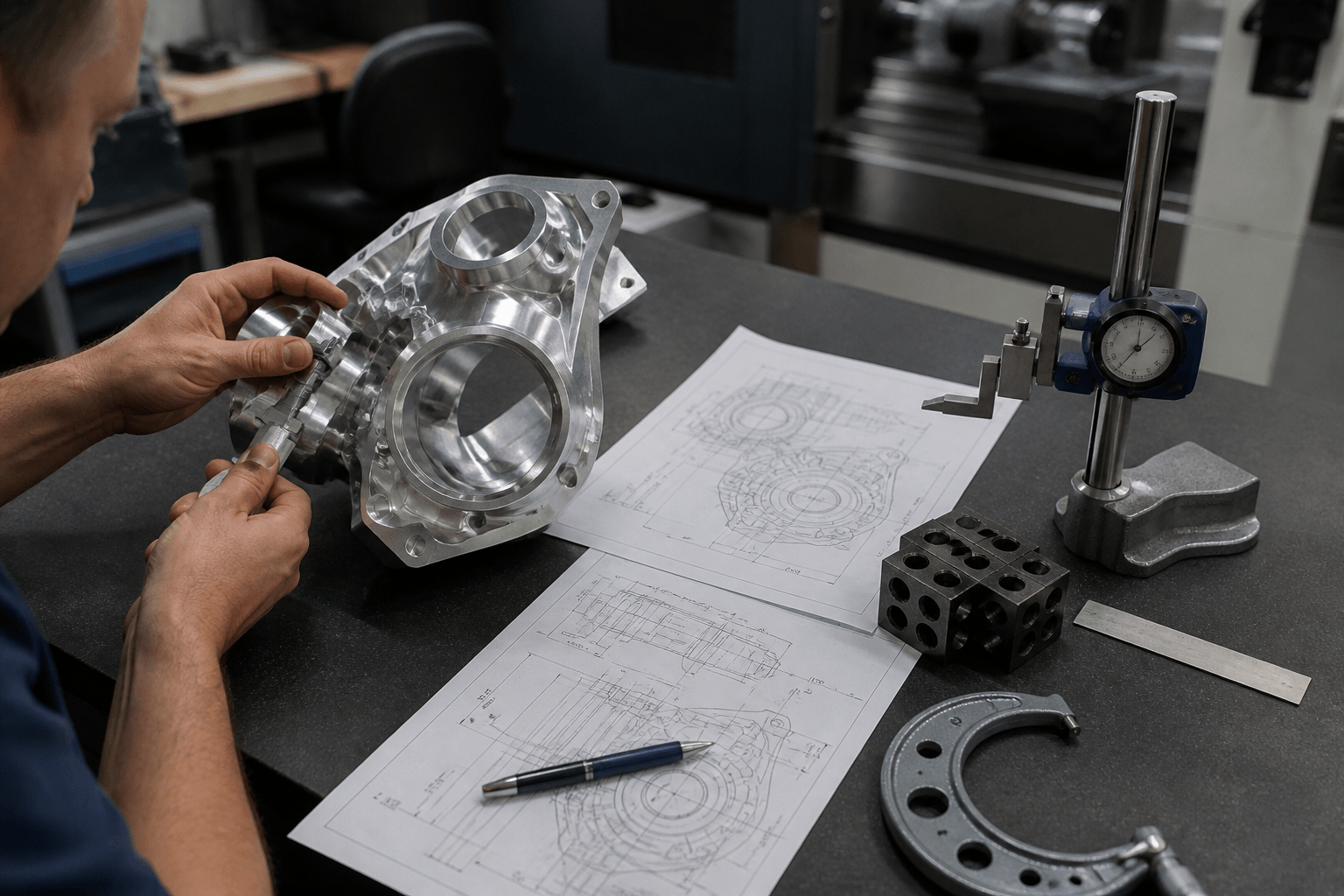
A technically capable machine is only part of the quality system. The supplier must also show how it establishes datums, measures critical features, records results, and manages revisions.
Start by separating three types of information:
- Specified requirement: the tolerance, surface-finish callout, geometric control, material condition, or inspection requirement shown on the drawing.
- Process capability: the range the supplier can normally achieve for a defined material, feature, machine, setup, and production condition.
- Inspection result: the measured evidence from the actual part or production lot.
Do not accept a broad statement such as “high precision” as a substitute for these distinctions. Ask whether the supplier can review the critical dimensions and identify which features require special control. A tolerance that is practical on one geometry may require a different setup, tool strategy, temperature control, or inspection method on another.
Useful questions include:
- Which dimensions or geometric tolerances will be treated as critical?
- How will the part be aligned to the drawing datums during inspection?
- What measurement method will be used for size, position, profile, or surface condition?
- Can the supplier provide an inspection report, first-article report, material certificate, or other requested records?
- How are drawing revisions, nonconforming parts, rework, and final approval controlled?
Request current, verifiable quality credentials when they are relevant to your purchasing requirements. A certification should be connected to the applicable business or facility, and its scope and validity should be confirmed directly. Do not infer a specific standard or regulated-industry approval from a general quality statement.
Surface finish also requires a defined requirement. Visual appearance, roughness measurement, deburring, edge condition, coating, anodizing, plating, and painting are different concerns. Confirm whether the 5 axis shop machines the required finish, measures it, or sends the part for a separate finishing operation. The final result may depend on the full process chain rather than on the milling operation alone.
Match Material and Production Stage to the Supplier
Material compatibility is more specific than a list of metals on a website. Ask whether the shop has relevant experience with the exact alloy or material family, its hardness or temper, stock form, and any special handling requirements. Aluminum, stainless steel, tool steel, titanium, engineering plastics, and other materials place different demands on cutting parameters, workholding, heat control, tooling, and finishing.
Material condition matters as well. A thin-wall component may move during machining; a hardened material may require different tooling; and a large stock allowance may change the roughing and finishing sequence. A useful supplier review considers the drawing, model, raw material specification, and critical features together.
Production stage should be discussed separately:
- Prototype work: The priority may be design feedback, manufacturability review, clear documentation of deviations, and a practical first-part process.
- Low-volume work: Setup efficiency, fixture cost, programming reuse, material purchasing, and repeatable inspection may have a greater effect on commercial suitability.
- Repeat production: The supplier should explain how programs, tooling, revision control, inspection plans, and replenishment scheduling will be maintained over time.
A shop that can make one prototype is not automatically prepared for repeat production, and a production-oriented supplier may not be the most economical choice for a one-off development part. Confirm available capacity, scheduling assumptions, minimum order expectations, and how priorities are handled rather than assuming them from a capability list.
For buyers comparing machining with fabricated assemblies, remember that a machined component may still need deburring, coating, welding, hardware installation, or final assembly. Ask which steps are included in the supplier’s responsibility and which must be coordinated separately. Yishang has more than 26 years of experience manufacturing custom sheet metal parts and metal products, serves OEM and ODM projects, and exports to more than 50 countries; its broader custom CNC machining service information can help buyers understand how a machining discussion relates to prototype and repeat-production requirements. Those facts do not by themselves establish a specific 5 axis machine capability, so the part-level review remains necessary.
5 Axis Machine Shop Comparison: Evidence to Request From Each Supplier
Use the following worksheet during supplier calls or quotation reviews. Record the answer, the supporting document, and any unresolved gap rather than marking a capability as verified based only on a website description.
- Machining mode: Is the work simultaneous 5 axis, indexed 5 axis, or a combination? Which method applies to the submitted part?
- Equipment fit: What machine configuration, usable work envelope, load limit, spindle characteristics, and tooling approach will be used?
- Geometry and setup: Which features require rotary access? How many setups are expected? How will datums and thin or flexible areas be supported?
- Material fit: Has the supplier reviewed the specified alloy, temper, hardness, stock form, and any material certificates?
- Quality evidence: Which tolerances and surface requirements are critical? What inspection method and report format are available?
- Production fit: Is the supplier prepared for a prototype, low-volume order, or repeat schedule? What capacity and continuity assumptions need confirmation?
- Additional operations: Are turning, sheet metal fabrication, welding, finishing, or assembly required? Which party will perform and verify each operation?
- Open issues: Which capabilities remain unconfirmed, and what drawing, model, sample, or document would resolve them?
Before the first technical conversation, provide the part drawing or 3D model, material and material condition, estimated quantity, production stage, critical tolerances, important surface requirements, inspection expectations, and documentation needs. Also state the delivery context without assuming that a supplier’s standard schedule or capacity will match your project.
Ask the shop to explain its proposed setup strategy, process risks, inspection plan, and continuity plan in terms of your component. This encourages a useful technical discussion and makes different suppliers easier to compare. The strongest response is not necessarily the one with the most impressive equipment list; it is the one that clearly connects the proposed process to the part’s geometry, requirements, and lifecycle.
Frequently Asked Questions
What is the difference between simultaneous and indexed 5 axis machining?
Simultaneous machining moves multiple axes during cutting, which can support continuous tool orientation around complex contours. Indexed machining uses the rotary axes to position the part before a cutting operation, then indexes to another orientation. The appropriate method depends on geometry, access, tolerance, tooling, and the supplier’s process plan.
Can a 5 axis machine shop handle both prototype and repeat-production work?
Some can, but the capability should be confirmed directly. Prototype work may emphasize rapid design feedback and first-part inspection, while repeat production requires stable programs, revision control, tooling management, inspection records, and scheduling continuity. Ask the supplier to describe its workflow for the specific production stage.
What machine and inspection details should be requested before selecting a shop?
Request the machine configuration, usable work envelope, load limits, spindle and tooling information, workholding plan, machining mode, and programming approach. For quality, request the proposed datum strategy, inspection method, applicable capability information, report format, and document-control process.
Does a 5 axis capability claim also cover turning, finishing, welding, or assembly?
No. A 5 axis claim normally refers to a CNC milling process. Turning, finishing, welding, sheet metal fabrication, and assembly are separate operations. They may be available from the same supplier or coordinated through partners, but each operation and its quality responsibility should be identified separately.
For a capability review, send the drawing or 3D model together with the material and material condition, estimated quantity, production stage, critical tolerances, surface-finish requirements, inspection expectations, and documentation requirements. This gives the manufacturing team enough context to determine whether the requested component fits the available CNC machining workflow and to identify the questions that must be resolved before the next commercial step.