
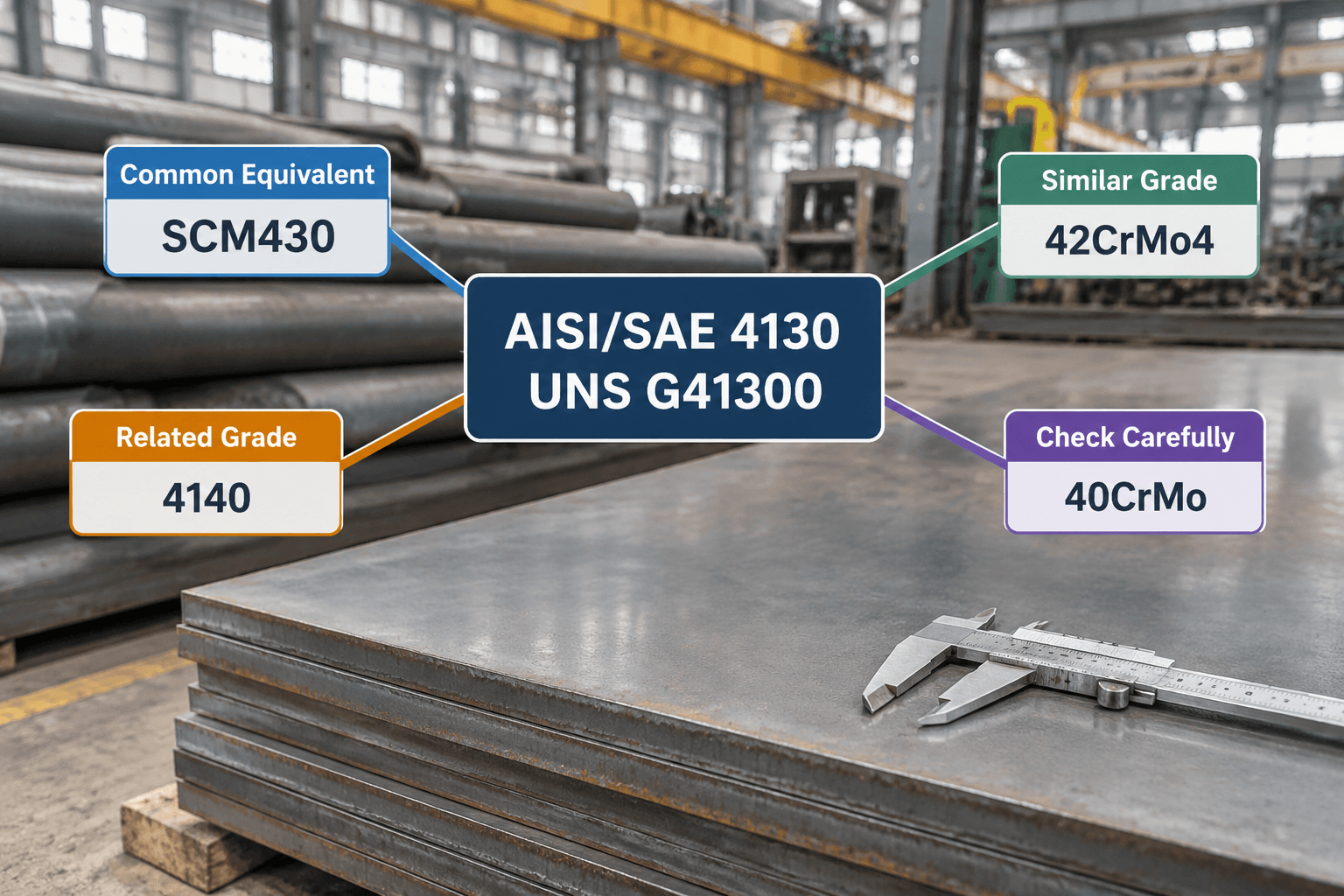
The closest recognized identifiers for AISI 4130 are SAE 4130 and UNS G41300, but there is no universally interchangeable AISI 4130 equivalent across all standards and product forms. SCM430 is a comparable Japanese chromium-molybdenum grade, but substitution is not automatic because its specified chemistry ranges differ. EN 1.1181/C35E is a medium-carbon, non-alloy steel and should not be approved as a direct 4130 replacement without application-specific engineering evidence.
An equivalency decision must consider more than a grade name. The governing material standard, product form, dimensions, delivery condition, heat treatment, mechanical properties, testing requirements, and material certificate must all support the intended application.
Which Designations Are Actually Equivalent to AISI 4130?
AISI 4130 is a chromium-molybdenum low-alloy steel designation historically associated with the American Iron and Steel Institute system. SAE 4130 identifies substantially the same grade family through the SAE designation system, while UNS G41300 is its corresponding Unified Numbering System identifier. Official and industry documents commonly place 4130 and G41300 together. ([saemobilus.sae.org](https://saemobilus.sae.org/standards/j404_199102-chemical-compositions-sae-alloy-steels?utm_source=openai))
These identifiers do not, by themselves, define a complete purchasing specification. A drawing that says only “4130 steel” may leave unanswered questions about whether the material is sheet, plate, bar, forging, seamless tube, welded tube, or another product. It may also omit the required condition, dimensional standard, testing method, and mechanical properties.
SCM430 is frequently proposed as the Japanese comparison because it belongs to the same general chromium-molybdenum alloy family and has a similar carbon range. However, JIS requirements are not identical to SAE chemistry limits. SCM430 should therefore be described as a comparable grade requiring verification, not as an unrestricted alias.
The same caution applies to European, British, Chinese, and other regional cross-reference charts. A chart may help engineers identify candidates, but it cannot replace a clause-by-clause comparison of the standards specified on the drawing and purchase order.
Designation Map and Chemistry Comparison
The following table separates recognized identifiers from grades that are merely comparable or sometimes confused with 4130. Composition values are nominal standard ranges by mass and should be checked against the current edition of the applicable purchasing standard.
| Designation | System or standard context | Relationship to AISI 4130 | Important qualification |
|---|---|---|---|
| AISI 4130 / SAE 4130 | US alloy steel designation; chemistry commonly defined through SAE J404 or an applicable product specification | Recognized grade designation | Does not define product form, condition, dimensions, testing, or guaranteed mechanical properties by itself |
| UNS G41300 | Unified Numbering System | Corresponding UNS identifier | Still requires a product and delivery specification |
| SCM430 | JIS G4053 machine-structural alloy steel | Comparable, not automatically interchangeable | Contains different allowable Mn, Cr, and Mo ranges |
| EN 1.1181 / C35E | EN ISO 683-1 and related European product standards | Not a direct chemical equivalent | C35E is a medium-carbon, non-alloy steel without the required minimum chromium and molybdenum content of 4130 |
| Reynolds 520 | Branded, cold-worked and butted tubing product | Related 0.30% carbon Cr-Mo tubing product | The brand describes finished tubing with controlled profiles and processing, not a universal replacement for every generic 4130 product |
Typical SAE 4130 chemistry includes carbon at 0.28–0.33%, manganese at 0.40–0.60%, chromium at 0.80–1.10%, and molybdenum at 0.15–0.25%. The cited JIS G4053 data for SCM430 specifies the same 0.28–0.33% carbon range but allows manganese at 0.60–0.90%, chromium at 0.90–1.20%, and molybdenum at 0.15–0.30%. ([static1.squarespace.com](https://static1.squarespace.com/static/677d87c404e5393add2a5270/t/67ee9f01d378de13026819bb/1743691521156/GSM%2B4130%2BAlloy%2BData%2BSheet.pdf?utm_source=openai))
Those ranges overlap substantially, but they are not identical. A heat complying with SCM430 could contain manganese, chromium, or molybdenum outside the SAE 4130 limits. Conversely, material compliant with SAE 4130 may not satisfy every SCM430 chemistry requirement. Similar average composition is therefore insufficient proof of dual certification.
C35E demonstrates why internet equivalency tables require caution. Its standard chemistry includes approximately 0.32–0.39% carbon, but chromium and molybdenum are limited as residual or maximum elements rather than intentionally required alloy additions. It is fundamentally different from a Cr-Mo grade whose hardenability and heat-treatment response depend on specified chromium and molybdenum levels. ([panel.bimekscelik.com](https://panel.bimekscelik.com/DOC/uploads/F1393/Urun/12307/066ecb4d-7bfb-4095-854d-6df3b904bf3c_KV35-R35PB_C35E-Nr.1.1181-C35R-Nr.1.1180-ENG.pdf?utm_source=openai))
What Must Match Beyond Chemical Composition?
Governing standard. The standard establishes what the supplier is certifying. SAE J404 addresses chemical compositions, while standards for bars, tubing, sheet, plate, forgings, or aerospace-quality material may add dimensional, quality, testing, surface, and heat-treatment requirements. Two certificates showing “4130” can represent different deliverables if they cite different standards.
Product form. Bar, plate, sheet, welded tube, seamless tube, and forging stock do not share one universal dimensional or mechanical-property specification. A tube specification may control wall thickness, eccentricity, flattening, flare performance, or hydrostatic testing. A bar specification may instead emphasize diameter tolerance, decarburization, straightness, and hardenability.
Delivery condition. Annealed, normalized, hot-rolled, cold-drawn, quenched-and-tempered, and stress-relieved material can behave very differently during cutting, machining, bending, welding, and service. Cold work can increase strength while reducing ductility. Heat treatment changes hardness and mechanical properties even when chemistry remains unchanged.
Section size and heat-treatment response. Mechanical properties depend on thickness or diameter, heat-treatment temperature, quenching medium, tempering condition, test location, and specimen orientation. This is why a single “AISI 4130 yield strength” cannot be applied to every product. For example, normalized bar and quenched-and-tempered tubing may share a grade name but not a valid design strength.
Manufacturing implications. For welded structures, engineering may need to review carbon equivalent, wall thickness, joint restraint, filler material, preheat, interpass control, and post-weld requirements. For formed parts, the delivered hardness, grain direction, bend radius, and prior cold work can be as important as the grade designation. In transportation metal fabrication, these details may affect both structural performance and the consistency of welded or assembled components.
Application requirements. Fatigue loading, impact performance, wear, corrosion protection, low-temperature service, and subsequent plating or coating may create requirements not visible in a basic chemistry comparison. The proposed material must satisfy the drawing’s functional intent, not merely resemble the specified alloy.
4130 Compared with Commonly Confused Materials
4130 versus 4140
Both belong to the chromium-molybdenum 41xx family, but 4140 contains more carbon. SAE 4140 is commonly specified around 0.38–0.43% carbon, compared with 0.28–0.33% for 4130. The higher carbon content generally supports greater hardness, strength, and wear resistance after appropriate heat treatment, but it can also make welding and forming more demanding. 4140 should not replace 4130 solely because it is perceived as “stronger.” ([landandmaritimeapps.dla.mil](https://landandmaritimeapps.dla.mil/Downloads/MilSpec/Docs/MIL-DTL-38726/dtl38726.pdf?utm_source=openai))
4130 versus C35E or EN 1.1181
C35E has a broadly similar carbon level, but it is not a chromium-molybdenum grade. Its allowable chromium and molybdenum limits do not reproduce the alloying strategy of 4130. This difference can change hardenability, weld procedure requirements, section-size response, and final properties. Approval would require application-specific evidence, not a comparison of carbon percentages alone.
Generic 4130 tubing versus Reynolds 520
Reynolds describes 520 as a branded 0.30% carbon steel tubing range using the same alloy as its 525 range, manufactured under licence and supplied as mandrel-butted tubing. Reynolds also publishes a tensile-strength range for that specific tubing product. These details describe the branded tube, its processing, and its profiles; they do not make every item sold as generic 4130 tubing identical to Reynolds 520. ([reynoldstechnology.biz](https://www.reynoldstechnology.biz/materials/steel/steel-520/?utm_source=openai))
For a frame or tubular assembly, wall thickness, diameter, butting profile, cold work, seam condition, straightness, and heat treatment can influence performance as much as the base alloy name.
AISI 4130 Substitute Approval Matrix
Engineering and purchasing teams can use this matrix before releasing an alternative material. A blank or unsupported field should be treated as an open technical question rather than assumed compliance.
| Review field | Specified material | Proposed substitute | Acceptance evidence |
|---|---|---|---|
| Grade and governing standard | Record the complete drawing note | State the exact grade and standard edition | Recognized designation or documented comparison |
| Product form | Sheet, plate, bar, tube, forging, or other form | Confirm the same form and applicable product specification | Supplier certificate and purchase specification |
| Dimensions and tolerances | Thickness, diameter, wall, profile, and tolerance class | List proposed stock dimensions | Dimensional report or standard compliance |
| Delivery condition | Annealed, normalized, cold-drawn, or heat-treated | State actual supplied condition | Certificate and heat-treatment record |
| Chemical composition | Applicable element limits | Heat analysis and permitted product-analysis variation | Material test certificate with heat number |
| Mechanical properties | Required yield, tensile, elongation, hardness, or impact values | Values for the relevant size and condition | Test results tied to the supplied lot |
| Fabrication compatibility | Welding, forming, machining, finishing, and assembly requirements | Identify process changes or restrictions | Engineering or procedure review |
| Approval status | Original requirement | Accepted, rejected, or conditionally accepted | Signed deviation or drawing revision |
The approval sequence should be straightforward: retrieve the original drawing requirement; identify the proposed grade and governing standard; compare chemistry, form, condition, and properties; review fabrication and service risks; obtain traceable certificates; and document approval before purchasing releases the material.
Do not allow a quotation note such as “SCM430 equivalent to 4130” to become the technical approval. If a substitute is accepted, the purchase order and inspection plan should state exactly what documentation is required and who has approval authority.
Yishang supports B2B OEM and ODM custom manufacturing projects and has more than 26 years of experience manufacturing custom sheet metal parts and metal products for customers in over 50 countries. For a technical specification review, provide the drawing, governing material standard, product form, delivery condition, required chemical and mechanical properties, and certificate or inspection requirements. This helps determine whether the material note is sufficiently defined or whether a proposed alternative needs documented engineering approval, particularly for automotive and transportation components.

Frequently Asked Questions
Is SCM430 the same as AISI 4130?
SCM430 is a close Japanese comparison, but it is not an unrestricted alias. Its JIS chemistry permits higher manganese, chromium, and molybdenum limits than typical SAE 4130 ranges. It may be acceptable when the actual heat analysis, product form, condition, properties, and governing standards satisfy the application and engineering approves the substitution.
Is EN 1.1181 or C35E a valid AISI 4130 equivalent?
Not as a general direct equivalent. EN 1.1181 identifies C35E, a medium-carbon non-alloy steel. It does not require the chromium and molybdenum ranges that characterize 4130. Any proposed use in place of 4130 needs a documented engineering assessment based on the component’s manufacturing and service requirements.
What are the practical differences between 4130 and 4140 steel?
4140 normally contains more carbon, giving it greater potential hardness and strength after heat treatment. That does not make it a universal upgrade. Welding, forming, machining, toughness, heat-treatment response, and the risk of cracking must be considered before changing grades.
Is Reynolds 520 the same as generic 4130 tubing?
Reynolds 520 is a specific branded, cold-worked and butted chromium-molybdenum tubing product based on approximately 0.30% carbon steel chemistry. Generic 4130 identifies an alloy grade but does not define the same tube profiles, wall distribution, processing, mechanical properties, or quality requirements. Compare the full tubing specifications before treating them as interchangeable.