
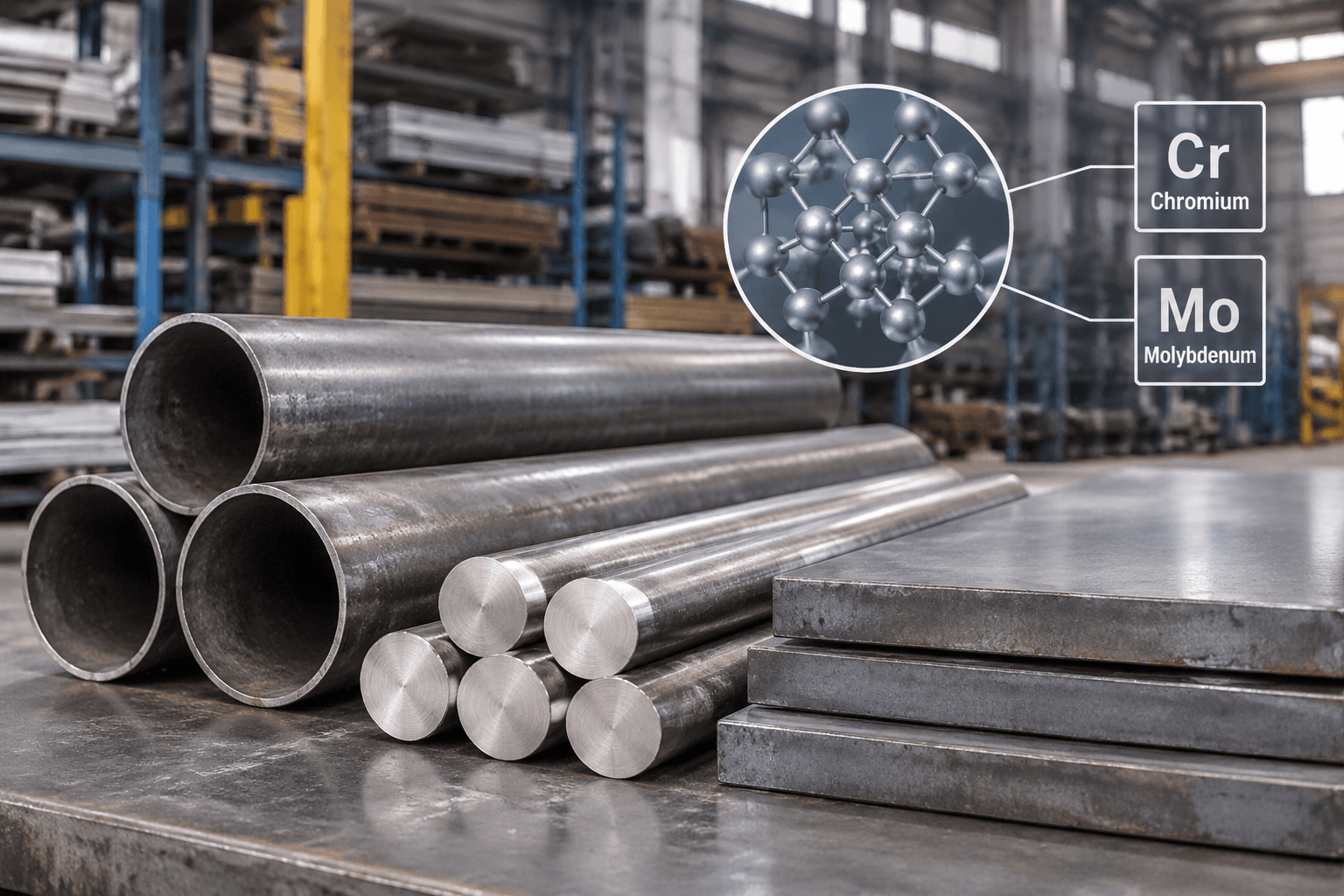
AISI 4130 steel is a chromium-molybdenum low-alloy steel containing approximately 0.30% carbon, commonly selected for components that require a useful balance of strength, toughness, heat-treatability, and weldability. It is often called chromoly or chrome-moly, but it is not stainless steel, and its mechanical properties cannot be defined without stating the product form, dimensions, supply condition, and heat treatment.
Designers encounter 4130 as tubing, sheet, plate, bar, forgings, and machined components. These forms may respond differently to rolling, cold work, welding, quenching, tempering, and testing. A material certificate stating only “4130” therefore does not establish the strength, hardness, or fabrication condition needed for a specific part.
What AISI 4130 Steel Actually Means
AISI 4130 belongs to the SAE/AISI 41xx family of chromium-molybdenum low-alloy steels. The “30” indicates a nominal carbon level near 0.30%, while chromium and molybdenum increase hardenability and help the steel develop useful mechanical properties through controlled heat treatment. SAE J404 is one of the authoritative references used to define the chemical composition of SAE alloy steels. ([saemobilus.sae.org](https://saemobilus.sae.org/standards/j404_199102-chemical-compositions-sae-alloy-steels?utm_source=openai))
Chromoly, chrome-moly, CrMo, cro-moly, CRMO, and similar terms are informal names. They may describe 4130, another 41xx grade, or a broader group of chromium-molybdenum steels. Procurement documents should identify the exact grade, product specification, form, condition, and testing requirements rather than rely on an informal family name.
Chromium content also does not make 4130 stainless. Its specified chromium range is far below the level normally associated with stainless-steel passivity, so unprotected 4130 can rust when exposed to moisture, salts, chemicals, or condensation.
| Element | AISI 4130 composition, weight % | Specification meaning |
|---|---|---|
| Carbon | 0.28–0.33 | Influences hardness, strength, weldability, and heat-treatment response |
| Manganese | 0.40–0.60 | Contributes to strength and hardenability |
| Silicon | 0.15–0.35 | Used as a deoxidizer and contributes modestly to strength |
| Chromium | 0.80–1.10 | Supports hardenability and wear response, but not stainless corrosion resistance |
| Molybdenum | 0.15–0.25 | Supports hardenability and tempering response |
| Phosphorus | 0.035 maximum | Controlled residual element |
| Sulfur | 0.040 maximum | Controlled residual element |
These commonly published SAE limits should be checked against the governing purchase specification because aerospace, pressure-service, or special-quality requirements may impose tighter residual-element limits or additional controls. ([emjmetals.com](https://www.emjmetals.com/pdf_indexer/pdfs/Mechanical_Properties_and_Hardenability.pdf?utm_source=openai))
Why Published Mechanical Properties Differ
There is no universal tensile-strength value for AISI 4130 steel. Annealing produces a relatively soft and workable condition. Normalizing changes the microstructure and often increases strength while retaining useful ductility. Quenching and tempering can produce much higher strength and hardness, but the result depends on austenitizing practice, quench medium, tempering temperature, section size, and cooling response.
| Product and condition represented | Ultimate tensile strength | Yield strength | Elongation | Hardness |
|---|---|---|---|---|
| Annealed reference data for bar or plate; section size not stated | About 552 MPa / 80 ksi | About 386 MPa / 56 ksi | 28% in 50 mm / 2 in. | About 149 HB |
| Normalized at approximately 870°C; representative 25 mm / 1 in. round dataset | About 670 MPa / 97 ksi | About 435 MPa / 63 ksi | 25.5% | About 197 HB |
| Representative 25 mm / 1 in. round, oil quenched and tempered at approximately 425°C | About 1,280 MPa / 186 ksi | About 1,190 MPa / 173 ksi | 13% | About 380 HB |
These figures illustrate condition sensitivity; they are not interchangeable design allowables or guaranteed purchasing minima. The normalized data are tied to a stated treatment and specimen form, while the quenched-and-tempered data come from a representative round-bar dataset. Sheet, thin-wall tubing, heavy plate, forgings, cold-drawn products, and welded assemblies may produce different results. ([emjmetals.com](https://www.emjmetals.com/pdf_indexer/pdfs/Mechanical_Properties_and_Hardenability.pdf?utm_source=openai))
Test direction matters as well. Longitudinal and transverse specimens can show different ductility and toughness, particularly in worked products. Before using a published value, determine whether it is a typical value, specification minimum, heat-specific result, or design allowable.
Where 4130 Provides a Useful Design Balance
4130 can be attractive when a component needs more hardenability and heat-treatment flexibility than a basic low-carbon steel, but does not require the higher carbon content of 4140. Its density is essentially similar to other steels. The often-mentioned strength-to-weight advantage comes from the possibility of using a thinner or smaller section after the required strength, stiffness, buckling resistance, fatigue performance, and joint behavior have been validated—not from 4130 being inherently lightweight.
Structural and tubular parts: Normalized 4130 tubing is associated with aircraft structures, roll cages, bicycle frames, and other welded frameworks. These examples do not mean every 4130 tube is suitable for a safety-critical structure. Wall thickness, tube specification, weld design, loading direction, fatigue, impact requirements, and inspection criteria remain decisive. Similar integrated review is necessary for automotive and transportation metal components, where material condition and joining details affect the complete structure.
Loaded machined components: Bars and forgings may be considered for shafts, fittings, fasteners, gears, and other parts requiring a combination of core strength and toughness. Final suitability depends on section size and the verified heat-treatment response through the section.
Wear surfaces: Heat treatment can increase through-hardness in lighter sections, and 4130 also responds to nitriding. Carburizing is technically possible and can create a hard surface over a tougher core, but 4130’s 0.28–0.33% carbon content is higher than that of many dedicated carburizing grades. Case depth, retained-austenite control, distortion, core properties, and the subsequent quench-and-temper cycle must therefore be engineered rather than assumed. ([hppi.com](https://hppi.com/hubfs/Material%20Data%20Sheets/Steel%20-%20Data%20Sheet.pdf?hsLang=en&utm_source=openai))
Fabrication Decisions: Welding, Machining, and Forming
Welding and cold-cracking control
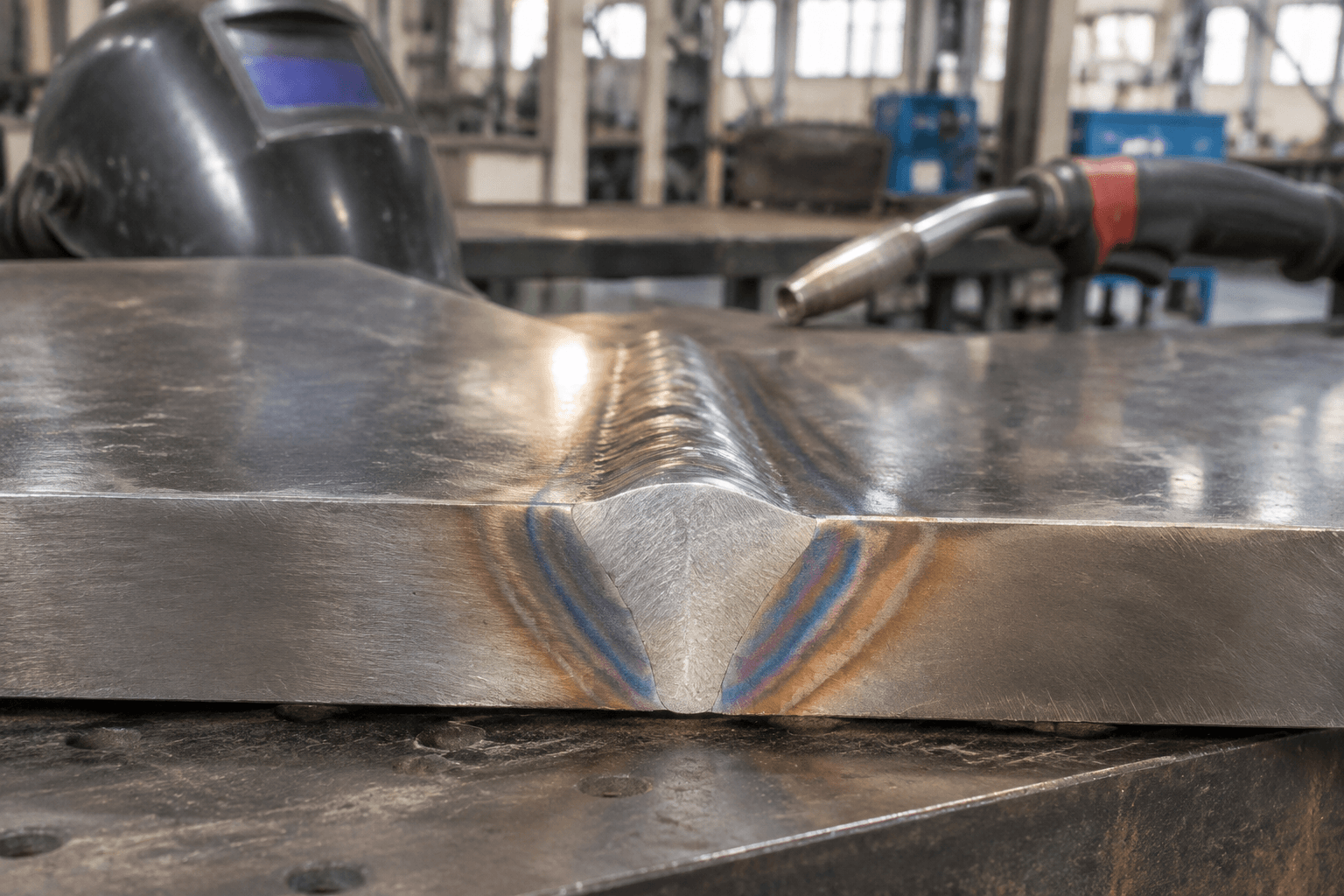
4130 is weldable, but weldability does not mean that every thickness and condition can be joined with the same procedure. A weld and its heat-affected zone can cool into a hard, crack-sensitive microstructure. Cold-cracking risk rises when hardenability, rapid cooling, diffusible hydrogen, high joint restraint, thick sections, and residual stress occur together.
Preheat slows cooling, assists hydrogen diffusion, and can reduce heat-affected-zone hardness. However, the required preheat and minimum interpass temperature depend on material chemistry, thickness, starting condition, joint geometry, restraint, welding process, heat input, and hydrogen level. A temperature recommended for a heavy plate or hardfacing operation should not automatically be applied to thin normalized tubing. ([twi-global.com](https://www.twi-global.com/technical-knowledge/job-knowledge/defects-hydrogen-cracks-in-steels-prevention-and-best-practice-046?utm_source=openai))
Filler selection is equally application-specific. A matching-alloy filler may be appropriate when subsequent heat treatment must produce compatible weld-metal properties. An undermatching filler may provide greater weld ductility in another design, provided the joint still meets strength, toughness, fatigue, and code requirements. Heat input must be controlled to balance penetration against excessive grain growth, distortion, and adverse heat-affected-zone properties.
Post-weld requirements may include controlled cooling, stress relief, tempering, or a complete heat-treatment cycle. They may also be unnecessary for some thin, low-restraint assemblies produced under an approved procedure. Critical pressure, aerospace, transportation, or dynamically loaded parts require a qualified welding procedure and the inspections specified by the responsible engineer or governing code.
Machining the supplied condition
Annealed or normalized 4130 is generally more practical to saw, drill, turn, mill, and tap than hardened material. Quenched-and-tempered stock increases tool load and may require different tooling, workholding, speeds, and process sequencing. Machining before final heat treatment can reduce cutting difficulty, but the drawing must account for heat-treatment distortion, scale removal, decarburization, and finishing allowance.
Forming and corrosion protection
Cold forming becomes more difficult as hardness and strength increase. Annealed material is usually the more formable starting condition, while normalized or hardened stock may demand larger bend radii or hot-forming review. Springback, grain direction, edge quality, thickness, and the effect of forming on subsequent heat treatment should be evaluated through the applicable material and part specification.
Because bare 4130 is not stainless, protection may involve paint, powder coating, plating, phosphate-and-oil systems, or another engineered finish. The correct system depends on outdoor exposure, salt, temperature, wear, electrical contact, appearance, and dimensional limits. For high-strength conditions, cleaning and plating processes also require hydrogen-embrittlement controls where applicable.
How to Validate Published AISI 4130 Property Data
| Item to verify | Question for design or purchasing review | Why it changes the answer |
|---|---|---|
| Material form | Is the requirement for sheet, plate, tubing, bar, forging, or a finished component? | Processing history and applicable specifications differ by form. |
| Dimensions | What are the thickness, wall, diameter, and critical section size? | Cooling rate and through-section heat-treatment response vary with mass. |
| Supply condition | Is the material annealed, normalized, cold drawn, stress relieved, or quenched and tempered? | The same chemistry can produce substantially different strength and ductility. |
| Property status | Is the value typical, minimum, heat-specific, or an approved design allowable? | Typical handbook data are not automatically acceptance criteria. |
| Test orientation | Were specimens longitudinal or transverse, and where were they taken? | Worked products can show directional differences. |
| Welding state | Are properties required before welding, as welded, or after PWHT? | The thermal cycle changes base-metal, weld-metal, and HAZ properties. |
| Environment | Will the part face moisture, salt, chemicals, abrasion, or elevated temperature? | 4130 may require a coating or a different material family. |
| Governing document | Which material, product, welding, and inspection specifications apply? | A grade name alone does not define all acceptance requirements. |
Choosing Between 4130, 4140, and Corrosion-Resistant Materials
| Design situation | Direction to investigate |
|---|---|
| Welded structure needing moderate alloy hardenability and controlled strength | 4130 may be a practical candidate when form, condition, joint design, and welding procedure are confirmed. |
| Component requiring higher through-hardness or wear strength | Consider 4140 or another heat-treatable grade, then assess the effect of its higher carbon content on welding and toughness. |
| Outdoor, marine, washdown, or chemical exposure without dependable coating maintenance | Evaluate an appropriate stainless steel or another corrosion-resistant material rather than treating 4130 as stainless. |
| Deep carburized case with a low-carbon, tough core | Compare dedicated carburizing grades instead of assuming 4130 is the optimal case-hardening choice. |
| Drawing lists a foreign “equivalent” grade | Verify chemistry, hardenability, product specification, condition, dimensions, and required properties before substitution. |
The most concise distinction is carbon content: 4130 is specified at 0.28–0.33% carbon, while 4140 is generally specified at 0.38–0.43%. The higher carbon level allows 4140 to develop greater hardness and strength under suitable heat treatment, but it also raises welding and cold-cracking concerns. Neither grade is universally better. ([saemobilus.sae.org](https://saemobilus.sae.org/standards/ams6395b-steel-sheet-strip-plate-095cr-020mo-038-043c-sae-4140?utm_source=openai))
For a technical specification review, provide the part drawing or 3D model, required material form and dimensions, specified grade and governing standard, supply condition, heat-treatment and welding requirements, service loads, wear conditions, and corrosion exposure. This information helps determine whether the AISI 4130 callout is complete enough for manufacturing review, including an automotive or transportation fabrication project.
Frequently Asked Questions
What type of steel is AISI 4130?
AISI 4130 is a chromium-molybdenum low-alloy steel in the SAE/AISI 41xx family. It contains approximately 0.30% carbon and can be supplied in annealed, normalized, cold-worked, or heat-treated conditions.
Is 4130 chromoly steel corrosion resistant?
Not in the way stainless steel is corrosion resistant. Its chromium content supports hardenability and wear behavior, but unprotected 4130 can rust. The service environment should determine whether a coating, plating system, corrosion allowance, or different alloy is required.
Why do AISI 4130 tensile-strength values differ between sources?
Sources may describe different product forms, dimensions, test directions, supply conditions, and heat treatments. An annealed bar, normalized tube, and quenched-and-tempered round can all meet a 4130 chemistry requirement while having substantially different tensile strength, yield strength, elongation, and hardness.
What is the practical difference between AISI 4130 and AISI 4140?
4140 has more carbon—typically 0.38–0.43% compared with 0.28–0.33% for 4130. Under suitable heat treatment, 4140 can achieve greater hardness and strength, while 4130 is often considered where weldability and a lower-carbon Cr-Mo composition are important. Final selection still depends on section size, loading, joining, wear, toughness, and environment.